Hire SEO Consultant: Vet the SEO Expert, Audit First
How to hire SEO consultant help in 2026: where to look, what the fee buys, and why your first purchase is a paid audit you can check in Search Console.
By Furkan AktaşPublished Updated

On this page
When you hire SEO consultant help, you're buying a diagnosis before you're buying any work. The diagnosis is the one part you can check yourself.
The rest of this guide works through the decision in order. You'll see which type of hire fits your situation, where to look, how to vet a candidate against your own Search Console data, and how to hand over access without losing ownership.
If you want to hire SEO expert talent and only take one rule away, make your first purchase a paid audit on a read-only role.
Scope the job before you hire SEO consultant help
A consultant fits a diagnosis, an agency fits execution capacity, a freelancer fits a defined task, and an in-house SEO fits a channel you already know how to run.
The consultant versus agency question is really about what's scarce on your side. If you can't say what's wrong with your organic traffic, you need judgment, and judgment is what a consultant sells.
If the work is known and big (content, technical fixes and links all at once), you need hands. That's what an agency's team is built for. Our ai seo agency comparison covers the agency-versus-software side of that choice, and what are seo services lists what a provider should deliver once you've picked one.
The in-house row comes from a rule of thumb by Martijn Scheijbeler. If you already know what you want your SEO team to work on and can wait another 2-3 months, he says you're better off hiring in-house, resources permitting. For short-term needs or a specialist gap, a consultant fits better.
Google adds two timing notes. It says a great time to hire is when you're considering a site redesign (the earlier, the better) or planning a new site. It also says a small local business can probably do much of the work itself.
The three gates
Whoever you hire, buy in three gates, and tie each gate's pass test to something delivered.
This is our advice, built on Google's audit guidance rather than quoted from it.
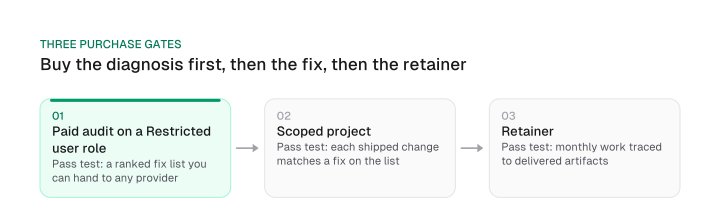
Gate 1 is a paid audit. Paid audit first, before any project or retainer. Google tells site owners who are offered an audit to grant only read access to Search Console at that stage, with no write access.
A Restricted user role fits. Google defines it as simple view rights on most data, so it hides some data. A Full user, which can take some actions, is a step you can add later.
Before the consultant starts, export a baseline: three months of Search Console clicks and impressions, plus the year-over-year comparison. That baseline export is what lets you credit a later change to the work instead of to the season.
The pass test for gate 1 is a ranked fix list in which every item cites a row of your own data and names the metric that should move. Because the list is yours and portable, you can hand it to any provider, including a different one for the fixes.
Gate 2 is a scoped project. Buy a defined slice of the fix list with named deliverables. The pass test is a match check: each shipped change maps to an item on the list, and the metric you named in advance either moved or comes with a written explanation of why it didn't.
Gate 3 is a retainer. Move here only once gates 1 and 2 produced artifacts you could verify. The pass test turns monthly: every billed hour traces to a delivered artifact, and the report ties the work to your baseline. Our guide on how to do seo audit shows what a thorough first-gate review looks like.
Google also warns that no one can guarantee a #1 ranking, and that you're ultimately responsible for the companies you hire. Gates are the practical answer to both. You spend small until the evidence says to spend more.
Where to look for an SEO consultant
Where to hire an SEO consultant comes down to five channels. Marketplaces such as Upwork and Fiverr publish prices up front, Toptal and GrowTal sell on stated terms (an acceptance rate and a trial at Toptal, hourly tiers at GrowTal), referrals bring someone with a reputation at stake, and agencies and in-house hires sell capacity.
"Pre-vetted" is a different claim on each platform, so compare what each one actually states. This section rests on public vendor pages and documentation, checked in October 2026. We didn't test any platform hands-on.
Download CSV (CC BY 4.0)
Upwork and Fiverr
Upwork and Fiverr are marketplaces where the price is visible before you talk to anyone. They're where most people start to hire freelance SEO expert help.
In May 2025 Upwork's cost page put the median hourly rate for SEO experts at $21, with rates typically between $15 and $35. The Ahrefs survey average for a freelance SEO consultant is $71.59 per hour, so that median is under a third of it ($21 divided by $71.59 is 0.29).
The gap tells you which tier you'll mostly meet: people priced far below the survey average, whose work you review yourself. Fiverr's SEO category shows about 1.1M reviews, so there's volume. On both marketplaces the vetting is your job.
It suits a small defined task where you can judge the output from your own data.
Toptal
Toptal says that of more than 200,000 yearly applicants, fewer than 3% are accepted. It also says every engagement starts with a trial period that runs up to two weeks, with no bill if you're unsatisfied.
Those are the two strongest stated protections in this comparison, and both are the seller's own claims. So the trial is where you test them. Use it for gate 1: buy the paid audit and judge the ranked fix list.
It suits senior strategy work where you want a way out in the first two weeks.
GrowTal
GrowTal lists three hourly tiers, starting from $30, $60 and $90 per hour. The entry tier lists familiarity with Analytics and Search Console.
The ladder is easy to read, but a cheaper tier isn't a safer one by itself. Match the tier to the gate. An entry tier can run a scoped project from a fix list you already own, while the diagnosis itself deserves a senior tier.
It suits matching budget to seniority without negotiating from zero. If you want an SEO consultant for hire at a fixed ladder of prices, it's the clearest of the six.
Consultant by referral
A consultant who comes through someone you trust skips the platform fee and the marketplace noise. In Ahrefs' SEO pricing study, updated August 2024, consultancies averaged $171.18 per hour and $3,250 per month.
A referral doesn't remove the credence problem described below, because your referrer had a different site. Ask for the paid audit anyway.
It suits a diagnosis from someone whose reputation depends on the person who sent you.
SEO agency
An agency sells a team: strategy, content, technical work and links under one invoice. The same survey puts agencies at $98.90 per hour and $3,209 per month on average.
That's cheaper per hour than a consultancy, which makes an agency the efficient way to buy volume.
Our own service sits in this channel too. Mission Growth is an AI-led SEO and GEO growth service: AI catches the signal, our experts make the move, and you see the result. We charge a monthly fee, quoted after an audit.
It suits execution across content, technical work and links at once.
In-house hire
An in-house SEO makes sense when the channel is core and the work is known. If you plan to hire an SEO specialist full time, Scheijbeler's rule applies: do it when you know what the person should work on and can wait 2-3 months, and otherwise start with a consultant.
An audit still helps, because it writes the job brief. Hiring without one means writing a job description from a competitor's job description.
It suits a channel you can run every day and a scope you can already describe.
Who is best
No individual provider on these platforms is best. The right match depends on your gate: a marketplace freelancer for a small task, a network consultant for the diagnosis, an agency for execution, an in-house hire for a channel that has become core.
What the fee buys
A fee buys hours of attention, so divide the retainer by the hourly rate. Ahrefs' SEO pricing study, updated August 2024, gives average hourly rates and average monthly retainers by provider type, and dividing one by the other gives the hours a month a retainer funds at those averages.
Download CSV (CC BY 4.0)
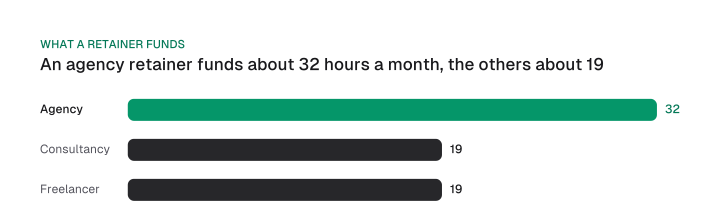
Read this as an illustration at survey averages. Ahrefs assumed each surveyed SEO charges the top of their pricing tier, and the hourly and retainer figures come from partly different respondents.
The pattern still holds. A consultancy retainer buys about 19 hours of senior attention a month, and an agency retainer buys about 32 hours from a team at a lower rate. For full price ranges by provider and model, see our seo cost guide.
How to vet an SEO consultant: check the diagnosis, not the pitch
A vetting call works when each question has a pass answer you can check against your own Search Console data, because buyers can't judge expert work from the pitch or even after delivery.
A case study or live dashboard shows what happened on someone else's site. Your own data is the only evidence that applies to yours.
The core update question has the clearest pass answer. A strong candidate doesn't open with a recovery checklist. They open with a date comparison in your Search Console: which pages and queries moved after the update, and which didn't.
The AEO and GEO row follows a line in Google's hiring guidance. It asks whether a provider's advice on AI experiences is aligned with Google Search's official guidance on generative AI features. For link sourcing, remember that a vague answer becomes your liability, since you answer for the companies you hire. A promised ranking fails every row.
Our guide to seo reporting shows what a consultant who works this way should report back.
Why the pitch can't settle it
SEO is a credence good. Dulleck and Kerschbamer described the problem in their 2006 Journal of Economic Literature paper: the buyer can't tell what was needed, and the concern persists even after repair and payment.
Think of a mechanic who says your gearbox needs replacing. You can't know whether it did, and driving away fixed doesn't tell you either. SEO has the same shape, because rankings lag and move for reasons outside the work. A good month and a good consultant are different things.
The remedy is our own advice, not a finding of the paper. Pay for a recommendation only when you can point to the data that motivates it and the metric that will show whether it worked.
For example, say a consultant recommends merging two overlapping guides. The recommendation should arrive with the row that motivates it: a Search Console export in which both pages collect impressions for the same query and neither holds a stable position.
It should also arrive with the test: clicks and average position for that query on the surviving page, compared against your baseline. If the consultant can't name the row or the metric, you've found the weak recommendation before paying for it.
The check tests plausibility rather than need, since a Search Console row shows a symptom. It still makes a billable fix defend itself.
The transfer has limits. The paper's examples are doctors, mechanics and computer specialists, and SEO matches them on one variable only: whether the buyer can verify the result. If single SEO changes could be reliably attributed to their effects, the credence problem would not apply here.
Because the gate 1 fix list is portable, diagnosis and fix needn't come from the same seller. That separation is the structural answer to the credence problem, and it is the reason the paid audit comes first.
Give access without giving away ownership
A Search Console property needs at least one verified owner, and that owner should be you, because only owners manage users and a departing verified owner can regain access until their ownership tokens are removed.
Three roles matter. An owner can add or remove users. A Full user has view rights to all data and can take some actions. A Restricted user has simple view rights on most data.
Google's documentation says you must be a property owner, or an owner of a parent property, to add or remove another user. It also warns that if all verified owners are removed, every remaining user and delegated owner loses access after a grace period.
So handing ownership to a vendor and then ending the contract is the fastest way to lose your own history. Our startup seo guide covers how a small team should set up its analytics before any outside help arrives.
The access checklist
- Before: confirm you're a verified owner of the property, and take the baseline export.
- Start: add the consultant as a Restricted user for the paid audit.
- During: upgrade to a Full user only when a named task needs it, and write down which task.
- Offboarding: remove the user in Search Console and read the notification. If it warns that the user might regain access, that user was a verified owner whose ownership tokens could still be used, so the tokens must go too.
- After: keep the ranked fix list and the exported data in your own files.
Contract points tied to deliverables
Tie each payment gate to a delivered artifact: the ranked fix list for gate 1, the shipped changes that match it for gate 2, a monthly report with work traced to artifacts for gate 3. State who owns the accounts, the exports and the fix list when the contract ends.
Keep duration out of the contract language and settle it in your own planning. Our article on how long does seo take covers that question separately.
The first thing you buy is a diagnosis you can check, delivered on a read-only role against a baseline you exported yourself, and every later payment follows the artifact it produced. Your next step today: export three months of clicks and impressions with the year-over-year comparison, confirm you're a verified owner, and ask your shortlist for a paid audit with a ranked fix list.
Frequently asked questions
Can I hire a consultant for only an audit?
Yes, and it's the safest first purchase. Google advises granting only read access to Search Console while an audit is under way, so a Restricted user role is enough. The ranked fix list that comes out is yours to use with any provider.
Not sure who to trust with your SEO?
Trust what you can verify. Start with a paid audit on a read-only Search Console role, and ask each candidate the vetting questions from the table above. Believe a recommendation only when it names the row of your own data behind it and the metric that will show whether it worked.
Should the consultant be a verified owner of my Search Console?
No. Only an owner can add or remove users, and a removed verified owner may regain access through ownership tokens until those are removed. If all verified owners leave, the remaining users lose access after a grace period. Stay the owner and grant a role.
Is hiring an SEO expert worth it?
It depends on the job. Google says a small local business can probably do much of the work itself, and calls a site redesign or a new site launch a great time to hire. Without such a trigger, buy the paid audit and let it decide.
Where can I hire an SEO consultant with 10 years of experience?
Try Toptal and GrowTal, whose terms are the most explicit in this comparison, or ask agencies for referrals. Years of experience are a claim you check against the work. Ask for the data row behind each recommendation instead of counting years on a résumé.
What is the difference between an SEO consultant and an agency?
A consultant sells judgment and an agency sells capacity. In Ahrefs' pricing study, updated August 2024, an average consultancy retainer funds about 19 hours a month against about 32 for an agency retainer, because agencies charge $98.90 an hour against $171.18.
Does Upwork or Fiverr work for SEO?
They can, for small defined tasks. Both show prices before you talk to anyone: in May 2025 Upwork put its SEO expert median at $21 an hour, and Fiverr's SEO category shows about 1.1M reviews. The vetting is yours to run.
Can a consultant guarantee a ranking?
No. Google states that nobody can promise a #1 position, and it warns against SEOs who guarantee rankings or claim a special relationship with Google. Treat a guarantee as a fail answer in any vetting call.
Who is responsible if the consultant breaks Google's rules?
You are. Google says you're ultimately accountable for what any hired company does for you, so know how they intend to help. That's why the vetting table asks how a candidate sources links.
Cite this page
Aktaş, F. (2026, October 15). Hire SEO Consultant: Vet the SEO Expert, Audit First. Mission Growth. https://missiongrowth.io/blog/how-to-hire-an-seo-consultant
Download the data: 2 tables as CSV (CC BY 4.0)
Figures we made for this post are free to reuse under CC BY 4.0 with credit to Mission Growth.
Get Mission Growth highlighted in your Google results.