
Topical Authority in SEO: What Google's Leak Names
Topical authority explained through the ranking fields Google's own leaked documents name, plus the topical map framework and the tools that actually build it.

On this page
Topical authority gets treated as a vague reputation score, something a site earns by publishing enough content and waiting. It isn't that vague. Google's own leaked ranking documentation names the exact fields behind it.
Four leaked field names explain the mechanism directly, and how to build topical authority starts there, rather than with the pillar-and-cluster tactics repeated everywhere. Content clusters SEO teams have built for years are proxies for that mechanism rather than explanations of it.
What topical authority is (and what it isn't)
Topical authority is Google's own site-wide focus calculation: siteFocusScore for how concentrated a site's content is on one topic, siteRadius for how far a given page drifts from that focus, and an entity-annotation confidence score for how well the site's entities are recognized. In practitioner terms, that's the trust and relevance a search engine assigns to a site for an entire subject, computed from site-wide focus and entity coverage.
Domain Authority is a separate, third-party metric; John Mueller of Google has said Google doesn't have anything like a website authority score, and Ahrefs finds no evidence any search engine uses Domain Rating or Domain Authority as a ranking factor.
The topical authority vs domain authority mix-up is worth running as a check: if a site's Domain Rating or Domain Authority is high but rankings for one specific topic stay flat, raising DA further won't help, since Mueller and Ahrefs both confirm it was never part of the calculation deciding those rankings.
Domain Authority and Domain Rating are third-party scores that Moz and Ahrefs publish, independent of Google. Check the site's focus and entity coverage on that topic instead.
"There's no evidence that search engines use Domain Rating (or similar scores such as Domain Authority, the power of domain, etc) as a ranking factor at all."
Google's John Mueller has confirmed the same for Google's own systems, stating plainly Google doesn't "have anything like a website authority score." Topical authority works from a different calculation altogether, one where DA plays no part at all.
How do you find your own domain authority, then? Moz's site-overview report and Ahrefs' Domain Rating report both publish the number directly, no crawl or audit required. Use it only as competitive context alongside this framework. Startup SEO's domain authority myth covers why the metric keeps getting confused with real ranking signals, in more depth than this piece needs.
Topical authority also overlaps with E-E-A-T, Google's framework for expertise, experience, authoritativeness and trust. It's one input into the "expertise" pillar within that larger framework.
How Google actually measures topical authority
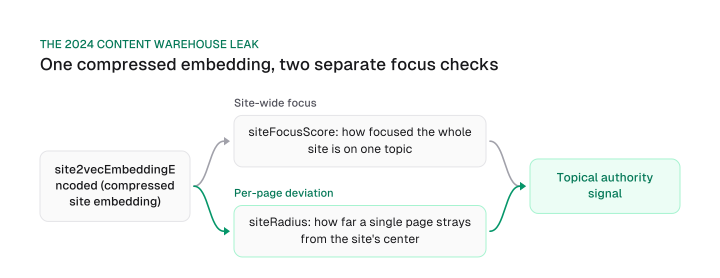
Google computes a site-wide focus score, a per-page deviation score, and an entity-annotation confidence score.
All three come from fields named directly in its own leaked ranking documentation, rather than from a formula anyone outside Google has reverse-engineered.
The Content Warehouse API leak, from March 2024, exposed the internal names and short descriptions Google's own engineers wrote for these fields. The source here is hexdocs.pm's auto-generated documentation of Google's official googleapis/elixir-google-api client library, the leak's original public location and not a third-party summary of it.
Four fields do the work:
site2vecEmbeddingEncoded: "Encoded site2vec embedding (to be used in superroot) since the full embeddings take too much space." This is a compressed vector representation of a site's content; the leak documents it in a separate module from siteFocusScore and siteRadius, so treat these as the same embedding-based system rather than a stated input-output chain.siteFocusScore: "Number denoting how much a site is focused on one topic." Derived from that compressed embedding.siteRadius: "The measure of how far page_embeddings deviate from the site_embedding." A per-page score, showing how far a given page sits from the site's overall center of gravity.- An entity-annotation confidence field, from the module
RepositoryWebrefEntityAnnotations(the leak's "WebRef" entity-linking system): "The overall confidence that the entity is annotated somewhere in the document or query."
None of these fields publish a numeric threshold. Google documents what each measures, not the formula or the score that counts as good, so anyone quoting a specific cutoff is guessing.
Together, they explain why pillar-and-cluster tactics work: a pillar page with tight internal links pulls siteRadius down and pushes siteFocusScore up, while an off-topic page dilutes both. The same leak documents a related indexing mechanism; Enterprise SEO's index tiers covers it in depth.
Why topical authority matters more now, in AI search
The case for topical authority in AI search runs from the same two fields, and it is reasoning rather than a measurement: an engine assembling an answer has to pick a source, and a site whose pages cluster tightly around one subject is an easier pick than one page standing alone.
Nobody has published a study that isolates site-level coverage from everything else that moves a citation, and this guide does not have one either. What follows is the argument, stated as one:
- A single well-optimized page used to compete on its own merits.
- Now it competes against whichever domain's cluster answers the surrounding questions too, even when no single page on that domain outranks it head to head.
Is SEO dead now that AI answers questions directly? No. AI answers still send readers to pages, and the work that makes a page worth citing is the work that made it worth ranking. What changes is where the leverage sits: the site's coverage of a subject, not one page's optimization.
Mission Growth's platform tracks AI citations and visibility for customers.
If that argument holds, the page inside a well-built cluster is the one that gets picked, and a stronger score on an isolated page does not close the gap. Treat it as a bet on the mechanism, not as a finding. How to optimize for AI search engines covers the broader playbook for AI-search visibility; this piece stays focused on the coverage layer underneath it.
The entity gap nobody's topical map closes
A topical map is incomplete until its entities are checked against the subject's real Knowledge Graph network.
That's the thing the leak's own entity-annotation confidence field is scoring, rather than something assembled from keyword research alone.
Treating "entities" as a synonym for keywords with intent behind them undercounts what RepositoryWebrefEntityAnnotations actually scores: whether a real-world entity is confidently linked in a document, not whether a string of text happens to appear near it.
A simple three-step check closes that gap:
- List the entities a subject-matter expert would expect. Not keywords: named things such as people, products, organizations and concepts that belong to the topic's real-world knowledge graph rather than its search-demand graph.
- Check each one against the site's existing content. A page can rank for a keyword and still never state the entity behind it clearly enough for an entity-linking system to annotate it with confidence.
- Treat missing entities as content gaps, not keyword gaps. The fix is rarely a new page targeting a new keyword; it's usually making an existing page state the entity relationship plainly enough to be recognized as one.
This method builds directly on the entity-annotation field named above. A full entity-based SEO methodology, mapping an entire niche's entity graph from scratch, goes further than this piece needs.
How to build a topical map (Koray Tuğberk Gübür's framework)
A topical map groups a subject's real sub-topics into clusters, then expands coverage one of three ways.
This is how to build topical authority in practice, rather than by publishing more pages at random.
SEO practitioner Koray Tuğberk Gübür names the three expansion paths in his own wording: "covering more entities from the same type," "covering more attributes from already existing entities," and "deepening the context with further consistency." His topical-map case study, published separately, is where these three paths actually appear.
On his own site, holisticseo.digital, Gübür defines topical authority as "a semantic SEO methodology to rank higher on search engine result pages by processing connected topics and entailed search queries with accurate, unique, and expert information."
Each path answers a different symptom. Which one to reach for is a judgment call this piece is making explicitly, not a rule Gübür states himself:
| Symptom | Expansion path | Why |
|---|---|---|
| Whole sub-topics are missing | More entities of the same type | The map has a hole, not a thin spot, so there's nothing yet to deepen |
| Sub-topics exist but read thin | More attributes on existing entities | The structure is right, but the content underneath it isn't complete |
| Competition is dense and thin content won't outrank it | Deeper context | Breadth is already covered, so the remaining edge is depth a competitor hasn't matched |
Applying the framework to one subject
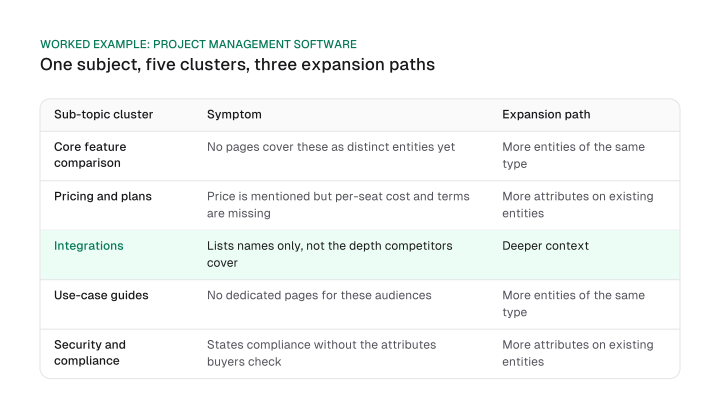
Here's what that looks like applied to a sample subject, "project management software": a full worked example you can copy onto your own topic rather than a case study.
| Sub-topic cluster | Symptom | Expansion path applied |
|---|---|---|
| Core feature comparison (task automation, resource scheduling) | No pages cover these as distinct entities yet | More entities of the same type |
| Pricing and plans | Pages mention price but skip per-seat cost, free-tier limits, annual vs. monthly terms | More attributes on existing entities |
| Integrations | A page exists, but only lists integration names, not the native-vs-Zapier depth competitors already cover | Deeper context |
| Use-case guides (agencies, remote teams) | No dedicated pages for these audiences | More entities of the same type |
| Security and compliance | A page exists but only states "SOC 2 compliant" without the attributes buyers actually check | More attributes on existing entities |
One case Gübür cites for this method reportedly went from 0 to 128,000 organic traffic in 123 days. That's self-published on his own site with no independent replication, so treat it as a directional example of the method rather than a benchmark to expect.
How many topics and clusters you actually need
A topical map's size follows the niche rather than a fixed number.
A narrow specialist subject needs roughly a dozen well-connected pieces; a broad subject needs several times that, and cannibalization risk rises with count before completeness does. Ahrefs publishes the closest thing to a sizing rule available:
| Niche breadth | Rough piece count (Ahrefs) |
|---|---|
| Specialized niche | 15-20 well-connected pieces |
| Broader subject | 50 or more |
That's Ahrefs' framing rather than an independently verified formula. Use it as a starting range, rather than a target to hit exactly.
The more useful discipline is watching for the failure mode that shows up before a map gets "complete": two pages competing for the same query as the cluster grows. Scaling a topical map without checking for that overlap trades depth for cannibalized rankings, which cancels out the gain the extra pages were meant to produce.
How to know it's working
Topical authority is working when a site's GSC query set inside the target cluster keeps widening.
It's also working when new pages inside the cluster get pruned toward what Google's patented information gain score actually rewards: new information the reader hasn't already seen.
That field is patented (US12013887B2, "Contextual estimation of link information gain"). Google's own filing describes it directly: "An information gain score for a given document is indicative of additional information that is included in the document beyond information contained in documents that were previously viewed by the user."
As with the fields named above, no numeric threshold is published; the patent documents what the score measures, rather than the formula behind it.
Three practical proxies stand in for the two Google fields this piece has already named. Reading them this way shows which one is actually failing:
- GSC query growth inside the cluster. If the set of queries a cluster ranks for keeps widening month over month,
siteFocusScoreand entity coverage are both moving in the right direction. - Position clustering, beyond a single position. Pages inside a topic ranking consistently in a tight band, rather than scattered across page one and page three, points to a low
siteRadiusfor that cluster. - An orphan-question audit, run manually against a subject's own PAA and forum questions rather than through a locked tool. List the real questions people ask about the subject, then check which ones no page on the site answers directly. This substitutes for content-gap tools like MarketMuse, which tie the same check to their own UI and their own keyword database.
Backlinks play a secondary role here too. A topically relevant referring-domain profile supports the signal; raw backlink count doesn't. AI SEO optimization checklist covers how to audit that specifically.
Once the cluster itself is in shape, how to rank higher on Google covers the broader ranking mechanics this piece doesn't repeat.
Tools that actually help (and what each one is for)
Topical authority tools split into three separate jobs: mapping, scoring, and crawl-linking.
No single tool measures the full picture directly, and every vendor's own content markets its tool as the one that covers the whole job, which is why the comparison below is built vendor-neutral instead of taken from any one tool's marketing page.
| Tool | What it actually does | What it doesn't do |
|---|---|---|
| Ahrefs | Groups keywords into clusters and shows which domains already own traffic share for a topic | Doesn't score your on-page coverage or check entity linking |
| Semrush | Groups keywords by topic and labels per-domain "topical authority" inside Keyword Overview | Same limit as Ahrefs, a keyword-mapping layer, not a content or crawl check |
| Clearscope | Scores on-page topical coverage against top-ranking content for a target term | Doesn't map the cluster structure or check crawl-level linking |
| MarketMuse | Flags content gaps inside its own UI | Locks the gap analysis to its own database, and the output still needs a human to prioritize it |
| Oncrawl | Analyzes crawl-level technical signals, internal link structure, orphan pages, that connect a topical map together | Doesn't touch keyword mapping or on-page scoring at all |
Pick the tool for the specific step you're on: mapping, scoring, or crawl-linking. A full keyword mapping workflow in a tool like Semrush takes its own dedicated guide; this piece only names where it fits.
Frequently asked questions
No. AI Overviews and chat answers still draw from sites with strong topical coverage. Completeness across a subject now matters more than single-page optimization, which pushes shallow content further down the results rather than out of them entirely.
Moz and Ahrefs both publish a number directly on their site-overview reports. It isn't a Google ranking signal, so treat it as competitive context rather than a target to optimize toward.
No independently verified timeframe exists; the "6-12 months" figure that circulates in practitioner content is unsourced.
Gübür's framework offers a more useful concept instead: "initial ranking," meaning new content earns a better starting position once topical authority is already established for the cluster it belongs to. That's self-published and unreplicated too, so treat it as a directional pattern rather than a guarantee. AI SEO agency vs. software decision covers that tradeoff.
A secondary one. Topically relevant referring domains support the signal; raw backlink count doesn't move it on its own.
A keyword map lists terms. A topical map groups those terms into sub-topic clusters and expands each one along one of three paths: more entities, more attributes, or deeper context. That's what a keyword map's flat list gets organized into.
The information gain score (patent US12013887B2) is a per-page score for new information against what a reader has already seen elsewhere. A topically authoritative page keeps earning it because the site as a whole reduces repetition across its own cluster, instead of restating the same points on every page.
Figures and images in this post are free to reuse under CC BY 4.0 with credit to Mission Growth.
Get Mission Growth highlighted in your Google results.