
What Is EEAT? Google's 2025 Guidelines, Explained
Google's own Sept 2025 rater guidelines and Dec 2025 documentation, quoted and dated: what eeat means, why it's not a ranking factor, and how to show it.

On this page
E, E, A and T: Experience, Expertise, Authoritativeness, Trustworthiness. That's the e-e-a-t meaning most people are searching for, and the answer to what does e-e-a-t stand for.
You'll also see it written eeat, without hyphens. It comes from one specific, dated Google document: the Search Quality Rater Guidelines.
Google's systems don't check E-E-A-T directly as a ranking factor. Human raters apply it as a framework, and their judgments shape Google's quality systems indirectly. This guide quotes Google's own documents by name and date, corrects a stale page count still in circulation, and answers the one question about anonymous authors that usually goes unanswered.
In this guide:
- What E-E-A-T actually stands for, and the exact, dated source it comes from
- Whether E-E-A-T is a ranking factor, in Google's own words
- The rater ladder's four levels, and how to check your own page against them
- Whether there's a real E-E-A-T score to run your site through
- How to rewrite one weak sentence per component, and what happens if you skip it
What E-E-A-T stands for, and where Google's guidelines put it
E-E-A-T is Google's shorthand for four qualities its Search Quality Rater Guidelines ask raters to weigh: Experience, Expertise, Authoritativeness and Trustworthiness.
That guide is not a fixed abstract concept; Google revises and dates it. The version live as this is written carries a September 11, 2025 revision date on its cover page, and runs 182 pages.
One widely read guide still cites a different count:
victorious.com: "a 176-page document"
It doesn't say when it checked, and the guidelines have grown since. Treat any claim about how many pages the guidelines run as a snapshot of one date, and check the cover page yourself if it matters to your work.
Is E-E-A-T a ranking factor?
E-E-A-T isn't itself a specific ranking factor, according to Google's own documentation.
Google's systems use a mix of factors to identify content that has it, and of the four qualities, trust matters most. If you're asking is eeat a ranking factor because you want a one-line answer: not directly, but indirectly, through everything else Google measures.
That's also how it factors into algorithm updates. Raters don't touch any single page's position directly; they apply the guidelines, dated to their own September 11, 2025 revision, to score current search results. Google aggregates that scoring to judge, system-wide, whether a ranking change is actually an improvement before it ships.
Google's own developer documentation, dated December 10, 2025, states it plainly: "While E-E-A-T itself isn't a specific ranking factor, using a mix of factors that can identify content with good E-E-A-T is useful."
"Of these aspects, trust is most important."
The date on that page matters as much as the sentence itself: the line is easy to find, but only a dated copy tells you whether it's still the current guidance or something Google has since walked back.
That's the core of e-e-a-t seo strategy: earn the underlying trust and quality signals Google's systems can detect, rather than treating the acronym itself as a checkbox. E-E-A-T sits alongside the wider set of google ranking factors, a lens Google applies across that whole list.
That's Google Search's own answer for classic ranking. AI answer engines are a separate question with their own visibility signals. Mission Growth's platform tracks AI citations and visibility for customers.
How Google's own raters actually score E-E-A-T
Google's Search Quality Rater Guidelines score E-E-A-T on a ladder of four levels: Lowest, Lacking, High and Very High.
Each level carries its own exact wording a page can be checked against. The table below lines up all four, current as of the September 11, 2025 revision, with a short self-check for each.
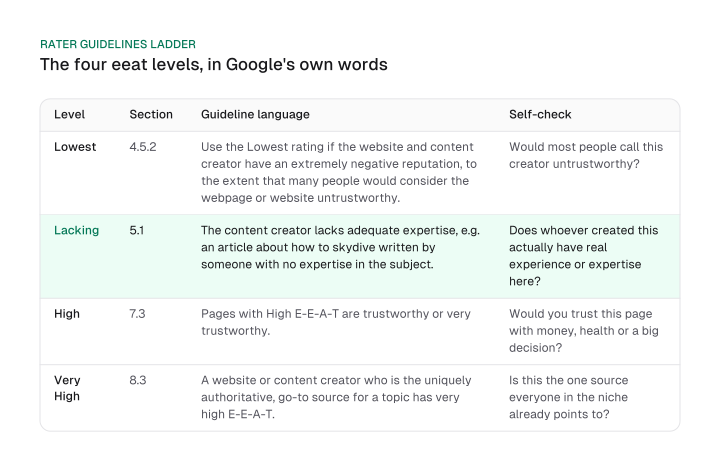
The ladder moves from a specific failure at the bottom to a specific standard at the top.
Section 4.5.2 puts a page at Lowest when the website or content creator has "an extremely negative reputation, to the extent that many people would consider the webpage or website untrustworthy." Section 5.1 puts a page in Lacking when a component is missing outright, for example "an article about how to skydive written by someone with no expertise in the subject."
Section 7.3 calls a High page one that is "trustworthy or very trustworthy." Section 8.3 reserves Very High for "the uniquely authoritative, go-to source for a topic."
Find your page on that ladder in Google's own words, not a paraphrase of them, before you change anything. Checking all four levels side by side, in one table, is faster than reading four separate guideline sections to work out where you land.
Is there an official EEAT score you can check?
E-E-A-T has no official numeric score in Google's guidelines, so an eeat score checker is measuring something else entirely.
Every page lands on the same qualitative Page Quality scale as everything else. Google's rater guidelines actually run two separate rating systems:
- Page Quality (where E-E-A-T lives): Lowest, Low, Medium, High, Highest.
- Needs Met (a different task, judging how well a result matches a specific query): Fails to Meet up through Fully Meets.
Neither system outputs a number, and E-E-A-T only ever lives in the first one. If you want the two scales checked against your own pages anyway, most ai seo audit tools blend them into one composite figure, built from proxies rather than Google's own rating.
How to demonstrate E-E-A-T in your content
If you're trying to work out how to improve e-e-a-t on a specific page, skip another tips list.
Rewrite one weak sentence against what Google's guidelines call High E-E-A-T, once per component.
Rewrite one sentence, one component at a time
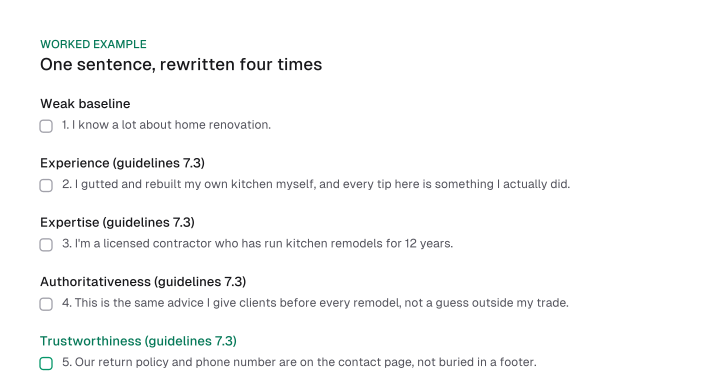
Start with a generic, unconvincing line, the kind that shows up on half the "about the author" boxes on the internet:
"I know a lot about home renovation."
Now rewrite it four times, once per component, against section 7.3's language for High E-E-A-T, and against section 5.1's disqualifying examples for what Lacking looks like:
- Experience. Section 7.3: "Experience is valuable for almost any topic." Section 5.1's failure case is a review "written by someone who has never eaten at the restaurant." Rewrite: "I gutted and rebuilt my own kitchen myself, and every tip here is something I actually did."
- Expertise. Section 7.3: "Expertise is required for satisfying content on a variety of topics." The disqualifying example in section 5.1 is an article "written by someone with no expertise in the subject." Rewrite: "I'm a licensed contractor who has run kitchen remodels for 12 years."
- Authoritativeness. Section 7.3 asks whether a page is "a go-to, authoritative source" for its topic. Section 5.1 disqualifies off-topic authority, like "tax form downloads provided on a cooking website." Rewrite: "This is the same advice I give clients before every remodel, not a guess outside my trade." Off the page, this component usually shows up as backlinks, mentions and awards from people who don't work for you, not as a line you can write yourself.
- Trustworthiness. Section 7.3 says trust "is especially important for High quality pages that involve processing financial transactions." Section 5.1's example of the opposite is "a shopping page with minimal customer service information." Rewrite: "Our return policy and phone number are on the contact page, not buried in a footer."
Common mistakes, sourcing and the click myth
Do the same for the specific claims and sources on your own page. Cite the actual study or document behind a number, name and date, instead of "studies show."
Skip the checklist mindset, too. Swapping in a credential or a generic bio with no checkable detail behind it reads the same as no bio at all.
Once you've rewritten one section, run the rest of the page against Mission Growth's ai seo optimization checklist so nothing else on it is still coasting on a vague line.
There's no single hack here for clicks or impressions. Visible trust signals, a real byline, cited sources, transparent contact information, can lift click-through because searchers trust the result more, and that happens before any ranking system gets involved.
When your authors can't be publicly named
Google's rater guidelines explicitly allow anonymity for a legitimate reason.
Personal sites can omit a home address or phone number under that rule, and user-generated content sites can let an author identify by alias or username alone.
The guidelines' own phrase draws a specific line:
"a legitimate reason for anonymity"
That protects an individual blogger's privacy or a forum's username-only culture. It doesn't excuse a YMYL page, or a page handling a transaction, from providing real contact and customer service information: that requirement, covered above, stands regardless of whether the author's own name is public.
That's a distinct question from AI-assisted, unbylined content, which we cover separately in our e-e-a-t ai content guide.
What happens when a page lacks E-E-A-T, and why YMYL pages carry more weight
E-E-A-T that's low enough earns a page Google's Lowest Page Quality rating, and no other consideration can override a genuine lack of it for the page's own topic or purpose.
Section 4.5.2 states the mechanism directly: "Use the Lowest rating if the website and content creator have an extremely negative reputation, to the extent that many people would consider the webpage or website untrustworthy."
Section 5.1 closes the loophole reputation-chasers look for: "No other considerations such as positive reputation or the type of website can overcome a lack of E-E-A-T for the topic or purpose of the page." A strong reputation somewhere else on your site doesn't rescue a page that lacks E-E-A-T for its own specific purpose.
YMYL topics get even more weight on this. Google's own documentation states that "our systems give even more weight to content that aligns with strong E-E-A-T for topics that could significantly impact the health, financial stability, or safety of people, or the welfare or well-being of society." The current guidelines sort YMYL into four harm categories, not the longer news-and-shopping list still repeated in a lot of SEO writing:
- Health or Safety
- Financial Security
- Government, Civics and Society
- Other
That's the answer for classic Google ranking. If you're weighing E-E-A-T's role in AI answer engine visibility instead, see our geo vs seo comparison for that lane specifically.
E-E-A-T is not a mysterious black box. It comes from a rater framework with a specific, checkable, revisable source, and the version being quoted is rarely the one that's actually live. Pick your page's weakest section, find its component on the ladder above, and rewrite it using section 7.3's own words today.
Frequently asked questions
No single hack exists. Visible trust signals, a real byline, cited sources, transparent contact information, can lift click-through because searchers trust the result more, and that happens before any ranking system gets involved.
The second "E" (Experience) was added to the older E-A-T framework to weigh firsthand, real-world experience with a topic alongside expertise, authority and trust, years before most SEOs noticed the term change.
Bing doesn't publish an E-E-A-T framework of its own. This guide is specific to Google's own documented rating system, and the query behind it is Google-specific too.
No tool reads an official E-E-A-T score, because Google's guidelines never assign one. A tool's "E-E-A-T score" is a vendor's own composite built from proxies, separate from Google's own rating.
Topics Google's guidelines say could significantly affect someone's health, financial stability, safety or society's wellbeing, currently grouped into four harm categories: Health or Safety, Financial Security, Government, Civics and Society, and Other.
Figures and images in this post are free to reuse under CC BY 4.0 with credit to Mission Growth.
Get Mission Growth highlighted in your Google results.