How to Track Brand Mentions in AI Search Engines for Free
How to track brand mentions in AI search engines: one prompt panel for ChatGPT, Gemini, Perplexity, Copilot and Google AI Overviews, then read the log.
On this page
How to track brand mentions in AI search engines comes down to one method: freeze a prompt panel, run it identically on ChatGPT, Gemini, Perplexity, Copilot and Google's AI Overviews.
Log every response by the mention type it actually is. A single mentioned-or-not checkbox hides more than it shows.
AI brand visibility, at bottom, is just this: whether an AI engine names a brand, links to it, or cites it at all when a buyer asks a relevant question. Everything below is how to measure that, engine by engine.
AI search tracking differs from traditional brand monitoring in what it watches. Traditional monitoring alerts on a mention that lives on a page that exists: a news article, a forum thread, a review site you can revisit and link to days later.
AI search tracking watches for a mention inside a generated answer that exists only for that one run, then is gone. That's exactly why the three mention types in the next section matter here in a way they don't for classic monitoring, where a link either sits on the page or it doesn't.
Testing a handful of prompts and checking weekly still leaves two gaps open for you to close. One is knowing which of the five engines a brand is actually invisible on. The other is knowing which log entries need action today versus a routine note next cycle.
What counts as a "mention" in AI search (and why lumping it with "citation" hides risk)
A brand mention in AI search is one of three distinct signals: a plain-text name, an inline link, or a citation-only source listing with no name in the prose.
A tracking log that doesn't separate them scores three different events as one. That mention vs citation ai search distinction is exactly what a single yes/no checkbox erases.
This three-way split isn't new. The SEO tool vendor Advanced Web Ranking named it first, and it turns up as a passing reference in at least one competitor guide. What's usually missing is a worked instance of each type, which is the actual gap in a reader's ability to classify a response in the moment.
Here's what each type looks like in a real AI answer about a fictional brand, Acme:
| Mention type | What it looks like in the response | What it tells you |
|---|---|---|
| Plain-text mention | "Acme is a solid pick for small teams." (no link, no source number) | The model knows the brand but isn't pointing traffic anywhere |
| Inline-link mention | "Acme is a solid pick for small teams," with "Acme" set as a clickable link to the brand's own site | The model both names the brand and sends a click |
| Citation-only reference | A numbered source list that links to the brand's site but never says the word "Acme" in the prose | The brand's page fed the answer, but a reader skimming the text never sees the name |
Treat these as three separate log columns. A brand can score well on text mentions while never getting an inline link or a citation.
That combination looks fine on a raw mentioned count and invisible on a click-generating one. Only a log that keeps the three apart shows which is actually happening. For the exact mention-rate and citation-rate math built from a log like this, see the exact formulas in our ai search analytics guide.
How to track brand mentions in AI search engines: build one prompt panel for every engine
A system for tracking brand mentions starts with one frozen prompt panel, its prompts written in buyer language and split across four query types (the exact list is below). Run it identically on ChatGPT, Gemini, Perplexity, Copilot and Google's AI Overviews.
That fifth engine matters. One competitor guide already runs the same idea across four of those five engines, which is the right instinct for ai search monitoring, but it stops one engine short and never tags a logged response by mention type at the moment it's captured.
Both gaps are worth closing. These five engines select, mention and cite brands differently enough that a blended score across them hides which one a brand is actually losing.
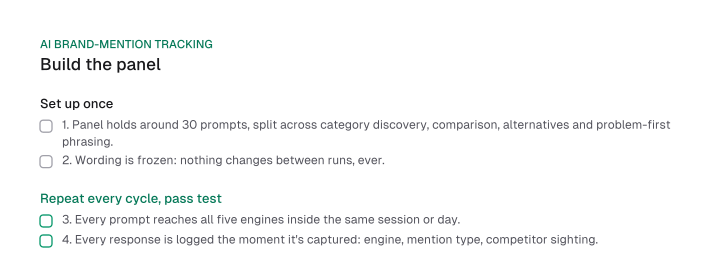
Building the panel is four steps:
- Write around 30 prompts in the language a buyer actually types, not brand-first phrasing: category discovery ("best tools for X"), comparison ("X vs Y"), alternatives ("alternatives to X") and problem first ("how do I solve Y").
- Freeze the wording. A prompt that changes between runs measures its own new phrasing instead of the engine's actual behavior.
- Run every prompt on all five engines in the same session or day, so an outside event (a launch, a news cycle) hits every engine at once instead of skewing one platform's numbers against the others.
- Log the response immediately: which engine, which prompt, mention type (plain text, inline link, or citation only, from the section above), and whether a competitor showed up instead.
A copyable log needs one row per prompt and one column per engine, with a mention-type field attached to each cell rather than logged separately later:
| Prompt | ChatGPT | Gemini | Perplexity | Copilot | Google AI Overviews |
|---|---|---|---|---|---|
| "best tools for [category]" | plain text | inline link | citation only | not mentioned | plain text |
| "[brand] vs [competitor]" | inline link | plain text | inline link | plain text | citation only |
Run the same panel with competitor names substituted for the brand name, and the log doubles as a sheet that tracks competitors too, at no extra setup cost. The mechanics stay the same; only the name being scanned for changes.
A 30-prompt panel run on five engines produces 150 logged responses per cycle. That volume is exactly why the type field has to be filled in the moment a response is captured, while the details are still fresh.
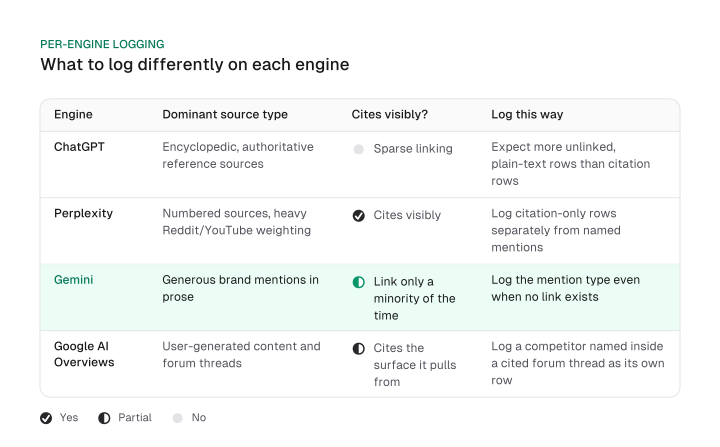
The five engines don't behave the same way, and your log should reflect that instead of treating a missing citation the same everywhere. ChatGPT leans on encyclopedic and other authoritative reference sources when a prompt asks it to define a category, and links sparsely even when it does name a brand. Expect more unlinked, plain-text rows there than citation rows, and don't read that pattern as underperformance on its own.
Perplexity cites visibly with numbered sources and weights forum sources like Reddit and YouTube heavily. Rows with a citation but no name in the prose are common on it, so log them separately from named mentions rather than folding the two into one count.
Gemini tends to name brands freely inside its prose, yet it only occasionally attaches a working link back to the source. Its citation rate alone underreports how often Gemini actually surfaces a brand, so log the mention type there even when no link exists.
Google AI Overviews lean on user-generated content and forum threads more than the other three, and sit inside the largest search surface of the five. A competitor's name turning up inside a cited Reddit thread is worth its own log row, even without a direct link to either brand's site.
Copilot runs on Bing's search infrastructure, which is a separate reason its results sometimes diverge from the other four. The dashboard implications of that infrastructure live in a dedicated KPI-reliability guide.
On ChatGPT specifically, memory personalization and account region settings can shift what a single tester sees between runs. That's a control specific to ChatGPT this post doesn't re-teach; see how to track chatgpt mentions with memory and account-region controls for the fix.
Gemini's own citation habits versus AI Overviews get a fuller side-by-side in gemini seo citation behavior versus AI Overviews.
How many times to run each prompt, and how often to repeat the whole panel
A single run of a prompt only shows what a multi-stage, partially observable pipeline happened to output on that one pass.
Running five engines at once means the repeats reveal something a tracker watching only one engine never can: whether that engine's number is real movement or just its own noise.
Repeating a prompt several times and logging a rate instead of a yes/no answer isn't a new idea. At least one competitor guide already instructs testers to repeat each prompt three to five times because a single run is noise, and Mission Growth's own ChatGPT guide teaches the same rate over a yes/no answer for that one platform.
This post doesn't reclaim either idea; it applies the same logic across five engines instead of one. That's also the real answer to how often to track ai brand mentions: check and repeat each engine on its own, separately.
The reason repeat-testing matters is mechanical. A 2026 academic survey of 45 GEO studies describes AI-search visibility as a stochastic, partially observable pipeline rather than one deterministic lookup: search activation and indexing feed retrieval and reranking, which feed citation, prominence and factual absorption.
That survey reports that commercial audits of this pipeline "reveal low source overlap, substantial run-to-run variability, and persistent fidelity gaps." That's the mechanism behind why one run of one prompt on one engine tells you almost nothing: the answer passed through several stages that can each vary independently between runs.
Keep three to five repeats per prompt per cycle as a reasonable starting point, not a number this post derived, and adjust it once real data shows how much a given engine actually moves between runs.
Repeat the whole panel weekly for the check cycle and read the trend monthly. That habit of aggregating weekly is a starting point several sources in this space converge on independently.
Peec.ai, an AI-visibility monitoring vendor, made the same case in a September 2026 post on its own measurement methodology: "tracking individual prompts will always be unreliable because LLMs are non-deterministic by nature," which is why it recommends aggregating results weekly rather than trusting a single day's snapshot.
What a tracker watching only one engine can't do, and a panel spanning five engines can, is tell a real per-engine gap from that engine's own noise between repeats.
When a prompt's mention rate is stable across four of the five engines but swings between repeats on just the fifth, treat that one engine as its own investigation. Don't fold its number into a blended average across all five.
Run-to-run variability isn't uniform engine to engine, so an outlier on one engine is a signal about that engine's reliability at the moment, not proof the brand suddenly has a problem there. See reading ai search visibility kpis reliably before a board report once the log is running consistently, before putting a number in front of a stakeholder.
Reading the log: a real gap vs. a hallucinated mention
Once the log is running, two different findings call for two different responses: a citation gap and a hallucinated mention.
A citation gap, where a brand is simply absent from a response it should plausibly appear in, is a content and PR problem that goes into the normal work queue.
A hallucinated or factually wrong mention (the AI stating a wrong price, a discontinued feature, or a claim the brand never made) is a factual-accuracy problem that can need same-day escalation. Treating both the same way wastes the log, because a missing mention and a wrong one call for different fixes on different timelines.
A raw citation rate from the log matters less than the band it falls into for your category, a separate reading this post doesn't derive here.
A rule based on severity and how many times an error repeats turns that distinction into an actual decision instead of a gut call:
| Finding | Confirmed on how many engines/runs | Action |
|---|---|---|
| Citation gap (brand absent where a competitor appears) | Any | Routine log note; feed into the normal content/PR queue |
| Wrong price or feature claim | One engine, one run | Routine log note; recheck next cycle before escalating |
| Wrong price or feature claim | Repeats on the same engine, or appears on 2+ engines | Same-day escalation |
| Brand attributed a claim it never made | Any repeat confirmation | Same-day escalation |
A citation gap is a content problem rather than a factual one, so it goes through the normal queue rather than an urgent one. The log surfaces it, but closing it is a separate optimization job covered elsewhere.
Sentiment is worth one more field in the same log: a rough positive, neutral or negative tag per mention, logged at capture time alongside the mention type. Building an actual sentiment score that means something is a deeper mechanism than a single field can carry; see fixing llm brand sentiment once you've found a real problem for that.
Once the log outgrows a spreadsheet (five engines, dozens of prompts, weekly repeats) the manual method starts costing more hours than it saves. That's the point to look at dedicated ai visibility tools once the log outgrows a spreadsheet rather than stretching the manual method past its limit.
Mission Growth's platform tracks AI citations and visibility for customers.
The method doesn't change with volume: one frozen panel, five engines, three mention types logged at capture, three to five repeats per prompt, a weekly check with a monthly trend read, and a severity rule that separates a content gap from a factual error before either lands on someone's desk.
Build the log template above in your own spreadsheet today, then run the panel once this week for a baseline. Set a recurring weekly slot for the next run. The numbers only mean something once you have a second data point to compare against the first.
Frequently asked questions
Open a logged-out ChatGPT or Perplexity session and ask one of the panel's category-discovery prompts, the kind a buyer would type before naming any brand. Read the response for a plain-text mention, an inline link, or a competitor's name in its place.
Yes. You can track brand mentions in AI search engines free, with nothing but the panel and a spreadsheet described above. Vendor tools have free tiers too, but that's a separate question about when to graduate from a spreadsheet, covered in the tools roundup linked above.
People who search to track brand mentions in AI search engines reddit threads are usually chasing the same method. Reddit itself doesn't run a tracker; it's simply a source two of the five engines cite heavily.
A mention is the brand's name appearing in the answer text, with or without a link. A citation-only reference is the brand's domain appearing in a numbered source list without the name ever showing up in the prose. A log that scores both as the same event undercounts the gap between the model knowing a brand and a reader actually seeing its name.
Yes. That's a hallucinated mention, a distinct log category from a missing one. It's the finding type that can justify same-day escalation rather than a routine note, depending on how many engines or runs confirm it.
Weekly for the check cycle and monthly for the trend read, as a starting cadence to adjust once real data shows how fast the numbers actually move. Run three to five repeat runs per prompt inside each weekly cycle, since a single run isn't enough to trust.
Only when you act on what it finds. The log pays off once it feeds a content, PR or factual-correction queue. AI brand visibility tracking with nobody reading the output is the same as not tracking at all.
Figures and images in this post are free to reuse under CC BY 4.0 with credit to Mission Growth.
Get Mission Growth highlighted in your Google results.