LLM Brand Sentiment: How AI Scores It and How to Fix It
LLM brand sentiment scores come from a biased AI judge reading biased prompts. See how the number is built, why engines disagree, and how to fix a bad one.
On this page
LLM brand sentiment is the tone an AI answer takes toward your brand once it names you, and most vendor dashboards report it as if it were a stable fact. It usually isn't. The number mostly reflects how a prompt was worded and which sources an engine's retrieval layer happened to pull that day, rather than a market verdict on your AI brand reputation.
That distinction matters if you're already watching brand sentiment in AI search, or about to buy a tool that promises to track it. A negative reading can come from a genuinely bad review that ChatGPT keeps citing, or from nothing more than a leading question in the prompt panel that produced the score. Treating both causes the same way wastes the fix.
In this guide:
- How the sentiment score actually gets built, and where the bias enters
- Why a prompt's wording can fake a negative score
- Why ChatGPT and Perplexity disagree about the same brand
- How to fix negative brand sentiment in AI, and how long each fix takes
- How to read competitor sentiment without borrowed case studies
What "LLM brand sentiment" actually measures
LLM brand sentiment measures the tone, positive, neutral or negative, an AI answer takes toward a company once that company is already named.
A brand can appear in ChatGPT's answer to "best project management tools" constantly and still read negative every time. A brand that rarely appears can read glowing on the few occasions it does.
Visibility asks whether you're in the answer. Sentiment asks how you're framed once you're there. A visibility problem means the retrieval layer isn't pulling your pages in; a sentiment problem means you're retrieved, but the judge step scored the mention negatively, or the prompt that produced the score was loaded to begin with.
Most vendor dashboards blend both into one combined score. A blended score that weights every negative mention the same as every positive mention hides which mentions actually require action. Before trusting a sentiment trend line, check whether the tool behind it separates:
- Mention presence. Does the brand appear in the answer at all, for a given prompt and topic.
- Recommendation. Is the brand the model's actual suggestion, rather than only referenced in passing.
- Tone. How the mention is framed once it's there, the subject of the rest of this guide.
Recommendation runs on a different mechanism entirely. If your open question is ranking rather than tone, read how ChatGPT decides which brands to recommend instead; this guide stays on the judge step that scores the mention.
Sentiment sits alongside mention rate and share of voice as one line in a wider stack of AI search visibility KPIs. It's the metric most teams read wrong first, because it looks like one stable number when it's really three variables tangled together.
If you're choosing a tool that claims to track this, see an AI visibility tools comparison.
How a sentiment score actually gets built
A sentiment score is produced by feeding the AI's brand-mention text into a second model acting as a judge.
That judge step carries its own documented biases, independent of what the text says about the brand. The pipeline runs in two passes. First, the engine, ChatGPT, Perplexity, Google AI Overviews, generates an answer that happens to mention the brand. Second, a separate classifier model reads that text and assigns it a label: positive, neutral or negative, sometimes a number.
That second pass is where most of the noise gets introduced. A November 2024 survey of LLM-as-a-judge research, Gu et al., "A Survey on LLM-as-a-Judge," documents three bias types built into this classifier step:
- Length and verbosity bias. The judge model tends to rate longer, more elaborate answers more favorably, regardless of what the answer actually says about the brand.
- Position bias. When the judge compares two pieces of text, which one comes first can shift the label it assigns.
- Self-preference bias. A judge model rates text more favorably when the text was generated by a model from the same family as the judge itself.
None of that reflects the brand's actual reputation. Two identical brand facts, worded differently or generated by different models, can score differently for reasons that live entirely inside the classifier.
The survey's mitigation research points at structured prompt formats, swapping the order items are compared in, and consensus across multiple judge models rather than trusting one. Most sentiment dashboards don't disclose whether they do any of this.
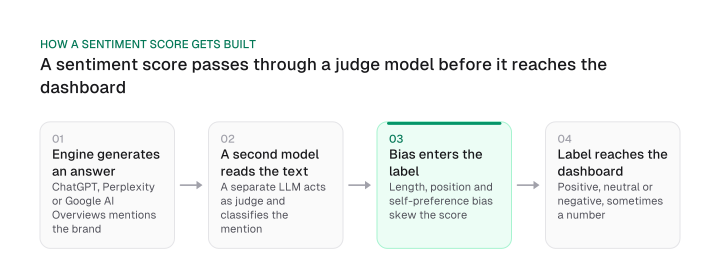
Treat the dashboard number as the output of a classifier with known failure modes, an input to interpret rather than a direct measurement of brand perception. That reframing is what the next section builds on.
Why most sentiment scores aren't measuring sentiment
Most sentiment scores measure how the prompt was worded, rather than how the market feels.
Only a neutrally worded branded prompt can carry a real signal. An unbranded prompt measures visibility. A valence-loaded prompt measures the question's own framing.
Before trusting any sentiment number, classify the prompt that produced it into one of three buckets. Two of the three produce numbers that look like sentiment but aren't:
| Prompt type | Example | What it actually measures | Use as sentiment signal? |
|---|---|---|---|
| Unbranded | "What are the best project management tools?" | Visibility only. The model is completing a ranked list from training-data frequency, not forming an opinion. | No |
| Branded, neutral | "Tell me about [Brand]'s pricing." | The only type that can carry a real sentiment signal. | Yes |
| Branded, valence-loaded | "What's bad about [Brand]'s pricing?" | The framing of the question rather than the brand. | No, use only as a delta test |
The reason wording shifts the answer is a documented pattern in human decision-making, not something unique to AI models: the framing effect, where a question's wording shifts the judged outcome even when the underlying facts stay the same.
A peer-reviewed 2016 study, Chick, Reyna and Corbin in the Journal of Experimental Psychology: Learning, Memory, and Cognition, found the effect holds even after researchers stripped out the ambiguous wording critics blamed for it, across repeated risky-choice tasks.
That original research tested human choice under framed descriptions of outcomes, like medical or financial decisions, rather than LLM text generation. What transfers is the direction of the mechanism rather than the exact magnitude: valence framing of the stimulus shapes the judged outcome, whether the judge is a person or a language model completing a sentence about your support team.
The decision rule that follows: never phrase a sentiment-tracking prompt with a valence-loaded stem. Use a neutral stem by default. If you need to test a specific valence claim, run both versions and trust only the difference between them.
Here's a worked version of that delta test, run on your own brand this week:
- Send a neutral prompt: "Tell me about [Brand]'s customer support."
- Send a valence-loaded prompt on the same topic: "What's bad about [Brand]'s customer support?"
- Diff the two answers. Claims in both responses are real signal. Claims that appear only in the loaded version are framing artifacts, produced by the question rather than the brand.
This test is diagnostic: it measures how much of a negative reading is an artifact of how you asked, beyond generic advice to word prompts carefully.
Why ChatGPT and Perplexity disagree about the same brand
ChatGPT and Perplexity disagree about the same brand mainly because their retrieval layers pull from structurally different source pools, not because the two models hold a different opinion.
Perplexity's citations lean toward Reddit, which alone accounts for 6.6% of all its citations. ChatGPT's citations lean toward Wikipedia-adjacent sources, with Wikipedia alone making up 7.8% of its total citations, per a June 2025 study of AI platform citation patterns.
A brand that reads well on Reddit and poorly on the encyclopedia-style pages Wikipedia links to will score differently on the two engines for a structural reason, rather than an opinion one.
That structural gap goes deeper than which sites get cited. Ahrefs' July 2025 study measured the correlation between a brand's mentions sitting on highly linked pages and that brand's AI-answer visibility, across the top 50 domains per engine. The strength of that relationship varies sharply by engine: Spearman rho = 0.70 (strong) for Google AI Overviews, rho = 0.40 (moderate) for Perplexity, and rho = 0.12 (very weak) for ChatGPT.
Dividing the two ends of that range, 0.70 for Google AI Overviews against 0.12 for ChatGPT: 0.70 / 0.12 ~= 5.8x. The same off-site brand mention carries roughly six times more predictive weight on one engine than the other. The same PR placement that reliably moves an AI Overviews reading can do almost nothing on ChatGPT.
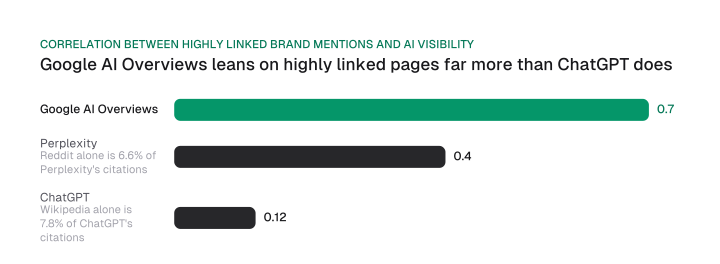
Cross-engine disagreement is a sourcing problem, not an opinion problem, so a blanket "improve sentiment everywhere" campaign wastes effort on the engine where it won't move the number. The fix is source-specific: get cited on the sources each engine actually weights. The mechanics are the ones behind how ChatGPT chooses sources, pointed at a claim that already exists rather than one you are trying to add.
How to build a sentiment tracking system that isolates a real signal
A trustworthy sentiment tracking setup samples each engine at a cadence that matches how that engine retrieves information, not a single fixed weekly check for every platform.
If you're building a system to track brand sentiment in AI answers, start from how each engine sources its answers. Engines differ in how much they lean on live web retrieval versus the weight baked into training data at the last cutoff. A one-size cadence over-samples one engine and under-samples another.
Engines split into two types for this purpose:
- Engines that lean on live retrieval. Answers can shift as soon as the sources they pull from change, so sample more often, in smaller batches.
- Engines that lean on training data. A content fix won't show up until the next retrieval pass or training refresh, so use a longer measurement window before judging a fix.
No vendor publishes a threshold for this, so treat it as a direction rather than a number: sample the live-retrieval engines more often, and give the training-weighted ones a longer window before you judge a fix.
Counting mentions and reading their tone are two different jobs, and most dashboards only do the first. Set the counting up with track ChatGPT mentions; the tone step is this guide.
Sentiment is one line in a wider stack that also carries referral tracking, Search Console and a measurement maturity model. That whole setup lives in ai search analytics. What the engine-specific cadence above adds is the part that only applies to reading tone.
Running this sampling per engine is the part teams drop first. Mission Growth's platform tracks AI citations and visibility for customers.
How to fix negative brand sentiment in AI answers
The right fix for negative AI sentiment depends on whether the underlying claim lives on a live-crawled page or is baked into the model's training data.
The two failure modes repair on completely different timelines.
A one-star review on a site an engine re-crawls every few days is a different problem than an outdated claim sitting inside a model's training weights from a year-old snapshot, even though both can produce the same negative sentence today.
| Where the claim lives | Fix | Expected timeline |
|---|---|---|
| Live-crawled page (review site, recent article) | Source correction request, or an owned-content update that directly addresses the claim | Shows up within that engine's next retrieval or re-crawl cycle |
| Baked into training data, no live citable source | Same content fixes are still correct | Lags until the next training cutoff; judging it a failure after one week is a measurement error, not a fix error |
Once you know which row you're in, the action is the same for both: correct the source, or publish content that states the accurate version clearly. What changes is your expectation for when it lands.
A live-crawled correction that hasn't moved a sentiment reading in three days is worth checking again. A training-data-weighted claim that hasn't moved in three days is exactly on schedule.
Once you've made the correction, the same mechanism applies to sentiment as to any other citation problem: getting ChatGPT citations to update after you fix the underlying source takes a retrieval cycle. Checking a week too early just tells you the crawl hasn't happened yet; it doesn't mean the fix failed.
How to monitor competitor brand sentiment in AI answers
A visibility-by-sentiment view sorts competitors into distinct priority groups.
A competitor with high visibility and weak sentiment is a different threat than one with low visibility and strong sentiment.
This is how you monitor competitor brand sentiment in AI answers without relying on borrowed case studies. The read-out that matters for competitive action is which quadrant each competitor sits in, not who has the better average score, because that determines whether the right response is a content play, a source play, or no action at all.
Build the quadrant with your own tracked visibility and sentiment numbers for each competitor, not borrowed ones:
- High visibility, negative sentiment. A reputation risk. The competitor is winning mentions but with bad framing, worth watching because a source correction on their side could flip this fast.
- Low visibility, positive sentiment. A hidden advocate pattern: whatever content or PR exists is working, but there isn't enough of it. A content or PR gap for them, not a reputation problem, and the quadrant most likely to shift if they invest.
- High visibility, positive sentiment. The position to defend. Expect a competitor here to keep winning mentions with good framing unless something on the source side changes.
- Low visibility, negative sentiment. Lowest priority. Worth fixing only if the category itself is about to grow and this competitor is likely to invest.
It replaces case-study numbers nobody outside one vendor can verify with a structure you fill in from your own account, using the AI visibility tools that track competitor sentiment.
Two brands can have identical average sentiment scores and sit in completely different quadrants once visibility is factored in. The quadrant, not the raw score, decides where you spend effort next.
Most teams' biggest mistake is skipping straight to "fix the negative sentiment" without first checking which quadrant, and which prompt type, produced the number.
What to do with a sentiment number this week
Most LLM brand sentiment scores measure how a prompt was worded and which sources an engine's retrieval pipeline happened to surface, not how the market actually feels about a brand.
Fixing that takes neutral branded prompts to get a real reading, an engine-aware measurement cadence instead of one weekly check for every platform, and a source-type-aware repair path. None of that requires a bigger dashboard.
Start with the delta test in the framing section above on your own brand's weakest topic this week. If the neutral and valence-loaded prompts produce the same claims, you have a real sentiment problem and can move to the fix-path table. If they don't, you were measuring the question rather than the market.
Frequently asked questions
Treating the raw label as ground truth without checking whether the prompt that produced it was neutral or valence-loaded. A branded, valence-loaded prompt produces a score that reflects the question's framing, not the brand, so the first check on any sentiment number is which of the three prompt types made it.
No, by default. A blended score that weights every negative mention the same as every positive one hides which mentions require action and which are noise from a single loaded prompt or an isolated bad source. Separate mention presence, recommendation and tone before trusting a trend line.
LLM brand sentiment is the tone, positive, neutral or negative, an AI answer takes toward a company once that company is already named. It's distinct from visibility, which only measures whether the company appears in the answer at all.
Mainly because their retrieval layers pull from structurally different source pools, Wikipedia-adjacent sources for ChatGPT, Reddit for Perplexity, so the same brand facts get filtered through different citation patterns before either engine forms a sentence about them. That's a sourcing difference rather than a difference of opinion.
Enough to cover neutral branded prompts across your main topics and themes, repeated on the cadence set out in the measurement section above, rather than a single fixed panel size. The panel needs to be big enough to separate a real trend from noise on the specific engine and topic you're tracking; a fixed number rarely applies everywhere.
An engine generates an answer that mentions the brand, then a separate judge model reads that text and assigns it a positive, neutral or negative label. The judge step carries its own documented biases, including a tendency to favor longer answers and to shift its label based on presentation order, independent of what the text actually says about the brand.
Figures and images in this post are free to reuse under CC BY 4.0 with credit to Mission Growth.
Get Mission Growth highlighted in your Google results.