ChatGPT SEO: How Brands Get Recommended
ChatGPT SEO explained: how ChatGPT decides which brands to recommend, what signals actually earn a mention, and a prioritized 4-tier program for B2B teams.
By Furkan AktaşPublished Updated
On this page
ChatGPT recommends brands it recognizes with strong, consistent signal: entities it learned confidently during training, reinforced by live web retrieval when it searches.
That retrieval favors sites already showing up clearly and repeatedly across the web ChatGPT can crawl and cite.
No keyword trick substitutes for that signal. ChatGPT SEO is less about optimizing a single page and more about building the evidence that a brand deserves to be named.
How ChatGPT decides which brands to recommend comes down to crawler access and citation signals, not the unsourced statistic the category keeps repeating, and a 4-tier program builds that access in order.
In this guide:
- How ChatGPT actually decides which brand to recommend, and which system you can influence
- Why a single mention now decides B2B shortlists
- The signals that earn a citation, and the fake stat worth ignoring
- A prioritized 4-tier program for crawler access, content, off-page signal, and measurement
- How ChatGPT SEO differs from traditional SEO
How ChatGPT actually decides what to recommend
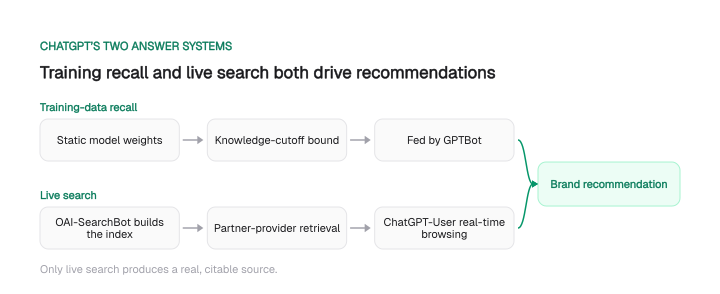
ChatGPT decides which brands to recommend through two separate answer systems, not one, and knowing which one is running changes what you can influence.
The base model recommends from training data: patterns baked into static weights and bound by a knowledge cutoff. If your brand was referenced widely and consistently across the web ChatGPT trained on, it can name you with no live lookup at all.
ChatGPT Search runs the second path. It retrieves current pages through an index built by OAI-SearchBot, OpenAI's dedicated search crawler, and pulls live results through a partner search provider.
OpenAI's own crawler documentation draws a clean line between three agents:
- GPTBot crawls pages for training data.
- OAI-SearchBot builds the index ChatGPT Search retrieves from.
- ChatGPT-User browses in real time during a live session.
You can allow OAI-SearchBot for search inclusion while blocking GPTBot to opt out of training use. The same search-versus-training split runs through every major AI crawler, and whether to allow GPTBot is only the first line of that policy.
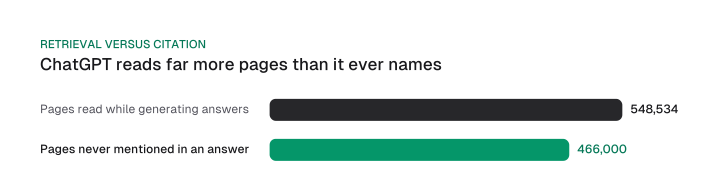
Showing up in retrieval isn't the same as being named. For example, a March 2026 analysis of 15,000 prompts found ChatGPT retrieved 548,534 pages while generating answers but cited only 15% of them in the final responses. That leaves roughly 466,000 pages it read and never mentioned.
The full retrieval pipeline, including how ChatGPT scores and selects sources, is covered in How to Get Cited by ChatGPT. This post stays at the strategy level: which system to influence, and how.
Why this matters for B2B SaaS right now
For a B2B SaaS brand, a ChatGPT recommendation is no longer a curiosity. It's a shortlist event. For the search side of that same shortlist, our B2B SEO strategy shows how to rank for the whole buying committee.
G2's 2025-2026 B2B Buyer Behavior Report puts numbers on the shift:
- 51% of B2B software buyers now start research with an AI chatbot more often than with Google, up from 29% in April 2025.
- 71% rely on AI chatbots for software research, up from 60% seven months earlier.
- G2 names AI chatbots the #1 source influencing which vendors make buyer shortlists.
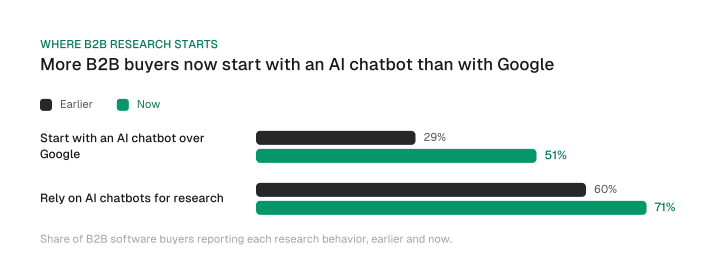
The report surveyed 1,076 B2B decision-makers across North America, EMEA, and APAC in March 2026, plus 39 qualitative interviews with software marketers. Turning that research behavior into pipeline is the job of a SaaS SEO strategy built around bottom-funnel pages.
The influence runs past discovery into the decision itself:
- 85% of buyers think more highly of a vendor when an AI chatbot mentions it in a recommendation.
- 69% chose a different vendor than they originally planned based on chatbot guidance, and 33% bought from a vendor they hadn't previously known.
- Four out of five buyers say AI chatbots sped up their purchasing decision, and 83% reported feeling more confident in their final choice.
ChatGPT reached 900 million weekly active users, announced by OpenAI on 2026-02-27 and roughly double the 400 million TechCrunch reported a year earlier. For a fuller set of sourced AI-search numbers, see our AI SEO Statistics roundup, and for every ChatGPT figure with its unit and date, our ChatGPT statistics.
So when ChatGPT skips your brand or names a competitor for a query your product answers, that isn't a vanity-metric miss. A buyer just built a shortlist without you on it.
The reverse is a channel too. A third of buyers bought from a vendor they hadn't previously known, so a consistent ChatGPT mention can put an unfamiliar brand onto a shortlist that paid search alone would never have reached.
For a challenger, that's one of the few discovery paths where an incumbent's brand budget doesn't decide the outcome.
What actually makes ChatGPT name a brand
Two families of signal decide whether ChatGPT names a brand: what's on your own pages, and what the rest of the web says about you.
Most ChatGPT brand recommendations trace back to a mix of both.
Getting named and getting described well are separate outcomes, and a brand can win the first while losing the second. The second one is brand sentiment in AI search, which runs on a different mechanism than recommendation does.
Content signals you control
Content signals live on the pages you control: ChatGPT tends to name brands whose pages answer a question directly and early.
Specifically, ChatGPT favors pages that:
- Answer the reader's question directly and early, before any background.
- Back claims with specific or proprietary data instead of generic assertions.
- Use a comparison structure that matches how buyers phrase their questions.
- Pair the brand name consistently with its category, so the model builds one stable association rather than a fuzzy one.
An answer-first page states its takeaway in the opening lines. A page that opens with three paragraphs of background before it gets to the point tends to get skipped, because the model can't pull a clean, quotable answer out of it.
Off-page signals: the citation mix that decides the rest
Off-page signals are where most brands underinvest, and they're decisive: ChatGPT's citation mix is lopsided toward a handful of platforms.
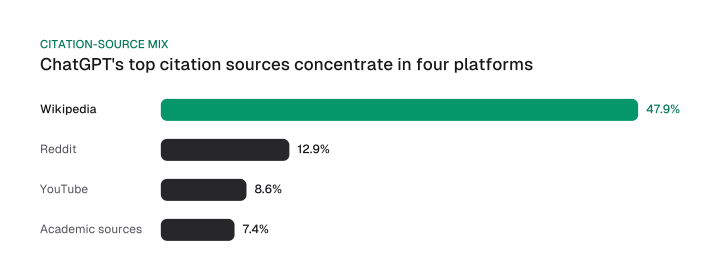
An analysis of 680 million AI citations gathered from August 2024 to June 2025 and found ChatGPT's top-10 citation sources skew heavily toward four categories:
- Wikipedia: 47.9%
- Reddit: 12.9%
- YouTube: 8.6%
- Academic sources: 7.4%
Those four categories account for 76.8% of the top-10 mix. And the same analysis found only 11% of domains are cited by both ChatGPT and Perplexity, so a presence that earns Perplexity citations doesn't automatically transfer to ChatGPT.
Two practical points follow:
- The concentration is extreme. Four platform types carry more than three-quarters of the top-10 citations, so a short list of surfaces deserves most of your off-page effort.
- The overlap is low. You can't optimize once for one AI engine and assume the work shows up in another; each engine's citation ecosystem stays close to separate.
The eight signals in one table
None of the signals above decides the outcome alone. ChatGPT names brands that show the same signal from several directions at once.
Here is how the main signals break down, and the single action each one points to. Read it as a portfolio to build, not a menu to pick one item from:
The signal-weight numbers you'll see everywhere (and why we're not using them)
Read three articles about ChatGPT recommendations and you'll meet the same three numbers: 41% of recommendations trace to authoritative-list mentions, 18% to awards, 16% to reviews.
They look precise, and they get repeated as though they came from a controlled study.
These percentages carry no disclosed sample size or methodology. Treat them as folklore, not evidence, until someone publishes both.
They didn't come from one, as far as anyone can show. The figures trace back to a single blog analysis that discloses no external source and no methodology for how the split was measured.
Later write-ups restate the same three percentages without re-deriving or crediting them. That's how an unverified estimate hardens into category folklore.
We aren't repeating them here as fact, and not because they're necessarily wrong. We can't verify how they were produced, and a number you can't trace is a number you can't build a program on.
When a statistic has a named source and a disclosed method, we cite it with the date, the way we did above. When it doesn't, we say so and leave it out.
Run a quick test before you cite a number:
- Can you point to a named study with a stated sample size and a date?
- Does it explain how the figure was measured, or does it just assert it?
- If the trail ends at another blog restating the same figure, you've found folklore.
That test is worth running on every AI-search statistic you plan to act on, including the ones in this post.
A prioritized ChatGPT recommendation program
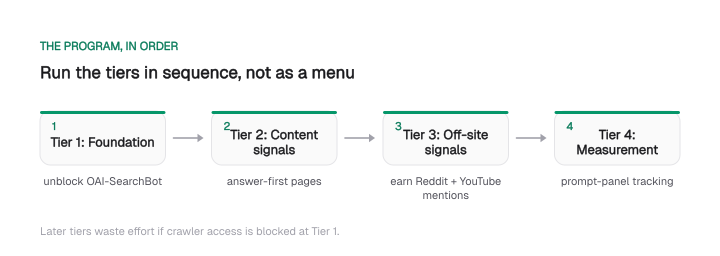
A prioritized ChatGPT recommendation program runs four tiers in sequence: crawler access, content signals, off-page signals, and measurement.
A flat list of tactics with no order is useless if you have limited time and zero mentions today. If you're asking how to get recommended by ChatGPT, the answer is a program run in sequence. Here is the order, from the fix that unblocks everything to the measurement that tells you it worked.
Tier 1: Foundation (crawler access and indexability)
None of the later tiers matter if ChatGPT's crawlers can't reach your pages or find them in the index it searches.
Start here even when it feels basic: a blocked crawler turns every other tier into wasted effort.
Fix these four things first:
- Unblock OAI-SearchBot. Confirm it isn't blocked in your robots.txt. Plenty of sites blanket-block AI crawlers by reflex and quietly remove themselves from ChatGPT Search.
- Get indexed in Bing, not only Google. ChatGPT Search's live retrieval leans on a partner search index, and a page Bing hasn't indexed stays invisible to that path regardless of its Google ranking. Run a
site:search in Bing scoped to your own domain to see what it has actually indexed. - Render without client-side JavaScript. We migrated our own React single-page app to prerendered static HTML for 20 marketing pages precisely because AI crawlers do not execute JavaScript, and content that only appears after the page renders in the browser is content those crawlers never see.
- Publish a clean llms.txt. missiongrowth.io publishes its own llms.txt and llms-full.txt, a plain-text knowledge base for AI crawlers. Our free llms.txt checker checks yours in a minute.
Check the exact OAI-SearchBot user-agent line as well as the wildcard rule. A broad User-agent: * disallow can catch it by accident.
Tier 2: Content signals
Once crawlers can see you, give them pages worth citing. This tier is the core of ChatGPT search optimization on your own site.
Three moves matter most:
- Lead with the answer. Restructure the pages that carry the most buying intent so the direct answer sits in the first two sentences, detail below it.
- Build comparison pages. Cover the exact questions buyers ask ChatGPT: X vs Y, best X for a use case, alternatives to a named competitor.
- Replace generic claims with data. A number only you can report is a reason to be named.
Group these pages into a topic cluster so the model sees consistent, reinforcing coverage of your category instead of one isolated post. A single strong page can get cited, but a coherent set of them builds the entity association that makes you the default answer.
If you're asking how to rank in ChatGPT for a buying query, this is where the work happens: the clearest answer, with the strongest sourcing, wins the citation more often than the page with the most keywords.
Tier 3: Off-site signals
Third-party signals decide most of what's left, and the citation-mix data shows exactly where that effort pays off.
Your own pages rarely carry a recommendation alone.
Prioritize four surfaces, in this order:
- Review sites and listicles. The roundups that buyers and ChatGPT both consult during evaluation, and the fastest to influence since you can request or correct a listing directly.
- Reddit. Genuine participation in the subreddits where your category is discussed. Drive-by promotion gets removed.
- YouTube. Demos, comparisons, and walkthroughs; video is a documented citation source that keeps earning views long after publish.
- Wikipedia. Only if your brand genuinely meets notability guidelines. Faking an entry backfires.
Sequence this by how much control you have. Start with the review sites and listicles you can influence directly, since those move fastest. Then invest in earned surfaces like Reddit and YouTube that take longer to build honestly and can't be rushed without looking like spam. Point the effort at the platforms that actually appear in ChatGPT's citations rather than a scattershot PR push aimed at outlets it never reads.
Tier 4: Measurement
Measurement tells you whether the program worked.
ChatGPT's answers vary from one run to the next, so a single check tells you almost nothing. You need repeated sampling on a stable set of prompts to see a real trend rather than noise.
Track three things:
- A fixed prompt panel. Track which prompts surface your brand and which surface competitors, over time. The exact prompt panel and GA4 method is in How to Track ChatGPT Mentions of Your Brand.
- Tooling, once manual tracking stops scaling. Our roundup of the best ChatGPT SEO tools covers when that switch makes sense.
- Your own analytics. Audit them so AI-referred traffic is actually captured. Our free tracker audit flags the gaps that let AI referrals go uncounted.
ChatGPT SEO vs. traditional SEO: what transfers, what doesn't
Traditional SEO and ChatGPT SEO share the technical basics but reward different kinds of authority.
Crawlability, clean indexable HTML, fast pages, and clear information architecture help both a Google ranking and a ChatGPT citation.
The break is in what counts as authority:
- Classic SEO treats backlink volume as the dominant signal.
- ChatGPT SEO cares more about where you're mentioned than how many links point at you.
A page that ranks second on Google can still be the source ChatGPT names, if it answers the question more directly and carries stronger third-party corroboration than the page ranked first.
This is ChatGPT's version of a broader discipline. The framework spanning Perplexity, Gemini, and Google AI alongside ChatGPT lives in our LLM Optimization guide, and the definitional entry point for the whole field is Generative Engine Optimization.
Mission Growth is our AI-led SEO and GEO growth service, and its platform tracks AI citations and visibility for customers. We don't yet publish aggregate data from it, so the numbers in this guide come from the named public studies.
Frequently asked questions
Does ChatGPT use live search or training data to recommend brands?
Both, depending on the query. ChatGPT's base model recommends from what it learned during training, which is static and bound by its knowledge cutoff. ChatGPT Search adds live retrieval through OAI-SearchBot's index and a partner search provider (Bing) for current information. A brand can have strong training-data recall and weak live-search visibility, or the reverse, so both paths are worth influencing.
How is ChatGPT SEO different from traditional SEO?
Crawlability and clean indexable content still matter for both. What changes is authority. Traditional SEO leans on backlink volume and keyword matching, while ChatGPT's citation mix skews heavily toward third-party platforms like Wikipedia, Reddit, and YouTube. Off-page presence on the platforms ChatGPT actually cites carries more weight than raw backlink count.
Do backlinks still matter for getting recommended by ChatGPT?
They matter for getting your site indexed and crawled in the first place, but backlink volume alone isn't the strongest lever. Third-party mentions on the platforms ChatGPT cites most, from Wikipedia and Reddit to YouTube and review sites, carry more documented weight than link count. Build presence where the citations actually come from.
How long does it take to get recommended by ChatGPT?
There's no fixed timeline. It depends on how much existing signal a brand already has across the web ChatGPT can crawl and cite. A brand with zero third-party presence needs to build that presence first (Tier 3 above), which realistically takes months. Treat this as a program.
Does ChatGPT rely on Bing for its search results?
Yes, for live retrieval. ChatGPT Search partners with a search provider (Bing) to fetch current web results, and OAI-SearchBot builds the index that powers this path. If a site isn't indexed by Bing, it stays invisible to ChatGPT's live-search retrieval, no matter how well it ranks in Google.
Can I pay to get ChatGPT to recommend my brand?
No. There's no paid placement mechanism in ChatGPT's answers. What you can influence is the underlying signal: indexability so crawlers can see you, content that directly answers the questions real buyers ask, and genuine third-party presence on the platforms ChatGPT cites most. That's the whole game.
Cite this page
Aktaş, F. (2026, September 15). ChatGPT SEO: How Brands Get Recommended. Mission Growth. https://missiongrowth.io/blog/chatgpt-seo
Figures we made for this post are free to reuse under CC BY 4.0 with credit to Mission Growth.
Get Mission Growth highlighted in your Google results.