Link Building Strategies: Pick by Cost and Google's Rules
Link building guide: pick tactics by what you can supply, see what a link costs by method, and learn when a paid link stops counting for Google.
By Furkan AktaşPublished Updated

On this page
Every link you earn is a trade: you hand a site owner something, and Google decides whether the result counts. This guide sorts the usual tactics by what you can supply, shows where Google's spam text draws the line, prices a link by method, and ends with a ledger that tracks link building SEO results as net links instead of gross links.
What is link building, and which tactic fits what you can supply?
Link building is how you persuade other websites to link to your pages, and the tactic that fits is set by what you can supply: an asset, expertise, a product surface, relationships or money.
The practical answer to what is link building is a sorting problem before it is an outreach problem. Knowing which tactic your team can supply matters more than the length of the tactic list.
Google gives links two jobs. Its documentation says it "uses links as a signal when determining the relevancy of pages and to find new pages to crawl." The popular "vote of confidence" picture hides the second job.
A link gives Google a path to a page and a hint about what that page covers. A crawlable link needs an a element with an href attribute, and its anchor text should describe the destination, so "supply table" beats "click here".
Semrush's link building guide says AI systems "don't have a link-based ranking system like Google's that we know of." It adds that an indirect effect is likely, because AI systems often rely on search engine indexes, so authority built in search can carry over.
It also reports that its own study with Kevin Indig found backlink-related factors influence AI visibility. Those are Semrush's sentences, and the guide gives no effect size. The evidence for one business type sits on the link building for SaaS page.
Google's AI Overview for this query splits tactics into "link producers" (volume tactics such as broken-link replacement, directories and guest posts) and "association producers" (digital PR, original research, infographics). That split sorts by effort.
Supply limits you before effort does: what you can hand a site owner that is worth a link. The table below sorts the same tactics by that supply and joins each to Google's text and the live page that goes deep.
Link building tactics differ in what they consume. Assets need production time, commentary needs a named expert, dead-link outreach needs a niche with enough rot, and money needs a budget that survives the next two sections.
Pick the one or two rows where you already hold the supply and fund those first. That is how link building strategies stay small enough to finish.
Link building in digital marketing
Link building in digital marketing is the off-page work of winning links on other sites that point to your pages.
Links are one strand, next to mentions, reviews and citations, and the off-page SEO guide maps the rest. This page stays on the links.
Benefits of link building
The benefits of link building follow from the two jobs Google gives a link: a signal about the relevancy of your page and a path to new pages to crawl.
A link from a relevant page helps Google find and place your page, and readers can click it. Whether links help AI answers is covered above as Semrush's claim, with no effect size.
Types of link building
The types of link building are earned, asked, added and bought, the four methods Semrush's own table uses, and the supply column tells you which of them you can run today.
Earned links sit on the asset, expertise and product rows, asked links on the mention, partner and dead-link rows, and bought links on the money row.
Common link building techniques
The common link building techniques are publishing a data asset, pitching expert commentary, replacing dead links, giving partners a page to reference, asking mentions to link and buying qualified placements.
Each one is a row of the supply table, so choose by the supply you hold and not by the technique's reputation.
Where Google draws the line, and what happens to a bought link
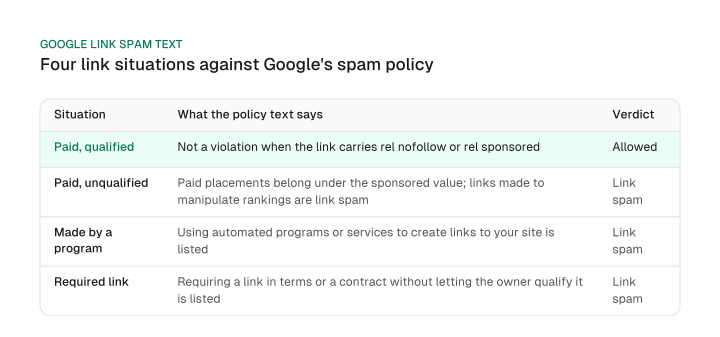
Google defines link spam as "creating links to or from a site primarily for the purpose of manipulating search rankings," and its SpamBrain system neutralizes unnatural links, so a link that crosses the line can simply stop counting. Payment is not what crosses it.
Google's spam policy says buying and selling links is "a normal part of the economy of the web for advertising and sponsorship purposes," and that it is not a violation of its policies to have such links as long as they are qualified. Its link attributes page says to mark advertisements and paid placements with the sponsored value.
Nofollow works too. So the line is the qualifier on the link, and the money and the payee are secondary. The linking site's side of the rel values is covered in external links vs backlinks.
One correction is worth making. Semrush's method table answers "Buy links" with "No," says the purchase breaks Google's spam guidelines and invites a penalty, and allows you to pay an agency or freelancer but not the site hosting the link. Google's own sentence is narrower: qualified paid links are not a violation.
Where Semrush is right in practice is the qualifier. BuzzStream's pricing analysis, built on a vendor database, observes that in all but the fewest cases rel=sponsored is never used on the guest post links vendors place, even though money changes hands. It gives no rate for that, so this is one analyst's observation about vendor-placed guest posts. The bought links on offer are mostly the unqualified kind.
What happens to those links? Google's December 2022 link spam update announcement says SpamBrain, its AI-based spam-prevention system, can now detect both sites buying links and sites used for the purpose of passing outgoing links. It adds that "ranking may change as spammy links are neutralized and any credit passed by these unnatural links are lost."
Google also says its algorithms and manual actions aim to nullify unnatural links at scale. That wording is why a flat claim that Google "penalizes" a bought link overstates it. SpamBrain neutralizes the link, the credit it passed is lost, and the link can simply stop counting.
A manual action is the second route. For the "Unnatural links to your site" action, Google's help page tells you to contact the owner of each offending site and ask that they remove the link or prevent it from passing PageRank, for instance with nofollow. You then use the disavow tool for what is left and request a review.
Google's list holds other clauses too: directory or bookmark links, a product sent in exchange for a link, and optimized-anchor links in guest posts or press releases. The off-page SEO guide covers those three.
What makes a high-quality link
A high-quality link comes from a page relevant to yours, is crawlable and was not created primarily to manipulate rankings.
Google uses links as a signal of relevancy, so the linking page's topic is part of the test, and an anchor that describes the destination helps. Vendors price quality by the linking site's domain rating and traffic, which sets a price tier and is not Google's test.
How much does link building cost?
A link costs about $179 as a vendor insertion, $295 to $461 as a guest post and $597 as a surveyed digital PR average, and BuzzStream's own pages disagree on the vendor guest post price. These are listed prices from vendor datasets, so read each row as a dataset and not as a market rate.
Two BuzzStream pages supply the price data used here. Its pricing page analyzes a vendor database of guest-post sites; its digital PR costs page reports a 2025 survey of about 70 providers, last updated 2026-06-12. The table keeps each figure with its source page, because they were measured differently.
Download CSV (CC BY 4.0)
The $2,000 month is an illustrative budget, not a sourced figure. Each count is the budget divided by the price, rounded down.
How much does link building cost over a month, then? A $2,000 month buys about 11 insertions, or between 4 and 1 vendor guest posts depending on which BuzzStream page you read. The cost per link moves with the dataset more than with the budget.
Two of those rows give BuzzStream's average for the same service, a guest post through a vendor: $461 on the pricing page and $1,459.06 on the digital PR costs page. The gap is one of vintage.
The $1,459.06 figure came from BuzzStream's earlier study of over 26,000 guest post sites. Its 2026 study covered nearly 500,000 sites and gives $461, and the digital PR costs page still carries the earlier number.
The quality tier moves the price on a single dataset. On the pricing page's insertion database, a top-tier link costs about $780 against $179 for the average, which is 4.4 times (780 divided by 179). The same page says only about 1.37% of its larger guest-post vendor database meets its quality standard, and attaches no price to that group.
Digital PR needs a reconciliation, because its two figures use different definitions. The $597 average is a survey of providers across service types, from $150 for guest posting to $800 for large hero campaigns, so it blends cheap guest posts with expensive campaigns.
The $1,250 to $1,500 is a pricing-page price per unique link that does not count syndicated links. Neither figure is wrong; they measure different things. Running a campaign is covered on the digital PR page.
Most priced placements are unqualified, so what is a qualified one for? Google says sponsored, ugc and nofollow "now work today as hints for us to incorporate for ranking purposes." A hint is not a promise of credit, so this page puts no ranking value on a qualified link.
A link building agency is a vendor that sells prospecting and outreach on a monthly contract. In BuzzStream's survey, agencies average $6,357 a month against $4,200 for freelancers. For the in-house versus agency question in a SaaS setting, see in-house vs agency link building. If you want the cost of a whole program and not a single link, how much does SEO cost prices that.
How to track link building: a net-link ledger and the tools for each job
A link ledger records each link you acquire with its date, tactic, rel value and status and reports net links, because Ahrefs counted 74.5% of links to sampled sites as lost since January 2013. Gross links flatter a program that is quietly leaking.
Ahrefs' link-rot study sampled 2,062,173 sites and updated its figures on 2024-02-02. Its 74.5% mixes links of every age from January 2013 onward, so it is not a survival rate for a link you build this year, and it does not tell you how many gross links to build. It does tell you that a count with no loss column overstates progress.
A ledger needs six columns:
- The linking URL and the target URL on your site.
- The date the link was first seen.
- The tactic that produced it, taken from the supply table.
- The rel value (none, sponsored, ugc or nofollow).
- Cost, in money or hours.
- Status, checked on a schedule, with the date of the last check.
Net links is acquired links minus lost links, counted from this sheet. The lost links need a response, and the reason for the loss decides which.
Ahrefs reports the most common reasons among the links it counted as lost: dropped (47.7%) and link removed (34.2%). Those are Ahrefs' shares of its own lost-link set, and "dropped" means the page left Ahrefs' index, not Google's. Treat them as a reason split and not as a rate for your links.
This is the lost-link triage, and it is where reclaiming broken links turns into a routine and not an occasional project.
Tools do three jobs in this workflow: find who links, contact them, and verify that links stay live. Search Console's Links report is the free baseline for the first, and the verify job feeds the status column of the ledger.
That makes the free report a discovery list and not the ledger. Link building tools sort into these same three jobs, and the job matters before the brand does.
Can you automate link building with AI agents?
Automating prospect research, pitch drafts and link checks is safe, but Google lists using automated programs or services to create links to your site as link spam, so the agent must never be what creates the links. Has anyone automated link building with a Claude skill? Yes, for the research and verification half of the work. The rule is the same for any agent or script.
Apply Google's clause to each task by asking one question: does a program or service create the link?
If the agent writes a pitch, a human sends the link ask, and the owner of the other site places the link, nothing in the clause is triggered. If the agent writes the placement itself, it is.
Creating low-value content primarily to manipulate linking and ranking signals is also on Google's list, so an agent that mass-produces pages to hold links fails twice.
The feedback loop is the useful part. Each status check writes a row to the ledger: live, removed, redirected, or not found. A removed link goes back to the triage table, which names the follow-up a person should approve.
Feeding indexing results back into the agent works the same way: the check results go into the ledger, and the ledger decides the next human action.
Link building is a trade between what you can supply and a line Google writes down. Pick the row of the supply table you can already fill, keep any paid placement qualified, price it by the method and dataset, count net links, and let software do the research and the checks.
To start this week, build the six-column ledger from your Search Console Links report export, mark the tactic for each link, and choose one supply row to fund next.
Frequently asked questions
Has anyone automated link building with a Claude skill?
Yes, for research and checks, never for placing links. A skill can find prospects, rank them against your supply table, draft pitches for review and check link status. Google lists using automated programs or services to create links to your site as link spam, so anything that places a link falls on the wrong side. The task table in the automation section sorts six jobs by that test.
Does link building still matter for AI search?
Semrush's guide says AI systems have no link-based ranking system like Google's that it knows of, that there is likely an indirect effect through the search indexes AI tools draw on, and that its own study with Kevin Indig found backlink-related factors influence AI visibility. All three are Semrush's statements and none comes with an effect size. For one business type's evidence, see the SaaS page linked earlier.
What are common link building mistakes to avoid?
The common link building mistakes to avoid are paying for links without a sponsored or nofollow qualifier, letting an agent place links, reporting gross links with no loss column, trusting one report and treating one price as the market.
BuzzStream observes that the qualifier is almost never used on vendor-placed guest post links. Search Console's Links report is a sample capped at 1,000 rows per table. And BuzzStream lists $461 and $1,459.06 for a vendor guest post on two pages, from studies of different vintage.
What is a link building agency?
A link building agency is a vendor that sells prospecting and outreach, usually on a monthly contract. In BuzzStream's survey of digital PR providers, agencies charge about $6,357 a month against $4,200 for freelancers. How that choice plays out for software companies is on the SaaS page linked earlier.
Is free link building possible?
Yes, at a cost in hours and not in money. Reclaiming lost links, asking sites that mention you to add the link and asking partners for links all cost no fees, and they are the "only hours" rows of the supply table. Free journalist-request feeds are covered on the HARO alternatives page linked in the supply table.
How many links does a month of budget buy?
On an illustrative $2,000 month, about 11 insertions at $179, 6 direct guest posts at $295, 4 vendor guest posts at $461 or 1 at $1,459.06, 3 surveyed digital PR links at $597, or 1 at the $1,250 pricing-page price. The range for vendor guest posts runs from 4 to 1 depending on which BuzzStream page you read.
Cite this page
Aktaş, F. (2026, October 11). Link Building Strategies: Pick by Cost and Google's Rules. Mission Growth. https://missiongrowth.io/blog/link-building
Download the data: 1 table as CSV (CC BY 4.0)
Figures we made for this post are free to reuse under CC BY 4.0 with credit to Mission Growth.
Get Mission Growth highlighted in your Google results.