Linkable Assets for Link Building: How to Pick One
Linkable assets earn backlinks on their own. See the types that actually work, how to pick one for your budget, and how to measure whether it's working.

On this page
Search for this topic and you'll find the same linkable assets list every time: infographics, tools, data studies, guides, templates. None of them tells you which one fits your actual budget, your actual data access, or the few hours a week your team can spend on outreach instead of production.
That gap is the real problem. You already know linkable assets earn links. What you need is to pick one, build it, promote it, then find out honestly whether it worked, using a number that a single reused embed can't inflate the way a raw backlink count can.
This guide does that: a resource-fit decision table instead of a flat list, a quality check you can run a draft idea through before committing budget, and a measurement rule built from nine examples other sites have already published, so you can compare your own asset against real numbers instead of guessing.
In this guide:
- The five-trait check that decides whether a draft idea is worth building
- A decision table matching each of the types of linkable assets to what it actually requires
- A repeatable, attributed workflow for drafting a data-study asset with AI
- The channel that gets each type promoted, keyed to the table above
- The ratio to track instead of raw backlink count, with a worked example
What linkable assets actually are
A linkable asset is content built specifically to be worth linking to on its own: a data study, an interactive tool, an in-depth guide, or a template.
An editor cites it unprompted because it makes their own piece better, never because you asked. Judge a draft idea against that standard; whether it converts a visitor into a lead is a separate question.
Each citation compounds two benefits beyond the click. It puts your brand in front of that publication's audience, and it adds to the topical authority search engines credit when they decide which page to trust on the subject.
Mailchimp's own definition names five traits that decide whether an idea clears the bar: quality, uniqueness, usefulness, relevance and shareability. Naming the traits is easy. Applying them to a draft idea before you spend a design budget isn't.
Run every draft idea through these questions:
- Quality. Would you be comfortable if a stranger cited this exactly as it is, no caveats needed?
- Uniqueness. Does it say or show something not already published elsewhere?
- Usefulness. Would someone bookmark or reference it without reading the rest of your site?
- Relevance. Does it sit inside a topic your actual audience already searches?
- Shareability. Could someone hand it to a colleague and explain it in one sentence?
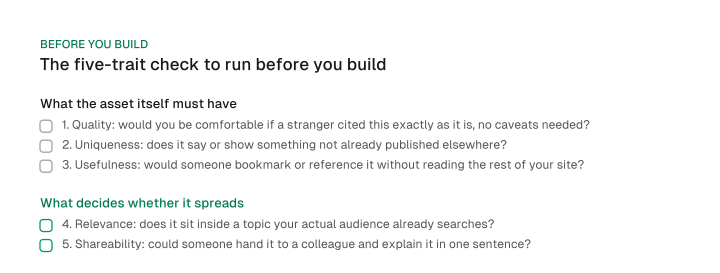
That's the practical answer to what is a linkable asset: a standard you can test a draft idea against, rather than a vague one-line definition. Why linkable assets earn anything at all comes down to whether they clear that bar. The format matters far less.
Run a draft idea through both groups above before you build anything. Miss the first three and no one has a reason to link to it, no matter how well you promote it. Miss the last two and even solid work stays invisible, because usefulness alone doesn't spread itself.
One more check belongs in the same pass: is this the best version of the idea, or just the fastest one to ship? An asset that's competent but derivative of what's already published earns fewer links every year it's out, because there's nothing left in it that the last three competitors didn't already cover.
Ask it bluntly: would someone researching this topic today bookmark your version, or close the tab and open a competitor's instead?
Here's the pattern worth breaking: teams measure whether an asset "worked" by counting its raw backlinks, sometimes referring domains, never anything past that.
Raw count conflates two different outcomes: an independent site linking to you because the asset earned it, and a handful of sites reusing the same embed code. A number that can't tell those two apart can't tell you whether the asset is actually working.
The fix is a ratio, not a count: backlinks per referring domain, used throughout this guide to judge every type, tool and example below.
Which type fits your resources
The right type depends on what you already have: data access, design or dev time, or outreach capacity.
Here's how nine published linkable asset examples break down by requirement and outcome, across the types of linkable assets worth considering.
| Asset type | What it requires | Real example (published) | Realistic link outcome |
|---|---|---|---|
| Data study or original research | A survey, proprietary data, or a reanalysis of public data; highest credibility, medium-to-high cost | Ahrefs' own study on how long it takes to rank in Google | High volume, if you can sustain the ongoing research cost |
| Interactive tool or calculator | Design and dev time, a one-time build that compounds for years | Dave Ramsey's tools page | Builds slowly at first, then compounds for years without new work |
| Awards, rankings or round-ups | Research plus outreach-heavy work, notifying every site you include | Ahrefs' "Mashies" awards page | Front-loaded: most links arrive right around launch |
| Coined term or named technique | A genuinely new idea plus a name memorable enough to spread on its own | Ahrefs' "Briefcase Technique" | Modest scale, but efficient: one clear framing does most of the work |
| Template or checklist | Lowest production cost, fastest to ship | Not measured among this guide's examples | Smaller link scale; works as a fast follow, not a flagship asset |
| eBook or whitepaper | Content you likely already have, repackaged behind a landing page | Not measured among this guide's examples | Fewer links than open formats, since it asks for something before it gives anything |
| Infographic or data visualization | Design resources, medium cost | Not measured among this guide's examples | Still earns links, but rarely the reason a site chose to cite you over a competitor |
Download CSV (CC BY 4.0)
Three of these rows deserve a caveat. A coined term only earns links if the underlying method is genuinely new: Ahrefs didn't earn links by renaming an existing tactic, it earned them by describing a distinct process that didn't have a name yet.
A template earns fewer links precisely because it's fast to copy, so treat it as a supporting asset rather than the thing you promote on its own. An infographic still earns links when it visualizes data nobody else has charted; a generic recap of someone else's numbers rarely does.
These picks aren't guesses. Each row is grounded in a real example, drawn from a published site and named in the table above.
Once one of these is live, promoting it is a separate skill from building it, covered in full in our guide to link-building strategy.
Data studies need their own freshness rule
Data studies age faster than the other types above. Ahrefs itself flags this about Moz's ranking-factors study, unrefreshed since 2015, which still holds 68K+ links from 5K+ referring domains.
A study can keep earning links for years on reputation alone while the numbers inside it go stale. Refresh the data on a schedule, or state its age plainly, instead of trading on old authority.
How to create it
How to create linkable assets starts with a topic your audience already asks about: a customer question, a competitor gap, or a dataset you can reanalyze.
Guessing at what "feels linkable" is where most drafts go wrong.
Three places to find linkable asset ideas before you draft anything:
- Support tickets and sales calls. The questions your team answers by hand every week are proof of demand nobody has to guess at.
- Competitor gaps. A question every top-10 page mentions but none actually answers is a ready-made brief.
- Data you already hold. Product usage, customer surveys, or a public dataset nobody has reanalyzed turns into a data study without new research spend.
AI tools can help you draft the backbone of a data-study asset, but they can't replace the practitioner who owns the data and the framing. Gabriela Covay runs BrightValleyMarketing.com as its founder and CEO, and uses a repeatable sequence for exactly this:
- Fix the title, intro and the visual element you'll build the piece around.
- Decide the key findings and their implications before you draft a single sentence.
- Write the methodology: what you measured, from where, and as of when.
- Draft the full piece in ChatGPT from that structure.
- Fact-check every output line by line before it goes near a publish button.
AI can draft the backbone. It can't verify the data or decide why a finding matters. That part still belongs to a practitioner.
How to promote it once it's live
Promotion should match the asset type, not one generic "share it on social" tactic for every format.
Here's the channel for each:
- Data studies. Pitch journalists and editors who already cite numbers in your niche. Lead with the single most surprising figure and save the rest for the piece itself.
- Interactive tools. Publish the embed code next to the tool itself, and reach out to sites that already link to comparable tools.
- Awards, rankings and round-ups. Email everyone you included before the public post goes live. Most of your first links come from the people already in it.
- Templates and checklists. These rarely justify outreach on their own. They work as a fast follow linked from a bigger asset, not as a promoted asset in their own right.
Once you've matched a channel to your asset, the outreach mechanics themselves (how to pitch, whom to contact, what makes an editor say yes) are their own skill. See our guide to digital PR outreach for the placement side of this.
Can you just buy a linkable asset?
You can pay an agency to build a linkable asset for you. That's different from paying for the links it earns.
One is a content-production service. The other risks manual-action exposure from Google or Bing.
Ahrefs' CMO, Tim Soulo, breaks link acquisition into four buckets: earn, ask, add and buy. A linkable asset only ever belongs in earn, content built to be worth linking to on its own. Paying someone to produce that asset stays a production service; it only slides into buy when the payment is for the links themselves.
One ranking guide for this exact topic answers its own FAQ headings, "Can anyone buy a linkable asset?" and "How does it work?": checked on 2026-09-22, it says yes if a buyer passes its vetting, and that it researches and builds the content for you to publish.
Here's the piece it leaves out. Commissioning the content is not the same as buying the links. Those still have to be earned once the asset is live, the same way as if you had built it yourself.
Paying for placement carries the real risk. Bought links get penalized because they're easy to spot: the same network of sites gets pointed at every buyer, so the pattern shows up the moment anyone checks the referring domains. Production work carries none of that exposure.
How to know if it's working
A linkable asset is working when independent sites keep citing it over time and it starts showing up in AI answers. A raw count climbing on reused embeds proves neither.
Here's the range, worked out from nine published examples (backlinks, then referring domains):
- Ahrefs' "Briefcase Technique": 370+ links from 90+ referring domains.
- Ahrefs' "Mashies" awards page: 930+ links from 140 referring domains.
- A seoprofy example page: 307+ backlinks from 163 referring domains.
- Smarter Travel's packing checklist: 1,200+ links from 370 unique websites.
- Ahrefs' own ranking-timeline study: 1,800+ links from 470+ referring domains.
- Dave Ramsey's tools page: 2,900 links from 650+ websites.
- A 2019 list of Inc. 5,000's fastest-growing companies: 1,200 unique websites linking in, 12,000+ links total.
- Backlinko's skyscraper-technique example: 6,700 backlinks from 2,200 websites.
- CoSchedule's Headline Analyzer: 16,000+ links from 3,600+ referring domains.
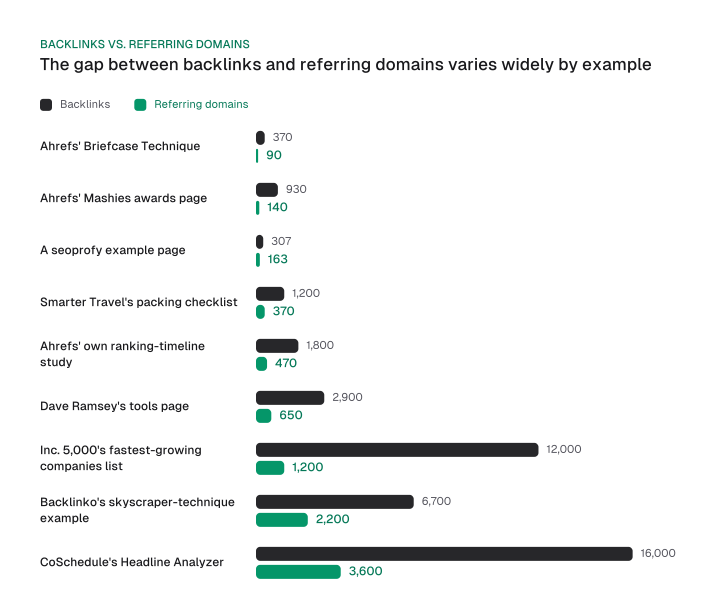
Divide each pair above and every example lands between 1.9 and 10.0 backlinks per referring domain, with a median of 4.1. Land near the middle of that range and independent sites are actually choosing to cite your asset instead of reusing the same embed.
Take the Headline Analyzer as the model. Divide its 16,000+ links by its 3,600+ referring domains and compare the result against the 1.9-to-10.0 range above. Run the same division on your own Ahrefs or Search Console numbers before you decide whether your last asset actually worked.
Track AI-answer mentions as a second signal
Backlinks aren't the only signal worth tracking. A large correlation study points to a second one: brand mentions.
Ahrefs' May 2025 study of 75,000 brands found weak-to-moderate correlations between AI Overview visibility and each of these:
- Brand mentions: 0.664.
- Domain Rating: 0.326.
- Referring domains: 0.295.
- Backlinks: 0.218.
Ahrefs itself says plain brand mentions look more impactful than link building, not that either signal drives rankings; see our full AI SEO statistics breakdown for the rest of that study. Mission Growth's platform tracks AI citations and visibility for customers.
That capability is one reason we treat mentions as a second signal worth watching alongside the ratio above, rather than folding them into it. This isn't a contradiction of what the correlation data says about links: the ratio answers a narrower question, whether independent sites chose to cite this or a handful of sites reused the same embed, and raw backlink count can't answer that on its own.
A mention count doesn't answer it either, since a mention carries no equivalent "how many distinct sources" signal the way a referring-domain count does. Track both, for different reasons, and see how to measure AI search visibility for the fuller picture beyond a single ratio.
If you're still weighing whether you need backlinks at all before investing time in a new asset, read how to rank higher on Google without backlinks first.
None of this replaces judgment, but it replaces guessing. Build the asset your resources actually support, track referring-domain diversity instead of a raw link count, and treat AI-answer mentions as a second column on the same scoreboard. Pull your own numbers for your last asset and run the division above before you plan the next one.
Frequently asked questions
No single method is "best" for every site. A linkable asset is the earn bucket in Ahrefs' four-way link-acquisition framework (earn, ask, add, buy); it's the only bucket built to work without ongoing outreach once the asset is live. See the decision table above to pick a type.
Look at CoSchedule's Headline Analyzer: 16,000+ links from 3,600+ referring domains, spread broadly enough to show independent pickup rather than one reused embed. Reproduce that ratio. The raw link count alone won't tell you whether you did.
Pick the asset type your resources actually support, using the decision table above, before you optimize outreach. A well-promoted asset nobody wanted to cite in the first place won't earn links no matter how good the pitch is.
Track referring-domain diversity instead of raw backlink count. A handful of sites reusing the same embed inflates the count without proving anyone chose to cite you independently; the ratio above catches that difference.
Yes, and it's the mechanism this whole guide teaches: build something worth citing first, then reach out about it, instead of running outreach with nothing to point to. Raw backlink count just isn't the honest way to judge whether it worked.
Infographics still earn links, but they no longer stand out since most competitors already publish one. Pick a type by resource fit, using the table above, rather than by novelty.
There's no honest single answer. Ahrefs' own caution is that Moz's ranking-factors study, unrefreshed since 2015, still holds 68K+ links from 5K+ referring domains years later, while other examples above built comparable totals much faster. Track the ratio as it grows instead of waiting for a specific date.
Figures and images in this post are free to reuse under CC BY 4.0 with credit to Mission Growth.
Get Mission Growth highlighted in your Google results.