Broken Link Building Strategy: How to Prioritize Prospects
Broken link building still earns backlinks in 2026: verified reply rates, a prospect checklist beyond referring-domain count, and the newest adoption data.
On this page
You've probably already read a "complete guide" to broken link building, maybe two. They all describe the same four steps: find a dead page, check it, build a replacement, email the owner. That's the mechanics.
It doesn't tell you whether the tactic still earns its keep in 2026, or which of the leads you find are worth an outreach hour and which aren't. This broken link building strategy answers both.
In this guide:
- Whether broken link building still earns a real backlink in 2026, checked against a live 2026 survey of SEO professionals.
- The ranking mechanism that separates a strong prospect from a diluted one.
- A prioritization checklist that goes past referring-domain count.
- Verified reply-rate data, replacing the numbers usually quoted for this exact claim.
- When to run broken link building, and when to put the hours into digital PR or HARO instead.
Does broken link building still work in 2026?
Broken link building means finding a dead page other sites still link to, then pitching your own page as the replacement. Backlinks still matter for it.
44.0% of the 500 SEO professionals Reporter Outreach surveyed in 2026 report using the tactic, about the same adoption share as most other link-building tactics measured.
Whether backlinks matter now that AI Overviews and chatbots are reshaping clicks is a related but separate question. Branded web mentions correlate far more strongly with AI Overview visibility than raw backlink count does, a point our guide to what AI Overviews mean for SEO covers in full. For ranking in the traditional sense, broken link building itself still earns its keep, and the adoption share above shows it.
How well it performs next to the other tactics in that same survey is harder to answer. Respondents also answered a second question: which single tactic delivers your best results? Five tactics have a figure for that. Digital PR leads at 34%, HARO and journalist sourcing at 21%, guest posts at 18%, link insertions at 14%, content-led outreach at 9%.
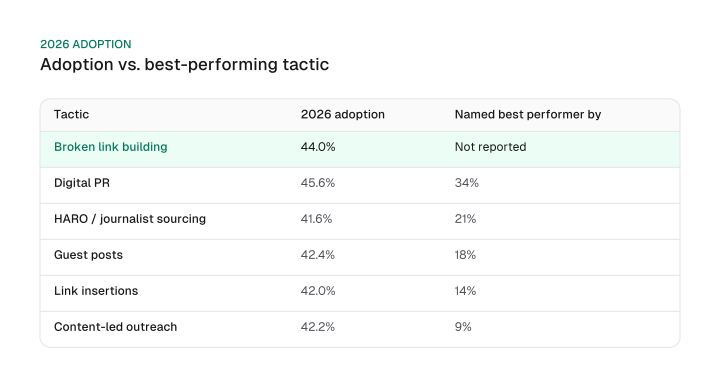
Broken link building's cell in that column is a dash. The survey left it unreported entirely, the same treatment it gave link exchanges, instead of assigning it a low score.
That's worth stating plainly rather than reading a verdict into it. Is broken link building still effective? Yes, at a rate on par with the field, just without the one figure that would show exactly how it ranks against the five tactics that do have it.
The mechanism: why a broken-link backlink is worth anything at all
A broken-link backlink's value comes from the linking page's own signals.
A 2024 leak of Google's API documentation for its Content Warehouse system describes a module called AnchorsAnchorSource, which records attributes of the linking page for every incoming mention it tracks.
Two of those attributes explain why two prospects with the same referring-domain count aren't equally valuable. The first, outsites, is the source page's own count of how many other sites it points to. The second, nsr, is that page's quality score, on a 0-1,000 scale.
The practical effect is dilution. A page that points to hundreds of other sites passes less weight through any single mention than a page that points to a handful, because Google's system tracks that outbound count when it evaluates what the mention is worth.
A high-nsr, low-outsites source passes more value than one with the opposite profile, even when both show an identical referring-domain count in your backlink tool.
The pitch behind broken link building is a genuine trade: the site owner fixes a dead page, you get an editorial mention in return. That trade explains why it happens; it says nothing about whether it's worth the outreach hour it costs. outsites and nsr measure that second question instead. Our guide to how to rank higher on Google covers the authority signals that follow a backlink in full, once you've earned one.
Find, evaluate and build the replacement
Finding a broken-link opportunity takes an hour with the right tool. Prioritizing it correctly decides whether the outreach hour that follows pays off.
That means weighing the source page's own outbound-mention count and where your listing sits on the page, on top of its referring-domain count.
Find broken-link opportunities
Here's how to find broken links, in order of typical yield:
- Competitor backlink-gap analysis. Pull a competitor's backlink profile in Ahrefs or Semrush, filter for pages that no longer resolve, and check which of those dead pages your own content could replace.
- Wikipedia's dead-link method. Wikipedia articles cite hundreds of external sources. Run a broken-link checker against a relevant article's reference list and you'll usually surface a handful of dead citations with a direct replacement angle.
- Resource-page and listicle scanning. Search "[topic] resources" or "[topic] links" with site-specific search operators (
intitle:"resources" "topic",inurl:links "topic"), open every result, and run each listed link through a checker for a dead destination. - A Wayback Machine check on the dead page's last live version. Before you pitch a replacement, pull the archived snapshot and read what the page actually covered: its headings, its examples, its depth. Your replacement should match that original scope, not a guess based on the URL or title alone.
- Expired-domain scanning. A domain-expiration tool flags names that recently lapsed after once ranking for your target terms; cross-check the expired domain's old backlink profile (Ahrefs or the Wayback Machine both work) for links that now point at a dead site you could still redirect traffic away from.
Evaluate and prioritize prospects
A referring-domains count alone can't tell a concentrated, high-value mention from a diluted one, and most campaigns skip that check entirely.
A resource page with hundreds of outbound links dilutes your mention; a page with a handful concentrates it.
Add the two checks the mechanism above explains: how many other sites the source page points to, and whether your mention sits in editorial body content or in a footer, sidebar or directory listing.
| Signal | Strong prospect | Weak prospect |
|---|---|---|
| Referring domains to the dead page | Several domains link to it | Only one or two |
| Linking page's own outbound link count | A few, focused outbound links | Hundreds of outbound links (a resource dump) |
| Link placement | Inside body content, editorial context | Footer, sidebar or directory list |
| Replacement fit | Your page covers the same specific topic the dead page did | Your page is only tangentially related |
A prospect that clears all four checks is worth the email. One that only clears the referring-domains count usually isn't, no matter how high that count reads in your tool.
Build the replacement page before you pitch it, so it's ready the moment someone says yes. Match the dead page's original scope first, using the Wayback snapshot as your reference, then go further: fix whatever made the source content go stale, add the section it never had, and update anything time-sensitive.
A replacement that only matches the original gives the site owner a weak reason to swap the link. A replacement that improves on it gives them an easy one.
Resource-page outreach
Resource-page outreach is a related but distinct move: getting listed on a live page instead of replacing a dead one.
You're asking to be added to a page that already points to relevant tools or guides in your space.
The targeting overlaps: you're still looking for a page that already references sites like yours. But there's no dead destination to point at, so the pitch has to justify your page's inclusion on its own merits.
Regular link building targets any page that could plausibly reference you. The resource-page version narrows that to pages built specifically to list resources, which usually means a higher acceptance rate against a smaller pool of targets.
This kind of check is worth running on your own site too, not only a competitor's: how to do SEO audit checks for broken links on your own site covers the full process.
Broken link building outreach that gets a reply
Broken link building outreach with one personalized follow-up should land well above the 8.5% baseline reply rate that generic, unpersonalized pitches get. Address it to the person who can actually approve the swap, found on the page's byline or its "Contact" or "About" page, not a generic info@ inbox a formal pitch is unlikely to reach.
The levers that move that baseline are documented and topic-matched, unlike the untraceable percentages that circulate for this exact claim. One widely cited figure, 21%, traces to Yesware. Checked directly, though, that 21% figure does appear on Yesware's own site: it measures the response rate of a first follow-up email in a general B2B sales sequence, unrelated to backlink outreach.
Backlinko's April 2019 analysis of 12 million outreach emails found that 8.5% overall reply rate, and identified which specific factors move it:
- A personalized email body. Lifts replies by 32.7% over a generic template.
- A personalized subject line. Lifts replies by 30.5%.
- A single follow-up email. Brings 65.8% more replies than sending none at all.
- Contacting more than one person at the target site. Lifts response by 93% compared with a single contact.
BuzzStream's August 2024 analysis of 12,000 campaigns found a different baseline: a 12% median reply rate across campaigns, with template-only sends (no personalization at all) actually running higher, at 16%.
Contextual, specific personalization added 10.7% on top of that baseline. Generic, templated "personalization", swapping in a first name with no real context, cost 1.3% instead of adding to it.
Layer Backlinko's lifts onto BuzzStream's baseline and you get a realistic estimate to plan around. Compounding the +32.7% personalization lift and the +65.8% follow-up lift onto BuzzStream's 12% median, or its 16% template-only rate, puts a well-executed, single-follow-up campaign at roughly 26% to 35%, the assumption this compounding shows rather than a separately measured finding.
Run the same stacking against your own baseline once you have outreach data of your own. Treat it as a working method you compute yourself, distinct from the sourced figures that feed it.
When to run broken link building (and when to lean on something else)
Broken link building earns its place as a supplementary, always-on tactic. Run it alongside a primary channel with a demonstrated best-performer track record; that channel carries the plan.
The adoption data above argues for that specific role instead of a flat yes-or-no verdict. Five tactics in Reporter Outreach's survey have a measured best-performer share: digital PR at 34%, HARO and journalist sourcing at 21%, guest posts at 18%, link insertions at 14%, content-led outreach at 9%.
Broken link building has none reported. That gap doesn't mean the tactic underperforms: it means the survey can't rank it against those five. Treat it as a volume layer on top of a channel with a proven track record.
Weigh the risks before you commit
Three risks make it a poor primary channel on its own:
- Wasted outreach hours. Most prospects, even well-evaluated ones, decline or never reply, and the hours spent chasing a rejected one don't leave you with a fallback asset the way a content-marketing piece does.
- Low-editorial-context links. A prospect that clears the referring-domains bar but sits in a footer or directory list still costs an email, and it still might not be worth accepting once it replies.
- Overlap with content marketing you already run. If your team already produces content for its own audience, broken link building outreach aimed at the same pages doubles the coordination cost without doubling the output.
Broken link building and content marketing aren't competing for the same budget line. They feed each other: the replacement page you build to pitch a prospect is content marketing, just produced with an outreach target already attached. Content built for its own audience doesn't need a broken-link prospect to justify it; content built specifically to plug a broken-link hole rarely earns organic traffic on its own.
Broken link building is also one link-building strategy among several: the category is bigger than this one tactic. It sits alongside digital PR, HARO and journalist sourcing, and guest posting as one lever in a broader mix, and none of those tactics carry a plan alone for long.
Decide with this table
| Situation | Recommendation |
|---|---|
| You have outreach hours free and no primary link channel running | Run broken link building as your entry tactic; the adoption data shows it isn't a fringe move |
| You already run digital PR or HARO and it's working | Keep broken link building as a secondary, always-on layer, not a replacement |
| Your outreach hours are limited and you can only run one tactic | Weight it toward digital PR or HARO/journalist sourcing first, the tactics the same survey shows professionals rate as their best performer |
Before committing outreach hours to any of these, calculate the SEO ROI of the outreach hours this takes so the decision isn't a guess.
None of this makes broken link building the tactic that carries a 2026 link-building plan on its own. It's still worth running: checked against Reporter Outreach's own numbers, it earns backlinks in 2026 the way it always has, and the mechanism behind why one prospect beats another sits in Google's own leaked ranking data.
Start with the five-source hunt above, run every prospect through the checklist, and if your reply rate after one follow-up isn't clearing double digits, shift the next batch of hours toward digital PR or HARO instead.
Frequently asked questions
No. Fixing your own site's broken links is internal technical hygiene: repairing or redirecting dead links you control. Broken link building is outreach: finding a dead page on someone else's site and pitching your live page as its replacement. For the internal-hygiene version, see broken internal links on your own site in our technical SEO checklist for 2026.
Link equity is the ranking value a page passes to whatever it links to, shaped by the linking page's own quality score and how many other sites it points to. A broken-link prospect only matters if the page passing that equity has enough of it worth the outreach hour.
Link reclamation recovers a backlink you already had and lost, when a site removes your link, restructures its URLs, or redirects it incorrectly. Broken link building targets links you never had: a dead page that used to point at someone else's content, which you pitch as your replacement instead.
Dead link building is another name for the same tactic: finding a dead page that no longer resolves but that other sites still reference, and offering your live page as the replacement. Some tools and practitioners use "dead link building" and "broken link building" interchangeably to describe the identical workflow.
A backlink-gap tool like Ahrefs or Semrush, the broken link building tools most teams reach for first, finds competitor dead pages fastest. Beyond that, a broken-link checker run against a relevant Wikipedia article's citations, a search-operator scan of resource and listicle pages, a Wayback Machine check on the dead page's last live version, and an expired-domain finder cover the rest of the method.
Figures and images in this post are free to reuse under CC BY 4.0 with credit to Mission Growth.
Get Mission Growth highlighted in your Google results.