
What Is Semantic SEO? The Vector Systems Google Named
Semantic SEO explained with the named Google systems (RankBrain, BERT) behind vector matching, and a rule for spotting a vector problem versus an entity one.

On this page
Type "semantic SEO" into Google and you'll get the same three words back: write naturally, use synonyms, be thorough. Ask on Reddit or in an SEO community and you'll get the same answer in different words. That's a description of an outcome. It doesn't tell you what's actually reading your page.
Google has named three systems that do that reading: RankBrain, Neural Matching and BERT, each confirmed on the record, by name, with a date.
In this guide:
- The three systems Google has confirmed behind semantic SEO, named and dated
- What RankBrain actually does, and the personalization myth around it
- How vector matching differs from entity scoring, and a diagnostic for your own pages
- A worked example to check whether two of your pages are semantically too close
What is semantic SEO?
Semantic SEO is optimizing a page for the systems Google has confirmed match meaning instead of exact words: RankBrain, Neural Matching and BERT.
Writing more naturally is generic advice about style. The old "LSI keyword" trick some guides still confuse it with is a myth Google has denied twice. Semantic SEO targets three specific, named systems instead.
Here's what each system does:
- RankBrain (2015). Interprets queries Google has never seen before by mapping them into vector space and matching them to similar known queries.
- Neural Matching (2018). Connects the words in a query to related concepts, without needing an exact word match.
- BERT (2019). Reads every word in a query in relation to every other word at once. More on this below.
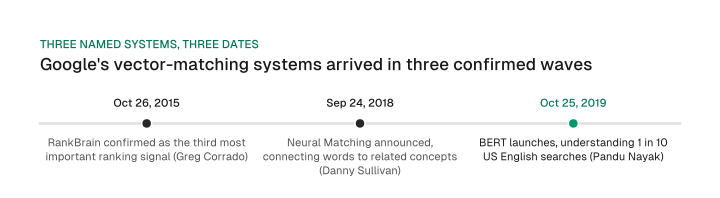
These aren't guesses. Google senior research scientist Greg Corrado told Bloomberg, in an October 2015 interview, that RankBrain had become the third-most important signal contributing to the result of a search query. Google separately said RankBrain helps process the roughly 15% of daily search terms it has never seen before, though it runs on a far larger share of daily searches than only that slice.
Neural Matching got the same on-the-record treatment. Google Search Liaison Danny Sullivan described it, in September 2018, as an AI method that connects words to related concepts, calling it "super synonyms, in a way." He said it affects 30% of queries.
RankBrain gets mischaracterized more than the other two. Several guides describe it as personalizing results to your individual search habits. But Google's own account and Bloomberg's original reporting describe something else entirely.
RankBrain interprets queries the system hasn't encountered before, then matches them to semantically similar ones it already understands. "Personalization" implies your account or history changes the result; the actual driver is the query's own meaning.
For example, a page built around "best running shoes for flat feet" can rank for "shoes for overpronation" without ever using that phrase, because Neural Matching connects the two concepts. That's the mechanism "semantic keywords" advice is really describing, a related term or synonym practiced downstream of a system that actually exists.
The other common confusion is calling this "LSI keywords." Latent Semantic Indexing is an old information retrieval technique, and Google's John Mueller has denied twice that Google uses it for ranking. "There's no such thing as LSI keywords," he wrote in July 2019, "anyone who's telling you otherwise is mistaken." He said it again in January 2023.
Semantic SEO targets the three named systems above, not an old indexing method with the wrong name attached. Our how to rank higher on Google guide carries the same correction with fuller context on ranking factors generally.
Semantic search is the broader idea behind all of this: retrieving results by meaning instead of exact words, something Google, other search engines and plenty of search boxes inside apps all do to some degree. Semantic SEO is the narrower, practical half: it optimizes your content for the specific systems Google confirmed it runs.
None of this replaces the basics. It changes what "covering a topic" means:
- Write for the concept, not the phrase. Cover a topic's related terms and subtopics instead of repeating one exact phrase.
- Group related pages into topic clusters. A cluster linked around one pillar page signals topic depth to these systems; that's its own discipline, and our companion guide on topical authority covers it in full.
- Link internally with descriptive anchors. Specific, varied anchor text on internal links helps these systems connect related content the same way it helps a reader find the next page.
- Answer the questions searchers actually ask. Covering the "People Also Ask" questions around your topic, in the page itself rather than a separate FAQ page, is table stakes for the same systems.
BERT and understanding context
BERT is Google's system for understanding a query's language in context, confirmed live in October 2019.
It reads a query's words in relation to every other word at once. That's why Google's own VP of Search called it the biggest leap forward in five years.
Before BERT, Search processed a query's words mostly in one direction, so a later word could change an earlier word's meaning without Search catching it. Google's own example: the query "2019 brazil traveler to usa need a visa" used to return results about a US citizen traveling to Brazil.
The word "to" reverses who's traveling where, and pre-BERT Search missed it. BERT reads that context from both directions at once, so the same query now correctly returns results for a Brazilian traveling to the US.
Google Fellow and VP of Search Pandu Nayak wrote, in October 2019, that BERT helps Search "better understand one in 10 searches in the U.S. in English." He called it "the biggest leap forward in the past five years," a specific, dated claim about how much of Search's daily query volume the update touched.
RankBrain and Neural Matching handle words and concepts Google hasn't seen before or that don't share an exact match. BERT handles something different: how the words already in a query relate to each other. The three systems interpret meaning at three separate layers that work alongside each other.
Vectors and entities are two different systems
Vector matching, RankBrain, Neural Matching and BERT, and entity scoring are two separate Google systems solving different problems.
A page that ranks for its exact target phrase but not for related or paraphrased queries has a vector or content problem. A page that ranks fine but never earns SERP features based on entities, a Knowledge Panel, a rich entity card, has an entity problem, and our companion guide on entity SEO covers that ground in full.
If you've read generic semantic SEO advice, it probably treats these as one blob: add more context, add more structure, done. They aren't the same system, and they don't share a fix.
| Symptom | Likely cause | Where the fix lives |
|---|---|---|
| Ranks for the exact target phrase, not for related or paraphrased queries | Vector matching, content breadth | This guide |
| Ranks fine, but never earns entity-based SERP features (Knowledge Panel, rich entity cards) | Entity scoring | Our companion guide on entity SEO |
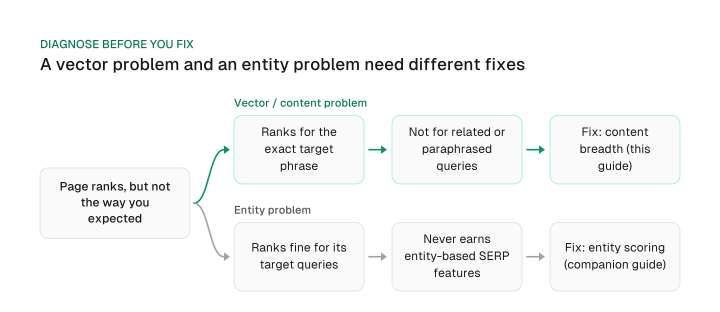
Run this check before you touch anything else. If related-query traffic is the gap, work the content and phrasing moves in this guide. If entity-based features are the gap, structured data and disambiguation are a different job, and the entity SEO companion guide owns that ground, from scoring to the knowledge graph to which fix to prioritize.
Semantic SEO tools (and a worked example to check your own pages)
A handful of free and paid tools surface semantically related keywords and concepts.
The fastest sanity check, though, is running your own draft through a free embedding tool and comparing it to the page it might compete with. A few tool categories help:
- Keyword clustering tools. Most SEO keyword research platforms group semantically related terms into clusters you can build one page around instead of chasing a single exact phrase. Our companion guide on semantic keyword mapping covers this tooling in depth.
- Free embedding tools. You don't need a paid platform to check semantic similarity yourself. A free embedding API turns any two pieces of text into vector embeddings you can compare directly.
An embedding tool works by turning each page into a vector embedding: a list of numbers representing its meaning. It compares two pages by the distance between their embeddings.
That's the same basic math, cosine or Euclidean distance between vector representations, described in an old, expired Xerox patent on comparing documents this way. It's useful for understanding what "distance" concretely means here, not a description of how Google's live systems are weighted today.
Here's the worked check:
- Paste your draft and the page it might compete with into a free embedding tool.
- Compute the cosine similarity between the two resulting vectors.
- Treat a high score, closer to your own page than to an unrelated one, as a signal to merge or differentiate the two pages before you publish.
This check belongs in your AI SEO checklist as a recurring step you run before every publish.
Frequently asked questions
Knowing whether a ranking problem is a vector problem or an entity problem. RankBrain, Neural Matching and BERT are diagnosed one way; entity scoring is diagnosed another, and most advice treats them as one thing. Check whether you rank for the exact phrase but not related queries before you touch structured data.
Failing at it looks specific: pages that rank for their exact phrase and nothing near it, a cluster of thin pages built around synonyms of one idea instead of one page that covers it, or markup that names entities the surrounding text never explains. The first and third are content gaps the diagnostics above catch. The second is the pattern Google's scaled content abuse policy names directly, and it can cost a ranking demotion or a manual action.
Yes, if you're doing content strategy. RankBrain, Neural Matching and BERT are systems Google has confirmed are live and named, and each has been running for years. Understanding them explains why adding more keywords stopped working, and what actually works instead.
There's no fixed course length, because semantic SEO isn't a certification. Learning it means understanding three named systems and applying the vector-versus-entity diagnostic above to decisions you're already making. You can likely do that within a day.
No. Our AI SEO trends 2026 guide tracks the full picture: organic ranking still predicts AI Overview citation, though Ahrefs found that relationship weakening, from 76.10% overlap in July 2025 to 37.10% in its March 2026 re-run. For the tactics that earn those citations, see how to get cited in Google AI Overviews. RankBrain, Neural Matching and BERT are part of how Google understands language generally, not a discipline AI search is making obsolete.
On-page, technical, off-page and local SEO are the usual four-way split. Semantic SEO is a technique inside that first category, on-page and content work, rather than a fifth category of its own.
Semantic SEO isn't a writing style, and it isn't the old LSI trick: it's three named, dated systems, RankBrain, Neural Matching and BERT, each doing a specific and different job, plus a separate entity system the companion entity SEO guide names and owns. So pull up a page that isn't ranking the way you expected, run it through the vector-versus-entity diagnostic above, and you'll know which fix to make first.
Figures and images in this post are free to reuse under CC BY 4.0 with credit to Mission Growth.
Get Mission Growth highlighted in your Google results.