What Is Organic SEO? What Search Console and GA4 Count
Organic SEO is earning unpaid Google rankings. See what Search Console and GA4 count as organic, which lever fits your symptom, and what a rank pays.
By Furkan AktaşPublished Updated
On this page
Earning unpaid rankings in Google's search results is the whole idea. That much is easy. The trouble starts when "organic" turns up in your Search Console, in your analytics and in a vendor's pitch, and each one means something slightly different.
So what is organic SEO, in a form you can check against Google's own reports? It's whatever Google and your analytics count as organic. A useful definition comes with the counting rules: what holds a position, what lands in the Organic Search channel, and what a position pays.
In this guide:
- The three senses of "organic" and the line between them
- How Search Console and Google Analytics 4 (GA4) count each part of a results page
- The three stages a page passes before it ranks, and the lever that fits each symptom
- What dropping from position 2 to 4 costs in clicks
What is organic SEO?
Organic SEO is the work of earning a place in Google's unpaid search results, where appearing costs nothing and nobody can pay for a better rank. Google's own SEO documentation says it never accepts money to include or rank sites, that advertising with Google has no effect on a site's presence in search results, and that it costs nothing to appear in organic search results.
The word does three jobs, and mixing them up causes most of the confusion:
The third row ties the word to Google's rules. Google's spam policies define spam as techniques that deceive users or manipulate its Search systems, and the definition names two targets: ranking content highly and manipulating generative AI responses in Google Search. Sites that violate the policies may rank lower in results or not appear at all.
That makes the method sense apply to AI answers too. If a tactic only works by tricking a ranking system or a generative response, it sits outside the practice, however unpaid it is.
A few neighbouring terms resolve quickly:
- Natural search: a synonym for organic search, the unpaid results. "Organic search engine optimization" is the long form of the same work.
- Paid SEO: Google has no such category. What gets paid for is advertising, which GA4 counts as Paid Search.
- Inorganic SEO or inorganic search: labels with no Google definition. Inorganic search usually means paid results, the ads above or beside organic search, and inorganic SEO usually means ads or rule-breaking tactics.
And SEO itself? It is the work of making a site easy for search engines to find, understand and rank. The organic part says how you want to be paid back: in rankings.
What counts as organic: results, Search Console and GA4
An organic result is any non-ad link on a Google results page, and Search Console gives ads no position, a featured snippet position 1 and an AI Overview one shared position for all its links. Search Console and GA4 then count the same visit differently, which is why "organic" needs a rulebook.
Here is how each element is counted in Google's Search Console documentation and in Google's default channel group definitions for GA4:
The GA4 column shows that organic search traffic is a channel rule as well as a result-type rule. The Organic Search channel covers non-ad links in search results, including Google's AI Overviews and AI Mode, while AI Assistant excludes them. So a click from an AI Overview lands in that channel and a click from a ChatGPT answer doesn't, even though nobody paid for either.
Organic traffic is the visits your site gets from unpaid search results. An organic traffic example: someone searches a question in Google, clicks your guide in the results, and GA4 records one visit in the Organic Search channel.
What is direct traffic? Direct traffic is visits that arrive by a saved link or by typing your URL, which GA4 files in the Direct channel. What is direct traffic in marketing terms? Visitors who already knew where to go.
Organic vs direct vs referral comes down to the route: a click on a search result is organic, a typed URL or bookmark is direct, and a non-ad link on another site, such as a blog or news site, is referral. So a reader who searched your brand in Google and clicked the listing is organic, and one who typed your domain is direct.
Search Console has no "organic" label of its own. It reports how often people saw or interacted with your site in Google Search, News and Discover, and it gives a featured snippet link position 1 because the snippet typically occupies it. To set up the AI side in GA4, read our guide to AI search analytics.
Position is where the counting rules bite. Search Console reports the topmost position your property held for a query, then averages across queries. For example, take Google's own worked case: for one query your page appears at positions 2, 4 and 6, so it counts as 2. For another it appears at 3, 5 and 9, so it counts as 3. The report shows 2.5.
So when two position numbers disagree, don't assume one is wrong. Check which element held the page: an ad gives none, a snippet usually gives 1, and an AI Overview link inherits the Overview's single position. If Search Console and GA4 disagree on volume instead, the SEO dashboard guide covers why.
How organic ranking works and which lever to pull first
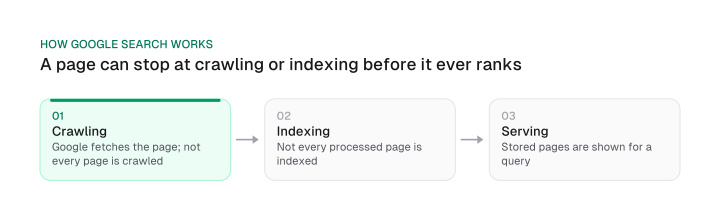
Google ranks a page only after it crawls, indexes and serves it, so the right SEO lever is the one for the stage where your page is failing. Organic search engine ranking has three stages, and Google says not every page makes it through each one.
A robots rule can stop a page at crawling. Indexing is not guaranteed either: not every page Google processes gets indexed. Serving is the stage where rankings are decided, and it only starts after both. And Google doesn't guarantee that it will crawl, index or serve a page, even when the page follows its Search Essentials.
The usual five levers each act on one stage:
Links earn their place because Google runs systems that read how pages link to each other to decide what pages are about. That's relevance, not a shortcut around the spam policies from the first section.
People often split this work into the four types of SEO: on-page, off-page, technical and content. Those are lever groups, and Google publishes no such taxonomy. Sorted by stage, technical SEO covers crawling and indexing, and the other three act on serving.
A checklist treats every lever as equal, but a page doesn't. The question of which lever first has a short answer: follow the symptom. This symptom ladder is our judgment, not a Google rule, built on the stage model and what you see in Search Console:
The fourth row is where the money is. One agency's 2026 click-through table gives position 2 a 10.2% click-through rate and position 4 a 3.7% rate when no AI answer shows. Divide 10.2 by 3.7 and you get about 2.8 times, which is why the next section puts a price on the climb.
Take the first row. A page that fails at indexing gains nothing from backlinks or rewritten copy, so match the lever to the stage. If you're unsure what a provider should be doing at each stage, what do SEO services include lays out the buy-side version.
The last row needs patience. A drop after an update tempts a rewrite, but Google recommends waiting at least a full week after a core update completes before analyzing the site in Search Console. For the triage by size of drop, see our Google core update guide.
Google's AI features follow the same gate. A page must be indexed and eligible to show in Google Search with a snippet to appear as a supporting link in AI Overviews or AI Mode, with no additional technical requirements, and the same foundational SEO practices apply. Whether that changes your plan is covered in will AI replace SEO.
What an organic ranking is worth
A ranking is worth the click-through rate its position earns, and one agency's 2026 panel puts position 1 at 22.6% when no AI answer shows and 3.6% when one does. The panel covers 1,184 domains and 3.67 billion Google impressions recorded between 1 March and 31 August 2026.
The table shows the first four positions. The "No AI answer" column is the source's own description of a shrinking and increasingly navigational slice of search, and the blended column is the source's own weighting of both cases:
Download CSV (CC BY 4.0)
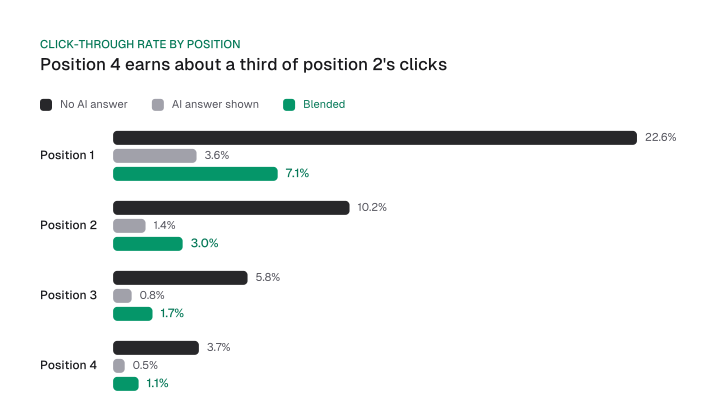
Read the table by ratio first, because levels vary by panel. Moving from position 2 to 4 removes 63.7% of clicks with no AI answer ((10.2 - 3.7) / 10.2), 63.3% in the blended column ((3.0 - 1.1) / 3.0) and 64.3% when an AI answer shows ((1.4 - 0.5) / 1.4). Those round to 64% of clicks in every column.
Google's core update guidance calls a drop from position 2 to 4 small, with no need to take drastic action. Both can be true. Google is describing risk to your site. The table prices the same move in clicks, and about 64% of them go.
One caution applies to the levels. This is one agency's panel, not independently replicated, so the ratio between positions is firmer than any single percentage. Don't paste these rates into a forecast. Pull your own click-through rate per position from Search Console and build a baseline, as our SEO KPIs guide shows.
The same source also corrects a number you've probably seen. The 39.8% position-one click-through rate that circulates online was First Page Sage's 2025 report figure. Its 2026 update lists 7.1% blended, which the agency describes as an 82% decline in twelve months. If you cite position-one CTR, cite the 2026 table with its sample.
Turning clicks into return is a separate step, and SEO ROI walks through it.
Organic search vs paid search: what they share
Organic and paid results share one results page but not one report: ads hold no position in Search Console and land in GA4's Paid Search channel, while unpaid links land in Organic Search. Is SEO organic or paid? Unpaid, because the rank isn't for sale.
What the two share is mostly bookkeeping:
Two claims about organic search deserve correcting. The first is "free". The click costs nothing, but the work costs people and time, and our SEO cost guide shows where that goes. Treat "free" as a statement about the click, never the budget.
The second is "stable". Several times a year, Google makes significant, broad changes to its search algorithms and systems through core updates. Persistence isn't a promise. Google also says most sites don't need to worry about core updates and may not even realize one has happened. So the accurate claim is that organic results can compound, but a core update can reorder them.
For the full choice between SEO and ads, including timelines and when to combine them, the SEO vs PPC comparison is its own question, and how long does SEO take covers the clock.
Back to the definition. Organic SEO is whatever Google and your analytics count as organic, so check the counting before you pick a tactic. Open the Performance report in Search Console today, find the row in the symptom table that matches your page, and pull that one lever.
Frequently asked questions
What is the difference between local SEO and organic SEO?
Local SEO targets Google's local results, which are mainly based on relevance, distance and popularity, according to Google Business Profile help. Organic SEO targets the standard web results. They overlap on fundamentals, but a Business Profile only feeds the local side. See local SEO for AI search for that work.
What is the difference between paid SEO and organic SEO?
Paid SEO isn't a Google category. Google never accepts money to include or rank sites in its organic results, so anything you pay for is advertising. GA4 files ads under Paid Search, and Search Console gives them no position. If a provider sells you "paid SEO", ask what exactly is being bought.
What does "inorganic SEO" mean?
Inorganic SEO is a label without a Google definition. People use it for paid search or for tactics that break Google's spam policies. The second meaning matters most. Google says violating sites may rank lower in results or not appear at all, so manipulation can erase the rankings it was meant to build.
Is organic SEO free?
The click and the listing cost nothing, because Google says it costs nothing to appear in organic search results. The work isn't free. Research, content, technical fixes and links take people and time, so budget for those even though no one bills you per click.
Does an AI Overview click count as organic traffic?
Yes. GA4's Organic Search channel includes non-ad links in Google's AI Overviews and AI Mode, and Search Console counts a click on an external link in an AI Overview as a click. A visit from ChatGPT or Gemini lands in the separate AI Assistant channel instead.
Cite this page
Aktaş, F. (2026, October 9). What Is Organic SEO? What Search Console and GA4 Count. Mission Growth. https://missiongrowth.io/blog/organic-seo
Download the data: 1 table as CSV (CC BY 4.0)
Figures we made for this post are free to reuse under CC BY 4.0 with credit to Mission Growth.
Get Mission Growth highlighted in your Google results.