Hiring a CRO Consultant: Cost, Red Flags, Payback Math
A CRO consultant costs $75-$500 an hour or more. See when to hire one over an agency or in-house, the red flags to check, and a payback-period test.
On this page
You have traffic, a conversion problem you can't diagnose in-house, and a stack of vendor blog posts that all end with a pitch to hire the company writing the post.
This guide skips the pitch. It ranks the 5 real hiring shapes by traffic and exit cost, and checks cro consultant cost against more than one source.
It also hands you a payback formula to run before you sign, and a scored checklist for whoever you shortlist.
What is a CRO consultant?
A CRO consultant is an independent specialist who runs the full conversion-optimization loop on a project or short retainer, diagnosis, hypothesis, testing, statistical read and reporting, to grow the share of visitors who take a wanted action.
The full title is conversion rate optimization consultant; this guide uses CRO throughout. A Contract Research Organization in clinical trials shares the same three letters but works in an unrelated field.
The title changes with the engagement shape more than the job itself. A CRO consultant works project to project, typically 3 to 6 months. A CRO specialist does the same work as an embedded, long-term hire, usually 12 months or more. A CRO expert is mostly a positioning term vendors use for premium, advisory work.
All three diagnose why visitors don't convert, design a test, read the result and report it. What differs is who they answer to and how long the engagement runs.
A CRO consultant is not:
- A CRO agency. A full-service team running strategy, design, development and QA across several clients at once.
- An SEO or digital marketer. They drive traffic to the site; a CRO consultant works on what that traffic does once it arrives.
- A UX designer. UX work improves usability broadly. A CRO consultant runs a narrower, structured test-and-measure loop tied to one conversion goal.
One more mix-up worth killing early: CRO has nothing to do with CRM, despite the shared acronym pattern. A CRO consultant changes what happens on a page before a visitor becomes a lead. CRM software manages that lead's data and communication after the fact.
What does a CRO consultant actually do?
A CRO consultant runs a research, hypothesis, test and report loop, and a real engagement hands you five specific artifacts you can check before paying an invoice.
Day to day, a CRO expert works through that loop in order: reading analytics and session recordings to find where visitors drop out, writing and scoring hypotheses, setting up and QA-checking the next test with your developer, and reading the tests already running before anyone calls a winner.
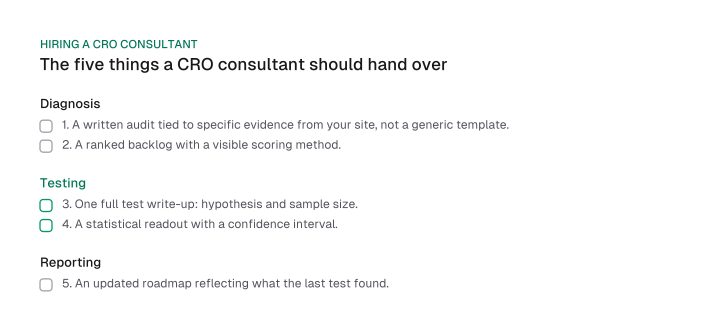
Judge the engagement by what you can point to and demand: a written audit, a ranked backlog with a visible scoring method, one full test write-up, a statistical readout, and an updated roadmap.
That loop touches three areas, and a consultant applies judgment across all three rather than expertise in just one. Which tactics are worth testing first, page speed, forms, CTAs and the rest, is its own evidence question with its own tiering. Which software runs and reads the tests is a separate tooling decision.
Finding where visitors actually drop out of your funnel, the leakiest stage, is the diagnostic step that decides what gets tested at all. You're paying the consultant for the sequencing and the read across all three.
Here's what to ask for before you pay an invoice:
- A written audit tied to specific evidence from your site. A generic template doesn't count. For a model of what a rigorous audit produces structurally, see how to do seo audit, then hold the CRO version to that same standard.
- A ranked backlog with a visible scoring method, so you can see why one test comes before another.
- One full test write-up, hypothesis stated plainly, with the sample size the test actually needed.
- A statistical readout with a confidence interval, always, even when the headline says "conversion went up."
- An updated roadmap that reflects what the last test found, rather than repeating the original plan untouched.
Ask for all five before you sign, and check them off again before the final invoice. Hold payment until a missing item shows up.
CRO consultant vs agency vs in-house vs fractional: which fits your stage?
An independent consultant is one of five realistic ways to get outside help, alongside a fractional CRO consultant, a full-service agency, an in-house hire and a hybrid setup.
The right shape depends on two numbers: how much monthly traffic you can point at a test, and how expensive that shape is to reverse if it doesn't work out. The cro consultant vs agency choice, specifically, usually comes down to whichever of those two numbers is tighter for your team.
Sources disagree on the exact traffic floor for a valid A/B test. One puts it at 5,000 monthly visitors. Two named practitioners at another site put it at 20,000 monthly uniques, or a floor of 10 conversion actions a day for even the simplest test.
The honest number is a band, roughly 5,000 to 20,000 monthly visits depending on how tight your funnel already is. Presenting one borrowed figure as settled would be dishonest given that spread.
Below that band, testing-heavy options can't validate a result quickly enough to justify the fee. A fractional consultant or a one-time qualitative audit is the shape that still makes sense there; a solo consultant or an agency running full statistical tests needs the volume first.
Here's how the five shapes stack up on both axes at once, so you can pick a row instead of stitching together several separate two-way comparisons:
| Shape | Engagement length | Minimum useful traffic | Cost to reverse | Best fit |
|---|---|---|---|---|
| Fractional consultant | Part-time, ongoing | No hard floor; leans on audits and judgment, not statistical tests | Low. End the arrangement without severance or a long notice period. | A site below the traffic band, or a team that wants judgment folded into its own staff |
| Solo consultant | Project or short retainer, 3 to 6 months | 5,000 to 20,000 monthly visits, to read a test reliably | Moderate. The contract runs to its term, then ends cleanly. | A single site ready to run and read its own test loop |
| CRO agency | Monthly retainer, ongoing | At or above the top of the band; several tests run in parallel | Moderate to high. Most contracts build in a ramp-down and notice period. | A site with enough volume to feed several tests at once |
| In-house hire | Embedded, 12 months or more | 8 or more tests a month, with development and design already staffed | Highest. Salary, hiring cost and severance if it doesn't work out. | A team already running enough tests to justify a full-time seat |
| Hybrid | In-house owner plus a part-time outside consultant | Matches whichever half is running the tests | Below full in-house. Only the outside portion ends if you cut it. | A team that wants an internal owner without full agency or full-time cost |
Two columns decide the row: your traffic and what it costs to walk away if the shape doesn't work. Match both before you sign anything.
A great CRO agency shows its process, alongside its client logos: a testing method it can walk you through, statistical discipline stated up front, ownership of implementation rather than handing designs to your own dev team, and reporting tied to your revenue metric rather than raw conversion rate alone.
The same buy-versus-build question shows up outside CRO too. If you're weighing an outside team against software elsewhere in your growth stack, ai seo agency vs software walks through the same traffic-and-exit-cost logic applied to SEO.
What does a CRO consultant cost, and does it pay for itself?
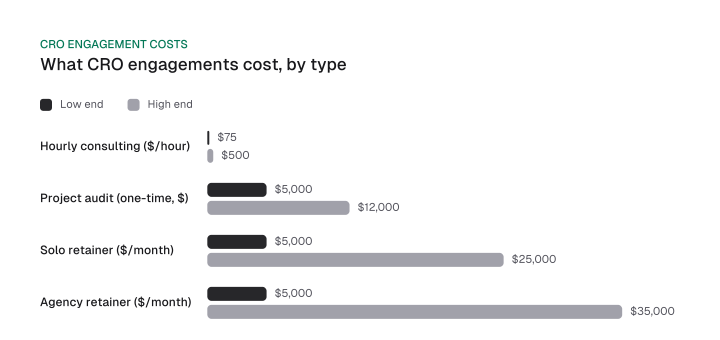
A CRO consultant's published pricing agrees closely in exactly one band, agency-level retainers, and diverges everywhere else. The number worth publishing for each band is the wider span across sources, our own synthesis rather than either vendor's own table.
Here's what each shape actually costs, checked against more than one source per band:
- Hourly consulting: $75 to $500 an hour, depending on the source and the consultant's seniority; a premium "CRO expert" tier runs $250 to $800 an hour.
- Project audit: $5,000 to $12,000, a one-time fee.
- Solo retainer: $5,000 to $25,000 a month.
- Agency retainer: $5,000 to $35,000 a month. Two vendor pages state the identical number, but one lists the other as a source, so this isn't two firms reaching the same figure independently.
- In-house salary: $74,000 to $130,000 a year for a single specialist, plus tooling. A full in-house team of several people often runs past $500,000 a year, a different scope than one salary line.
A quote only makes sense if it pays back faster than the contract's minimum term. Run this formula with your own numbers: divide the monthly fee by the projected monthly revenue lift to get months to break even, then compare that to how long you're locked in.
Say you run a site converting at 1.5% on 8,000 monthly visitors, with a $90 average order value, and a consultant quotes $6,000 a month projecting a lift to 2%. Current revenue is about $10,800 a month (8,000 x 1.5% x $90); at 2%, that's about $14,400, a lift of roughly $3,600.
Payback is $6,000 divided by $3,600, about 1.7 months, well inside a typical 3-month minimum contract.
Now run the same formula on a smaller site: 1,200 monthly visitors, same rates, same $6,000 quote. Current revenue is about $1,620 a month; at 2%, about $2,160, a lift of roughly $540.
Payback is $6,000 divided by $540, about 11.1 months, longer than a typical 3-month contract. The arithmetic says wait, or negotiate a shorter engagement first, whatever the pitch sounds like. Neither example is a real client's numbers; run the formula on yours before you decide.
The same break-even logic applies to any paid growth service beyond CRO. For the general version of this math, seo roi formula walks through the same payback question for SEO spend.
How to vet and hire a CRO consultant
A qualified CRO consultant can show four things: experiment design and statistics, analytics implementation, a UX or user-research method, and a portfolio that includes tests that lost.
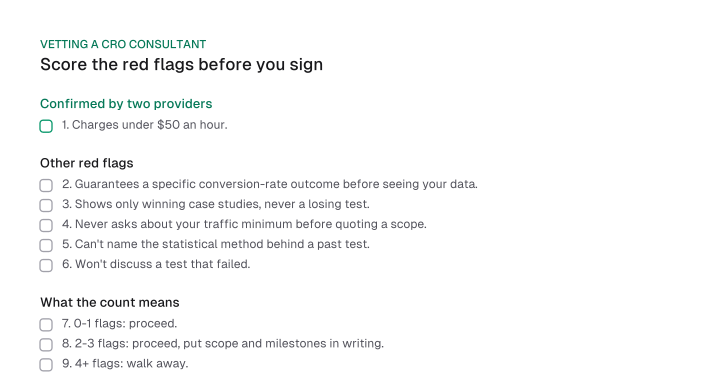
A consultant worth hiring also clears a scored check against six specific red flags, and the count decides your next step.
Two CRO provider pages land on the exact same number: don't hire anyone charging under $50 an hour. They give close to the same reasoning, that a rate that low, or a promise to guarantee a specific lift, signals someone selling rather than testing, because CRO outcomes are inherently probabilistic.
One page lists the other among its sources, so this is a shared number more than two firms reaching the same conclusion separately.
Treat it as a floor worth checking rather than a market consensus: a rate under $50 an hour is still a fair line to screen out, whatever produced the agreement.
Score a shortlisted consultant against these six flags:
- Charges under $50 an hour.
- Guarantees a specific conversion-rate outcome before seeing your data.
- Shows only winning case studies, never a losing test.
- Never asks about your traffic minimum before quoting a scope.
- Can't name the statistical method behind a past test.
- Won't discuss a test that failed.
Zero or one flag, proceed. Two or three, proceed, but put scope and milestones in writing before you sign. Four or more, walk away, regardless of how the pitch sounds.
Where you look depends on the title. Embedded specialists are usually hired the way any full-time employee is, through LinkedIn or Indeed. Independent consultants more often come through Upwork, Consultport, or a referral from a founder who has already used one.
None of the five hiring shapes above is universally right, and cost alone never tells you whether a quote is worth taking. Before you hire a cro consultant, an agency or anyone else, check your traffic against the floor above, run the payback formula on the actual quote in front of you, and score the red flags.
If your traffic doesn't clear 5,000 monthly visits yet, start with a fractional consultant or a one-time audit instead of a full retainer.
Frequently asked questions
Is a CRO consultant the same as a CRM system or role?
No. CRO and CRM only share an acronym pattern. A CRO consultant changes what happens on a page before someone becomes a lead, diagnosing, testing and improving what turns a visitor into an action. A CRM system manages that lead's data and communication afterward.
What is a CRO consultant, in one sentence?
An independent specialist, hired on a project or short retainer, who runs the full conversion-optimization loop, diagnosis, hypothesis, testing, statistical read and reporting, to grow the share of visitors who take a wanted action.
Is CRO the same as SEO?
No. SEO drives traffic to a page; a CRO consultant works on what that traffic does once it arrives. They don't manage SEO strategy, run paid ads, or handle brand design, those stay separate disciplines even on the same growth team.
How long before a CRO consultant shows results?
Results depend on whether your traffic clears the testing floor, roughly 5,000 to 20,000 monthly visits depending on your funnel, not on a fixed number of weeks. Below that band, a single test takes too long to read reliably, regardless of who runs it.
Can a small business hire a CRO consultant?
Yes, at the fractional or project-audit tier, where the full A/B testing traffic floor doesn't apply. A written audit and a prioritized backlog still work below that floor; the five-option comparison above shows which tier fits a smaller site's traffic.
Where do you find one?
The channel differs by title. Embedded specialists are usually hired the way any full-time employee is, through LinkedIn or Indeed. Independent consultants more often come through Upwork, Consultport, or a referral from a founder who has already used one.
Figures and images in this post are free to reuse under CC BY 4.0 with credit to Mission Growth.
Get Mission Growth highlighted in your Google results.