Meta description: how Google picks it and how to write one
Meta description guide: Google rewrote 63% of hardcoded ones in Ahrefs' 2020 study. See three split tests and why Google sets no length limit.
By Furkan AktaşPublished

On this page
A meta description is a bid for one query. Google decides for each search whether to print it under your title, and a character count cannot tell you what it decided.
Google builds the snippet again for every search, takes text from the page most of the time, and picks your description only when it describes the page better for that query. Below: what the large studies and three split tests measured, how to write the tag for each page type, how to check what Google shows for the queries that matter, and which pages deserve a hand-written one.
What a meta description is and how to add one
A meta description is an HTML tag in the page head that Google can use as the text under the title in search results, and it uses it only sometimes. Google's snippet documentation says snippets are "primarily created from the page content itself."
Google "sometimes uses the meta description HTML element if it might give users a more accurate description of the page than content taken directly from the page." That makes the tag a candidate for the search results snippet and never a guaranteed one.
In HTML the tag is <meta name="description" content="...">, and the content attribute carries your text:
<meta name="description" content="Waterproof leather hiking boots with a grippy rubber sole, built for wet trails. Free returns on every size.">
The meta description tag sits in the head section of the page, so visitors never see it while browsing. You cannot judge it by looking at the page. You judge it in the results page, which is what the per-query check further down does.
Every major CMS exposes the tag as one field. The paths below are the ones the platforms and their documentation name.
The no-plugin WordPress route is a theme job. WordPress documents wp_head as the hook that prints inside the theme's head, and says you can use it to add meta tags, so a theme or a small snippet in the theme can output the tag.
For plugin choice and the order of a full WordPress SEO setup, our WordPress SEO setup guide covers the wider workflow; this post stops at the field. Headings are a separate on-page element, and how Google reads your heading hierarchy is covered on its own.
After saving, open the live page, view the source and search for name="description". If the tag is missing from the HTML Google fetches, the CMS field is writing somewhere else (a social preview field, for instance) or a template is overriding it. The wider on-page SEO checklist treats this as one of several head checks.
How meta descriptions are used on SERPs
On a search results page (SERP), Google can show a meta description as the snippet text under the title link, and it does so only when the tag describes the page better than the page's own text for that search.
The snippet is rebuilt for each search, so the same page can return the tag for one query and a sentence from the body for another. Google cuts it to the device width, and a social preview may use the tag when Open Graph tags are missing.
How often Google shows the description you wrote
Google shows your hardcoded description for about 37% of results on average, because it builds each snippet per search and takes page text for the rest.
The mechanism is in Google's own documentation: snippets "are designed to emphasize and preview the page content that best relates to a user's specific search," so "Google Search might show different snippets for different searches." One page can return its tag for one query and a sentence from the body for the next.
Two studies put numbers on this, and they measured different things.
Download CSV (CC BY 4.0)
The Semrush sample has a ceiling of 200 snippets (10 keywords times 10 results times 2 devices, our arithmetic), which makes the 28% a small observation next to a 20,000-keyword comparison. The gap between the two shown shares is 9 points (37% against 28%, computed from the two studies).
Because the studies differ in year, sample and definition, do not average them; read them as a range from 28% to 37%.
Both also point to one reading: Google's default, per its own documentation, is page content, with the tag as an occasional alternative.
Ahrefs expected long-tail queries to explain the rewrites, and its own data found a small gap
Ahrefs went into the study with a hypothesis about why rewrites happen. Its premise was that the average first-page result "ranks for hundreds of keywords, and the hardcoded descriptions are usually written around the primary 'head' keyword." On that premise, a head-keyword description should survive on the head query and get replaced on the long tail. That was Ahrefs' hypothesis, and the study tested it.
The result was close to flat. Google rewrote 59.65% of descriptions for head keywords and 65.62% for long-tail keywords, a gap of 5.97 points (computed from Ahrefs' two figures).
Ahrefs' own reading is that Google is "more likely to rewrite meta descriptions for long-tail keywords," but only "by a small margin." It also flags a limit: "there's no way to identify fat-heads and long-tails with 100% certainty."
A description written for the head query is still replaced about six times in ten on that query. Writing the tag well raises its odds on the query it targets, but it never guarantees the slot, which is why the rest of this guide spends its effort on measuring what Google actually shows.
Do meta descriptions affect rankings or clicks?
Google said in 2009 that it does not use the description in ranking, and the tests that measured clicks found lifts of 2.2% to 6.5% with stable impressions, in two 21-day tests on one site each. The statement reads: "we still don't use the description meta tag in our ranking."
Two years earlier, in 2007, it said the quality of a snippet "can have a direct impact on the chances of your site being clicked." Together the two statements are the whole official position: no ranking input, real click influence.
Some reference guides still describe a ranking effect. MDN's metadata tutorial says a description with keywords "has the potential to make your page appear higher in relevant searches performed in search engines." For Google, the 2009 statement says otherwise; the keywords in a description can win the snippet and the click, not the position.
Three tests have put numbers on the click side. Read each one as a result for a single site and never as a rule for a page type.
Download CSV (CC BY 4.0)
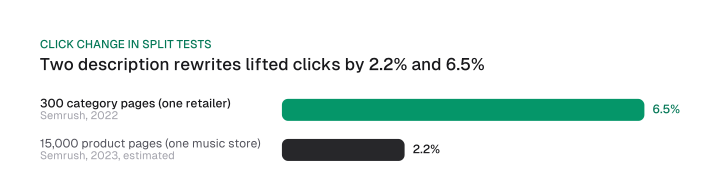
The baselines change how to read the numbers. In the product test, Semrush's own research found that Google "was often not displaying the website's CTA-focused meta description but instead choosing to display body content from the page."
The 2.2% is therefore partly a story about swapping a tag Google disliked for one it showed more often. It should not be read as the effect of a better description over one that was already working.
The indirect-ranking claim has no support in these tests
A common line is that descriptions do not rank but "more clicks can indirectly boost your SEO performance." Both Semrush tests looked for that.
In the category test, "rankings and impressions remained fairly stable" against the modeled control group. In the product test, the change "only impacted the CTR of the tested pages, rather than their visibility in Google search results." Clicks rose while impressions did not move, and Seer's test found "minimal shifts" in average position across its periods.
That is an absence of movement over 21 days on single sites, so it cannot rule out a lagged effect that builds over months. It does show that these tests found no ranking change, and Google's only explicit statement on the tag, from 2009, is that it does not use it in ranking.
Treat the meta description in SEO as a click lever: write it to win the click, and measure it as a click change.
How long a meta description should be
Google documents no length limit for the tag, only truncation to the device width, so a fixed character target is a habit rather than a rule. The documentation says "There's no limit on how long a meta description can be, but the snippet is truncated in Google Search results as needed, typically to fit the device width."
The meta description character limit that sites quote comes in two versions:
"Meta descriptions should be between 50–160 characters or around 680 pixels." (Moz)
"Stay between 150 and 160 characters, or keep the most important information within that character count." (Shopify)
Both mark where a snippet usually ends on a desktop result. The range decides how the snippet ends and says nothing about whether Google uses it.
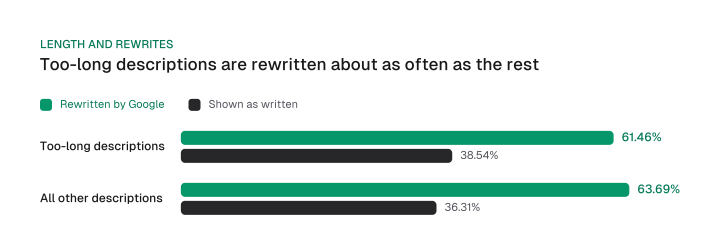
Ahrefs checked that directly in its 2020 comparison of 20,000 keywords on desktop. Google rewrote 61.46% of descriptions that were too long and 63.69% of the rest. Ahrefs called the results "pretty much equal," and the numbers agree: the too-long group's description was shown 2.23 points more often (38.54% against 36.31%, computed from the two rewrite rates).
Ahrefs does not define "too long", so the finding says only that crossing the usual threshold does not decide whether the tag is used. Meta description length is also commonly over the line: 40.61% of the 192,656 unique pages Ahrefs studied had one; the study does not say how that page set relates to its 20,000 keywords.
Semrush measured what Google does show. Its 2025 sample averaged 146.28 characters per snippet on desktop; the mobile average was 135.87. Those are averages across a handful of keywords, so they say where snippets tend to land and cannot tell you where yours will be cut.
The practical rule follows from truncation: put the claim first and treat anything after it as a bonus. If the end is cut, the searcher still gets the promise. Titles have their own limits and rewriting, which how to write title tags covers.
Two robots directives are the only real length controls, and both are blunt. max-snippet caps how much text may be used in a snippet. Google says it applies to all forms of search results, including AI Overviews and AI Mode, and "will also limit how much of the content may be used as a direct input for AI Overviews and AI Mode."
The nosnippet directive removes the text snippet altogether. Neither directive tunes a description, and using either on a page you want clicked removes the text you are trying to improve.
How to write a meta description for each page type
A meta description works when it names the page's single promise in the words the searcher used, and the wording that wins differs by page type. Google's guidance is to "create descriptions that accurately describe the specific page," and it adds that "identical or similar descriptions on every page of a site aren't helpful."
Because Google scores a snippet per search, your description competes with page text on the wording the searcher typed. If the query words are in the tag, Google has a reason to pick it.
Use this order: the promise (what the page gives), the proof (the one detail that makes it believable), the next step (what the click leads to). The table adds what each page type puts in and leaves out, and which test, if any, backs it.
Both test results are single-site results with different baselines. The table reports them as what happened on those sites, and it does not claim that product pages in general respond to product-focused wording.
Before-and-after examples
Each meta description example below is a constructed illustration for this guide. We report no ranking or traffic outcome for them. Run a character count on your own versions in the CMS preview; each pair here keeps the claim in its first sentence.
Product page. Before: "Shop the best hiking boots online. Great prices, fast shipping and a huge range. Buy now!" After: "Waterproof leather hiking boots with a grippy rubber sole, built for wet trails. Free returns on every size." The change (89 characters before, 108 after): the before could sit on any shop's product page, while the after names the product, the decisive attribute and a return term.
Category page. Before: "Our running shoes category. Browse all of our shoes and find something you like." After: "Running shoes for road, trail and track, from cushioned daily trainers to light race-day pairs. Compare by fit and weight." The change (80 characters before, 122 after): the before describes the page's existence, the after describes its range and gives a reason to click.
Article. Before: "In this post we talk about meta descriptions and many other things about SEO that you should know." After: "A meta description is the text under your title in search results. See when Google uses it and how to write one that earns the click." The change (98 characters before, 133 after): the after answers the question the page is about and says what the click delivers.
A call to action works when it follows a specific promise, so copywriting formulas such as problem, agitation and solution are better treated as ways to order those two sentences than as a template.
Write in active voice and keep to one natural mention of the query; the point is to match the searcher's wording. Product-focused descriptions, as in the music store test, describe the item itself before any call to action.
How to optimize a meta description
To optimize a meta description, write it for the one query the page must win, in the searcher's words, then check what Google shows for that query. If the query is a question, question based keywords shows where to find the exact wording searchers use.
Here's the order:
- Pick the head query the page must win.
- Write the promise, proof and next step, with the query words first.
- Make it specific to this page, since identical descriptions aren't helpful.
- Put the claim first, because the end may be truncated to the device width.
- Run the per-query check; rewrite only where page text shows for the head query.
Why Google ignores your meta description
Google skips a meta description when page text answers the searched query more directly, and a four-step check by query tells you which case you are in. Google lists no official reasons for replacing a description.
What it documents is the mechanism covered above: the snippet is built per search, from page content by default, and the tag is used when it gives a more accurate description. So the useful question is for which queries Google replaces your tag.
Here is a check that answers that for your page:
- Take the page's top five queries from Search Console.
- Search each one in a normal results page and find your result.
- Record whether the snippet shows your tag or a sentence from the page.
- Act on the outcome for that query.
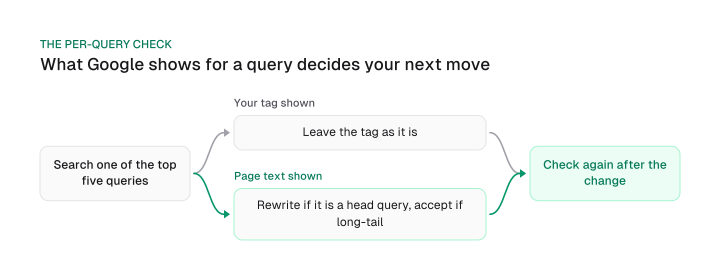
The action depends on what you recorded:
- Tag shown. Leave it.
- Page text shown for the head query. Rewrite the tag to answer that query in the page's own wording.
- Page text shown for long-tail queries. Accept it; Google replaces long-tail descriptions slightly more often (65.62% against 59.65%).
- Neither, or no description at all. Check the tag in the rendered HTML with view-source.
If Google chose a sentence from the body, that sentence is a hint about what matched the query. A missing or overwritten tag, a plugin conflict or a theme that prints the description twice shows up in view-source.
Run the check on the pages that matter and repeat it after a change; a tag that gets shown for its head query after a rewrite is the evidence that the rewrite worked. Rankings and impressions will not tell you, because the description does not move either.
Writing meta descriptions at scale
Hand-write descriptions for the pages that earn organic traffic, template the product and database pages, and leave long-tail pages to Google. Google supports this split. After telling site owners to describe each specific page, its documentation addresses large sites: "programmatic generation of the descriptions can be appropriate and are encouraged. Good descriptions are human-readable and diverse."
Ahrefs' advice for a huge site agrees on where to spend effort: prioritise pages that "already get organic traffic" and "were created to rank in Google."
Hand-writing is slow. Seer Interactive's test put manual writing at 19.1 minutes per page against 2.5 minutes with ChatGPT-4, which for 100 pages is 31.8 hours against 4.2 hours (our arithmetic from Seer's per-page times).
That gap is why the triage matters: it tells you which hours to spend. For a store, the best hours go to category pages and top sellers, where ecommerce seo effort concentrates anyway. A site audit finds which pages those are and which have missing or duplicated tags; the process is in how to do seo audit.
Free AI meta description generators and AI-written descriptions
Any AI meta description generator, free ones included, is useful for drafting and risky as the final text. Seer's test is the only measured comparison here, and its results come with confounds.
It put 237 pages from its own blog in three groups. The ChatGPT-4 group saw CTR fall 21.5%, while the manual group's CTR rose 16.3% against the previous period.
The groups were different pages with different starting CTR, so compare each group with its own history and never with each other. Seer itself says its next test will swap half of the manual group to ChatGPT-4 descriptions because of the multiple variables in this one. Rankings showed only minimal shifts, so Seer could not link them to either method.
The workable use is a generator for the first draft, then a check against the page-type table: does it name the page's single promise, use the searcher's wording and avoid the line every page of the site repeats? A draft that fails those three questions is a template line, and it should be rewritten or left to Google.
The same logic holds at scale. The tag is worth writing for the query a page must win, worth templating where pages rank on many long-tail queries, and worth measuring through a split test and the per-query check instead of a character counter.
This week, pull the top five queries for your best-earning page and run the four-step check; what you record will tell you which descriptions to rewrite first.
Frequently asked questions
What is a good meta description example?
A good example is a one-sentence promise for one page in the searcher's words, such as "Waterproof leather hiking boots with a grippy rubber sole, built for wet trails. Free returns on every size." The page-type section above gives constructed before-and-after pairs for a product, a category and an article.
Is the meta description a ranking factor?
No. Google said in 2009, "we still don't use the description meta tag in our ranking." The tag can still change clicks, and the two Semrush tests above measured clicks moving while impressions stayed stable.
Does Google use the keywords meta tag?
No. Google's 2009 statement is "Google doesn't use the keywords meta tag in our web search ranking." Google's 2009 post said it had ignored it for years, and its documentation today says it has no effect on indexing and ranking at all, so writing one adds nothing for Google. Skip it and spend the time on the description. W3Schools' tag reference still lists "search engines (keywords)" among the uses of metadata, which describes the tag's original purpose, not Google's ranking today.
Should I still write a meta description if Google rewrites it?
Yes, for the pages and queries where it matters. Google showed hardcoded descriptions about 37% of the time on average in Ahrefs' 2020 study, and Semrush's 2025 observation was about 28%. A description that matches a query is a bid to be in the shown share, and Google's 2007 statement says snippet quality can directly affect the chance of being clicked.
Do meta descriptions matter for AI Overviews?
The max-snippet directive is the documented control there. It applies to AI Overviews and AI Mode and limits how much of a page's content may be used as direct input, per Google's robots meta tag documentation. That is a control over text length, and the documentation does not describe the description tag as a ranking or selection signal for AI Overviews.
Where else is a meta description used?
Social previews may use it. Ahrefs says the tag fills the social snippet when Open Graph tags are absent, while Open Graph defines the optional og:description property separately. If a social preview matters to you, set that property and let the meta description act as the fallback.
Cite this page
Aktaş, F. (2026, October 12). Meta description: how Google picks it and how to write one. Mission Growth. https://missiongrowth.io/blog/meta-description
Download the data: 2 tables as CSV (CC BY 4.0)
Figures we made for this post are free to reuse under CC BY 4.0 with credit to Mission Growth.
Get Mission Growth highlighted in your Google results.