
Copywriting Formulas: The AIDA Formula and How to Pick One
Copywriting formulas like AIDA and PAS explained: what each one does, when it breaks, how to combine them, and a rule for picking the right one every time.

On this page
Copywriting formulas like AIDA and PAS promise a shortcut, but a bare list of acronyms doesn't prove it works.
In this guide:
- Why a formula beats freestyle copy, and two "facts" about it that don't hold up
- Every core formula, matched to the reader it fits
- A two-question rule for picking one, and how to test it
What copywriting formulas actually are, and why they beat freestyle copy
Copywriting formulas are a fixed order of persuasion steps. They convert better than freestyle writing because a familiar structure is easier for a reader's brain to process than an unfamiliar one, and that's a specific, named mechanism, not a vague nod to "psychology."
Reber, Winkielman and Schwarz, writing in Psychological Science in 1998, found that stimuli people process more fluently get judged more favorably, almost on contact, before the reader has consciously evaluated anything. A formula gives a reader's brain a shape it already recognizes, so resistance drops before the argument even lands.
The underlying studies used simple shapes and font legibility in a lab, never a full page of sales copy. The transfer holds until a familiar formula converts worse than an unfamiliar one in a real test; that result would disprove it.
Three things get called "formulas," and they're different tools:
- A formula sequences the whole piece. AIDA, PAS and BAB run from open to close and decide what comes first, second and last.
- A template fills in one line. A headline formula or a subject-line formula shapes a single sentence, not the piece around it, like compressing PAS into the subject line "Deadlines slipping? Here's the fix."
- A checklist audits a draft you've already written. The 4 Cs, covered below, works this way: it tells you what to fix after you've written, not what to write first.
The same fluency principle shows up outside persuasion, too. Generative engine optimization rewards passages built around predictable, easy-to-parse structure. An answer engine, like a reader, extracts what it can process quickly.
The core sequence formulas: AIDA, PAS, BAB, FAB and the 4 Ps
AIDA, PAS, BAB, FAB and the 4 Ps are the five formulas that structure an entire piece of copy from open to close, each built around a different persuasion engine for a different stage of reader awareness.
Put them side by side and the pattern is a gradient, not a pile of interchangeable options. A cold reader who doesn't know they have a problem needs a different opening move than a reader comparing spec sheets.
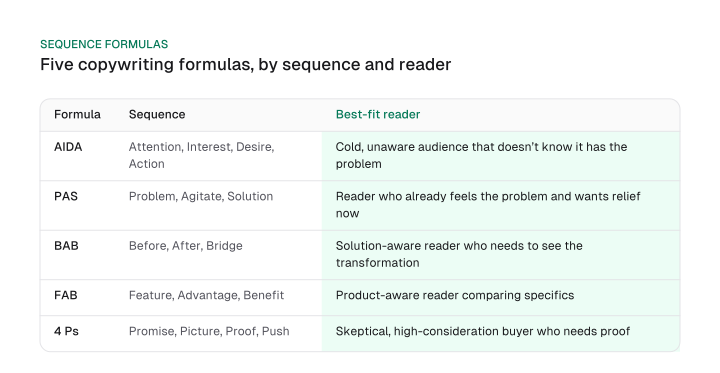
AIDA: attention, interest, desire, action
The AIDA formula moves a reader through Attention, Interest, Desire and Action. It fits a cold, unaware audience that doesn't yet know it has the problem you're about to name.
A cold ad opening with "Your team's deadlines keep slipping and nobody notices until the client asks" is doing AIDA's first job: naming the problem before asking for anything.
Thrivethemes.com claims AIDA "was formally documented in 1898" and has "been guiding persuasion for over 120 years." Elias St. Elmo Lewis's own 1908 book doesn't support that framing. It states his formula as "Attract, Interest and Convince," a three-part phrase, not four, and treats "getting action" as a separate concern in a later chapter rather than one fused sequence with attention, interest and desire.
PAS: problem, agitate, solution
The PAS formula moves through Problem, Agitate, Solution (sometimes extended to PASO, with a fourth step added). It fits a reader who already feels the problem and wants relief now.
That's different from AIDA's cold reader, who still needs convincing the problem exists. PAS's failure mode is specific: agitating past the pain the reader has actually named, in their own words, reads as manipulation rather than persuasion.
BAB: before, after, bridge
BAB moves through Before, After, Bridge. It fits a solution-aware reader who needs to see the transformation.
Where PAS lingers in the problem, BAB spends most of its words on the "after," then treats your offer as the bridge that gets the reader there.
FAB: feature, advantage, benefit
FAB moves through Feature, Advantage, Benefit. It fits a product-aware reader who is comparing specifics, like a spec sheet or a pricing page.
It starts with what the product does, then what that does for the reader, then why that matters.
The 4 Ps: promise, picture, proof, push
The 4 Ps move through Promise, Picture, Proof and Push. They fit a skeptical, high-consideration buyer who needs proof before a big commitment.
Proof carries more weight in this formula than in any of the other four, because the reader you're writing for won't move without it.
Formulas built for a harder sell: QUEST, the 4 Cs and AICPBSAWN
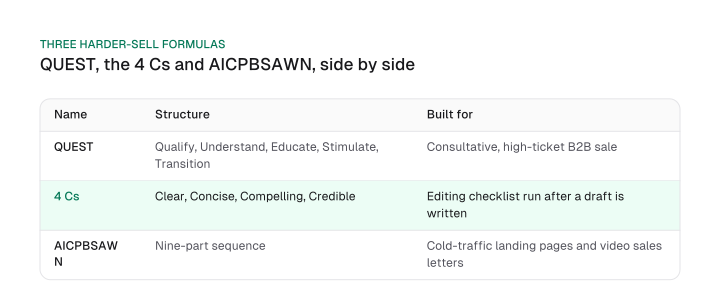
QUEST, the 4 Cs and AICPBSAWN solve three different harder problems: a consultative B2B sale, a pre-publish quality check, and a long, cold-traffic page. They don't compete with AIDA or PAS so much as sit next to them, built for situations the five core formulas above don't cover well.
QUEST: qualify, understand, educate, stimulate, transition
QUEST moves through Qualify, Understand, Educate, Stimulate and Transition. It's built for a consultative, high-ticket B2B sale where trust has to be established before the ask.
It's deliberately the slowest formula here: a reader deciding on a five-figure contract needs to be qualified and educated before anyone stimulates urgency.
The 4 Cs (and the 5th nobody agrees on)
The 4 Cs of copywriting, Clear, Concise, Compelling and Credible, are an editing checklist applied after a draft is written, not a sequence formula like AIDA or PAS. Run a finished draft against all four before you publish it: cut what's unclear, cut what's wordy, and cut anything you can't back up as credible.
There's no single agreed fifth C. Search for "5 C's of copywriting" and you'll find some sources adding "consistency" as the fifth, others adding "call to action" instead, with no resolution between them. Four Cs are settled; a fifth has never been agreed on, and that gap is worth stating plainly.
AICPBSAWN: the long-form structure
AICPBSAWN is a nine-part sequence built for cold-traffic landing pages and video sales letters, longer and more granular than any formula above it. It gets a light touch here: building the full sequence into an actual page, headline through CTA placement, is building a landing page's job, not a formula-mechanics guide's.
Headline formulas: the levers behind the templates
Headline formulas are single-line templates, not full-piece sequences, and the dozens circulating online collapse into five real levers: curiosity gap, specificity, outcome promise, negation and social proof. A reader doesn't need thirty templates memorized. They need to know which lever a given headline should pull, then write to that lever.
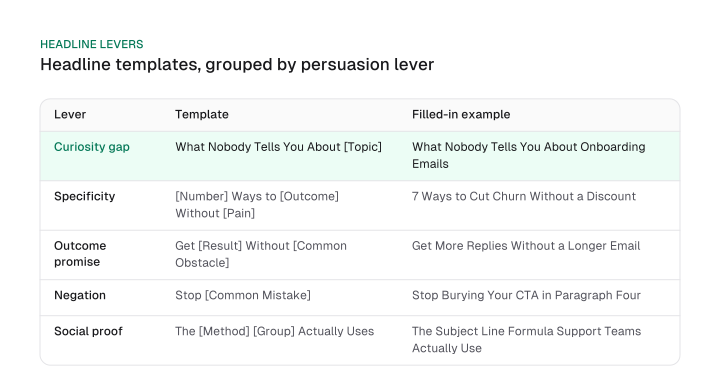
| Lever | Template | Filled-in example |
|---|---|---|
| Curiosity gap | "What Nobody Tells You About [Topic]" | "What Nobody Tells You About Onboarding Emails" |
| Curiosity gap | "The One [X] Mistake Costing You [Result]" | "The One Subject Line Mistake Costing You Opens" |
| Specificity | "[Number] Ways to [Outcome] Without [Pain]" | "7 Ways to Cut Churn Without a Discount" |
| Specificity | "How We [Achieved Result] in [Timeframe]" | "How We Rebuilt Onboarding in a Weekend" |
| Outcome promise | "Get [Result] Without [Common Obstacle]" | "Get More Replies Without a Longer Email" |
| Outcome promise | "[Result], Faster" | "Fewer Missed Deadlines, Faster" |
| Negation | "Stop [Common Mistake]" | "Stop Burying Your CTA in Paragraph Four" |
| Negation | "Why [Common Belief] Is Wrong" | "Why 'Shorter Is Always Better' Is Wrong" |
| Social proof | "The [Method] [Group] Actually Uses" | "The Subject Line Formula Support Teams Actually Use" |
That regrouping ties back to the fluency mechanism from the first section, with one exception. Most body copy wants to be fluent, because fluent processing reads as more trustworthy.
A headline built on the curiosity gap lever wants the opposite. It's a controlled break in the pattern the reader expects.
Alter, Oppenheimer, Epley and Eyre, writing in the Journal of Experimental Psychology: General in 2007, found that harder-to-process information triggers more analytic, more memorable processing. That's exactly the job a curiosity-gap headline does: a familiar formula lowers resistance in the body, while a pattern interrupt in the headline is what gets the reader to open it in the first place.
Same product, three formulas: a worked rewrite
The same project-management software benefit reads completely differently depending on which formula carries it, because each formula puts a different element first. The underlying facts don't change.
Here's one benefit, "your team stops losing track of deadlines," written three full times for a fictional tool called TaskPilot:
AIDA version, for a cold reader: Your team's deadlines keep slipping, and nobody notices until a client asks why. TaskPilot shows every deadline against your team's real capacity in one view, so a task turns red while it's still at risk, not after it's already late. Picture a week where nothing sneaks up on you. Start your free trial.
PAS version, for a problem-aware reader: Your team already knows the problem: deadlines slip, and by the time someone flags it, the client has already noticed. Every missed date chips away at the trust that got you the contract in the first place. TaskPilot flags a task the moment it's at risk, so your team fixes it before anyone outside the team has to ask. Fix the pattern this week.
FAB version, for a product-aware reader: TaskPilot cross-references every deadline against your team's real, current workload, instead of only the date on the calendar. That means a task shows as at-risk before it's overdue, instead of after. The result: fewer missed deadlines, and fewer client calls that open with "just checking in."
These are copywriting techniques examples you can copy directly: the same benefit, run through three formulas, so the difference is visible instead of described.
The facts never changed across the three versions. What changed is which element the reader meets first, and what they're asked to feel before they're asked to act.
Picking the right formula for the reader and the channel
Picking a formula comes down to two questions: has the reader already named their own pain, and how many words does the channel actually give you before they leave. Answer both and the choice narrows on its own.
- Has the reader already named their pain? If yes, they're problem-aware: reach for PAS or BAB. If they're still imagining a better future rather than naming a present pain, reach for AIDA or QUEST instead.
- How many words does the channel give you? A five-second channel, a push notification or a paid social headline, gets a compressed two- or three-element version of whichever formula fits. A full page or a long email gets the complete sequence, up to a long-form structure like AICPBSAWN when the traffic is cold and the price is high.
That split tracks roughly with B2B and B2C, too. A consultative B2B sale usually needs the longer, proof-heavy end of the scale, QUEST or the 4 Ps, while a B2C purchase decided in one sitting fits AIDA or PAS in a short channel.
That first question is where the most repeated claim about loss aversion gets overstated. One popular breakdown states that a loss "is twice as powerful" as an equivalent gain, presented as settled fact.
Tversky and Kahneman's own 1991 paper is more careful than that. They wrote that "these findings suggest that a loss aversion coefficient of about two may explain both risky and riskless choices," an estimate reached "with caution" from a convergence of separate gambling experiments, not a fixed constant.
The decision rule above still holds either way. A reader who has already named a loss responds to PAS or BAB, which lean into that loss; a reader who hasn't named one yet responds better to AIDA or QUEST, which build toward a gain instead.
Only 1 of the 8 competitor copywriting guides read for this post offers any framework for choosing between formulas, a straight count of those 8 guides. The rest either list the formulas with no selection criteria or skip the question entirely.
A formula also assumes the underlying message is already right; it only shapes how you sequence it. If the message itself isn't settled, a positioning statement is the fix to make before any formula helps.
Mixing, stacking, and where a formula breaks
Formulas combine cleanly when each one owns a different job in the sequence: open with PAS, prove with the 4 Ps, close with AIDA's action step. They break when you stack them for coverage instead of for a reason.
Running PAS, AIDA and BAB on the same page doesn't make it more persuasive. It makes the page harder to follow.
Three specific ways it breaks:
- Formula soup. Stacking formulas because more structure feels safer, not because each one has a distinct job, produces a piece with no clear spine.
- Filling in the blanks. A formula fixes the order of the argument, never the wording. Copy that reads like each slot was filled in turn has kept the sequence and lost the reason the sequence persuades.
- Agitating past a pain the reader hasn't named. This is PAS's specific failure mode: pushing the "agitate" step past what the reader has actually said about their own problem reads as manipulation, not persuasion.
Feeding an AI drafting tool a named formula as a structural container, rather than a bare topic, is one place mixing and misuse show up together. A prompt that says "write PAS copy for X" gives the model a container to fill; a bare topic prompt tends to produce generic filler that a formula would have prevented. That's one piece of a larger AI content workflow, not the whole of it.
A formula doesn't fix everything AI drafts. What separates a differentiated page from a generic one is still e-e-a-t ai content: real experience, real sourcing, a real point of view.
Whether AI is replacing copywriters as a job is a separate question, covered in our b2b copywriting guide.
How to test which copywriting formula actually converts
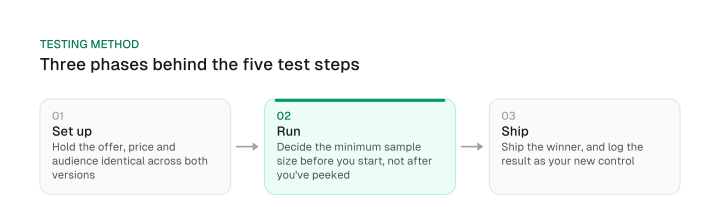
Testing which formula wins means changing only the formula on an otherwise identical page, holding the offer, price and audience constant, and running until you hit the sample size the expected difference requires. "Trying" a formula and moving on if it feels wrong isn't a test. Testing means a narrower, five-step method:
- Pick one page or asset and hold the offer, price and audience identical across both versions.
- Change only the formula: version A opens with PAS, version B opens with AIDA, nothing else moves.
- Decide the minimum sample size the expected difference requires before you start, not after you've already peeked at early results.
- Run both versions until you hit that sample size, not until a day feels convincing.
- Ship the winner, and log the result as your new control for the next test.
None of the choices above require guessing. A formula is a mechanism, not a lookup table: match it to how aware your reader already is, write the same message through a second one to see what changes, and let a real test settle which one wins. Rewrite one line of your current copy through a different formula today, then run it against your control with only that one variable changed.
Frequently asked questions
What are the 4 Cs (or 5 C's) of copywriting?
The 4 Cs, clear, concise, compelling and credible, are the version every source that defines the Cs agrees on. A "5th C" (consistency, or a call to action, depending who you ask) is never resolved anywhere, so treat the four as settled and the fifth as an open disagreement.
Which copywriting formula should I test first?
Match it to your reader's current awareness: PAS if they already feel the problem, AIDA if they don't know they have one yet. Test the new formula against your current control with only the formula changed, and let the sample size, not a feeling, decide the winner.
What is one formula to copywriting?
There isn't a single universal one. AIDA is the most-cited starting point for a cold reader, but the right formula depends on how aware that reader already is of their problem, which is why a problem-aware reader usually converts better on PAS or BAB instead.
What's the real difference between AIDA and PAS?
AIDA builds desire for a reader who doesn't yet feel the problem. PAS leverages a pain the reader already feels and wants solved now. They're built for opposite starting points on the awareness scale, not interchangeable options for the same reader.
Can I mix two copywriting formulas in the same piece?
Yes, as long as each formula owns a distinct job in the sequence, one opens, one proves, one closes. Stacking formulas for coverage instead of for a reason is what creates formula soup: more structure, not more persuasion.
Does a copywriting formula still matter if AI drafts the first pass?
Yes. Feeding an AI tool a named formula as a structural container produces usable copy, while a bare topic prompt tends to produce generic filler the formula would have prevented.
Figures and images in this post are free to reuse under CC BY 4.0 with credit to Mission Growth.
Get Mission Growth highlighted in your Google results.