Landing Page Copy That Converts, Section by Section
Write landing page copy that converts, section by section: match copy to reader awareness, pick the right length, and avoid the mistakes that cost conversions.
On this page
You're about to write, or rewrite, a landing page's copy. The usual advice, use numbers, add social proof, keep the headline punchy, doesn't tell you how long it should run, which objection to lead with, or why the same offer needs different copy on a paid campaign than on organic search.
All of those decisions collapse into one variable: where the reader actually stands on the awareness spectrum, and what device and traffic source put them there. This guide builds landing page copy that converts from that one variable, section by section, with a worked example and two decision tools.
Most landing page copy mistakes trace back to one factual correction near the end of this guide.
What landing page copy actually is (and who it's written for)
Landing page copy is the words that do the entire persuasion job on a page built around one offer and one action. A typical website page can lean on navigation, other sections and a search box to share that load. This one has none of that, so every sentence has to earn its place.
That single-purpose design is why the same advice you'd give a homepage falls apart here:
- One offer, one action. No menu to browse, no other page to land on if this one doesn't convince.
- Message match. The words on the page have to match the words that got the click, whether that's a paid ad's headline or an organic search result's promise.
- No second chance to explain. A confused visitor doesn't dig for a "learn more" link. They leave.
Every copy decision that follows, how long a section runs, what tone it takes, which objection it handles first, comes back to that same single variable from the intro. Get it right and the rest follows.
If you haven't nailed down what makes your offer different yet, build your message hierarchy first. This guide assumes you already have one to write from.
The five-stage awareness map, and why paid vs. organic and B2B vs. ecommerce copy diverge
A reader's awareness stage, not their traffic source alone, decides how much a landing page has to explain before it asks for the click. Copywriter Eugene Schwartz named five stages: unaware, problem-aware, solution-aware, product-aware and most-aware. A reader who is unaware doesn't know they have the problem yet; a most-aware reader just needs a reason to buy now instead of later.
Traffic source and buyer type shift where most of your visitors land on that map, which is why the same offer needs different copy depending on where it's promoted:
- Paid search or paid social, cold audience: usually problem-aware at best. The copy has to establish the problem before it can sell the fix.
- Organic search on a specific query: often solution-aware or product-aware already, because they searched for something specific.
- B2B, considered purchase: frequently multiple stakeholders at different stages reading the same page, so the copy has to work for a skeptical evaluator and a decided champion at once.
- Ecommerce, single product: usually closer to product-aware or most-aware, so the copy can lead with the offer instead of the problem.
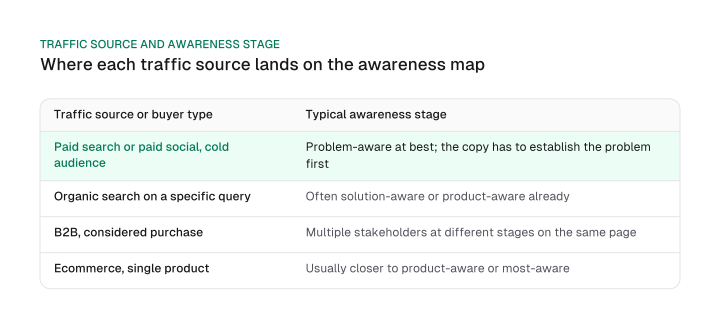
This is the variable the rest of the guide builds from.
How much copy a landing page actually needs
A landing page needs enough copy to move its reader from their actual awareness stage to the action, and no more. Length isn't a fixed word count; it's a function of two variables: how much the reader already knows, and how complex the offer is.
Most advice treats length as a single-variable question: simple offer, short page; complex offer, long page. That misses half the picture. A simple offer aimed at an unaware audience still needs room to establish the problem first, and a complex offer aimed at a most-aware audience can stay short, because the reader already did the thinking.
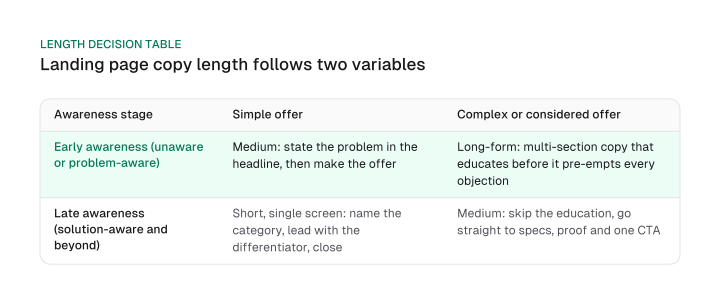
Crossing awareness stage with offer complexity gives four practical bands:
- Early awareness (unaware or problem-aware), simple offer: a medium page. State the problem in the headline, then make the offer.
- Early awareness, complex or considered offer: a long-form landing page, multi-section copy that educates before it pre-empts every objection it can find.
- Late awareness (solution-aware and beyond), simple offer: a short, single-screen page. Name the category, lead with the differentiator, close.
- Late awareness, complex offer: a medium page that skips the education and goes straight to specs, proof and one CTA.
That last band is usually where SaaS trial and demo pages sit: the visitor already knows the category, the offer carries real complexity (seats, integrations, pricing tiers), and the copy's job is proof and specifics rather than persuasion from zero. If landing pages are part of your SaaS SEO strategy, that's typically the band you're writing for.
Write for the phone in the visitor's hand
Most landing page traffic arrives on a phone, and copy that assumes a monitor is losing conversions it never has to.
Unbounce's 2024 Conversion Benchmark Report puts the mobile share at 83% of the visits it analyzed, across a sample of more than 57 million conversions and over 41,000 landing pages.
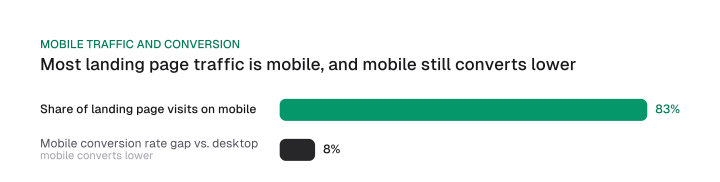
The same report found that mobile converts 8% lower than desktop. That gap isn't spread evenly: some industries already beat it.
The report's own math shows what closing it is worth. It states it might have reported over 1.3 million additional conversions industry-wide if every page closed the gap, which works out to about 32 more conversions per page across its roughly 41,000 landing pages (1,300,000 ÷ 41,000 ≈ 31.7, rounded).
Treat that number as the report's own conditional estimate, never a measured loss every page is carrying today.
What that means for the copy itself, beyond the layout:
- Front-load the benefit before the fold. A mobile reader sees less of the page at once, so the headline and subheadline have to carry the offer without scrolling.
- Shorten the subheadline. A line that wraps to three lines on desktop wraps to five on a phone, and each extra line is a chance to lose the reader.
- Write the CTA label for a thumb, not a mouse. "Start your free trial" beats "Click here to learn more about how we can help" when someone is tapping with one hand.
The section-by-section landing page copy skeleton
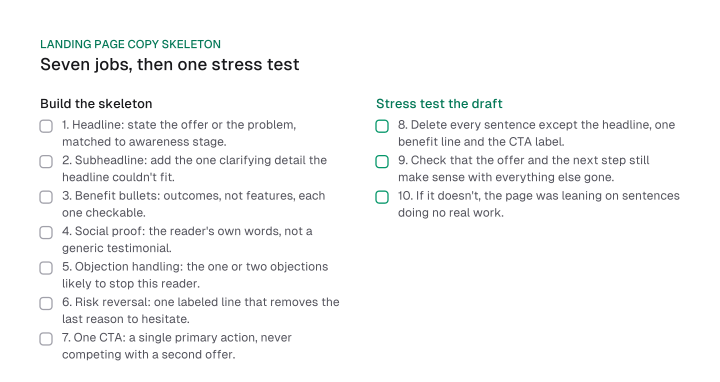
A landing page copy skeleton has seven jobs to do: headline, subheadline, benefit bullets, social proof, objection handling, risk reversal and one CTA.
Treat it as a landing page copy template: seven fixed jobs, but the content of each one is set by the awareness stage from the first section, not by a fixed word count.
That seven-part list on its own isn't new. What turns it into something useful is running it end to end against one example and checking the finished draft against a real test, so here's both.
Headline
The headline states the offer or the problem, depending on awareness stage, in one line a skimming reader can parse in a second. For an unaware audience, lead with the problem; for a most-aware audience, lead with the offer itself.
If you want a named structure to build that line from instead of writing it cold, a proven copywriting formula can carry the sentence. This section is about where the line sits in the page, not which formula writes it.
Landing pages built to rank as well as convert also need the query language the visitor actually searched, in the headline or subheadline. That's where SEO for startups work usually starts.
Subheadline
The subheadline adds the one clarifying detail the headline couldn't fit, usually who the offer is for or what makes it different, in a single sentence.
Benefit bullets
Benefit bullets state outcomes, not features, and each one should be checkable rather than vague. The next section covers exactly how to make that concrete.
Social proof
Social proof works best in the reader's own words, not a generic testimonial. A specific customer quote naming a real result beats a five-star badge with no name attached.
Objection handling
Objection handling addresses the one or two objections most likely to stop this specific awareness stage from converting, not every possible objection the offer could face.
Risk reversal
Risk reversal: one labeled line (a guarantee, a trial period, a cancel-anytime note) that removes the last reason to hesitate right where the CTA sits.
One CTA
A landing page gets one primary call to action, repeated if the page is long, but never competing with a second offer.
A worked example. One of many landing page copy examples this skeleton can produce: a fictional scheduling tool for salon owners, aimed at a problem-aware audience arriving from a paid social ad. Here's how each section reads:
- Headline: "Stop losing bookings to no-shows."
- Subheadline: "Automated reminders built for single-location salons, live in one afternoon."
- Benefit bullets: three checkable outcomes, never feature names.
- Social proof: one line from a named (fictional) salon owner.
- Objection handling: "Works with the booking calendar you already use, no new system to learn."
- Risk reversal: "Cancel in one click, no questions asked."
- CTA: a single button, "Start now."
Run that draft, or your own, through this check before you ship it: delete every sentence except the headline, one benefit line and the CTA label. If the offer and the next step still make sense with everything else gone, the draft passes. If it doesn't, the page was leaning on sentences that were doing no real work.
Make every claim checkable
Concrete, checkable claims beat vague benefit language because concrete words are recognized and recalled more reliably than abstract ones. That's a real cognitive mechanism, not a matter of sounding more credible.
A 2019 study in the journal Memory & Cognition, by Taylor, Francis, Borunda-Vazquez and Carbajal, found that "concrete words were better recalled and recognized than abstract words."
That's the concreteness effect, a finding from cognitive psychology, and it gives a mechanism to a rule stated everywhere as a bare tip: use numbers to be believable. For landing page copywriting specifically, the mechanism is dual coding, a concept named by psychologist Allan Paivio.
A concrete claim gets stored two ways in memory, as language and as a mental image, while an abstract claim only gets stored one way. Two retrieval paths make it easier to recall at the exact moment a reader is deciding whether to trust it.
Which means the fix is mechanical, not stylistic. Take every benefit claim that can't be pictured or independently checked and replace it with something that can:
| Vague (abstract) | Concrete (checkable) |
|---|---|
| "Powerful reporting" | "Export a PDF report before your coffee gets cold" |
| "Loved by teams everywhere" | "The receptionist stopped fielding no-show calls the day it went live" |
| "Fast onboarding" | "Live in one afternoon, no developer needed" |
| "Great support" | "A real person answers support tickets, not a bot" |
The effect is bounded. It's measured in lab tasks on word-level recognition and recall, and no study connects it directly to landing page conversion rate.
The same paper's second experiment also directly rejects a competing explanation, that the effect comes from surrounding context rather than the words themselves: "the results of Experiment 2 do not support the context availability hypothesis of the concreteness effect in recognition memory." Read the original study for the full experimental detail.
What would disprove the transfer for your page specifically is a real A/B test where a concrete rewrite performs no better than the abstract version it replaced. Until you run that test, the safer bet is the checkable claim over the vague one.
The landing page copy mistake that costs the most, and the SEO myth that keeps it alive
The most repeated landing page copy mistake is writing to a word-count target instead of to the reader's awareness stage, and the belief that Google requires a minimum word count to rank is false. One common version of the claim reads:
If you want your landing page to rank on Google, it should be at least 300 words.
Google's Search Central guidance, updated in July 2026, says the opposite directly: "There's no ideal page length" and "There's no requirement to break your content into tiny pieces for AI to better understand it."
The actual rule is the one from the length section above: length follows awareness stage and offer complexity, not a digit target. Padding a short, product-aware page to hit that word count doesn't help it rank, and it actively hurts conversion: it forces a reader who already knew enough to convert to wade through sentences that aren't doing anything for them.
When to rewrite your landing page copy
Landing page copy needs a rewrite when one of four dated signals shows up, not on a fixed maintenance schedule. "Review it regularly" gives you nothing to check against; these four do:
- A sustained conversion-rate drop against the page's own prior baseline. Not a single bad day, a real decline against what this specific page used to do.
- An offer or price change. If the B2B SEO checklist work on a page's lead-gen offer changes what's actually being promised, the copy that sold the old offer is now inaccurate, not merely out of date.
- A new claim a competitor is making that the page doesn't address. If the market's expectations moved and your objection-handling section didn't move with it, that section is out of date even if nothing else changed.
- An upstream positioning or audience shift. If the message hierarchy the page was built from has changed, the landing page copy built on the old version is now off-message, no matter how well it converted before.
Landing page copy decisions, length, tone, which objection goes first, how it reads on a phone, all resolve to that same variable: reader awareness plus device and traffic source. The length table, the mobile rule, the skeleton and the rewrite triggers above all run off it instead of a disconnected checklist.
Pick the page you're writing or rewriting right now, name its reader's actual awareness stage, and start the headline from there.
Frequently asked questions
Can ChatGPT build a landing page?
An AI tool can draft a first pass of the copy, but it won't make the decisions that make that draft convert: matching length to awareness stage, picking the right objection to lead with, and writing the mobile-first version. Those decisions turn a draft into a page that converts; the AI draft is a starting point, not the finished page.
What's the ideal word count for a landing page?
There isn't a fixed number. Length depends on where your reader stands on the awareness spectrum and how complex the offer is, which is why the decision table earlier in this guide crosses those two variables instead of naming a word count.
Should I use my landing page for both paid and organic traffic?
You can, but expect to write for the more skeptical of the two audiences. Paid, cold traffic usually arrives less aware than organic traffic that searched for something specific, so a page serving both needs the paid audience's problem-first framing without losing the organic visitor who already knows what they're looking for.
What's the difference between a landing page and a regular website page?
A landing page is built around one offer and one action, with no navigation, no other pages and no search box competing for the visitor's attention. A regular website page assumes the visitor might browse, so it can afford to explain less in any single spot and let other pages fill in the rest.
When should I update my landing page copy?
Update it when one of four signals shows up: a sustained conversion-rate drop against the page's own baseline, an offer or price change, a new competitor claim the page doesn't address, or an upstream positioning shift. Absent one of those, a page that's still converting doesn't need a rewrite on a calendar.
Figures and images in this post are free to reuse under CC BY 4.0 with credit to Mission Growth.
Get Mission Growth highlighted in your Google results.