
Messaging Framework: Build One, With a Worked Example
A messaging framework turns positioning into pillars, proof points, and per-audience messages. See a worked example and how to choose the right one.

On this page
You've seen the checklist a dozen times: value proposition, pillars, proof points, done. What you haven't seen is one filled in, start to finish, as a real document instead of a diagram.
You probably haven't heard the real reason consistent brand phrasing now matters beyond your sales team either: the AI systems reading your pages.
A messaging framework is the document that turns a company's positioning into words every team can reuse: one positioning statement narrowing into pillars, each with proof points.
Some teams call it a brand messaging framework instead. The document is the same either way; only the label differs.
That structure is already consensus. Two of the guides ranking for this term organize around the same hierarchy. What's missing is a worked instance you can compare directly against, an independent way to choose among the named frameworks vendors keep pitching, and a mechanism, not a slogan, for why consistency now does technical work for language models.
In this guide:
- What a messaging framework is, and the three documents people confuse it with: positioning statement vs messaging hierarchy, mainly, plus brand strategy
- A worked example, one pillar built end to end
- A decision table for choosing among message house, messaging matrix, JTBD and more
- The mechanism that makes consistent phrasing matter for AI systems, plus two corrections to claims you've probably seen
What a messaging framework is, and the three documents it gets confused with
A messaging framework is the single document that turns a company's positioning into words every team can reuse.
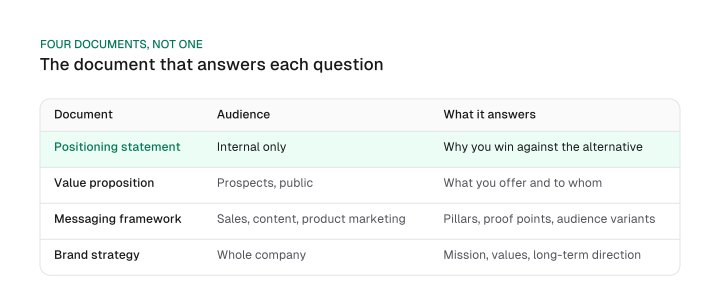
It holds one positioning statement, three to five pillars, proof points and audience variants. Confusion about what a messaging framework is usually comes down to which of four documents you actually need:
- Positioning statement. An internal document. It answers "why choose us over the alternative" and every other document draws from it.
- Value proposition. The first thing a prospect sees. It answers "what do you offer and to whom" in one or two public sentences.
- Messaging framework. The team-facing reference: positioning broken into pillars, proof points and audience-specific variants that sales, content and product marketing all pull from.
- Brand strategy. The identity document for the whole company (mission, values, long-term direction) that the messaging framework turns into sentences.
A product messaging framework is the same document narrowed to one product line: the pillars stay, the audience and proof points shift.
Get the positioning statement wrong and every pillar inherits the error, which is why the next section starts there before it starts writing pillars.
A messaging framework also feeds how a page targets b2b seo: the differentiation a framework locks down is the same differentiation a page needs to rank against competitors selling the same thing.
The message hierarchy, built one pillar at a time
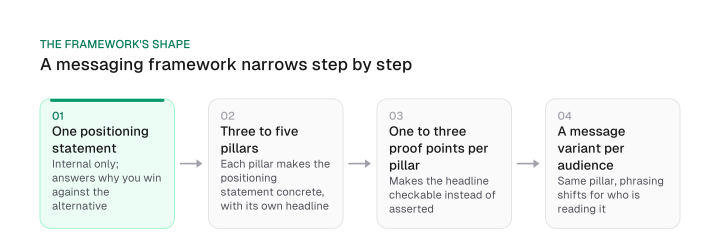
The message hierarchy runs from one positioning statement to three to five pillars, then narrows into a message variant for each audience that needs one.
Each pillar carries a headline, a value proposition and one to three proof points. Five steps build it:
- Research. Talk to sales, support and the audience itself. What objection comes up every call? What claim actually lands?
- Write the positioning statement. One internal sentence: who you're for, what category you're in, and why you win against the alternative.
- Draft three to five pillars. Each pillar is a claim the positioning statement makes concrete, with its own headline.
- Attach proof points. One to three per pillar: a number, a mechanism, a named capability, anything that makes the headline checkable instead of asserted.
- Write audience variants. The pillar stays fixed; the phrasing shifts for who's reading it.
Teams that skip straight to drafting often skip the research step, too. A Starr Conspiracy benchmark of 200-plus B2B tech companies, analysis window January to September 2024, found 73% higher conversion and a 2.2x lift in lead generation for teams working from data-driven buyer personas.
A framework only becomes usable once you've filled in one pillar completely. That's where the abstract components, value prop, proof point, turn into sentences a writer can actually copy the shape of.
Here's a messaging framework template you can reuse, worked end to end using Mission Growth's own published positioning as the subject:
- Positioning statement: "AI catches the signal. Experts make the move. You see the result."
- Pillar headline: Monitoring, strategy and execution in one service.
- Value proposition: Mission Growth is an AI-led SEO and GEO growth service: AI catches the signal, our experts make the move, and you see the result.
- Proof point: The service runs continuous AI monitoring of search and AI-answer visibility, paired with expert strategy and execution, instead of handing a client a dashboard and a login.
- Audience variant (founder): You get AI that never stops watching your visibility and a team that acts on what it finds, without having to build either function in-house.
That's a full pillar, filled in end to end and checkable against Mission Growth's own published positioning: real sentences, real labels, no placeholders. Treat it as one of many messaging framework examples: swap in your own positioning statement, pillar and proof point using the same shape, line for line.
A brand story or a USP can supply a proof point inside a pillar. The pillar stays the reusable asset your team actually works from.
Once your pillars are set, AIDA or PAS structures the individual piece of copy each pillar produces; the framework decides what gets said, the formula decides how one piece of writing says it.
The pillars also decide how that message lands on a landing page once you sit down to write one: get the hierarchy right first, then write the actual page copy around it, section by section.
A framework needs the right people confirming it as well as drafting it: marketing writes the first version, and sales, product and often partner or PR teams should check the pillars against what they're actually hearing in the field.
Test pillars the same way: watch whether sales repeats the language unprompted within a few weeks of a launch. A pillar nobody repeats usually means the proof point was weak rather than the pillar being wrong.
If you're building the framework document itself rather than writing from one already in place, the claims your sales and marketing teams write from it come later, once the pillars and proof points already exist and give them something to draw from.
Choosing the right framework for your situation
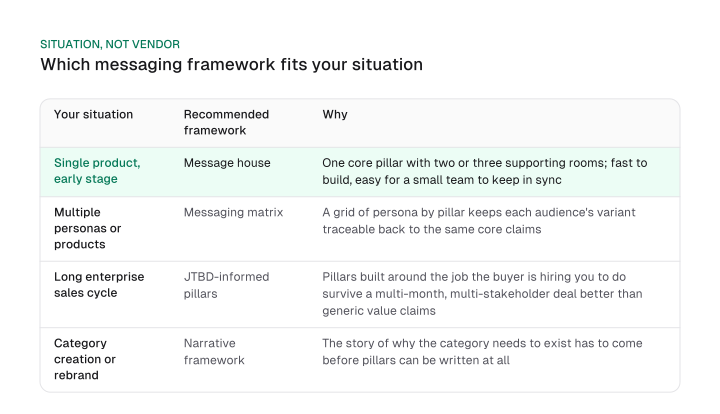
The right messaging framework depends on what you need it to produce: one pitch for the whole company, alignment across several personas, or proof for a long sales cycle.
Not every named "framework" in a comparison list is the same kind of tool. You'll see names like ICPmf, Raskin, JTBD, Dunford's positioning method, Bain's and StoryBrand on one list, and Value Prop Canvas, the Three-Message framework, SPIN Selling and the Hero's Journey on another. Two of the comparisons circulating online either mix categories like these together or favor whichever framework the page's author happens to sell.
The table below isn't pulled from any single vendor's comparison. It matches the situation to the tool, independent of who sells which one:
| Your situation | Recommended framework | Why |
|---|---|---|
| Single product, early stage | Message house | One core pillar with two or three supporting rooms; fast to build, easy for a small team to keep in sync |
| Multiple personas or products | Messaging matrix | A grid of persona by pillar keeps each audience's variant traceable back to the same core claims |
| Long enterprise sales cycle | JTBD-informed pillars | Pillars built around the job the buyer is hiring you to do survive a multi-month, multi-stakeholder deal better than generic value claims |
| Category creation or rebrand | Narrative framework | The story of why the category needs to exist has to come before pillars can be written at all |
Download CSV (CC BY 4.0)
One correction belongs here. SPIN Selling shows up in at least one messaging-framework comparison as an interchangeable option alongside the frameworks above.
SPIN Selling, Neil Rackham's Situation, Problem, Implication, Need-payoff method, is a sales-call questioning technique. It structures the questions a rep asks in one conversation and produces no reusable document.
Every entry in the table above produces a document your whole team can pull from; SPIN Selling structures a single conversation instead. That makes it a different kind of tool, not a weaker version of the same one.
Keeping it consistent as you scale, including for AI
A messaging framework stays useful only if its core description is phrased the same way everywhere.
That consistency is the exact input a language model needs to correctly identify what your brand is.
Most advice frames consistency as good brand hygiene. It's closer to a technical requirement now, and there's a specific mechanism behind why.
Language models identifying a brand face the same problem a knowledge graph faces when it has to figure out which real-world entity a name refers to: entity disambiguation. Research on the mechanism (Pons, Bilalli & Queralt, "Knowledge Graphs for Enhancing Large Language Models in Entity Disambiguation," ISWC 2024) shows candidate identities get pruned first through the knowledge graph's class hierarchy.
A short factual description is then fed to the model so it can pick the right identity from what's left. Google's leaked documentation holds a similar step: the disambiguation field in its NlpSaftEntityProfile module stores a phrase that keeps each entity's name unique, without confirming this exact method runs in production.
A consistent brand description does the same job for your brand that the factual description does for the disambiguation model: it gives the system one clean signal to converge on instead of several different ones scattered across your pages.
The practical rule: carry one short, consistent descriptor everywhere your brand gets described. A pattern that works: "[Brand] is a [category] that does [core action] for [audience]." Use it in your About page, your bio, your directory listings and your press mentions.
If a bio calls you a "growth agency" and your homepage calls you a "growth platform," that's two candidate identities for a model to reconcile instead of one.
Update the framework on a trigger, not a calendar:
- A new competitor enters the market.
- You move into a new market or segment.
- A rebrand happens.
- Sales quietly stops using the pillars you gave them, the clearest sign a proof point stopped landing.
A full framework document usually runs a handful of pages once you've written three to five pillars with proof points. It's neither a single slide nor a sprawling wiki.
Two corrections, because both numbers get repeated more often than they're checked.
Gartner's "brand doom loop" finding, that 84% of companies are stuck in it, surveyed 426 senior marketing leaders in September and October 2025. It measures underinvestment in brand measurement and lost executive confidence, not messaging inconsistency across teams as one popular guide frames it. Concede the number; correct only what it's said to show.
Storyblok's brand consistency survey of 200 consumers across the US and Europe found 87% say it's important a brand feels the same across all touchpoints, and nearly 80% say inconsistent branding makes them trust a brand less or raises doubts. A widely repeated conversion figure attributed to that same survey doesn't appear on Storyblok's own page, so it stays out of this post.
Consistent phrasing is the same input generative engine optimization depends on across every AI surface, from Google's AI Overviews to ChatGPT.
It also shapes ai brand reputation once models start forming an opinion of a company from scattered mentions across the web.
If you track chatgpt mentions and notice your brand described differently from model to model, inconsistent phrasing is worth checking first.
McKinsey's November 2025 State of AI report found 88% of organizations now report regular AI use in at least one business function, up from 78% a year earlier (n=1,993, 105 countries). That's the pace at which more of a brand's first impressions get assembled by a model instead of read directly off a page.
The pillars and proof points structure was never the hard part. Two of the guides ranking for this term already organize around it.
What's been missing is a checkable instance of that structure filled in, an independent way to pick among the named frameworks instead of trusting whichever one a vendor's comparison favors, and an actual mechanism for why a language model treats a consistent brand description as one resolvable identity instead of a fragmented one.
Start with the positioning statement. Write one pillar completely using the worked example above as the template. Then check whether your bio, About page and directory listings all use the same descriptor before you write a second pillar.
Frequently asked questions
What is a messaging hierarchy framework?
It's the same thing as a messaging framework. "Hierarchy" names the structure directly: pillars narrowing from one positioning statement into audience-specific messages, the same worked example this guide builds above.
What are communication frameworks?
Communication frameworks are the broader category: any structured approach to internal or external communication, from meeting formats to crisis-response protocols. A messaging framework is the specific communication framework built for positioning and brand messages.
What's the difference between a messaging framework and a brand strategy?
A brand strategy sets identity, mission and long-term direction. A messaging framework is the operational document teams pull sentences from day to day, built on top of what the brand strategy decided.
Should messaging be the same everywhere?
The core pillars stay fixed everywhere; the audience-specific message variants don't. A pillar aimed at a founder and the same pillar aimed at a procurement buyer should share a proof point but not a sentence.
How long should a messaging framework be?
Long enough to cover three to five pillars with proof points attached, which usually runs a handful of pages once it's written out. It's a working reference document, not a single slide and not a sprawling wiki.
How often should you update it?
On a trigger, not a flat calendar rule: a new competitor, a new market, a rebrand, or sales quietly dropping the pillars you gave them. Any of those is a reason to revisit it; none of them run on a fixed schedule.
Figures and images in this post are free to reuse under CC BY 4.0 with credit to Mission Growth.
Get Mission Growth highlighted in your Google results.