
SEO Content Writing: How to Write Pages AI Can Cite
SEO content writing that ranks in Google and gets cited in AI Overviews: the two passage signals Google's own scoring patent penalizes, keyword placement and a before/after rewrite.
On this page
Every SEO content writing guide gives you the same three moves: use your keyword, break up your paragraphs, add some headings. Follow all three, and your page can still get skipped, both by Google's ranking system and by the AI Overview sitting above it.
That's a structure problem, not a checklist one, and it has a name.
SEO content writing in 2026 is one craft, not two. The same declarative passage structure that Google's classic answer-box system rewards is also what any answer engine, AI Overview included, needs to pull a clean citation.
Not because one mechanism scores both. Both systems have to extract a complete answer from somewhere, and none of the ten pages currently ranking for this exact keyword make that case.
If you haven't chosen a keyword or topic yet, that's a separate step: building a candidate list from your own site, your competitors and tools like Keyword Planner, done before this guide starts. This one picks up once you already have a target keyword, at the draft itself.
In this guide:
- What SEO content writing means now, and why the old "why it matters" answer is out of date
- The two things Google's own scoring patent penalizes in a passage, and the fix for each, in one line
- How long a passage should run, benchmarked against today's top guides instead of a rule of thumb
- A before/after rewrite that fixes keyword placement, links and E-E-A-T in the same pass
What SEO content writing is, and why it matters in 2026
SEO content writing is drafting web copy that satisfies a reader's exact search intent while giving Google and AI answer engines a citable passage that stands on its own for each sub-question it covers.
Whether that's your first attempt at seo content writing for beginners or your hundredth post, every heading needs to answer one question completely enough that a search engine, or the AI system summarizing it, can lift that passage on its own.
Why it matters has changed since most of the guides ranking for this term were written. One popular guide still frames the case around rising paid-search costs and a tightening data-privacy climate, an argument that dates to several years ago and never mentions how people find answers today.
Google published dedicated guidance on writing for AI-powered search in July 2026. It treats generative AI answers as a normal search surface, not a side case. You can watch that shift happen on this exact keyword.
Google's AI Overview for "seo content writing" answers directly, citing 8 sources. Four of those sources never make the organic top 10 for the same query.
Getting read isn't only about the blue link anymore; it's also about whether your passage is clean enough to lift. The full case for that shift lives in what AI Overviews means for SEO; here, the focus stays on how to draft a page built for it.
Structure every passage so it can be lifted, not only ranked
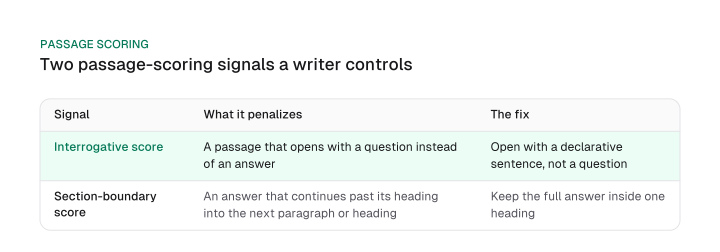
Google's own patent for scoring answer-box passages names exactly what earns a lower penalty: a declarative opener, and an answer kept inside one heading.
Patent US9940367B1, with a 2014 priority date and granted in 2018, describes how Google's classic answer-box and featured-snippet system scores a candidate passage. It predates AI Overviews, but the structural habits it rewards are what any retrieval system needs to pull a clean answer.
The interrogative score penalizes a passage that opens with a question rather than an answer. The fix is a declarative first sentence under every heading, every time.
The section-boundary score penalizes an answer that isn't finished before its heading ends, one that spills into the next paragraph or heading before it's complete. The fix there is just as direct: keep the whole answer inside the heading where it starts.
Retrieval concerns like this already reshape how pages get built, down to the sentence level. We migrated our own React single-page app to prerendered static HTML for 20 marketing pages, because AI crawlers don't execute JavaScript.
That's an infrastructure fix. The sentence-level version is the same idea: if your passage isn't structured for a machine to lift, it doesn't matter how well the page around it ranks.
That's the whole fix, in two lines:
- A declarative first sentence under every heading
- The full answer kept inside that same heading, never split across two
This isn't a reason to abandon a structure checklist. This site's own audit for that lives at the full AI SEO checklist; what the patent adds is the mechanism behind one line in it, which named signal a question opener or a split answer actually trips.
Does writing for AI Overviews mean rewriting your content in some new way? No. Google itself says there's no requirement to write differently for generative AI search, no need to chop content into tiny pieces, and no ideal page length to hit.
The structural habits above, a declarative opener and one heading per answer, are the whole difference. For the fuller playbook on winning that citation once the structure is right, see how to get cited in Google AI Overviews.
Decide how long each passage should run
Today's top 8 SEO-content-writing guides average 139 words per H2 section, a real benchmark for how long a working passage runs when it isn't a snippet-target definition.
Ten pages rank for this keyword, but only eight structure their guide with headings at all. Across those eight, the median page runs 2,078 words spread over 15 H2 sections, about 139 words for every section once you divide one by the other.
8 of today's 10 ranking guides use H2 headings. Median: 2,078 words across 15 sections, about 139 words per section.
Most seo content writing tips stop at "keep it short" without saying short compared to what. Here's the number that fills that gap.
But treat that number as a benchmark: a passage chasing a definition, a featured snippet or a "People Also Ask" slot earns its place by staying as short as the question allows, while a process, a comparison or a worked example runs as long as its own sub-question needs.
Google said as much itself in July 2026: no ideal page length, no forced chunking. That's not permission to pad. It just means the sub-question sets the length, never a word count target.
Place keywords, links and technical elements without diluting the passage
Keyword placement, internal links, alt text and E-E-A-T signals support the passage; none of them replace the one declarative answer sentence a retrieval system is scoring.
Where keywords, links and E-E-A-T actually go
Put the target keyword in the title, near the top of the page and in one heading. Everywhere else, let natural synonyms and secondary phrases do the work for you; repeating the exact phrase in every paragraph doesn't help, it just crowds out the sentence doing the actual answering.
Alt text, a clean heading hierarchy and one internal link per passage are still worth doing, they just aren't the thing being scored. Alt text should name what an image shows, not repeat the keyword a second time, for example "a table of H2 word counts across today's top guides" rather than a keyword stuffed into a caption twice.
E-E-A-T earns its place in one line, not a lecture: a named author, and a reason the page is worth trusting, is worth more than restating the acronym.
If you're using an AI drafting tool for a first pass, authorship isn't the risk to watch. The risk is whether is AI content bad for SEO applies: thin, generic passages that skip the mechanism above.
Writing the page well the first time is what this section covers. Keeping it accurate after it's live, refresh cadence and republishing decisions, is a separate job that starts once the page is out.
A before-and-after passage rewrite
Here's what that looks like in one pass.
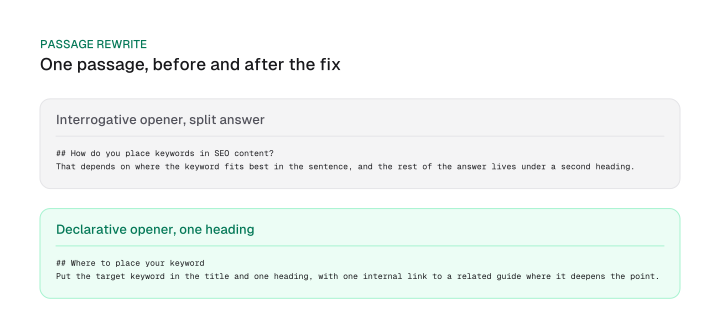
The before version opens with a question, "How do you place keywords in SEO content?" Its answer hedges instead of committing: "That depends on where the keyword fits best in the sentence, and the rest of the answer lives under a second heading."
The after version opens declaratively instead: "Where to place your keyword." The line underneath states the fix directly: "Put the target keyword in the title and one heading, with one internal link to a related guide where it deepens the point." Nothing here asks the reader a question it should be answering itself.
That's how to write SEO content that ranks and gets cited at the same time: a declarative opener under every heading, the full answer kept inside it, and a passage length that the question itself sets.
Take the last post you drafted and open it at its second heading. Read only the first sentence under it. If it asks a question instead of answering one, that's the line to fix first.
Frequently asked questions
No. Google's own July 2026 guidance says there's no requirement to write differently for generative AI search, no forced chunking and no ideal page length to hit. The declarative-opener habit above is most of what it takes to get cited by ChatGPT too.
Neither replaces the other, and you don't need both to start. The handful of structural rules in this guide, declarative openers, one sub-question per passage, cover most of what "SEO" means at the level of a single page.
In practice, none. SEO copywriting vs content writing is a distinction without a difference: both jobs need a solid grip on search intent, on-page structure and persuasive writing, and the two titles describe the same skill set under different names.
It depends on the passage. A snippet-target answer stays as short as the question allows; everything else runs as long as its sub-question needs and never gets padded to hit a count. Today's top guides average about 139 words per H2 section, useful as a benchmark for how a working passage runs.
Figures and images in this post are free to reuse under CC BY 4.0 with credit to Mission Growth.
Get Mission Growth highlighted in your Google results.