Track Perplexity Rankings: the DIY Method, Then a Tool
Track Perplexity rankings the way its own retrieval design actually works: what to log, a free 5-run DIY method, and when it needs a paid tool.
On this page
You check Google Search Console out of habit, then go looking for a way to track Perplexity rankings and find nothing: no ranked list, no position column, no dashboard that tells you where you stand.
That gap matters. Buyers now read a Perplexity answer the way they used to scan a results page, and whether your brand shows up as a clickable source or just a name in the text changes what that answer does for you.
This guide names the mechanism behind why there's nothing to look up, gives you a free method for logging what Perplexity does expose, and gives you the exact point at which logging it by hand stops being enough.
Perplexity's retrieval design, and what it means for tracking
Perplexity's own Head of Search, Denis (Alexandr) Yarats, told Unite.AI the company built "a much more compact index optimized for quality and truthfulness" instead of matching Google's index breadth.
That index is tuned to the topics people actually ask it about, and its ranking layer is designed to "natively combine the retrieval system and LLMs," optimized for helpfulness and factuality rather than click-through probability.
Perplexity co-founder and CEO Aravind Srinivas described the retrieval mechanics on the Lex Fridman Podcast: "It's not purely vector space... packing all the knowledge about a webpage into one vector space representation is very, very difficult."
Instead, Perplexity layers in BM25, "a more sophisticated version of TF-IDF," plus Ngram-based retrieval, and separately weighs "ranking signals outside of the semantic or word-based, which is page rank-like signals that score domain authority and recency."
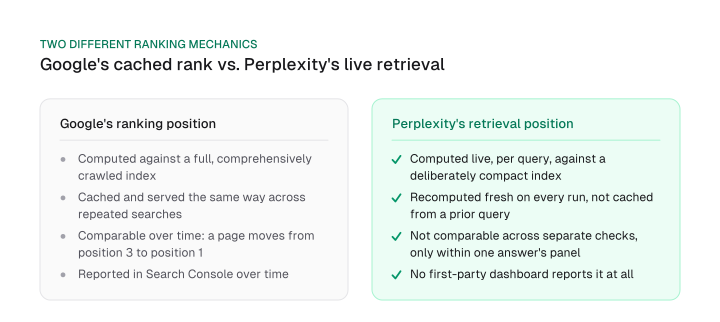
Google's classic ranking position is computed against a full, comprehensively crawled index, cached and served the same way across repeated searches. That's why it's comparable over time, a page can move from position 3 to position 1, and why Search Console can report it over time.
Perplexity's position works nothing like that: it's computed live, per query, against a deliberately compact index, and recomputed fresh on every run rather than cached from a prior query.
Put those two statements together and you get the actual mechanism, rather than only the claim that Perplexity is "non-deterministic": every query runs a live search over a small, quality-filtered index, scored with keyword-matching techniques blended with domain-authority and recency signals, recomputed fresh each time.
Nothing about that process is stored and served back to the next person who asks a similar question, the way a Google ranking position is.
That's the real reason no tool can hand you a stable #1 position for Perplexity: the retrieval that produces an answer runs fresh on every call, against a compact index, weighing recency and trust signals anew each time, rather than being looked up from a static rank table.
Once you know that's the mechanism, you know what a tracker actually has left to measure, which is what the next section logs. For the full mechanics of how that same retrieval decides which sources get cited in the first place, see the full perplexity seo guide to retrieval and indexing.
What to log instead: citation, mention, and position-in-panel
A citation in Perplexity's answer is a clickable source URL that appears in the numbered source panel. A mention is your brand named in the answer text, no link attached.
The perplexity citation vs mention distinction matters because trackers that collapse both into one "visibility" score hide which one you actually have. A citation and a mention are worth very different things to a reader deciding whether to click through.
| What it is | How to check it | What it's worth |
|---|---|---|
| Citation | A clickable source URL listed in that answer's source panel | Traffic-eligible: the reader can click straight to your page |
| Mention | Your brand or product named in the answer text, no link attached | Brand-awareness signal only, no click path |
| Position-in-panel | The citation's numbered slot within one answer's panel | Meaningful only inside that single run, not comparable across separate checks |
The two engines don't even source the same way. Profound's analysis of 680 million AI citations, collected August 2024 to June 2025, found Perplexity's top-cited source is Reddit at about 6.6% of citations, while ChatGPT's top source is Wikipedia at about 7.8% (tryprofound.com, June 2025).
Perplexity's citation pattern skews community; ChatGPT's skews authority. That's useful context for reading your own log: if you expected Wikipedia-style sources and Perplexity keeps citing forum threads instead, that's the platform's own citation philosophy showing up, not a sign your tracking sheet is broken.
If you want the fuller breakdown of how ai visibility tools handle citation source analysis across engines beyond just this one, that comparison lives on its own page.
Why GSC and GA4 alone can't show this
Google's Generative AI performance report, shipped inside Search Console, rolled out to every site worldwide as of 2026-08-31.
It reports impressions for AI Overviews and AI Mode only, Google's own AI search features, with no third-party engine named anywhere on the page (support.google.com, verified 2026-09-22).
Bing Webmaster Tools shipped a comparable dashboard of its own, called AI Performance, into public preview on 2026-02-10. It reports Total Citations, Average Cited Pages, Grounding queries and page-level citation activity, though Microsoft states plainly on its own webmaster blog that none of those numbers "indicate ranking, authority, or the role of any page."
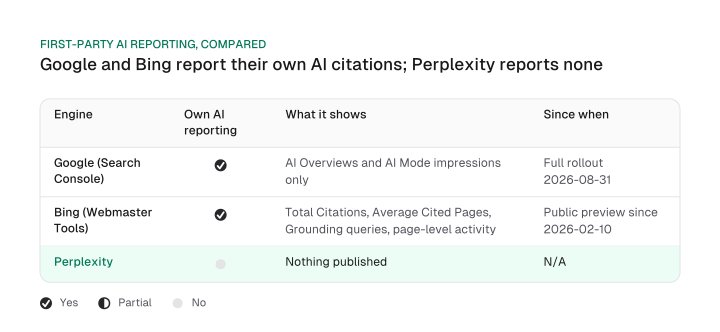
Neither dashboard reaches Perplexity by name:
- Google's Generative AI performance report: Google's own AI Overviews and AI Mode impressions only
- Bing's AI Performance dashboard: Bing's own citation and grounding activity only
Each company reports only on its own AI surfaces; Perplexity publishes no first-party dashboard of its own. Checked directly against each tool's own documentation, neither Google's nor Bing's report names Perplexity anywhere, which is the specific, current reason a manual method or a third-party tool is the only way to see this data at all.
GA4 closes a narrower, different gap. Once someone clicks a Perplexity citation through to your site, GA4 can attribute that session to Perplexity as a referral source.
That only works after the click already happened, though; it tells you nothing about the answers where you were cited or mentioned and nobody clicked. This is how to track Perplexity citations after the fact; the next section covers what to log before any click happens. For the referral-tracking setup itself, see how to get cited by perplexity ai, measured with GA4.
This same first-party blind spot shows up across AI search reporting generally, not only around Perplexity; see the wider ai search analytics gaps this report doesn't close for how it plays out on the other engines too.
Track Perplexity rankings yourself first: a free 5-run method
Track Perplexity by hand using a fixed list of 10 to 15 prompts, the same ones a buyer would plausibly type, run consistently from a dedicated or logged-out test account.
That account-and-prompt-list setup is already published, in more depth than this post needs to repeat, inside perplexity-seo's manual prompt-testing library.
What that setup doesn't include, and what neither the wider competitor field nor our own site currently covers for Perplexity, is repeating each individual prompt 3 to 5 times inside the same check, instead of running it once.
Log whether you were cited, whether you were mentioned without a citation, and the panel position for every run. Then read the result as a rate, "cited in 3 of 5 runs," rather than a single yes-or-no per prompt per cadence.
How to track chatgpt mentions, the method this adapts already applies this exact repeat-run discipline to ChatGPT; nothing on the Perplexity side of the site had adapted it until now.
| Run | Cited | Mentioned without a citation | Position |
|---|---|---|---|
| 1 | Yes | No | 2 |
| 2 | No | Yes | - |
| 3 | Yes | No | 1 |
| 4 | Yes | No | 2 |
| 5 | No | No | - |
Download CSV (CC BY 4.0)
That's the number that moves when you improve a page, not a single run's yes-or-no, and fifteen prompts is also a natural ceiling for hand tracking: the cheapest paid plan's own entry size, where the next section picks up.
When to graduate to a paid Perplexity tracker
Graduate from the spreadsheet once your prompt panel outgrows the cheapest paid tier, or once you need daily automated runs rather than a manual weekly check.
Otterly AI's own Lite plan, the entry tier in its category, caps out at 15 prompts for $29/month ($25/month billed annually), with daily tracking across four base engines: ChatGPT, Google AI Overviews, Microsoft Copilot and Perplexity (otterly.ai, verified 2026-09-22).
That 15-prompt cap is a useful line to graduate at, the industry's own smallest paid unit. Once your manual list is bigger than what the cheapest perplexity rank tracker covers, the spreadsheet is doing more work than paying for one would.
The best Perplexity mention tracker under a three-digit monthly bill is whichever of these two verified options clears your own checklist below: Otterly's Lite plan at $29/month for 15 daily-scanned prompts, or Rankability's $99/month plan, which bundles Perplexity with ChatGPT, Google AI Overviews and Gemini rather than tracking it alone.
Before paying for any perplexity rank tracking tool, verify these four things it actually does, rather than what it claims to do:
| Criterion | What to check | Why it matters |
|---|---|---|
| Citation-level reporting | Does it report the citation URL itself, instead of only an "appeared" flag | An appeared flag hides whether you got a citation or only a mention |
| Citation vs. mention kept separate | Does it report the two separately, or fold them into one score | A combined score hides which one you actually have |
| Scan cadence | Daily vs. weekly, and whether the interval is yours to set | Live, per-query retrieval (the mechanism above) means a stale cadence misses real swings |
| Prompt-volume ceiling vs. price | How many prompts the plan allows, at what price | Otterly's Lite plan: $29/month for 15 prompts; Rankability's $99/month plan: bundles Perplexity with ChatGPT, Google AI Overviews and Gemini, cancel anytime (rankability.com, verified 2026-09-22) |
Download CSV (CC BY 4.0)
For a full side-by-side across every tool and tier, see the full best ai rank tracking comparison. Otterly and Rankability appear here only as two verified price anchors. Mission Growth's platform also tracks AI citations and visibility for customers, alongside those two examples.
How this differs from tracking ChatGPT or Claude: Perplexity always shows an ordered, visible source panel attached to a given answer. Its own citation habits also skew community rather than authority, per the same Profound data above for ChatGPT specifically (Reddit at roughly 6.6% of Perplexity's citations against Wikipedia at roughly 7.8% of ChatGPT's).
A tool built primarily around ChatGPT's authority-source pattern may not weight a forum-thread citation from Perplexity the same way, which is worth asking about directly before you buy.
Four dimensions move differently across engines: position, citation frequency, mention frequency and source mix. Perplexity's panel is always visible and ordered, where other chat engines are less consistent about showing one at all, and citation and mention are worth logging separately on any of them, for the reasons above.
Source mix is the fourth dimension: Reddit-heavy on Perplexity, Wikipedia-heavy on ChatGPT. A tracker tuned for one engine's mix of these four can misread another's.
Frequently asked questions
No. Search Console's Generative AI performance report only covers impressions for Google's own AI Overviews and AI Mode; it names no other AI engine, including Perplexity.
Most trackers bundle Perplexity in with several other engines on the same plan. Otterly's Lite tier, for example, covers four engines including Perplexity for one price, and Rankability's $99/month plan bundles Perplexity with ChatGPT, Google AI Overviews and Gemini rather than tracking it alone. A genuinely Perplexity-only tool is rare, and most buyers don't need one anyway.
Perplexity is one of several AI search engines readers now use alongside ChatGPT search, Google AI Mode and Copilot; this page covers Perplexity-specific tracking mechanics only, not how the engines compare as a category.
Yes. Perplexity always shows an ordered, visible source panel attached to its answer, and it cites community sources like Reddit noticeably more than ChatGPT, which skews toward authority sources like Wikipedia. A single tracking method tuned for one engine won't automatically read the other correctly.
A tracker can show you the citation's URL and domain, nothing more, because that's all Perplexity's retrieval hands back: it recomputes the answer live per query rather than storing a ranking formula a tool could read the reasoning out of. Figuring out why a competitor's page won that slot instead of yours is a manual comparison you do yourself: open both pages side by side and check for the freshness, domain-authority and format signals the mechanism above weighs.
A free Perplexity rank tracker exists as a one-time checker, giving you a single snapshot across engines, which is useful for a quick baseline. It won't give you the repeat-run citation rate this page's method produces; for that, or for ongoing tracking, you need the DIY method above or a paid plan.
Perplexity not having a numbered rank was never the finding here; two competitor pages and Google's own AI Overview already say as much. What actually determines whether you can use the citation and mention data Perplexity does expose is running the same prompt panel enough times to read a rate instead of a guess, and knowing precisely which of Google's or Bing's dashboards do, and firmly don't, cover it.
Start this week: pick your 10 to 15 prompts, run each one 3 to 5 times, and log citation URL, mention text and position per run. Once that list outgrows Otterly's 15-prompt entry tier, or you need daily runs instead of weekly ones, that's your signal to pay for automation instead of your own time.
Figures and images in this post are free to reuse under CC BY 4.0 with credit to Mission Growth.
Get Mission Growth highlighted in your Google results.