Gemini Visibility Tracker: 11 Tools to Track Brand Mentions
A Gemini visibility tracker guide: what these tools measure, what Search Console can't show you, and 11 vendors compared on verified 2026 pricing.

On this page
A peer-reviewed 2026 study puts the overlap between what Google Search, AI Overviews and Gemini actually cite at just 0.11 to 0.18 Jaccard similarity, across every pair.
Google's own Search Console reporting stops at AI Overviews and AI Mode. A brand can rank #1 there, look clean in its AI report, and still be structurally invisible in Google's Gemini app. Zero first-party signal warns them.
A Gemini visibility tracker is the tool built to close that gap. It runs a fixed prompt panel against Gemini on a schedule, scored for mentions, citations and position.
Whether you already run an AI visibility tracker for ChatGPT or AI Overviews and are deciding if Gemini needs its own, or you're starting from zero, the setup below gets you there.
In this guide:
- What a Gemini visibility tracker measures, and why it needs separate tracking
- How to read mention rate, citation rate, position and share of voice in Gemini
- How often to check, given how fast Gemini's cited sources turn over
- Every leading tool compared on verified September 2026 pricing
What a Gemini visibility tracker measures, and why Gemini needs its own
A Gemini visibility tracker runs a fixed set of prompts against Google's Gemini app, then records whether your brand is mentioned, which URL gets cited, and its position.
It's a distinct category because Gemini cites a measurably different set of sources than Google Search or AI Overviews do. Run weekly, a tracker builds its picture from four raw signals:
- Mention. Whether the answer names your brand at all, with or without a linked source.
- Citation. Which URL, if any, Gemini attaches as a source for that mention.
- Position. Where that citation sits among Gemini's numbered sources.
- Trend. How mention, citation and position move across several weekly runs; a single run can look like an anomaly.
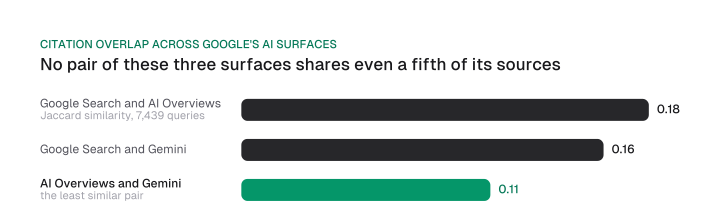
Gemini's citation set isn't a coincidence of formatting. A 2026 SIGIR paper compared the source lists Google Search, AI Overviews and Gemini 2.5 Flash returned for 7,439 real queries. It scored each pair's overlap with Jaccard similarity, the share of sources both surfaces returned divided by the share either one returned.
Google Search and AI Overviews overlap the most, at 0.18. Search and Gemini overlap at 0.16. AI Overviews and Gemini, the two surfaces built by the same company, overlap the least, at 0.11 (Grossman et al., SIGIR 2026).
The AIO-Gemini number is the one worth sitting with: AI Overviews runs on a lightweight Gemini model, and its source list still looks less like Gemini's own than Google's classic organic results do.
"Despite AIO being built with a lightweight Gemini model, the source lists retrieved by AIO and Gemini are the least similar."
Gemini's citation mix skews toward editorial content, too. In a proprietary sample of over 300,000 citations, blog, article and news pages accounted for 32.7% of sources, review and comparison pages another 12.2%, and product, pricing or FAQ pages under 0.6% combined.
A page built like a pricing sheet starts from a much smaller share of the pie than a page built like an explainer. That's exactly what gemini citation tracking has to account for.
The same distinction holds against other engines. Each one draws from its own source mix, so a page built to get cited in one doesn't automatically get cited in the others; see the best ChatGPT SEO tools for that engine's own picks.
One proprietary citation database also shows Gemini pulling in YouTube as a source about a fifth as often as AI Overviews or AI Mode do. It reportedly cited LinkedIn nine times over that same four-week window, per that database, another reason a citation strategy built for one Google AI surface won't transfer cleanly here.
None of this shows up where most teams already look. Google Search Console's generative AI performance report covers impressions for AI Overviews and AI Mode on Search only; it names no line item for the Gemini app, by Google's own Search Console Help documentation.
Ranking #1 in Search and a clean Search Console AI report tell you nothing about whether Gemini mentions you, because the two systems each measure a different overlap band.
The reverse holds too: showing up more in Gemini doesn't move where you rank in classic Google Search, since the two systems draw on separate signals. Our gemini SEO playbook covers how to get cited by Gemini once you know the gap exists.
Measuring that gap comes first, including whether what looks like a gemini rank tracker is even measuring rank at all. It isn't: Gemini has no ranked SERP position, only numbered citations.
The stakes are also moving in one direction only. Google's Gemini app crossed 1 billion monthly active users in August 2026, by Google's own account the fastest-growing product in Google's history.
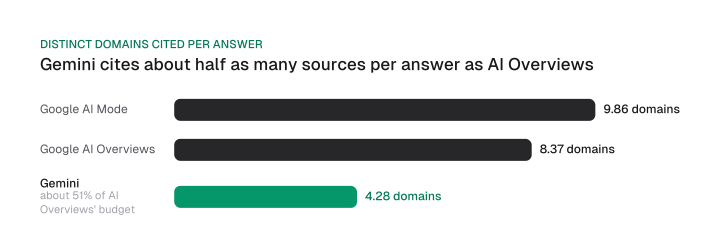
Its reported citation budget hasn't grown to match. Gemini's own reported figure sits at 4.28 distinct domains for every answer, compared with 8.37 for AI Overviews and 9.86 for AI Mode.
That's roughly half of AI Overviews' budget (4.28 of 8.37) and 43% of AI Mode's (4.28 of 9.86). Reach and citation budget are not the same curve: one keeps climbing, the other has barely moved, and a bigger audience competing for a narrower set of citation slots is the real case for tracking gemini ai search visibility on its own terms.
Some of this confusion comes from lumping Gemini in with Google's other AI surfaces. AI Mode is a separate assistant layer inside Search; see how Google AI Mode itself works for its own retrieval mechanics. This piece only compares its citation numbers to Gemini's.
Most Gemini trackers also cover Workspace-style prompts, inside Gmail, Docs or Sheets, alongside the standalone app and mobile. A single dashboard tracking gemini brand mentions can capture where your brand shows up across surfaces without a second tool.
Before you buy, check that a tool actually samples Workspace-style prompts and not only the consumer app. The two are easy to conflate inside one dashboard, and a tool that only covers the app misses half the picture for a B2B brand whose buyers live in Workspace.
For the fuller AI SEO trends 2026 picture, including where Gemini fits alongside AI Overviews as a third answer surface, that roundup covers the wider context.
How to read a Gemini visibility number, and how often to check it
A Gemini tracker's headline number is one of four things: mention rate, citation rate, citation position or share of voice.
They disagree often enough to change what you do next. Before you act on a dashboard number, know which of the four it actually is:
- Mention rate. The share of tracked prompts where Gemini names your brand at all, with or without a link attached.
- Citation rate. The share of prompts where Gemini attaches your URL as a source, a stricter bar than a name-only mention.
- Citation position. Where your citation sits among Gemini's numbered sources; virtually every citation carries one (100% do, and about 85% land within positions 1 to 10).
- Share of voice. Your citations as a share of every citation Gemini hands out for the topic, the only one of the four measured relative to competitors.
Read position alongside mention rate before deciding a gap is real. A high mention rate paired with a weak position means Gemini knows your brand but doesn't trust it as a primary source. A low mention rate paired with a strong position, on the few prompts where you do appear, means the opposite problem: narrow reach.
Treating either number alone as "visibility" hides which fix actually applies. Read position and mention rate together, every time.
Here's the difference in practice. Take a hypothetical 50 tracked prompts for a mid-size SaaS brand. Suppose Gemini mentions the brand in 14 of them, a count that looks respectable read alone.
Only 9 of those 14 carry a citation inside the top 5 positions. The count that actually matters, one a searcher is likely to click, is 9. The other 5 mentions are name-only, with no linked source, and a mention-rate-only dashboard counts all 14 the same way.
Check every week; a month is too slow. Of 1,795 tracked prompts, 19.8% held onto the same top-cited source across an entire month; the remaining 80% swapped it out at least once.
In any single tracked week, 40.5% of cited domains were fresh appearances. A monthly snapshot misses most of that churn, and a dashboard reading you trust for a full month is usually already stale by week two.
Run the same prompt panel by country and language if your market is global. Gemini's cited sources shift by locale the way Search results do, so a US-only prompt set can miss a gap that's showing up clearly in another market. If you're tracking more engines than Gemini alone, the best AI rank tracking tools covers the cross-engine picture.
The best Gemini visibility trackers, compared
Omnia, GEOflux and PromptRush are the strongest dedicated picks. SE Ranking and RankZero fit best if you already track other engines from one dashboard.
Mission Growth fits teams that want the tracking handled as part of a managed service instead of another self-serve seat.
If Gemini is one of several engines you're tracking, the broader AI visibility tools category covers vendors across ChatGPT, Perplexity and Gemini together.
Checking that verdict means opening ten pricing pages directly instead of trusting what one vendor says about another. No single one of these ten pages puts all ten real, current prices in one place, cross-checked against each vendor's own page rather than reprinted from somewhere else.
That gap shows why the check matters. Omnia's own comparison table misquotes SE Ranking's price outright: wrong currency, and wrong amount. SE Ranking's own pricing page states $129 a month, or $103.20 billed annually, the number worth trusting instead of a rival's secondhand quote.
| Tool | Entry price | Notes | Best for |
|---|---|---|---|
| Omnia | €79/month (Growth) | Its Omnio layer turns a citation gap into a content brief | Teams that want the tracking tool to also assign the fix |
| GEOflux | $99/month (Starter, up to 50 prompts) | Publishes its own session-capture methodology alongside the dashboard | Teams that want to see how the number was produced |
| PromptRush | $19/month (Lite) | Prompt-level tracking with paraphrase variants, not single keywords | Budget-conscious teams running their first Gemini tracker |
| SE Ranking | $129/month ($103.20/month billed annually, Core) | Folds Gemini into an existing classic SEO toolkit | Teams already standardized on SE Ranking for organic |
| RankZero | €29/month (Lite) | Widest single-dashboard coverage here: ChatGPT, Perplexity, Google AI, Claude, Gemini | Teams tracking Gemini alongside four other engines |
| Peec AI | Not publicly listed (Starter, Pro, Advanced, Enterprise tiers named) | Citation intelligence: sentiment and framing insight alongside presence | Teams that need to know how Gemini frames them, and not only if it does |
| GetMint | €74/month (Starter) | Growth tier at €299/month | Teams wanting a European-priced entry point |
| Arvow | $39/month promotional, $69/month regular (Solo) | Gemini tracking bundled inside a broader AI content and SEO platform | Teams that want tracking inside a bigger toolkit, not standalone |
| SearchScore | £49/month (Starter tracker tier) | A free audit tier is available before committing to a paid plan | Teams wanting a low-commitment first look |
| ChatObserver | $99/month (Starter) | Pro and Business tiers run $279/month and $699/month | Teams with more prompts or seats to track than the entry tier covers |
| Mission Growth (our platform) | Monthly fee, quoted after an audit | AI monitoring plus expert strategy and execution for SEO and GEO | Teams that want Gemini tracking delivered as part of a managed service |
Download CSV (CC BY 4.0)
Omnia
Best for: teams that want the tracking tool to also assign the fix.
Omnia is the strongest all-in-one pick if you want a citation gap turned into an assignment instead of a bare number. Its Omnio layer takes a prompt where you're absent and turns that gap directly into a content brief, so tracking and the next action live in one place.
Price: €79/month (Growth).
GEOflux
Best for: teams that want to see how the tracking number was produced.
GEOflux is the pick for teams that want to understand the method behind the score before trusting it. It publishes its own session-capture methodology narrative alongside the dashboard, instead of presenting citation numbers as a black box.
Price: $99/month (Starter, up to 50 tracked prompts).
PromptRush
Best for: budget-conscious teams running their first Gemini tracker.
PromptRush is the pick for teams starting Gemini tracking on a tight budget. It tracks at the prompt level with paraphrase variants rather than single keyword-style prompts, closer to how people actually phrase questions to Gemini.
Price: $19/month (Lite).
SE Ranking
Best for: teams already standardized on SE Ranking for organic tracking.
SE Ranking is the pick if you already run it for classic SEO and want Gemini folded into the same toolkit instead of a new login.
Price: $129/month, or $103.20/month billed annually (Core).
RankZero
Best for: teams tracking Gemini alongside four other engines.
RankZero covers the widest single dashboard here: ChatGPT, Perplexity, Google AI, Claude and Gemini together. That makes it the pick when Gemini is one engine among several you need in one view.
Price: €29/month (Lite).
Peec AI
Best for: teams that need to know how Gemini talks about them, and not only whether it does.
Peec AI goes past presence into citation intelligence: sentiment and how Gemini frames your brand.
Price: not publicly listed (Starter, Pro, Advanced and Enterprise tiers named, unpriced on its own pricing page).
GetMint
Best for: teams wanting a European-priced entry point.
GetMint's Starter tier sits at €74/month, with a Growth tier at €299/month for teams that outgrow it.
Price: €74/month (Starter).
Arvow
Best for: teams that want Gemini tracking folded into a bigger content platform rather than run as a standalone tool.
Arvow bundles Gemini tracking inside a broader AI content and SEO platform rather than shipping it as a dedicated tool. Its listed prices are promotional: the $39/month Solo rate runs against a $69/month regular price, so budget for the regular rate once the promotion ends.
Price: $39/month promotional, $69/month regular (Solo).
SearchScore
Best for: teams wanting a low-commitment first look at their numbers.
SearchScore's Starter tracker tier runs £49/month, with a free audit tier available separately if you want a look before committing to a plan.
Price: £49/month (Starter tracker tier).
ChatObserver
Best for: teams comparing entry price against SE Ranking's similarly priced tier.
ChatObserver's Starter plan opens at $99/month, with Pro and Business tiers running $279/month and $699/month for teams that need more tracked prompts or seats.
Price: $99/month (Starter).
Mission Growth (our platform)
Best for: teams that want Gemini tracking delivered as part of a managed AI-led SEO and GEO service rather than run themselves.
We're an AI-led SEO and GEO growth service: AI catches the signal, our experts make the move, and you see the result. Our platform tracks AI citations and visibility for customers, and we deliver Gemini tracking as part of a managed engagement instead of another seat your team has to run.
Price: Monthly fee, quoted after an audit.
Gemini's citation set overlaps with Google Search by just 0.16 Jaccard similarity, and Search Console doesn't track the Gemini app at all, so a dedicated tracker is the only way to know where you actually stand. Pick one from the table above, point it at your brand and the prompts that matter most, and run the first weekly check before assuming the gap isn't there.
Frequently asked questions
No. Search Console's generative AI performance report covers impressions for AI Overviews and AI Mode on Search; it names no line item for the Gemini app, so a clean Search Console AI report carries zero first-party signal about whether Gemini mentions you at all.
Coverage varies. Several trackers, including GEOflux and Omnia, log the specific cited URLs and domains behind each answer rather than reporting a bare score, so you can see exactly which source Gemini picked and check it yourself.
Keep it for keyword research and organic rank tracking. Add a dedicated Gemini tracker on top for citation and position data neither product currently reports; the two jobs don't overlap enough to drop one for the other.
Some tools do, including RankZero, GEOflux and ChatObserver. Since the two engines cite different source sets, read their numbers as two separate metrics inside one dashboard rather than one blended visibility score.
No. Every Gemini citation carries a numbered position, but that position reflects Gemini's own source selection, which overlaps with organic Google Search results by only 0.16 Jaccard similarity, a different system measuring a different thing.
Figures and images in this post are free to reuse under CC BY 4.0 with credit to Mission Growth.
Get Mission Growth highlighted in your Google results.