Best ChatGPT Rank Tracker Tools 2026: 16 Compared by Price
Best ChatGPT rank tracker tools compared by price, prompts and run depth, plus free checkers and the run math that shows whether a tracker's number holds.

On this page
A ChatGPT SEO tracker sells a visibility rate, and so does every ChatGPT rank tracker. ChatGPT has no fixed position to read, so each tool reports how often your brand shows up when it runs your prompts again and again.
That changes how you compare them. Sticker prices hide the two numbers that matter: how many five-prompt topics a plan covers and how many times each prompt runs a month.
This page helps you pick the best ChatGPT rank tracker: it prices 15 trackers on those terms, shows the run math behind a number you can defend, and lists five things to ask a vendor before you pay.
Best ChatGPT rank trackers compared: price, prompts and free options
A ChatGPT SEO tracker fits when its topic count and run cadence match your panel.
Here is the short version: Geoptie Starter for 3 topics, Otterly Lite for 4, Peec AI, AIclicks or LLM Pulse for 6 to 10, SE Ranking AI Visibility for 15, Rankability for 20, LLMrefs when you want 100 weekly.
The table puts every plan on the same unit. A five-prompt topic is five prompts about one subject, and the price per topic is the monthly price divided by the number of topics the plan holds.
Download CSV (CC BY 4.0)
Three conclusions come out of this ChatGPT rank tracker pricing table. Price per topic runs from $0.79 to $34.50, with an $8.38 median across the 12 dollar-priced plans.
The cheapest plans per topic are the weekly or keyword-first ones (LLMrefs and, in euros, LLM Pulse), so topics and runs have to be read together. And the credit plans from Rankscale, Ahrefs and AthenaHQ are conversions that assume every credit goes to daily ChatGPT runs.

Euro and dollar prices are never converted here, so LLM Pulse and Omnia sit outside the median. If you want to use ChatGPT for SEO work instead of measuring it, the guide to ChatGPT SEO tools covers that job.
How these ChatGPT trackers were compared
Fifteen ChatGPT trackers were compared on each vendor's published entry plan, using public pricing and product pages checked in October 2026.
A ChatGPT rank tracking tool made the list when its public pages state a plan that covers ChatGPT. There is no hands-on scoring, so nothing here is a test result.
Five criteria shaped the table:
- Entry price: the cheapest plan that tracks ChatGPT, in the currency the vendor charges.
- Prompts: the allowance as the vendor states it, converted to five-prompt topics.
- Five-prompt topics: one topic is five prompts about one subject, the definition, comparison, alternatives, use case and buying question that Semrush uses in its 2026 topic study.
- Runs per prompt: how often each prompt runs in a month, from the stated cadence.
- Disclosures: whether the vendor says how it collects ChatGPT answers.
Price per topic is the plan's monthly dollar price divided by the five-prompt topics it holds. Across the 12 dollar-priced plans it runs from $0.79 at LLMrefs to $34.50 at Morningscore Lite, with a median of $8.38, which is why the table sorts on it instead of on the sticker price.
We use prompts per topic and runs per prompt as the unit because a tracker that cannot state them sells a number without conditions. The margin of error for a rate comes from the standard confidence interval for a proportion, explained in the run math below.
The last card covers Mission Growth, the platform we built. Profound publishes no price, so it has a card but no price per topic.
What a ChatGPT rank tracker measures
A ChatGPT rank tracker reports how often your brand appears across repeated runs of a prompt, a visibility rate with no position to read.
Each run is one answer produced under a set of switches: whether ChatGPT searched, what query it rewrote, the approximate location, signed-in state and saved memories.
OpenAI's own help page spells out the switches. ChatGPT may search the web automatically when a question benefits from current information, so search is not always on.
When it does search, it typically rewrites your query into one or more targeted queries. If memory is enabled, saved memories can shape that rewrite.
Location comes from the IP address: ChatGPT may use an approximate location based on it, and a VPN or network location can change that. People who are not signed in can also use web search.
Each switch is a way for two runs of the same prompt to differ, and any ChatGPT visibility tracker inherits that spread. And a tracker's servers sit in some country, with some account state, whether the vendor says so or not.
Here is how that differs from a Google rank tracker:
One draw is not much. SparkToro's January 2026 study gave 600 volunteers 12 prompts across 3 tools, for 2,961 runs, and found fewer than 1 in 100 chance that two responses give the same list of brands.
Its hospital example shows the cost of reading position. A Los Angeles hospital was named in 69 of 71 ChatGPT answers, a 97% visibility rate, yet it was the top mention in only 25 of them.
So buy on presence rate and read the position inside an answer as colour. Presence survived the noise; position did not.
The tracking itself comes in a few kinds:
- Citation tracking: whether ChatGPT links to your pages as a source.
- Mention tracking: what a ChatGPT mentions tracker records, whether ChatGPT names your brand in the answer, with or without a link.
- Prompt-level tracking: a fixed list of prompts run on a schedule, which is what the plans in the table sell.
- Crawler tracking: whether AI crawlers fetch your pages, a different signal from what ChatGPT says.
Which sources ChatGPT trusts is a separate question from measuring it, and one that decides whether the prompts you track ever name you. The recommendation side is covered in how ChatGPT SEO decides what to recommend.
Citations are the other half: once the tracker shows where you stand, the playbook to get cited by ChatGPT tells you what to change.
How many runs a ChatGPT tracker needs per prompt
A ChatGPT tracker needs 60 to 100 runs per prompt for a stable brand list, and a daily prompt reaches only 30 runs a month.
That leaves a margin of error near 18 points, while a weekly prompt gets about 4 runs and a margin near 35.
The 60 to 100 advice is SparkToro's. The margins are ours: a confidence interval at a 50% rate, which is the worst case, with a Wilson interval at the 4 and 5 run counts where the plain formula breaks down. Every margin below holds only if runs are independent draws.

Download CSV (CC BY 4.0)
Cadence, not price, decides precision. Here is where each tracker's stated cadence puts a prompt:
LLM Pulse states 50 AI responses per week per model for 50 prompts on Starter. That works out to one run per prompt per model per week, or about 4 runs a month. Morningscore states weekly lookups, so its 10 prompts get the same. To decide how many prompts a plan like that must cover, see best AEO prompts and the sizing arithmetic behind each count.
A worked example shows what the margin means. A brand named in 12 of 30 runs has a 40% visibility rate with a margin of 17.5 points, so the true rate could sit 17.5 points either side of it. Run the same prompt 5 times and the margin is 33 points, which is why "5 runs is enough" is a habit worth dropping.
Panels fix part of this. Pool 20 prompts run daily and you have 600 runs a month, a margin near 4 points. One five-prompt topic run daily pools 150 runs, near 8 points, and 50 prompts daily pool 1,500 runs, near 2.5 points.
But pooling works only if the prompts are about one topic. Twenty unrelated prompts averaged together measure nothing, which is why the unit is the topic.
Dividing price by cadence reorders the table. LLMrefs is cheaper per topic ($0.79 against $3.09 for Rankscale Pro), but per topic and per run Rankscale Pro costs $0.10 against $0.20 for LLMrefs, and Peec AI costs $0.32. LLMrefs tracks keywords and generates prompts, and the $0.79 counts its 500-prompt allowance literally as 100 topics, so read it as a floor price.

Weekly plans cannot give one prompt a usable rate in a month. Read them as a topic-level trend. The free manual method sits at the other end, where 3 to 5 runs is the hand-check floor.
Five disclosures that make a tracker's number readable
A tracker's ChatGPT number is readable only when the vendor states five things.
They are whether the run used web search, which country it ran from, signed-in and memory state, whether the answer came from the ChatGPT interface or an API, and how many runs stand behind each rate.
Here are the five disclosures, each with the reason it moves the number:
- Web search on or off. ChatGPT does not always search, so a run without search draws on a different source than one with it.
- Which country the queries run from. A tracker queries ChatGPT from its own servers or proxies, ChatGPT may use an approximate location based on the IP address, and a VPN or network location can change it.
- Signed-in and memory state. Saved memories can shape a rewritten query, and signed-out users can search too.
- ChatGPT interface or API. The two paths can return different answers, so the number describes whichever one the vendor uses.
- Runs per prompt. The margin of error above depends on it.

Only 3 of the 15 vendor pages say how they collect ChatGPT answers. Ask the other 12 for all five in the sales chat before paying.
This is what the three that do say:
The rest disclose cadence at best. A page that gives a prompt count and a price but no collection method leaves you to guess which of the five switches it flipped. And Geoptie counts each country as a separate prompt, so three markets use three of your 15 prompts.
How to track ChatGPT rankings with a panel you can afford
To track ChatGPT rankings, build the panel as five-prompt topics (definition, comparison, alternatives, use case, buying question), run each prompt daily, and read topic ownership instead of single-prompt wins.
Here is how to set it up:
- Pick topics. Choose the subjects a buyer asks ChatGPT about before choosing in your category.
- Write five prompts per topic. Cover the definition, comparison, alternatives, use case and buying question.
- Run each prompt daily. That gives 30 runs per prompt a month and the pooled margins above.
- Report the topic. Count the brand as leading only when it appears in 4 of 5 prompts with a 5-point lead.
That ownership rule comes from a Semrush study of 1,094 US categories tracked monthly in ChatGPT from January through June 2026, using its own toolkit data. It is one vendor's study, but its numbers show why single prompts mislead.
Only 15.2% of categories had a clear owner. Where the leader flipped, the median lead was 1.3 points; where it held, 2.9.

Semrush's leads are share-of-mentions points, a different quantity from an appearance rate, so they set a scale and not a count. Telling a hypothetical 3-point difference between two brands' appearance rates from noise would take about 2,100 runs per brand, and about 11,000 for 1.3 points. That is a formula on an assumed gap, and Semrush never measured it.
No single prompt gets that many runs in months. So size the panel to the decision you must defend, and report topics.
A worked sizing example: four topics of five prompts is 20 prompts. Run daily, that is 600 runs a month and a pooled margin near 4 points, if the prompts are one topic.
Plans that state a prompt allowance of 20 or more are LLMrefs (500), Rankability Starter (100), SE Ranking AI Visibility (75), Peec AI (50), LLM Pulse (50, roughly weekly), AIclicks Starter (30), Omnia (25), Semrush Base (25), SE Ranking Core (25) and Otterly Lite (20, counted on its minimum 3 engines). Geoptie Starter holds 15, so it does not.
Composite scores are a different product from per-topic rates. To run the panel by hand first, track ChatGPT mentions manually for a month.
The 15 ChatGPT SEO trackers, one by one
The 15 trackers fall into five groups.
The groups are small daily panels (Otterly, Geoptie, AIclicks, Omnia, Peec), weekly or keyword-first plans (LLM Pulse, Morningscore, LLMrefs), flexible and credit-metered plans (Rankability, Rankscale, Ahrefs, AthenaHQ), suite plans (SE Ranking, Semrush) and an enterprise platform (Profound).

No tracker wins every row. Each verdict follows the decision table at the end. Where a tracker also reports competitor mentions and share of voice, treat those as more reads of the same sampled answers, so the margin of error applies to them too.
Otterly.ai
Best for: a first panel of 4 topics, daily, at the lowest entry price.
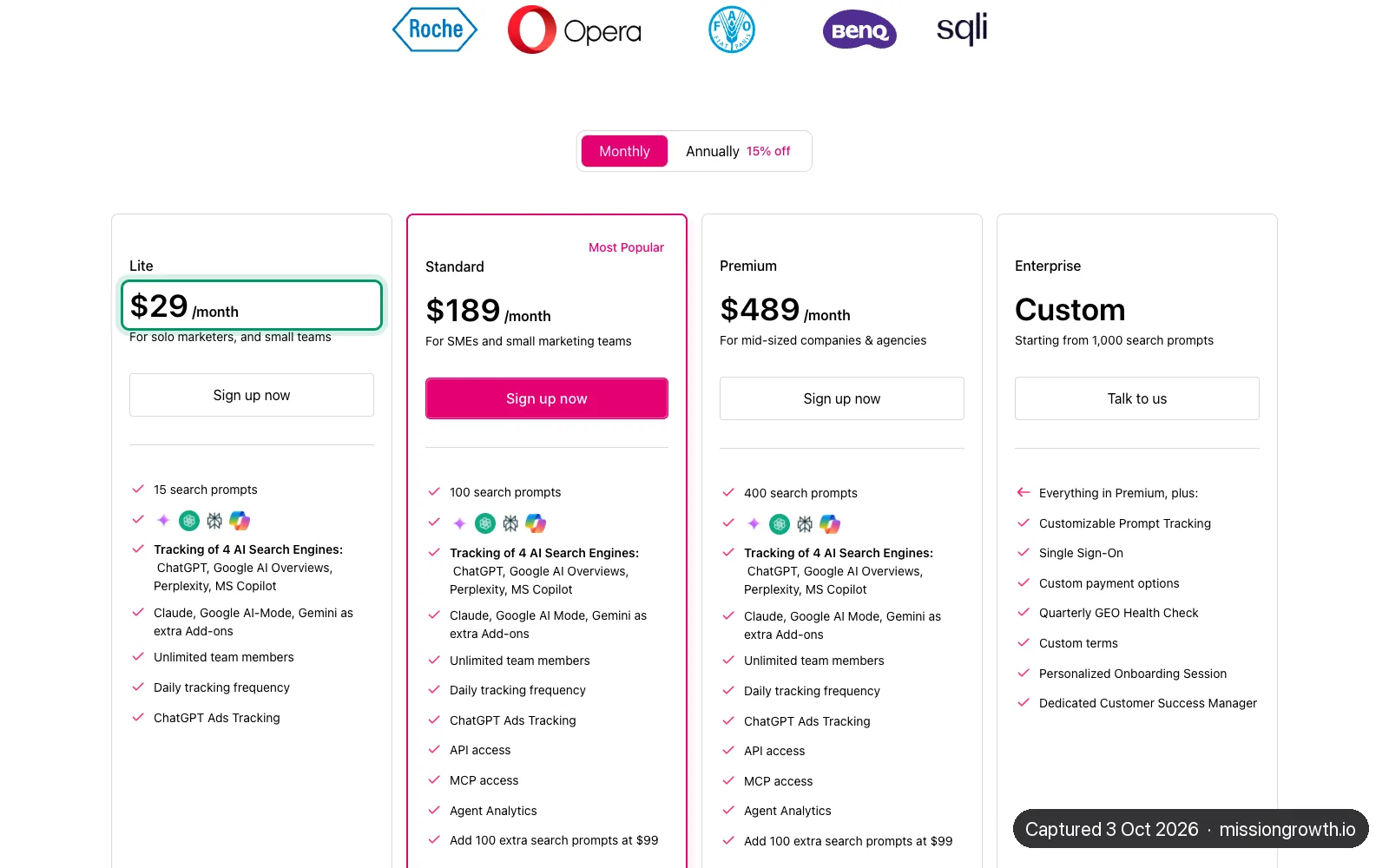
Otterly.ai is the cheapest way to start a daily ChatGPT panel, at $29 for 20 prompts on Lite. The Standard plan holds 160 prompts at $189 and Premium 535 at $489, all counted on the minimum 3 engines.
At $29 for 20 prompts the sticker is the lowest in the table, and at $7.25 per topic for 4 topics it also undercuts Peec AI ($9.50) and AIclicks ($9.83), though it buys a smaller panel. Daily runs give each prompt 30 runs a month and a margin of error near 18 points.
Engines come from a selector of seven: ChatGPT, Google AI Overviews, Perplexity, Microsoft Copilot, Google AI Mode, Gemini and Claude. Every plan can track any of them, each engine spends credits, and at least 3 must stay selected.
The listed prompt counts assume those 3, so more engines spread the same credits over fewer prompts, and each Claude answer counts as 3 credits against 1 for the others. Geoptie's roundup says of Otterly:
Claude is not supported on any tier
Otterly's own pricing page says otherwise: Claude is on the selector for every plan, so recount the prompts after you pick your engines, and budget 3 credits per Claude answer, before you compare.
Setup is the easy part. G2 reviewers rate Otterly highest for its clean dashboard and quick onboarding, and several praise responsive support and the onboarding session (a group session on Lite and Standard, a personal one on Premium and Enterprise). The drawbacks they repeat are thin report customisation, limited filtering and historical granularity, and a refresh that slows down when you track several domains.
Plan limits shape the choice more than the sticker does. Lite allows one workspace and no extra prompts, so growing a panel means jumping to Standard, which a few G2 reviewers found a large step. Standard adds the public API, an MCP connection and a Looker Studio connector, which matter if you want results in your own reporting. Agencies can apply to a partner program with client workspaces.
Pros:
- Lowest entry price in the table, tracked daily.
- A free trial for new users.
Cons:
- 20 prompts is 4 topics, and the count falls as you pick more engines.
- A G2 reviewer in June 2026 found it not always clear what actions follow from the findings.
Price: $29 a month (Lite); $189 (Standard); $489 (Premium)
Geoptie
Best for: any 4 of 7 engines from the entry plan, with per-country tracking.
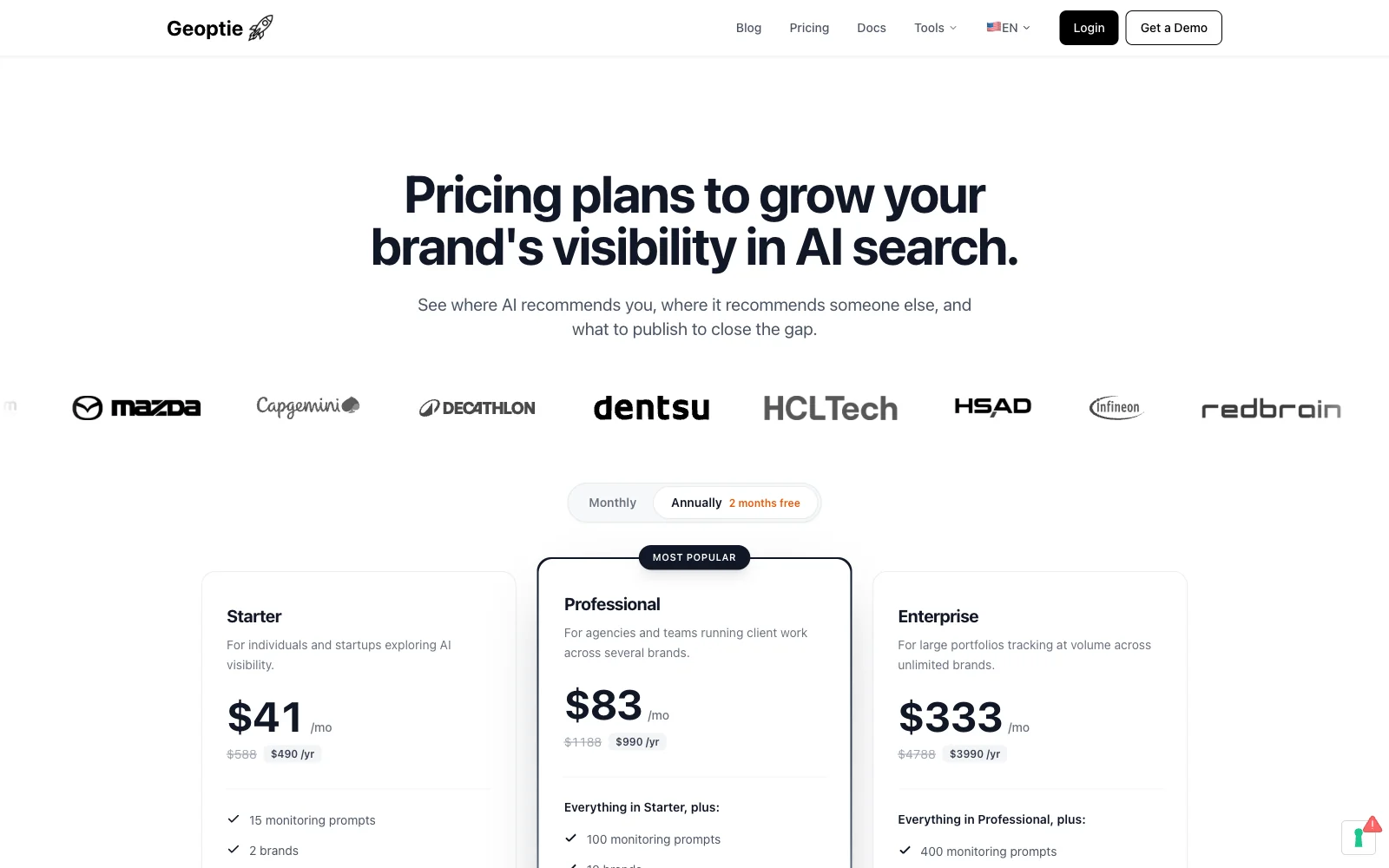
Geoptie is the pick if you want engine choice from the first plan: every plan tracks four engines of your choosing per brand. Starter costs $49 a month for 15 prompts and 2 brands, or $41 on annual billing.
It also runs a free ChatGPT tracker, covered in the free routes below.
Per-country tracking is the reason to look at it, and it is also where the allowance goes: Geoptie bills each country as its own prompt, so one question watched in three countries spends three of your 15. At $16.33 per topic it costs more than Otterly Lite, which holds 20 prompts against Geoptie's 15, so the extra pays for engine choice and the free tool.
The free tool and the paid platform do different jobs. The free ChatGPT rank tracker runs a single query for the brand and category it infers from your domain, then reports whether you are mentioned, which competitors appear and where you sit inside that answer. It's a one-off check. Scheduled tracking with trends and exports, covering ChatGPT, Perplexity, Claude, Gemini and AI Overviews, belongs to the paid platform.
Location coverage is wide: Geoptie lists 123 markets, or global, so you can check a prompt for the country that matters to you. Every plan exports a PDF brand report and a CSV; white-label reports, the REST API and an MCP server start on Professional. Geoptie doesn't say whether it collects answers from the interfaces or through APIs, so ask before you put its numbers in a client report.
There's no free trial on the pricing page, so use the free tracker as your trial: run your brand through it, note which competitors it names, and compare that with what you see when you ask ChatGPT yourself.
Pros:
- Any 4 of 7 engines per brand on every plan.
- A free tracker with no signup.
Cons:
- 15 prompts is 3 topics.
- Each country multiplies prompts: three countries use three prompts.
Price: $49 a month (Starter), $41 on annual billing
AIclicks
Best for: 30 prompts, daily, with interface-based collection.
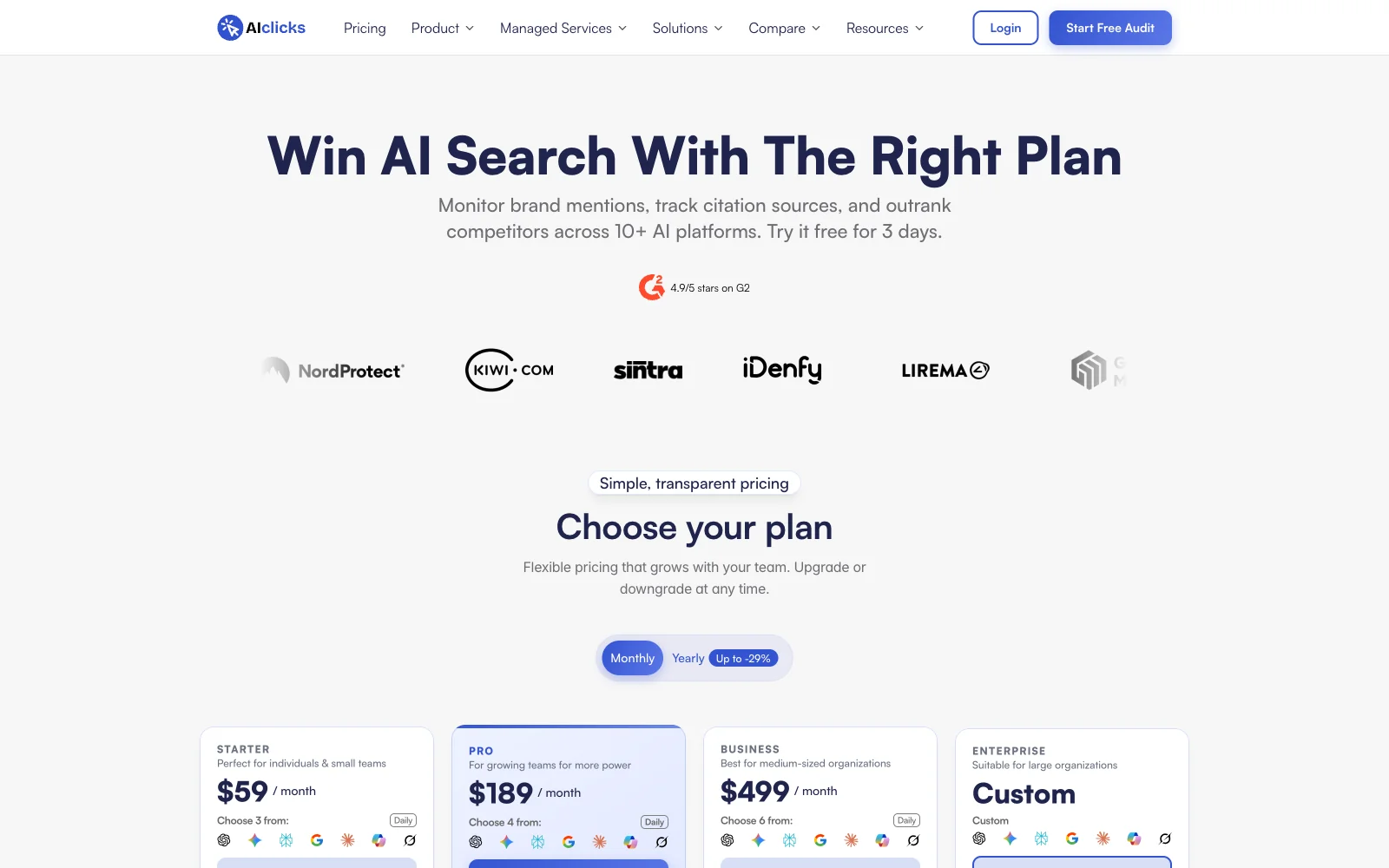
AIclicks is the mid-priced daily option, at $59 for 30 prompts with 3 models of your choice. Pro is $189 for 150 prompts and 4 models.
It states that it queries AI platforms through their actual interfaces, not APIs, which makes it one of the three vendors that disclose a method. Pricing rests on prompts, engines and answers analysed per month.
Because every tier runs daily, a prompt gets 30 runs a month and a margin near 18 points, the same precision as Peec AI. The price per topic is $9.83, so the lower sticker price is not a lower price per topic: it buys 6 topics where Peec AI buys 10. Choose AIclicks when 30 prompts is enough and you want interface-based collection.
Method is the reason to shortlist AIclicks. It queries each AI platform through its user interface and runs daily, so what it records is the answer shown in each product. Which engines you get depends on the plan: Starter picks 3, Pro 4, Business 6, and Enterprise tracks all of them.
Setup and reporting lean toward action. A Recommendations tab turns visibility data into a ranked to-do list covering content, source outreach and Reddit. Starter tracks one country per project, while Pro and Business are unlimited, so a multi-market team should start on Pro.
Connections differ by tier. Starter has CMS integration only; Pro and Business add GA4, the API and an MCP connector, and support moves from CMS-only to Slack to a dedicated specialist as you go up. A Product Hunt reviewer called it easy to use and cost effective for agency work.
Pros:
- Daily runs on every tier.
- States its collection method.
Cons:
- The 3-day trial is the shortest in the table.
- Starter picks only 3 models.
Price: $59 a month (Starter); $189 (Pro)
LLM Pulse
Best for: 50 prompts across five engines at the lowest euro price, when weekly sampling is enough.
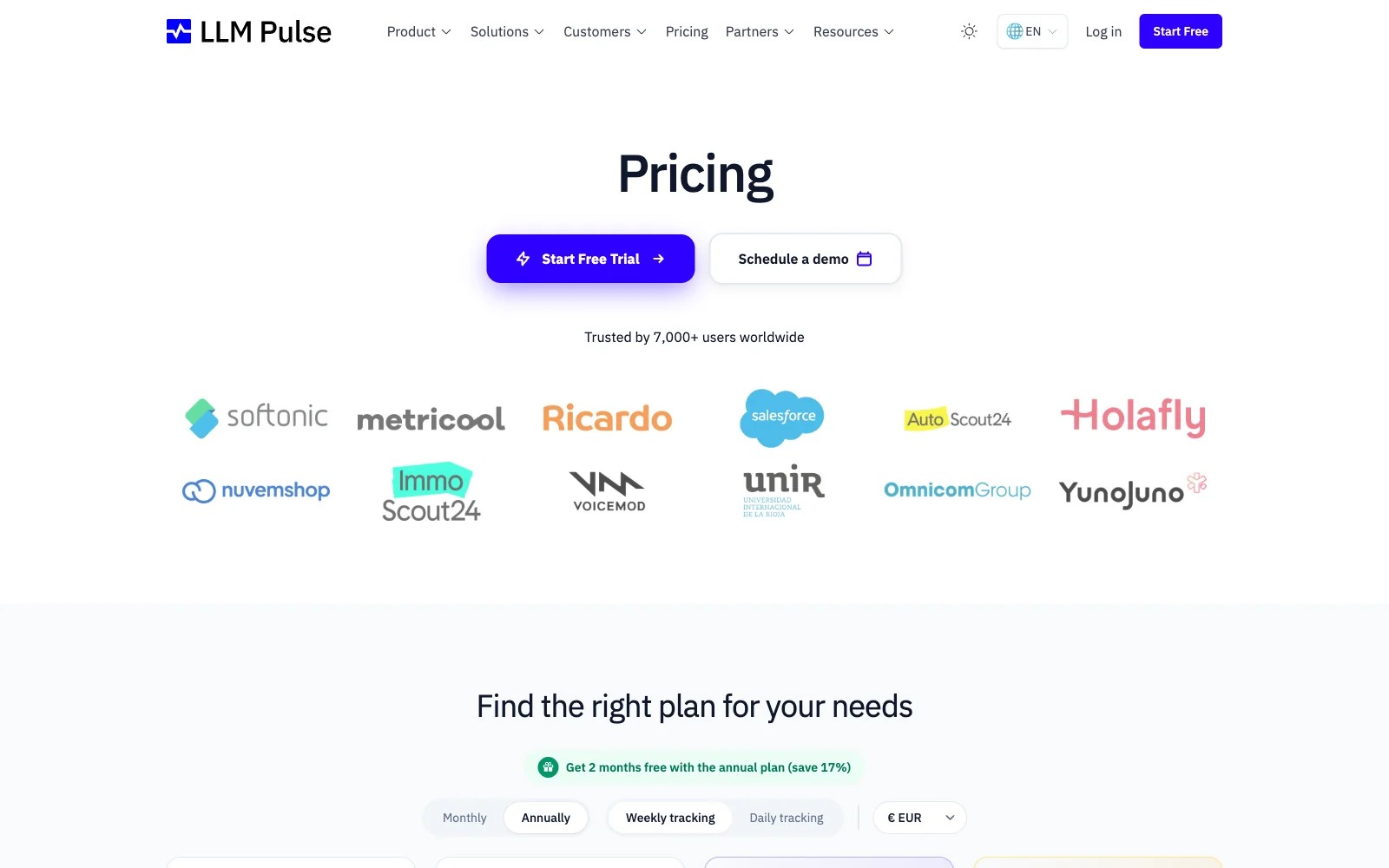
LLM Pulse is the lowest euro price per topic in the table (EUR 4.90) because it samples weekly. Starter is EUR 49 a month for 50 prompts and 5 models.
Its table lists 50 AI responses per week per model, so each prompt gets one run per model per week.
That makes the EUR 4.90 per topic a weekly-sampling price. If you read the panel as a trend across a topic, it is the cheapest euro route to 10 topics; if you need a rate for a single prompt, about 4 runs a month will not give you one. Compare it with Omnia at EUR 15.80 per topic, daily; euros are never converted.
LLM Pulse stores the real AI answer behind each prompt, and the vendor says every metric opens to the answer and the sources it cites. That matters for a weekly panel: when a number moves, you can read the response that moved it instead of trusting a score. It doesn't state whether answers are collected through APIs or interfaces.
The entry plan covers ChatGPT, Perplexity, Gemini, Google AI Overviews and AI Mode. Claude sits outside the five included models, and extra models are a paid add-on, so a panel that needs Claude costs more than the headline price. Analytics filter by country and language.
Connections and reporting go further than the price suggests. An MCP server comes on every plan, while the REST API, CLI and Looker Studio connector start on Scale. Exports come as PDF, CSV and Excel, with Slack and email alerts and white-label portals. A free trial exists on paid plans, though its length isn't stated on the page.
Pros:
- 50 prompts across 5 models on the entry plan.
- A clear statement of responses per week.
Cons:
- Weekly sampling leaves each prompt about 4 runs a month, a margin near 35 points.
Price: EUR 49 a month (Starter)
Morningscore
Best for: an SEO suite buyer who wants a few ChatGPT prompts.
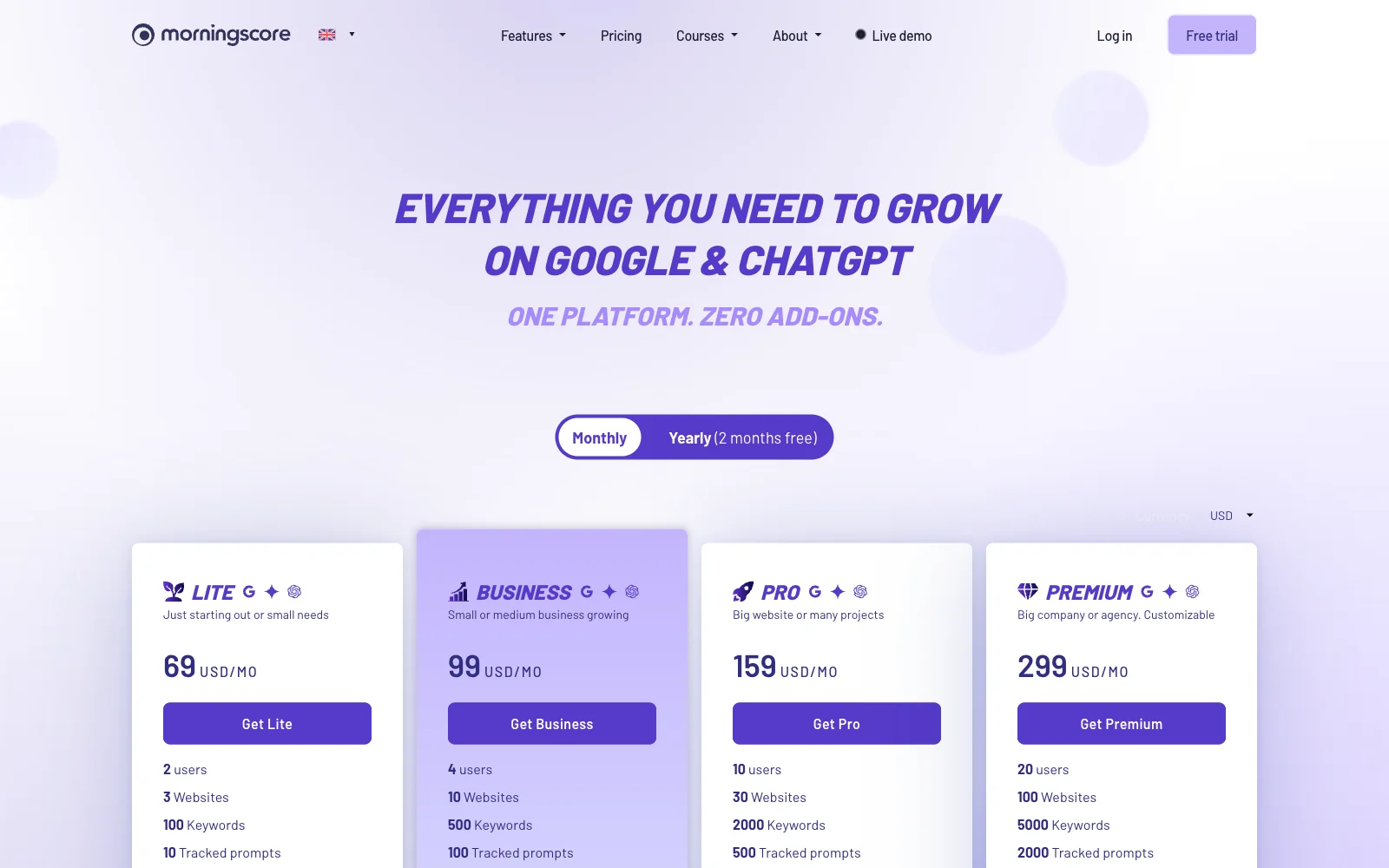
Morningscore fits a team that already wants its SEO suite, because the prompts come with it. Tiers run $69 for 10 prompts, $99 for 100, $159 for 500 and $299 for 2,000, with weekly prompt lookups.
Weekly lookups give each prompt about 4 runs a month, so the 10-prompt Lite plan cannot yield a rate for any single prompt and works as a first look at the panel idea. The $159 tier holds 500 prompts and the $299 tier 2,000. Without a need for the suite, the daily plans in the table give more runs for the money.
Morningscore is an SEO suite first and a ChatGPT tracker second. Prompt tracking and Google AI Overviews come with every plan, with no engine add-ons, and the platform also includes keyword tracking, site scans and gamified missions that keep a team finishing SEO tasks. Reviewers value that for beginners and small businesses. Whether suite tracking like this is enough turns on four tests covering volume, engines and seats.
Its limits show up in reviews. A YouTube reviewer found the keyword and backlink data weaker than Ahrefs or Semrush, and noted that extra countries need credits and there's no history from before setup. The co-founder's own Reddit reply described the AI visibility feature set as still maturing, which fits a tracker bolted onto an SEO tool.
The terms are friendly for a test: a 14-day free trial with no card, and monthly plans you can cancel any time. Yearly plans bind you for 12 months in exchange for two months free. The API and MCP are open on all plans, and WordPress and Shopify plugins are included.
Pros:
- Tiers scale from 10 to 2,000 prompts.
- A 10-prompt trial with no card.
Cons:
- Lite is the dearest per topic at $34.50.
- Weekly lookups.
Price: $69 a month (Lite) to $299 (Premium)
Omnia
Best for: country- and language-heavy tracking with daily runs.
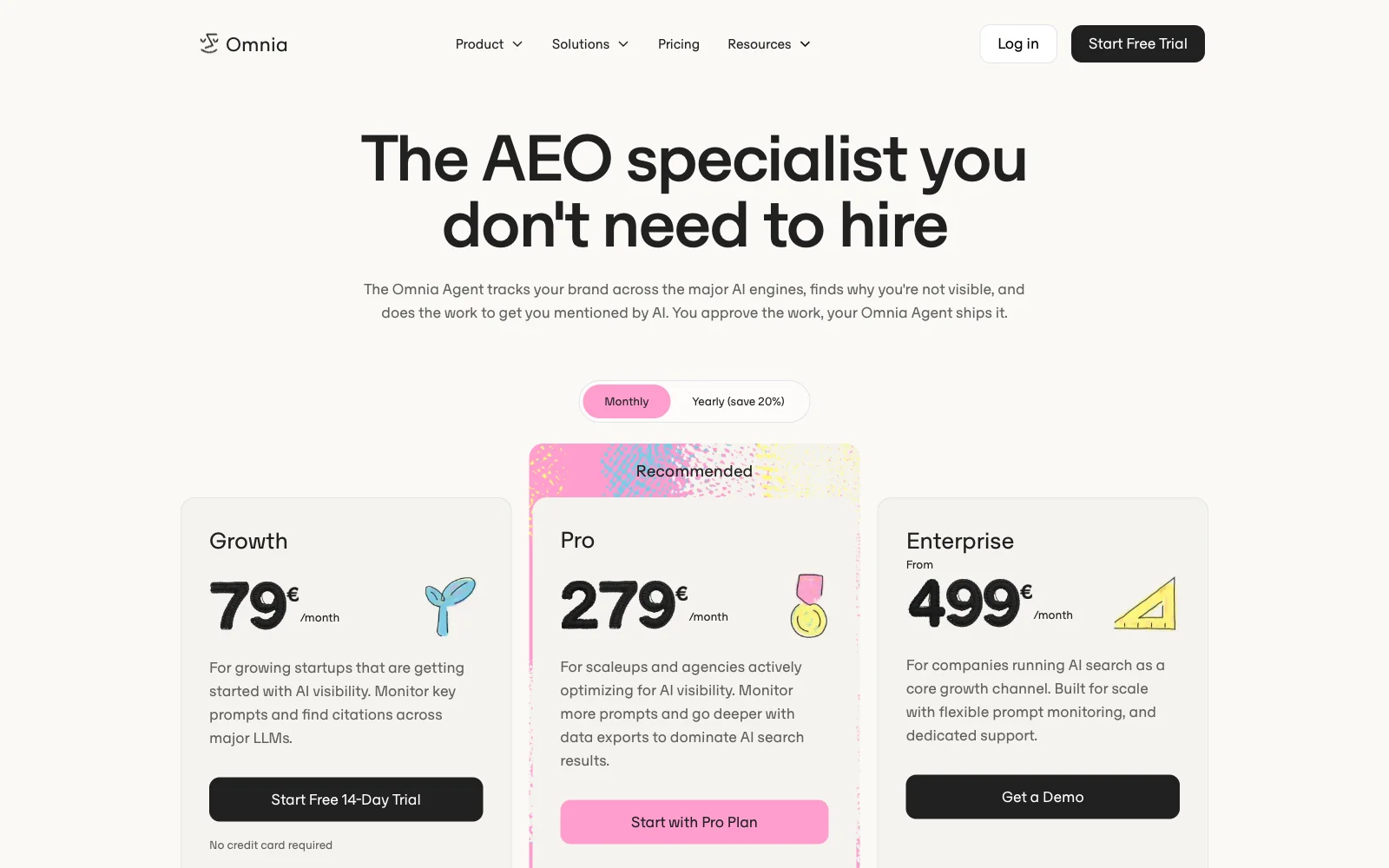
Omnia tracks prompts every 24 hours and says it mimics real user behaviour, one of the three disclosed methods. Growth is EUR 79 a month (EUR 63 billed annually) for 25 prompts and 4 engines by default, up to 7.
At EUR 15.80 per topic it costs more than the other daily panels, and the extra buys a stated simulation method. Its 25 prompts make 5 topics, so a panel of four topics fits with room for a fifth. Engines beyond the default 4 are available up to 7, which matters if you want more than ChatGPT in the same panel.
Omnia's pitch is volume of markets with a stated method. It runs prompts every 24 hours and says it mimics real user behaviour, and it supports unlimited brands, countries and languages. If you sell in several countries and want each one checked in its own language, that is the feature to weigh before the per-topic cost.
Sentiment analysis comes on all plans, and the plan comparison lists API access, data exports and MCP access, although the page text doesn't show which plan has which. Ask before you assume the API comes with Growth.
Credits work as a top-up. Prompt packs of 25 are sold as an add-on, and insights spend credits. The trial runs 14 days with no card on Growth, enough to see two weeks of daily answers for your own category before you pay. Omnia has also launched an agent, announced on its blog.
Pros:
- Daily runs and a stated method.
- A 14-day trial with no card.
Cons:
- 25 prompts is 5 topics.
- Engines beyond 4 on request.
Price: EUR 79 a month (Growth)
Peec AI
Best for: a 50-prompt daily panel with 3 models of your choice.
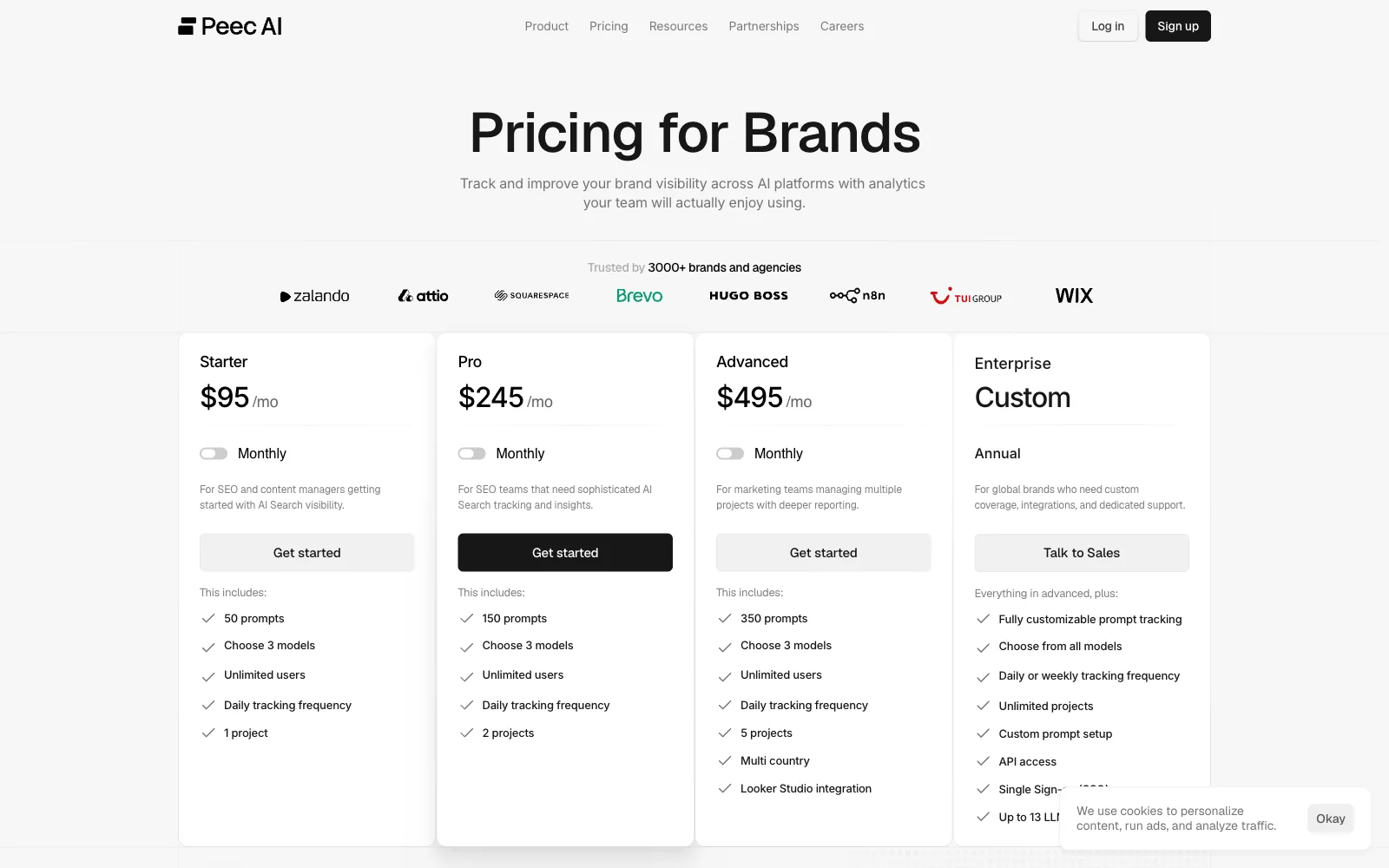
Peec AI is the sturdiest daily panel at its price: Starter is $95 a month for 50 prompts, 3 models of your choice and daily tracking on one project. Its runs are prompts times active models times frequency, which makes the cost of adding a model easy to calculate.
50 prompts run daily pool 1,500 runs a month and a margin near 2.5 points, as long as the prompts belong to one topic. Split into 10 topics, each topic gets 150 runs and a margin near 8 points. That is the precision the $9.50 per topic buys.
Peec AI shows more than a rank. Each tracked prompt reports visibility, position and sentiment, and a Query Fanouts page shows the searches an engine runs before it answers, which helps explain why a competitor was named. Reviewers praise easy setup and an intuitive dashboard, and a Reddit commenter recommended it to agencies for its clean UX.
Limits sit in the plan structure. Every plan picks only 3 models, and extra models are paid add-ons that rise with each tier. Multi-country tracking is named only in the Advanced tier. G2 reviewers complain that model access is locked behind tiers, that default prompt suggestions overlap and that it's hard to link actions to changes in AI search.
Integrations lean technical. An MCP server connects Peec to Claude, Cursor and n8n, a Looker Studio integration comes on Advanced, and API access is listed under Enterprise. Starter support is chat only. If you expect advice on what to change, plan to get that elsewhere. How starter and enterprise tiers differ across vendors is covered in what each AEO tool tier adds.
Pros:
- 50 prompts tracked daily.
- Unlimited users.
Cons:
- A G2 reviewer said it shows visibility but gives no clear recommendations on how to improve.
- 3 models per plan.
Price: $95 a month (Starter)
Rankability
Best for: 100 tracked prompts with a stated live-search method and location.
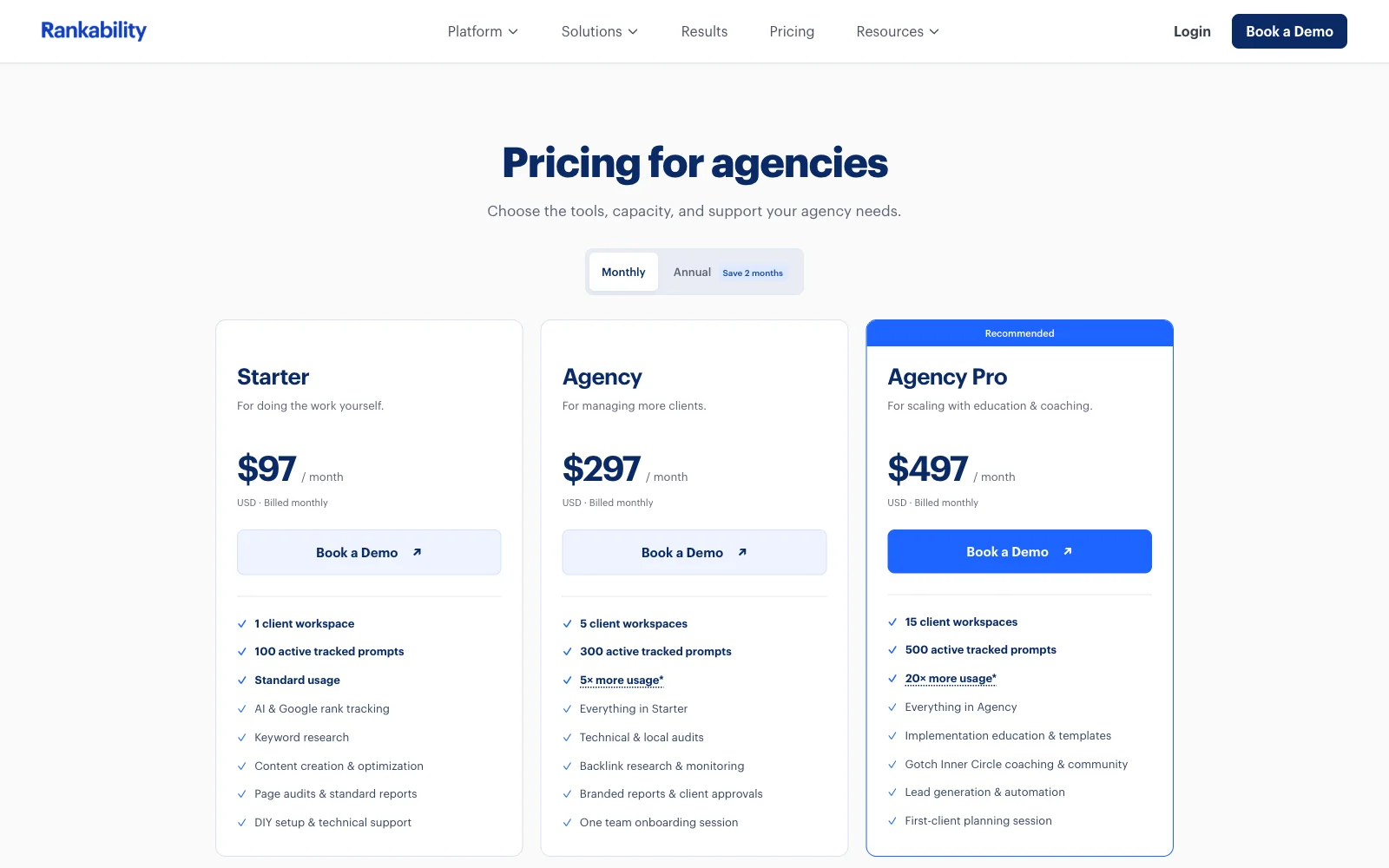
Rankability is the most flexible plan at its price: Starter is $97 a month, Growth $297 and Pro $497, with 11 platforms on all paid plans. One saved query uses one slot, and you pick daily, weekly or custom runs.
It scans ChatGPT using live web search and appends your location to every query.
Its 100-prompt Starter allowance makes 20 topics at $4.85 each, the lowest price per topic among the three vendors that state how they collect answers. You choose the cadence, so a topic you care about can run daily while the rest run weekly. The trial needs a card, and trial usage is limited.
Rankability is a keyword and content suite with AI visibility tracking attached, and tracking comes with all three tiers. The platform list on its pricing page includes ChatGPT, so the engine you came for is covered.
The tiers scale on prompts and usage. Growth and Pro raise the prompt and usage allowances in steps. Team members and client workspaces are unlimited on every tier. Branded client reports, client keyword approvals and API and MCP access are included on every tier, and priority technical support starts on Growth.
A YouTube reviewer liked the Google Search Console and Analytics connections and the content editor, and noted it reports data but doesn't do the work for you, and has no backlink acquisition. Pick it when you want ChatGPT tracking next to keyword and content tools.
Pros:
- States its method and location handling.
- 11 platforms on every paid plan.
Cons:
- A card is required for the 7-day trial.
Price: $97 a month (Starter)
LLMrefs
Best for: keyword-first teams that want 500 prompts and accept weekly reports.
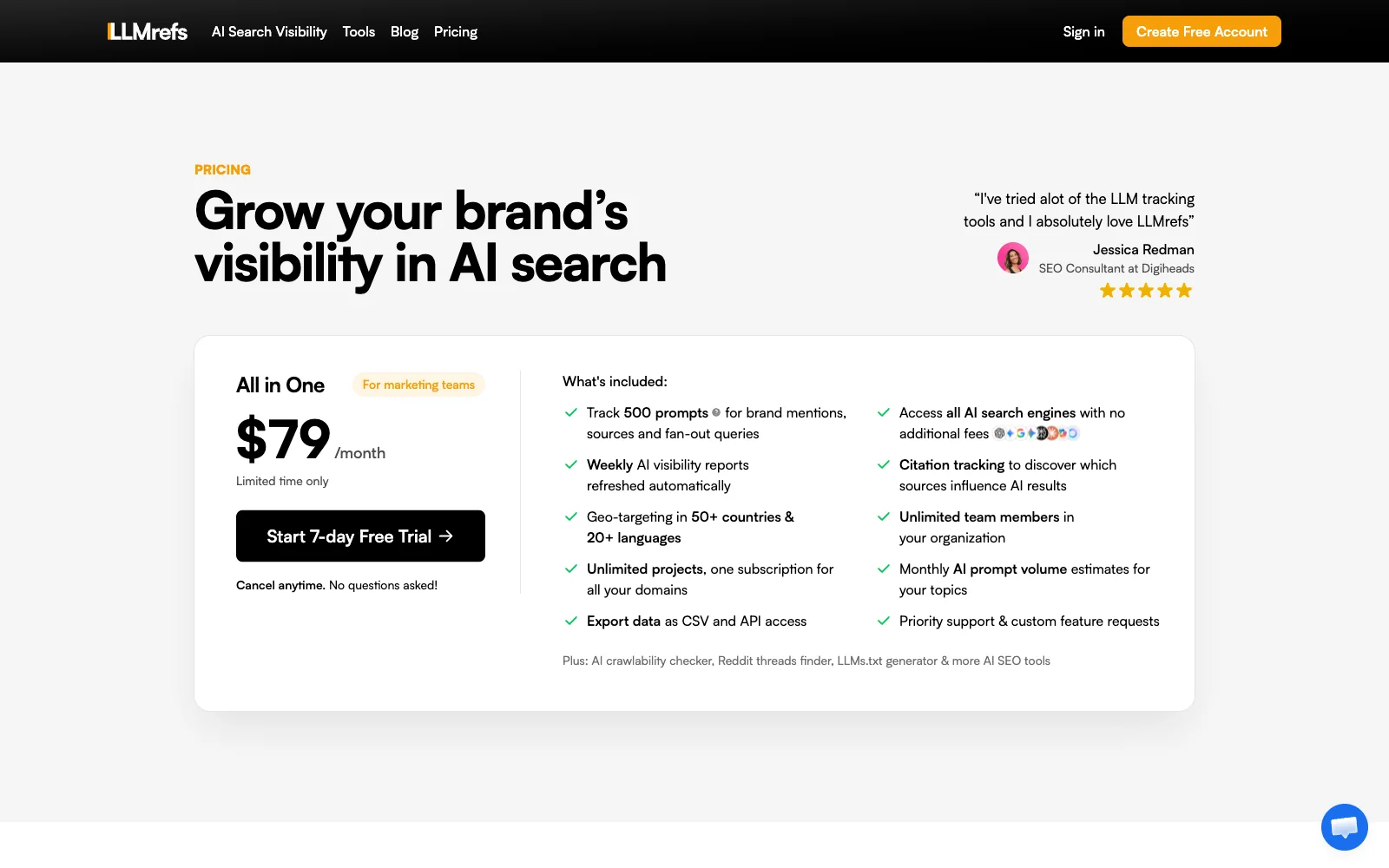
LLMrefs is the cheapest per topic ($0.79) because you track keywords, not prompts, and it generates the prompts. It costs $79 a month for 500 prompts, with weekly AI visibility reports.
The 500-prompt count is generous because the product generates prompts from the keywords you give it. That is a different panel from five prompts you wrote by hand for one topic, so treat the $0.79 per topic as a floor price. With weekly reports each prompt gets about 4 runs a month, and the cost per topic per run is $0.20.
LLMrefs starts from keywords. You import the SEO keywords you already track, it generates the prompts, sends them to the engines and aggregates answers, citations and brand data per keyword. The vendor says weighting results across every prompt gives statistically significant brand rankings. That is a vendor statement; this guide's run math says a prompt sampled weekly stays imprecise, so read keyword-level trends.
The plan itself is generous on seats: unlimited team members and unlimited projects, with CSV export and API access included, plus citation tracking and monthly prompt volume estimates. The API documentation page is still a placeholder, so check the current state before you plan automation.
Reviewers split on value. One praised the price-to-coverage ratio of the $79 plan. Others call it basic monitoring with no workflows to act on the data, and say teams that need daily data should look elsewhere. A 7-day free trial and a free account make it easy to test; the free account is too small to run a weekly loop.
Pros:
- 500 prompts at one price.
- A 7-day free trial.
Cons:
- Weekly refresh.
- Prompts are generated from keywords.
Price: $79 a month
Rankscale
Best for: choosing cadence from hourly to monthly, paying per answer.
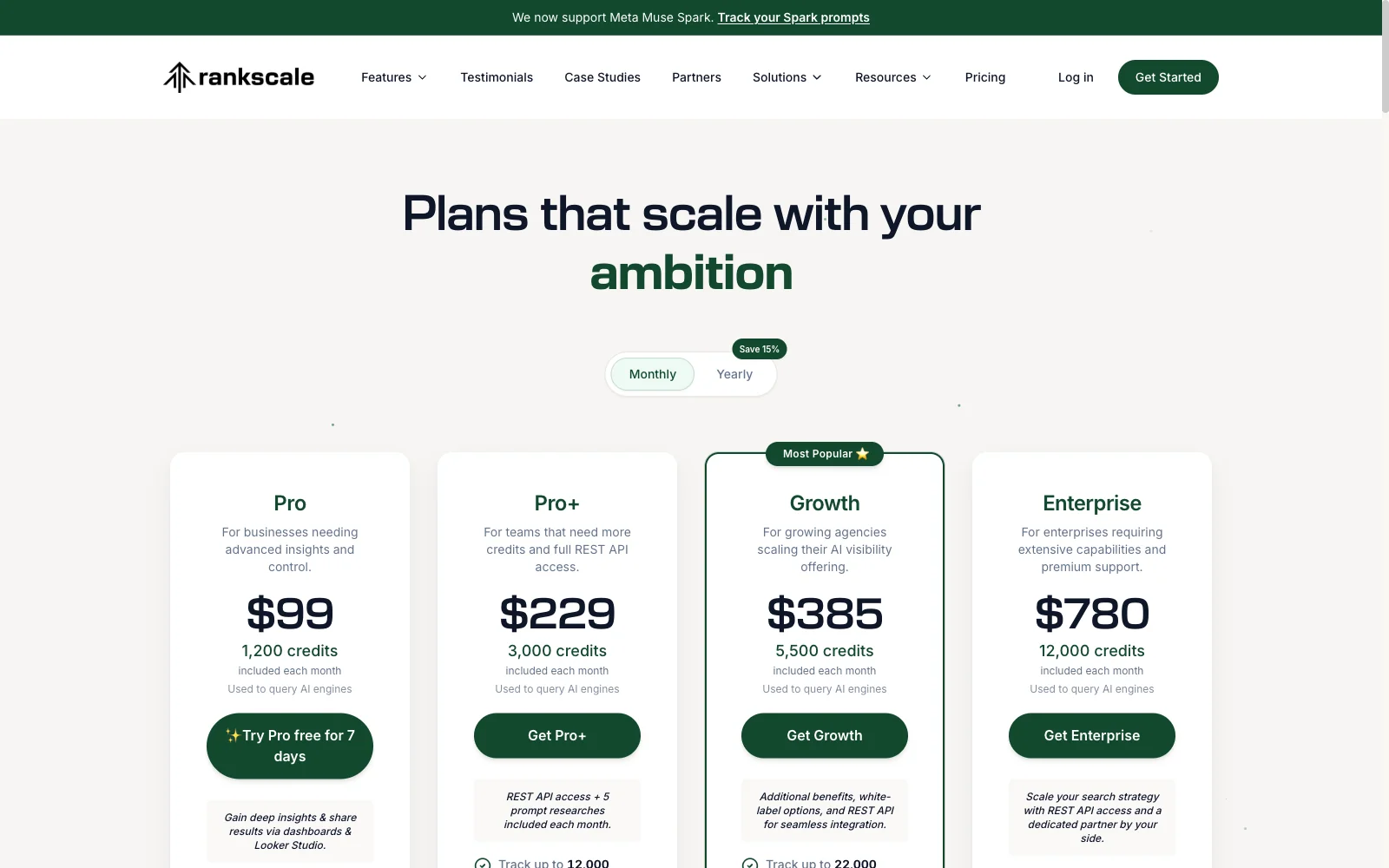
Rankscale charges per answer: each query uses a fraction of a credit, typically 0.25, and Pro covers up to 4,800 answers a month. Scheduling runs hourly, daily, weekly or monthly, and engines include ChatGPT, Gemini, Perplexity, Claude, DeepSeek, Mistral, Grok and Copilot, though Rankscale's changelog says Microsoft Copilot has been retired (entry published 8 November 2026) while its pricing and feature pages still list it.
Cadence is the lever. Run daily on ChatGPT alone, Pro works out to $3.09 per topic and $0.10 per topic per run, below LLMrefs at $0.20 and Peec AI at $0.32. Run hourly and the same credits drain faster, so pick the cadence before the plan.
Rankscale suits buyers who want to control spend. Each engine query costs a fraction of a credit, typically 0.25 for ChatGPT, Gemini and Perplexity, while Claude costs 2 credits per run, so an engine list that includes Claude changes the maths. A newer engine, Meta's Muse Spark, costs 4 credits per run.
Regions and languages are set per search term, and all regions are open on every paid tier. Search terms are unlimited, but running them uses credits. Credits roll over up to 2x on lower tiers, and Pro includes 10 brand dashboards, with extra slots available in the app.
Reporting is built for sharing. Custom dashboards, share links, CSV and Google Sheets export and Query Fanout reports are in the changelog, and Pro includes Looker Studio. The REST API starts on Pro+. A 7-day free trial of Pro is available. Older Reddit threads describe it as a budget-friendly option that was still in beta then, and a YouTube reviewer called it the cheapest AI visibility platform.
Pros:
- Hourly to monthly scheduling.
- A wide engine list.
Cons:
- Essentials is sold yearly only.
- Credits rise with the number of engines.
Price: $99 a month (Pro)
SE Ranking
Best for: existing SE Ranking users who want a ChatGPT-named AI Visibility plan from $71 a month, or the 25 prompts bundled in Core.
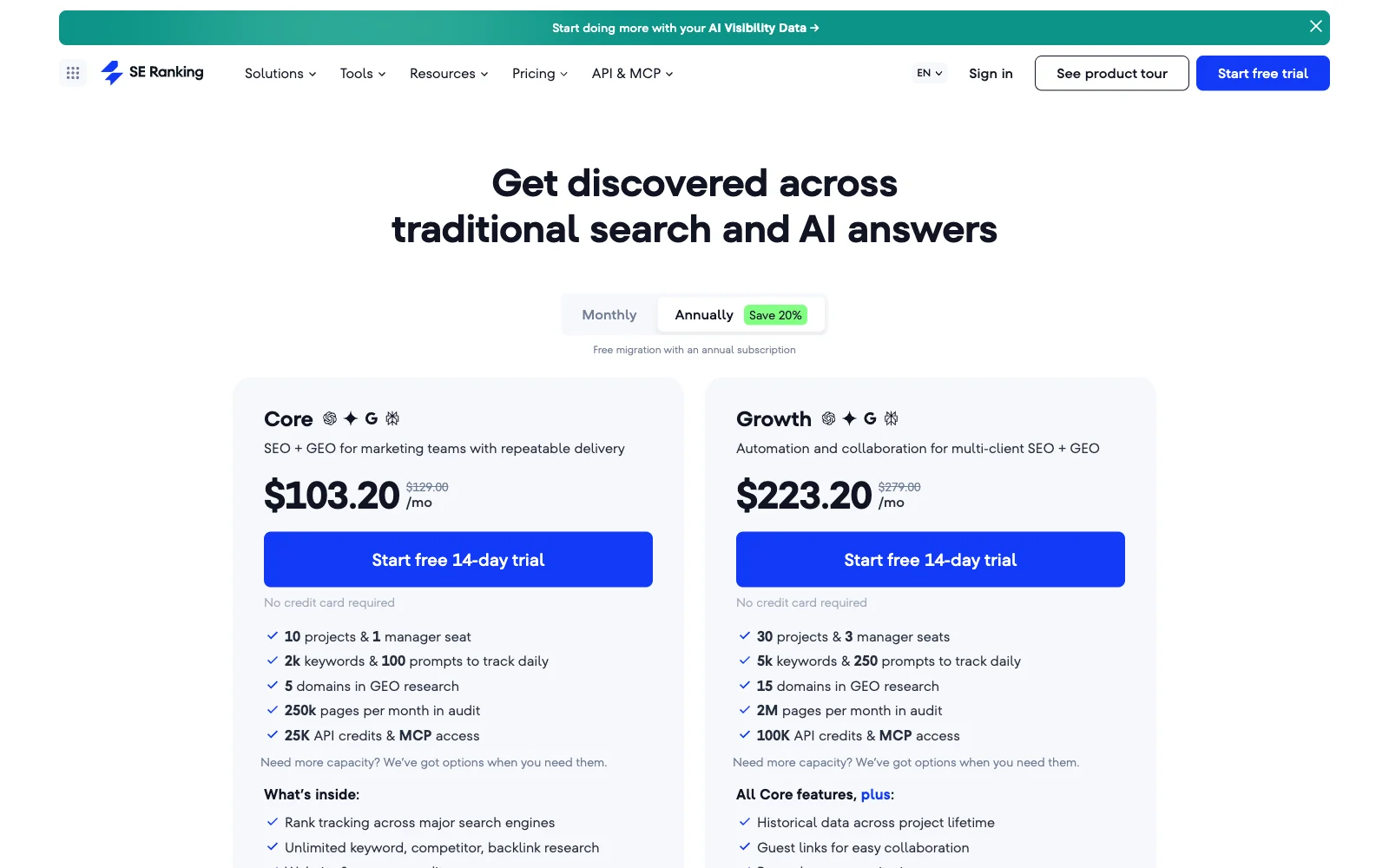
SE Ranking is the natural choice if you already use its SEO tools. Its AI Visibility product starts at $71 a month with 75 prompts across AI Overviews, AI Mode, Gemini, ChatGPT, Copilot and more, so that is the entry plan priced here.
Core at $129 a month bundles 25 prompts daily on 5 AI engines, and Growth at $279 bundles the same. The 14-day trial of the main plans includes 20 AI prompts a day.
The AI Visibility product's 75 prompts make 15 topics at $4.73 each, tracked daily for 30 runs a month per prompt. The bundled alternative is Core's 25 prompts daily, which makes 5 topics at $25.80 each. Core lists at $129 a month ($103.20 annual) and Growth at $279 ($223.20 annual), so the bundle pays off when you would buy the suite anyway.
The pricing page does not name the 5 engines bundled in Core, so confirm ChatGPT is among them before you rely on that route. If your team already uses SE Ranking, the AI prompts sit in the same account.
SE Ranking is the choice when rank tracking, audits and ChatGPT visibility should share one login. The platform also covers GA4, Google Search Console, Data Studio, Make, n8n and Zapier connections, API access and MCP.
Plan limits are the fine print. Core covers 5 domains in GEO research and Growth lifts that to 15, with larger audit-page and API-credit allowances. An Agency Pack adds 30 projects, 30 client seats and white label for $69 a month on annual billing, and the API can be added for $45 a month. Both are annual only.
G2 reviewers praise ease of setup and criticise inflexible pricing, estimate-only competitor data and limited segmentation of AI tracking by prompt and market. The Reddit reports are sharper: backlink reporting weaker than Semrush, rank data that dropped during a Google change, and the AI tracker reset. Test it in the 14-day trial before committing.
Pros:
- 75 prompts tracked daily with ChatGPT named, or 25 prompts bundled in Core.
- A 14-day trial on the main plans.
Cons:
- Bundled in Core it is 5 topics at $25.80 each, and the $71 AI Visibility product is a separate purchase.
- A Reddit user said the tracker went to zero and support took weeks.
Price: From $71 a month (AI Visibility); $129 (Core); $279 (Growth)
Semrush
Best for: existing Semrush users.
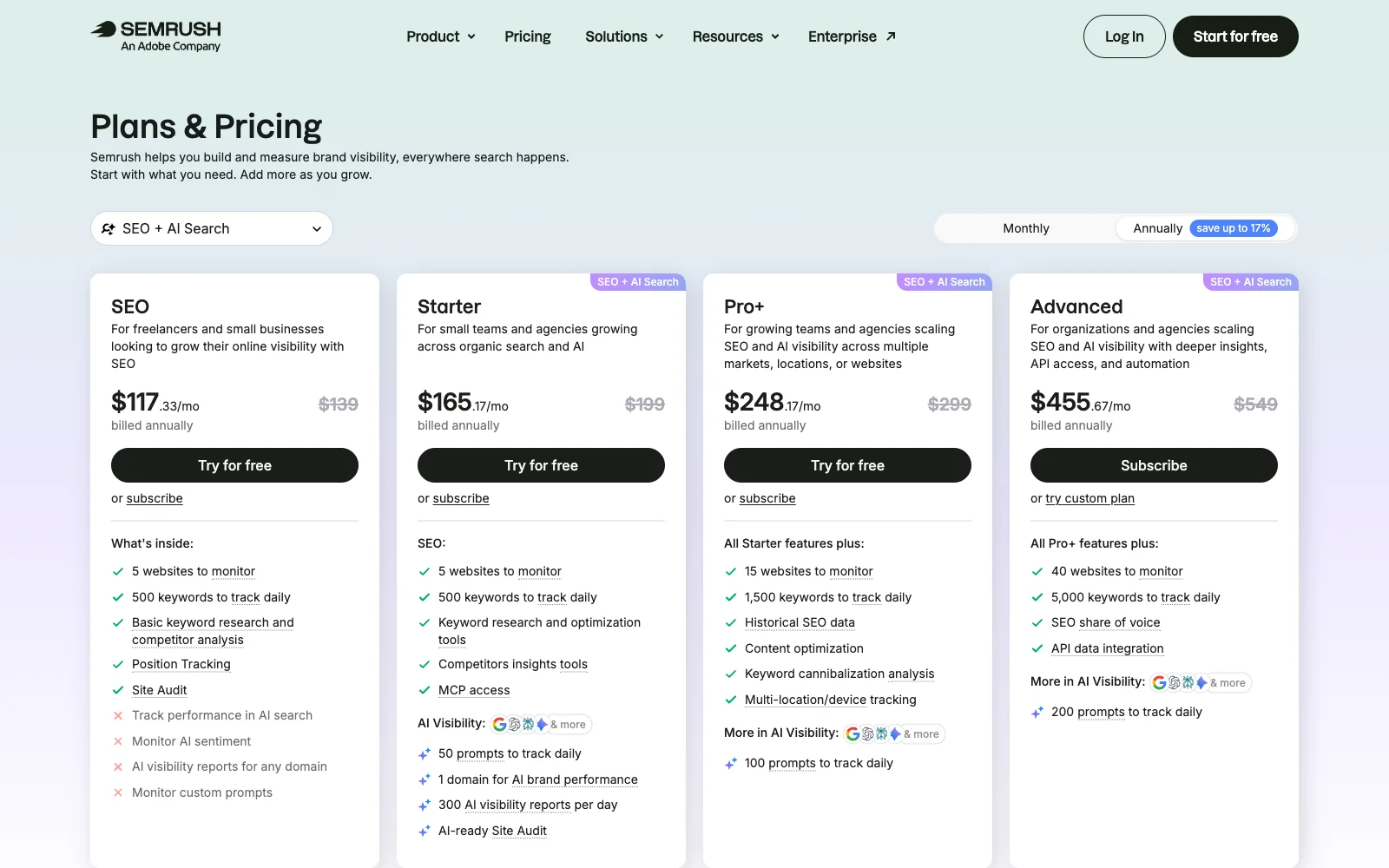
Semrush works when the rest of your SEO already lives in it. Base is $99 a month per domain, billed annually, for 25 prompts daily across ChatGPT, Google AI, Gemini and Perplexity. Starter SEO plus AI Search is $199 a month for 50 prompts, and additional users start at $45 a month.
Base prices 25 prompts at $19.80 per topic, the second dearest dollar plan in the table, so it earns its place through the account you already pay for rather than through ChatGPT value alone. Starter SEO plus AI Search doubles the prompts to 50 daily at $19.90 per topic, with $165.17 a month on annual billing.
Semrush gives you the widest toolset around the tracker. Besides prompt tracking it reports brand sentiment per AI platform, visibility and share of voice against competitors, and a gap analysis listing the prompts and sources where competitors are cited and you aren't. The vendor names ChatGPT and "Google AI" plus unnamed other platforms, so confirm the engine list before you buy.
Prompt allowance climbs by plan: Starter 50 daily prompts, Pro+ 100 and Advanced twice that, and Enterprise is custom with daily or weekly frequency. Starter covers one domain and 300 AI visibility reports a day. API data integration starts on Advanced, MCP access on Starter, and a dedicated account manager is Enterprise only.
Two promised features are still marked "Coming soon" on the product page: one-click AI visibility reports with ROI, and AI-traffic reporting that connects Google Analytics. The pricing page shows a 7-day free trial, and a free plan with one demo project. Affiliate videos advertise 14 days, so the length depends on the link you use.
Pros:
- Daily tracking on both tiers.
- Fits into a Semrush account.
Cons:
- Base is 25 prompts.
- Priced per domain.
Price: $99 a month (Base, billed annually); $199 (Starter SEO + AI Search)
Ahrefs Brand Radar
Best for: Ahrefs users who want an index of every brand plus custom prompts.
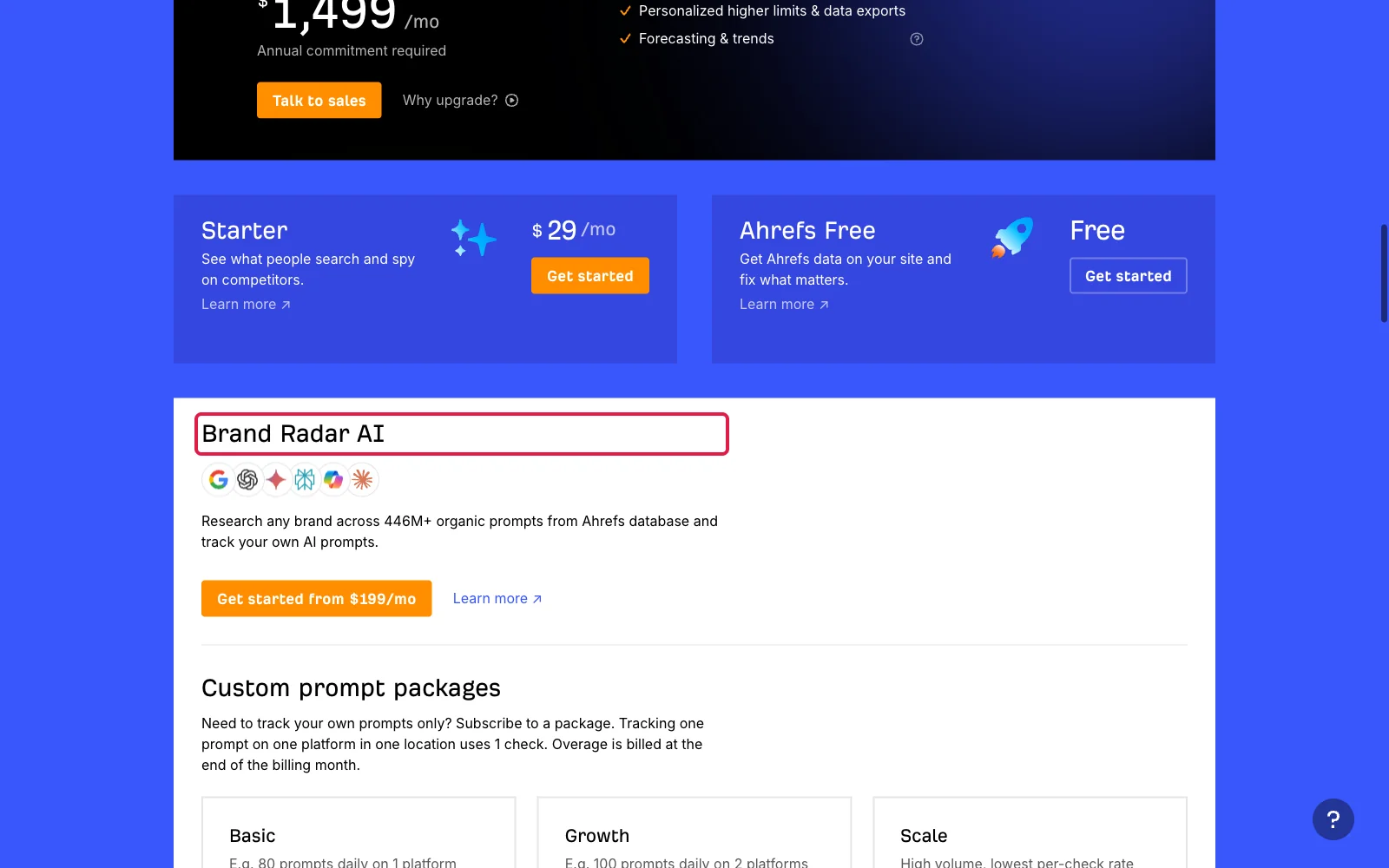
Ahrefs Brand Radar pairs an index of 485 million+ prompts with packages for your own. One check is one prompt on one platform in one location, so the checks stretch or shrink with the platforms and markets you track, and the Basic package is $50 a month for 2,500 checks, which the pricing page illustrates as daily tracking on one platform.
On daily ChatGPT-only runs it works out to $3.12 per topic, well under the $8.38 median. Ahrefs says it never runs discounts or free trials, so the first month is your test.
Brand Radar answers a different question from a prompt tracker. Its index runs Ahrefs' own prompt database through each AI platform and stores the responses, so you can search any brand with no setup. The catch is that the index is built on Ahrefs keyword data and may cover brands with little search volume only thinly.
Custom Prompts is the tracker side: you define the buyer questions, and data starts when you begin tracking, at a cadence from monthly to daily per platform. A prompt checked daily on one platform uses about 30 checks a month, and Claude costs 8 checks per update.
It reports mentions, citations, AI share of voice and estimated impressions, and ties them to search demand and cited pages. Beyond AI answers it covers Reddit threads and YouTube. You can buy it without the full Ahrefs suite, and overage is billed per check at the end of the month. G2 reviewers like the multi-country coverage but warn that updates restate history.
Pros:
- A very large prompt index to research any brand.
- Custom prompts by package.
Cons:
- A G2 reviewer said history is restated after index updates.
- No trial.
Price: $50 a month (Basic package)
AthenaHQ
Best for: credit-metered tracking with a free tier to test.
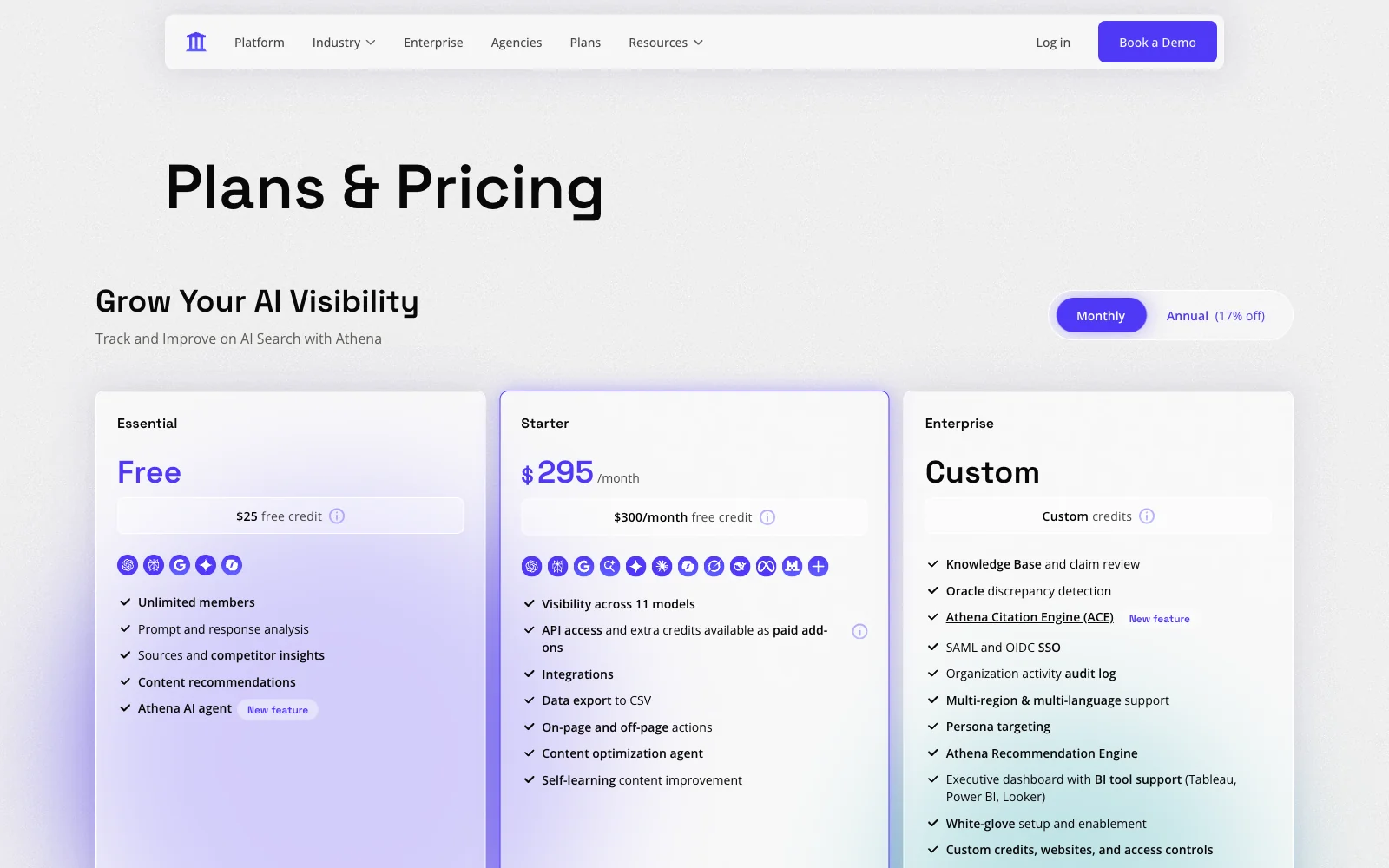
AthenaHQ meters in credits, where 1 credit is 1 AI response. The free tier carries a $25 credit with 300 credits, and Starter is $295 a month for 3,600 credits.
On Starter, 3,600 credits are 3,600 AI responses. Spent entirely on daily ChatGPT runs, that works out to $12.29 per topic, above the $8.38 median. The free tier is enough to see how the product reports 300 responses before you commit to the $295 entry price.
AthenaHQ is built for teams that want a lot of surface area. Starter lists 11 models, including Grok, DeepSeek, Meta AI and Mistral, and other models are available on request. Credits meter everything and extra credits are paid, so a plan that tracks many engines uses its credits faster than one that tracks ChatGPT alone.
Starter is a single region and language, while Enterprise adds multi-region tracking; a recent vendor update claims city-level tracking across its markets, which is a vendor claim. CSV export and a content optimisation agent are on Starter. The API is a paid add-on on Starter and included on Enterprise, and Tableau, Power BI and Looker connections are Enterprise only.
Recent releases lean toward shopping and ads: Shopping Pages, Shopify catalog sync and ChatGPT Ads reporting. If you sell products online, that is the reason to look. Reddit commenters value the broad multi-engine monitoring, reporting and team features. They also raise price, say the tool can't show how its prompt set is built, and one saw their brand's entity misread in AI Overviews.
Pros:
- A free tier to test.
- Credits map to responses.
Cons:
- $295 entry.
- Credits drain per response.
Price: Free; $295 a month (Starter)
Profound
Best for: enterprise teams that want up to 10 engines.
Profound is the enterprise end of the market: a custom plan with up to 10 answer engines and dedicated support. The free trial runs 50 prompts daily for 7 days on ChatGPT, Gemini and Google AI Overviews.
Profound publishes no price for Enterprise, so there is no price per topic to compute. Seven daily runs per prompt are too few to show a rate, so use the trial to judge the product and its reporting. It can't read your visibility.
Profound is more than a tracker. Its Agents draft content, launches and brand fixes and ask for approval, and the company says it traces inaccurate AI claims to the publishers repeating them. Separately, Agent Analytics reads CDN or server logs to show AI-crawler visits and AI-referred traffic, with guides for Cloudflare, Vercel, CloudFront, Fastly, Netlify and others.
The trial is a limited test. It uses a prompt set recommended by industry that you can't customise, one language and one region, with no history, exports or API. Enterprise adds all-time history, CSV and JSON export, the API, custom languages and regions, and dedicated support.
G2 reviewers praise a clear view of how the brand appears in answers and which sources are cited, fast shipping and quick onboarding. They criticise a high or inflexible price, a steep learning curve and a dashboard that shows that scores moved but not why. Reddit commenters call it enterprise-oriented and demo-gated, and say it monitors a score over time but explains little about why a brand is missing.
Pros:
- Up to 10 engines on Enterprise.
- A trial that runs prompts daily.
Cons:
- One Reddit commenter called it overpriced.
- No public price.
Price: Free trial for 7 days; Enterprise is custom
Mission Growth (our platform)
Best for: teams that want monitoring plus strategy and execution.
Mission Growth is an AI-led SEO and GEO growth service: AI catches the signal, our experts make the move, and you see the result. We built Mission Growth for teams that want the monitoring and the fix done together. Mission Growth's platform tracks AI citations and visibility for customers.
Price: Monthly fee, quoted after an audit
What users report about ChatGPT trackers
Reviewers of Profound, Otterly.ai and Peec AI repeat one complaint: the tracker shows what moved or where you are absent but not what to change.
A Reddit commenter said of Profound in June 2026 that it is useful once you know what you are fixing and less useful when a client asks why. Price complaints attach to Profound as well: one commenter called it overpriced.
So price complaints cluster on the enterprise-leaning tool and "what to change" complaints cluster on the mid-priced ones. Both say a tracker is a measurement.
Buy it for the measurement, and plan the fix separately. Pair the tracker with a page-level fix list, then re-read the topic after 30 runs to see whether the fix moved the rate.
Free ChatGPT rank trackers and checkers
A free ChatGPT rank tracker is a one-off check rather than a tracker.
Geoptie's tool runs one real ChatGPT query, HubSpot's grader asks models what they remember, and every other route is a trial of 3 to 14 days.
Geoptie's tool is free with no signup, no card and no time limit. HubSpot's grader is a one-time diagnostic, and its standalone tracking product costs $50 a month.
Trial length differs by tool: AIclicks gives 3 days, Profound and LLMrefs 7, Rankability 7 with a card, and Omnia and SE Ranking Core 14 days. Morningscore's trial covers 10 prompts with no card.
The rule is short. Free is enough for a first check and a screenshot: it tells you whether the brand appears today in one draw, so use it to decide what goes in the paid panel. Pay when you need 20 or more prompts run daily.
The best ChatGPT SEO checkers are these one-off tools, and none of them is a ChatGPT ranking checker in the sense of a stable score, because one draw has no margin. If you want the hand method, track ChatGPT mentions for free with 3 to 5 runs per prompt.
Which ChatGPT SEO tracker fits your situation
The right ChatGPT SEO tracker is the plan whose topics and runs match your panel.
Pick Otterly Lite or Geoptie Starter for a first 15 to 20-prompt panel, Peec AI or AIclicks for 30 to 50 prompts run daily, Rankability for 100, LLMrefs for 500 weekly, and the AI tracking in your suite when your team already lives in SE Ranking, Semrush or Ahrefs.
ChatGPT tracking software earns its price when topics and runs match your panel, so size the panel first. Brands whose buyers ask ChatGPT for a shortlist benefit most, because a tracker is the only way to see whether ChatGPT names you. If you are not there yet, start with the free routes above.
Download CSV (CC BY 4.0)
If you need a ChatGPT tracker under $100 a month
Start with these daily plans under 100 dollars a month: Otterly Lite, Geoptie Starter, AIclicks Starter, SE Ranking AI Visibility, Peec AI and Rankability Starter. Choose SE Ranking, Peec AI or Rankability if you need more than 20 prompts, Otterly if 20 is enough, and Geoptie if 15 is enough for a first panel.
If you also need Grok or DeepSeek
Grok or DeepSeek tracking depends on engine lists. Rankscale lists both, LLMrefs reaches all AI search engines with no additional fees, and Rankability covers 11 platforms including Grok and DeepSeek. For a wider comparison, see the LLM SEO tools page, and the best AI rank tracking tools for Google AI Overviews and AI Mode ranks.
Alternatives to Morningscore for ChatGPT tracking
Alternatives to Morningscore Lite ($69 for 10 prompts, weekly) are Otterly Lite ($29 for 20 prompts, daily) and Peec AI ($95 for 50 prompts, daily). Both run every day, so a prompt gets 30 runs a month against Morningscore's 4.
Open the vendor page and check the five disclosures before a year of anything. A tracker returns a rate from a handful of runs, so buy the plan that gives your topics the runs and the stated conditions to defend it. Start with a free one-off check this week, then size four topics against the table.
Frequently asked questions
Can ChatGPT searches be tracked?
Yes, in the brand sense: trackers run your prompts through ChatGPT and record how often your brand appears. A vendor cannot see what individual users ask or say. What OpenAI stores about chats is a privacy question this page does not cover.
What is the best rank tracker for ChatGPT?
There is no single best. Choose by topics and cadence, using the decision table above. At $29 a month, Otterly Lite suits a first panel; Peec AI at $95 suits 50 prompts daily; Rankability at $97 suits 100 slots with live search and location.
Is there a free ChatGPT rank tracker?
One-off checks are free: Geoptie's tool runs a real ChatGPT query without signup. Trials last 3 to 14 days. Pay when you need a rate, because a free check is one draw and a rate needs repeated runs.
Does Rankability only track ChatGPT?
No. Rankability covers 11 platforms on all paid plans, including ChatGPT, Google AI Mode, Claude, Perplexity and Gemini. One saved query across its included platforms uses one tracking slot.
Can I track my ChatGPT visibility for local searches?
Yes. Rankability appends your location to every query, and Geoptie counts each market as one prompt. ChatGPT's own location comes from the IP address, so the country a tracker runs from matters.
Can I track ChatGPT rankings in Google Search Console?
No. Search Console reports Google Search performance only, so tracking ChatGPT needs a tracker that runs your prompts through ChatGPT itself.
Cite this page
Aktaş, F. (2026, November 12). Best ChatGPT Rank Tracker Tools 2026: 16 Compared by Price. Mission Growth. https://missiongrowth.io/blog/best-chatgpt-seo-tracker
Download the data: 3 tables as CSV (CC BY 4.0)
Figures we made for this post are free to reuse under CC BY 4.0 with credit to Mission Growth.