
Common AI SEO Mistakes: 5 Beliefs the Evidence Checks
Five common AI SEO mistakes, checked against Google’s own policies, Anthropic’s research and Pew’s click data. What’s actually true, and the fix for each.

On this page
You’ve read the same AI SEO mistakes checklist on five different blogs this month. Fix your schema. Watch for AI content penalties. Avoid keyword stuffing. Track your zero-click rate. None of those posts showed you where a single item came from.
Every common AI SEO mistakes checklist already lists the same long set of items, with no source beyond an unnamed internal audit. This page checks five of those beliefs against the primary source behind each: Google’s own policy language, a named research paper, a controlled study, and Pew Research’s click data.
Four turn out to be wrong or imprecise. The fifth, keyword stuffing, turns out to be right, for a more precise reason than most checklists give.
What “AI SEO mistakes” checklists get right, and where they stop checking
AI SEO mistakes usually come from a belief nobody checked against the primary source.
The usual items are correct as far as they go. Weak internal linking really does hurt an AI crawler’s path through a site, and how to optimize for AI search engines covers that fix directly.
AI SEO runs on the same ranking systems as regular SEO, plus a distribution layer on top. AI search optimization vs traditional SEO covers exactly where the two diverge.
Generative engine optimization covers the budget question separately. None of that is wrong, and none of it is the gap this page fills.
What’s usually missing is the step after the checklist item: the source. A checklist of AI content mistakes tells you to avoid keyword stuffing without ever quoting Google’s actual definition.
The same checklists tell you to fix mistakes before a “penalty,” without naming which of two enforcement systems that word covers. An AI SEO audit tells you what a checklist item checks. It doesn’t tell you whether the belief behind the item holds up. This page checks five of those beliefs directly.
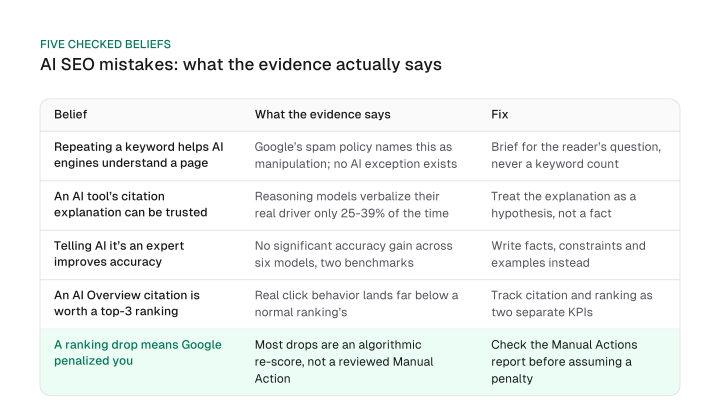
Match the belief in the first column to what you’ve told your team, then jump straight to that section.
Mistake: repeating your target keyword and synonyms throughout the page helps AI answer engines understand it
Repeating a keyword or its synonyms throughout a page doesn’t help AI answer engines understand it.
Google’s spam policy names keyword stuffing as its own enforcement category, on exactly the terms it always has.
Google’s spam policy defines keyword stuffing as filling a page with keywords or numbers to manipulate rankings, with worked examples: a list of phone numbers with no added value, a block of text naming cities and regions the page is chasing rankings for, a paragraph repeating the same phrase in every sentence.
That definition has nothing to do with AI. It’s the same enforcement category Google has used for years to catch spam written by people, and it never mentions automation.
The part that applies equally to AI comes from a different policy on the same page. Google’s scaled content abuse policy states that the policy applies “no matter how it’s created,” language its March 2024 announcement of the same policy made explicit: it applies “whether automation or humans are involved.”
Keyword stuffing and scaled content abuse sit in the same spam policies document, under the same category for manipulating rankings. Neither carves out an exception for one production method over another. Brief a drafting tool to hit a keyword count, and it’s just as exposed as a human writer who does the same thing.
Here’s the difference in practice. A stuffed sentence names a keyword because the writer, human or AI, was told to hit a count: “Buy running shoes online, cheap running shoes, best running shoes for sale.” A natural sentence names the keyword once, because the sentence needed it, and reads the same to a person and to a classifier.
This is really a search-intent problem wearing a keyword-density costume. Get the reader’s actual question right, and the keyword count takes care of itself.
Fix: brief a drafting tool on the topic and the reader’s real question, never on a keyword count. A page that reads naturally passes the same test a human-written page has to pass. If the technical fundamentals underneath the page also need work, technical SEO fundamentals covers those.
Mistake: trusting an AI tool's own explanation of why it cited (or would cite) a page
An AI tool’s own explanation for why it cited a page is worth treating as a guess.
Anthropic’s own interpretability research, published in April 2025, tested whether a reasoning model’s stated logic matches what actually changed its answer.
The setup was a multiple-choice quiz with a hint inserted before the question. When the hint changed a model’s answer, Claude 3.7 Sonnet mentioned using it in its chain-of-thought only 25% of the time; DeepSeek R1, 39% of the time.
On more sensitive hints, unauthorized access to what looked like the answer key, faithfulness moved in opposite directions: 41% for Claude, up from 25%, and 19% for DeepSeek R1, down from 39%.
That’s a 25-39% faithfulness rate on a neutral hint, and a split result on a sensitive one: better for Claude, worse for DeepSeek R1. Anthropic doesn’t claim this generalizes to every task. The paper is explicit that it tested a contrived quiz format, not higher-stakes, real-world questions, and it never tested citation explanations specifically.
Here’s the extension, and it’s ours, not the paper’s: if a model’s reasoning about a hint diverges from what actually moved it most of the time, its reasoning about why it cited a source isn’t something to take at face value either. Both are the same underlying gap.
A model’s stated reason and its real one can diverge, and the model itself doesn’t have privileged access to which.
Fix: treat “ask ChatGPT why it cited you” as a hypothesis to test, never as verified SEO guidance on its own. Check the resulting theory against a primary source or measured data before you act on it.
If the underlying question is whether AI-generated content itself hurts a citation’s chances, is AI content bad for SEO already checks that against the same kind of primary source.
Mistake: telling the AI "you're an SEO expert with decades of experience" makes its output more accurate
Telling an AI it’s an expert doesn’t make its output more accurate.
A controlled study assigning expert personas to six large language models across two knowledge benchmarks found no significant accuracy gain over a plain prompt.
The study, published in December 2025, tested GPQA Diamond and MMLU-Pro, two benchmarks built to resist guessing. Across most of the six models, an expert-persona prompt (“You are an SEO expert with decades of experience…”) scored no better than a plain instruction asking for the same answer.
One model, Gemini 2.0 Flash, was the exception.
Here’s why that tracks. A persona prompt shifts the tone and register of a model’s output. It doesn’t add facts the model didn’t already have access to, and it doesn’t change which facts the model retrieves. Confidence in the writing style isn’t the same thing as accuracy in the content.
Fix: write prompts with facts, constraints and examples instead of a fictional expert identity. Tell the drafting tool the reader’s actual question, the source it should ground its answer in, and the format you need. Save the persona framing for tone, where it does work.
Mistake: an AI Overview citation is worth about as much as a top-3 ranking
An AI Overview citation isn’t worth about as much as a top-3 ranking.
Our own AI SEO impact ranking statistics page shows real click behavior lands far below that, and the practical question this raises, what to do about it, is what that page doesn’t answer.
When an AI summary appears above the results, most searchers still don’t click anything inside it. A citation converts a small fraction of the clicks a normal top-3 ranking gets. The stats page has the exact figures and how they’ve moved; this section is about what to do once you’ve seen them.
The mistake is sizing a generative engine optimization investment as if a citation converts clicks the way a ranking would. It doesn’t. So a plan built on that assumption overpromises before it starts, one of the quieter AI visibility mistakes: crediting a citation for something it hasn’t actually delivered.
This cuts the other way too. SEO ROI is right that a shrinking click count on its own isn’t a failure signal; rankings and visibility still count even when fewer people click through.
That’s a different mistake than this one: don’t count a citation as compensation for a ranking you lost, the way this section warns against, and don’t give up on clicks entirely, the way that one explains.
Fix: track AI-citation inclusion and organic-ranking traffic as two separate KPIs. Report them separately, budget for them separately, and don’t let a citation on the dashboard paper over a ranking you actually lost.
Mistake: a ranking drop after an AI SEO mistake means Google "penalized" you
A ranking drop after an AI SEO mistake usually doesn’t mean Google issued a “penalty.”
Most of what these mistakes trigger is a silent algorithmic re-scoring, a system separate from a reviewed Manual Action. Most of what people call AI SEO penalties are this quieter, algorithmic kind.
Google’s Search Console Help defines a Manual Action as something a human reviewer decides: a real person determines your site violates a spam policy, and you get a notice in the Manual Actions report plus a path to file a reconsideration request once you’ve fixed the problem.
That’s not the default path. Google’s own spam-policies page states it detects policy-violating practices “both through automated systems and, as needed, human review that can result in a manual action.” Automated detection runs first, by default; a reviewed manual action is the rarer exception.
Neither page says outright that an algorithmic drop comes with no notice and no reconsideration path, but that follows from what the two pages each define: a notice and a reconsideration path are specifically what a manual action gets, and the “as needed” language frames human review as the smaller, secondary path.
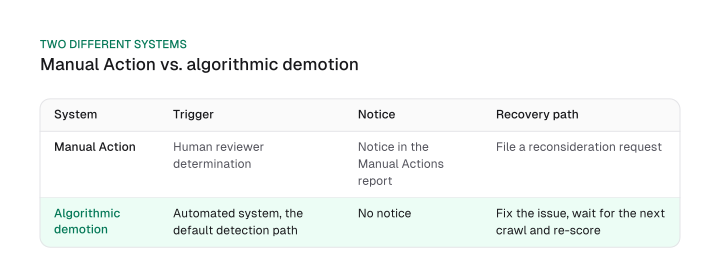
Fix: check the Manual Actions report first. A clean report means the drop is algorithmic, and the fix is quality plus waiting for the next crawl and re-score, not a reconsideration request that doesn’t exist for this kind of drop.
That doesn’t mean AI SEO mistakes never trigger a real Manual Action; severe scaled content abuse still can. Check the report before you assume one. Run the AI SEO optimization checklist against the site once the report is clear, so the next drop is easier to diagnose.
The pattern underneath all five
The fix for every mistake above is the same habit: check the primary source before repeating the checklist advice, and read the reviewer’s or the algorithm’s own language before calling something a “penalty.”
None of these five fixes costs a bigger budget. Rewording a prompt costs nothing. Checking the Manual Actions report is free. Rereading a spam policy takes ten minutes. What they cost is the habit of opening the primary source before you repeat what five blogs already told you.
That’s the pattern behind every AI SEO mistakes correction on this page: most AI SEO myths trace back to nobody opening the primary source before repeating the checklist. Run the full AI SEO optimization checklist once you’ve corrected these five beliefs first. A checklist assumes the beliefs underneath it are already right.
Frequently asked questions
No. AI changes distribution, AI Overviews and chat answers sit above the traditional results, without removing the ranking systems behind them. Google still runs automated detection and human review on the same spam policies this guide just corrected beliefs about; nothing about AI search replaces that.
If you have to pick one, it’s treating “penalty” as a single thing. That belief sends teams toward a reconsideration request for a drop that’s actually an algorithmic re-score, the wrong recovery path for what happened, which wastes the most time of the five.
No. Every fix on this page is a process or wording change: auditing search intent, checking a free Search Console report, rewording a prompt. None of them is a budget line, and none needs a large team to run.
It depends which system is involved. An algorithmic re-score resolves on the next crawl and re-score cycle once you’ve fixed the underlying issue. A real Manual Action needs a reconsideration request and a human review, which takes longer and isn’t guaranteed to land on your timeline.
Figures and images in this post are free to reuse under CC BY 4.0 with credit to Mission Growth.
Get Mission Growth highlighted in your Google results.