
Multi Armed Bandit vs A/B Testing: When Bandit Testing Wins
Multi armed bandit vs a/b testing, decided by the numbers: a proven regret bound, a Thompson Sampling walkthrough, and a decision table for your traffic.

On this page
Multi armed bandit vs a/b testing is the choice in front of you the moment you decide how to split traffic on your next test.
Get it wrong and you either wait for a decision that didn't need the wait, or ship a change nobody can defend later.
Multi armed bandit vs a/b testing: the short answer
The choice comes down to one variable: whether your test window, traffic and stakes can survive a fixed, even split.
Bandit testing wins only when the window is short, traffic is thin, or the decision doesn't need to hold up under scrutiny months later. Everything else favors a fixed A/B test, or a sequential test when you need to check the result early.
That tradeoff gets stated as a vibe everywhere: multi-armed bandit testing is "faster," A/B testing is "more certain." This guide turns it into a number, the exact share of traffic a bandit spends on the losing variant while it explores, and a table you can point your own traffic at.
Quick read:
- Thin traffic, short window: run a multi-armed bandit.
- Plenty of traffic, a decision that has to hold up later: run a fixed A/B test.
- Need to check the result early without breaking the math: run a sequential test instead of either.
- Four or more variants: the bandit's exploration cost adds up faster, so lean fixed.
How a multi-armed bandit reallocates traffic
A multi-armed bandit shifts traffic toward whichever variant is currently scoring best instead of holding an even split, using an algorithm such as UCB1 or Thompson Sampling to decide how much to shift and when.
- Fixed A/B test: an equal split, held constant until the test ends, with one effect size estimate reported once at the finish line.
- Multi-armed bandit: the split shifts toward whichever arm is scoring higher as data accumulates, though a well-built bandit never abandons the other arms entirely.
"Dynamic reallocation" covers more than one method: a family of named, provably-bounded algorithms. UCB1, short for Upper Confidence Bound version 1, is the clearest one to reason about, and Thompson Sampling, covered below, is another. Both count as a multi-armed bandit algorithm.
UCB1 tracks each variant's estimated conversion rate plus a confidence margin that shrinks as more visits come in, and always sends the next visit to whichever arm has the higher of the two added together. Researchers call this general problem regret minimization: keeping the cumulative cost of ever picking a worse arm as low as possible while you're still learning which one is best.
Auer, Cesa-Bianchi and Fischer's 2002 analysis of UCB1 proves a hard ceiling on the algorithm's own mistake: the expected number of visits sent to a losing arm after n plays is bounded at 8·ln(n)/Δ² + 1 + π²/3, where Δ is the gap between the best arm's true conversion rate and the loser's.
A short-window promotion, like a holiday-promo price test, is exactly the case a bandit fits. Traffic is capped by the calendar, so cutting exploration short and exploiting the leader sooner counts for more than a clean audit trail.
A fixed split also carries its own allocation-integrity check, the kind sample ratio mismatch catches, in a way a continuously shifting bandit split doesn't need in the same form.
What exploration actually costs you, in visits
A bandit's exploration cost has a hard ceiling. The UCB1 bound from the section above sets a hard ceiling on how many visits go to a losing variant, and running real traffic numbers through it turns "wastes less traffic" into a percentage you can check against your own test.
Take a 3-variant bandit test running 500,000 total visits, where the true conversion gap between the best and worst variant is 5 percentage points. The bound caps the expected visits sent to the losing variant at roughly 41,996, about 8.4% of all traffic.
Narrow that gap to 2 percentage points and scale traffic up to 2,000,000 visits, and the bound rises to roughly 290,177 visits, about 14.5% of traffic sent to the loser. Both figures are our own calculations, run through the formula above with n and the gap size as inputs, not numbers measured on a live test.
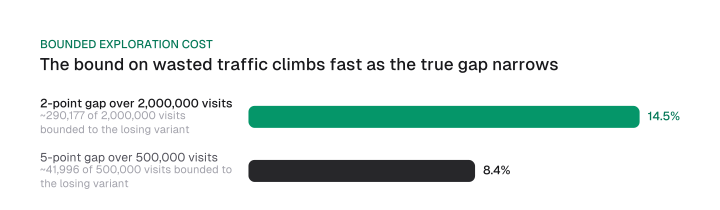
The smaller the true gap between variants, the higher the share of traffic the bound allows to reach the loser. A wide, obvious gap gets cleaned up fast; a close call keeps testing both arms longer, which is exactly what a sound algorithm should do.
Winner: multi-armed bandit, when the true gap is likely to be small and traffic is capped by the calendar.
Why a bandit's traffic split is still a statistics-backed decision
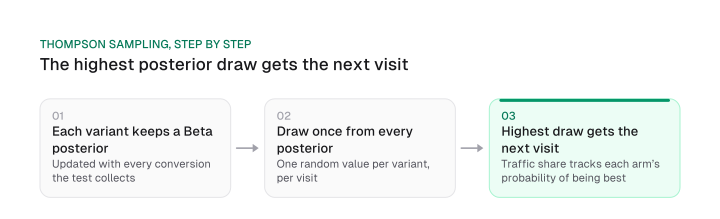
Thompson Sampling's traffic split is a real statistics-backed decision. It draws a random value from each variant's Beta posterior distribution and serves whichever draw is highest, a bet weighted by the posterior probability that variant is the true best one.
Chapelle and Li's 2011 analysis of Thompson Sampling defines the rule precisely. For a conversion-rate metric, each variant keeps a Beta(successes, failures) posterior; the algorithm draws once from every variant's posterior, and whichever draw comes out highest gets the next visit. Over many draws, a variant's share of traffic tracks the probability that it's actually the best one, what the paper calls probability matching.
One widely read guide gets this backward. Amplitude's own comparison states it plainly:
we can't make a statistics-backed decision on the best overall variant
That understates it. A Bayesian bandit gives up a p-value, not a statistical estimate: the posterior probability behind every Thompson Sampling draw is itself a real statistical quantity, updated with each conversion the test collects.
Where bandit results break: changing behavior and Simpson's Paradox
A multi-armed bandit's guarantees break down once user behavior stops being stationary, because every proven regret bound, including UCB1's, assumes each variant's true conversion rate holds steady for the length of the test.
Break that assumption and the bandit's own reallocation habit works against you. Say a variant's real conversion rate rises and falls across the test window, converting better on weekdays than weekends. If the bandit happens to shift more traffic toward it right as a strong cohort arrives, the pooled numbers can show a bigger gap than the two variants ever produce on a like-for-like day.
That's Simpson's Paradox: a trend in combined data that shrinks or reverses once you split the data by the variable actually driving it. A bandit's constantly shifting mix makes this easier to trigger than a fixed test's constant split does.
Three more limits get stated as bare facts in most write-ups, without the mechanism behind them:
- Single-metric optimization. A bandit reallocates toward whichever metric you point it at, so a variant that wins on conversion rate while quietly increasing support tickets or refunds keeps winning traffic unless that second metric is wired in as a guardrail.
- Inconsistent user experience. Because the split keeps moving, a returning visitor can land in a different variant than their last visit unless the bandit sticky-buckets by user ID, something a fixed A/B test gets for free from its constant split.
- Delayed convergence and tuning. More variants or more noise in the reward signal make the bound from the earlier section take longer to close in on a winner, the same n-and-gap tradeoff pushed harder. Getting there also means choosing an algorithm and setting its parameters, like UCB1's confidence margin or Thompson Sampling's prior, complexity a fixed test skips.
Is a multi-armed bandit the same as reinforcement learning?
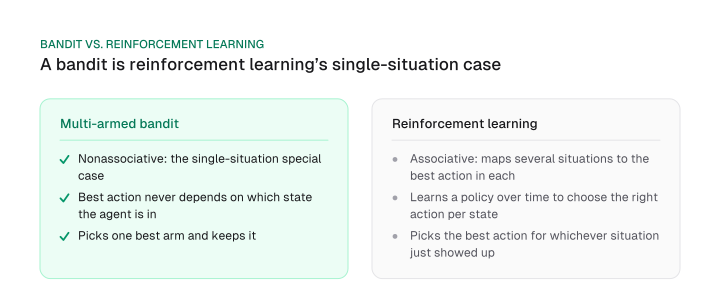
A multi-armed bandit is a narrower thing than full reinforcement learning: the single-situation, nonassociative special case, where the best action never depends on which state the agent is in.
One widely read FAQ, from Braze, blurs this line:
Multi-armed bandit testing is not the same as reinforcement learning... reinforcement learning is more advanced and adapts decisions at the individual level
That leaves "advanced" and "individual level" undefined.
Sutton and Barto's textbook draws the distinction precisely: a k-armed bandit problem never involves learning to act in more than one situation, so there's no state to condition on. Full reinforcement learning is associative, mapping several distinct situations to the action that works best in each, through a policy the agent learns over time.
A bandit picks one best arm and keeps it. Reinforcement learning picks the best action for whichever situation just showed up.
When a fixed A/B test is still the right call
A fixed A/B test is the right call whenever the decision has to survive being questioned later, because its even split is what lets you report one clean, defensible effect size instead of a bandit's traffic-weighted estimate.
That's what "certainty" actually means in the tradeoff every comparison repeats without defining it: one estimate nobody can say was measured on a shrinking, shifting sample.
Run a fixed split when:
- The change is big and permanent, like a pricing model or a core flow redesign, where you'll defend the number in a review months later.
- You're comparing exactly two things, cleanly, with no real reason to explore a family of variants.
- You need an audit trail: a single effect size and confidence interval that doesn't depend on which day of the test a visitor arrived.
Winner: fixed A/B test, if the decision has to hold up under scrutiny after the test ends.
A fixed split also tells you, in plain numbers, how much traffic a fixed test actually needs before it reaches significance, which is worth checking before you commit resources to it. That required volume depends directly on your minimum detectable effect, the smallest lift size you actually care enough about to catch and report.
Once you've committed to a fixed test, CUPED is a separate way to shrink how long it needs to run, by adjusting for a pre-experiment covariate rather than changing how traffic is split.
What about sequential testing?
Sequential testing sits between the other two. It still ends in one stop/go decision like a fixed A/B test, but lets you check the result early without breaking the statistics, unlike a bandit's continuous reallocation. This guide answers "bandit or fixed," not "how do I peek safely," which is sequential testing's job.
Multi-armed bandit vs. A/B testing: the decision table
The right method for your next test is a function of three numbers: how much traffic you have, how long the decision window lasts, and how many variants you're running.
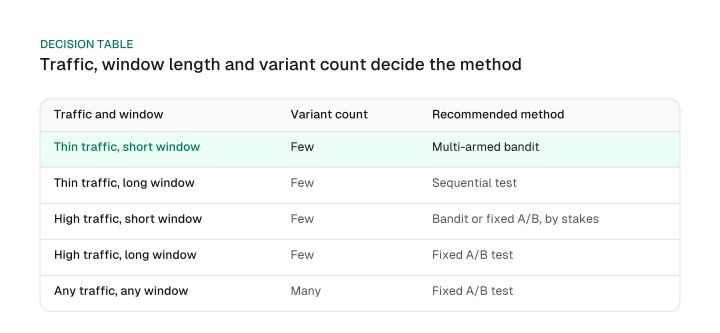
Start with your traffic and window, then check the variant count against it. Thin traffic on a short window is the bandit's exact use case: a small pool of visits with no room to wait, where continuously shifting weight toward the leader beats holding a full split for a fixed sample size.
The same thin traffic under a long window shifts the call to a sequential test, since you can afford to wait but still want to stop the moment the result is clear. High traffic on a short window is a real judgment call: a bandit if speed matters more than a defensible paper trail, a fixed split if it doesn't.
High traffic on a long window has no real argument for anything but a fixed A/B test. Running four or more variants pushes the recommendation back toward a fixed test across every row, because the bandit's own exploration cost, from the bound above, grows with every extra arm it has to keep sampling.
Not every test carries the same stakes, so it helps to size how much the decision is worth before picking a method: a minor copy tweak and your core pricing page can tolerate very different amounts of exploration cost.
The choice between the two comes down to a provable, quantifiable tradeoff you can check against your own traffic. You now have the regret bound, the Thompson Sampling mechanism and the table to do it. Pull your last few tests' average monthly traffic and typical decision window, and run them through the table above before you pick the next one.
Frequently asked questions
Is multi-armed bandit testing the same as reinforcement learning?
No. A multi-armed bandit is the single-situation, nonassociative special case of the problem: the best arm doesn't depend on any state. Full reinforcement learning is associative, mapping multiple situations to the best action in each through a learned policy, the distinction Sutton and Barto's textbook draws formally.
What is better than A/B testing?
It depends on your window. For a short one, a multi-armed bandit converges faster and wastes less traffic on the loser. For a longer window where you want to check results early, a sequential test lets you do that without breaking the statistics. Neither is better in general, only for a given window.
Is A/B testing worth it?
Yes, whenever the decision has to be defensible after the test ends: a fixed split gives you one clean effect size nobody can say was measured on a shifting sample. It's not worth it if your traffic can't reach significance before the window closes.
What are the pros and cons of multi-armed bandit testing in marketing?
Pros: faster convergence on short windows, and traffic sent to a clear loser stays within the regret bound above rather than growing unchecked. Cons: it optimizes one metric by default, breaks down once user behavior stops being stationary, and produces a traffic-weighted estimate instead of a fixed test's clean audit-trail effect size.
When should I use multi-armed bandit testing vs. A/B testing?
Check three numbers: your monthly traffic, how many weeks the decision window lasts, and how many variants you're testing. Thin traffic on a short window favors a bandit; the same traffic on a longer window favors a sequential test; enough traffic and a window long enough to wait favors a fixed A/B test.
Figures and images in this post are free to reuse under CC BY 4.0 with credit to Mission Growth.
Get Mission Growth highlighted in your Google results.