Product Qualified Lead (PQL): Definition and Scoring Model
A product qualified lead (PQL) is defined by usage, not a form fill. See a real scoring model, when to route PQLs to sales, and how to measure conversion.
On this page
A product qualified lead (PQL) is only as useful as three things: a scoring model that names which signals to exclude, a routing rule tied to account size, and a measurement method that separates causes.
The routing rule sends a five-figure account down a different path than a self-serve signup. The measurement method tells you whether a weak number is an activation problem or a follow-up problem.
The conversion-rate multipliers used to justify caring about PQLs at all are, checked against their own named sources, either uncited or wrong.
What is a product qualified lead (PQL), and what it isn't
In-product usage, rather than a form fill or a sales call, is what turns a prospect into a product qualified lead (PQL). The exact behavior that counts is different for every business.
PQL scoring sits downstream of the activation event a team already tracks. A user who never reaches that first taste of value has nothing worth scoring yet, whatever the pitch says.
Getting that definition right matters because PQL is one spoke of a wider growth marketing strategy, not a synonym for "engaged free user."
Scoring product qualified leads matters because it replaces a guess with a behavior. A team that scores usage instead of demographic fit spends sales hours on accounts that already found value, instead of chasing every signup with the same generic outreach.
A PQL is not:
- A free-trial signup by itself. Signing up shows interest, but the account hasn't used the product yet.
- A single login or a pricing-page view without repeat use. One visit shows curiosity; a pattern needs several.
- A one-time upgrade click or feature try that never happens again. It has to repeat to count.
Turn that exclusion rule into four checks you can apply to any incoming account:
- The behavior repeats; it isn't a one-time action.
- It isn't a sign-up, a login or a pricing-page view by itself.
- The threshold is segmented by account size instead of one flat rule for everyone.
- The model gets re-validated against real outcomes after 30-60 days.
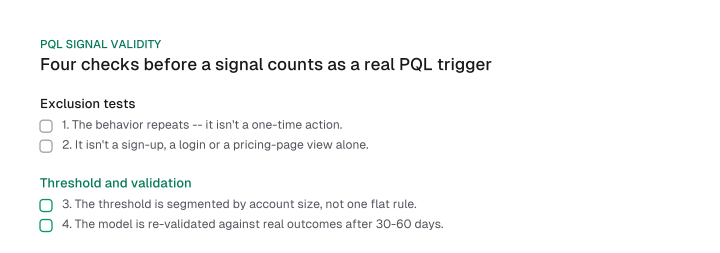
Pass all four and the signal is real. Fail one and the lead only looks qualified on a dashboard, whatever your team decided when it first answered what is a PQL for this product.
PQL vs MQL vs SQL
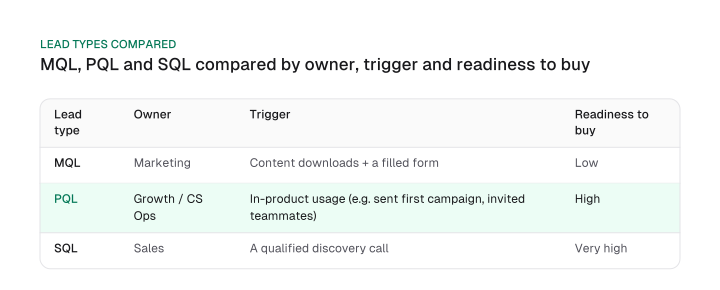
A PQL differs from an MQL and an SQL by who owns it, what triggers it, and how close it is to buying.
Marketing owns MQLs on content downloads and form fills, with low readiness to buy. Growth or CS ops owns PQLs on in-product usage, with high readiness. Sales owns SQLs on a qualified discovery call, with very high readiness.
PQL vs MQL comes down to trigger and ownership: marketing-driven content versus product usage. PQL vs SQL comes down to distance from a signed deal: a usage signal versus a completed discovery call.
A pure MQL model breaks down for a self-serve or freemium buyer. The moment that predicts a purchase happens inside the product, before the buyer ever fills out a form on a landing page.
A visitor who downloads a whitepaper and never opens the app behaves like a classic MQL. An active free user who never filled out a form might already be your best account, and form-based scoring alone misses that person completely.
One widely repeated claim tries to make the case for PQLs over MQLs with a number:
Data Mania found that PQLs convert at 20%-30%, MQLs close at 13%, and SQLs convert at only 6%.
That line, quoted by GoConsensus, doesn't appear on Data Mania's own MQL-to-SQL benchmarks page.
What that page actually states is a set of industry-specific MQL-to-SQL conversion rates ranging from 12% to 21%; Healthcare sits at 13%, for example. It contains no PQL figure anywhere and no 6% SQL number either.
Why PQLs convert differently -- and the real numbers behind it
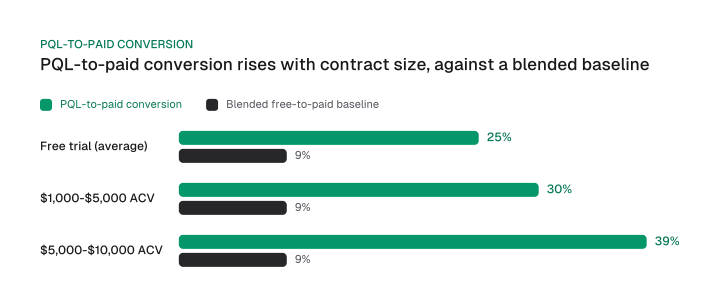
PQLs convert to paying customers at a materially higher rate than a blended free-account baseline: roughly 2.8x for an average free trial and 4.3x at higher contract sizes.
That's not the 5-6x or "20-30% vs. 13% vs. 6%" figures repeated across the category without a check.
Those numbers come from ProductLed's PLG Benchmarks survey, which polled more than 600 SaaS businesses and published its findings in February 2025. It breaks the PQL-to-paid rate down by contract size:
- Free trial (average): 25%
- $1,000-$5,000 ACV: 30%
- $5,000-$10,000 ACV: 39%
The same survey also reports a 9% baseline across all conversion models, blended across freemium and free-trial motions rather than filtered to PQL status specifically. Measuring against it is a directional comparison, and not a strict same-population multiplier.
Divide the free-trial rate by that blended baseline (25% over 9%) and PQL-qualified trials convert at roughly 2.8x the survey's overall average. Run the same math on the top ACV tier (39% over 9%) and the lift grows to roughly 4.3x.
One specific example gets misquoted more than any other. Paddle describes Slack's rule that any team exchanging 2,000 messages has "a 93% conversion chance."
Slack's own co-founder, Stewart Butterfield, described that number differently in a 2015 interview with First Round Review: "Any team that has exchanged 2,000 messages in its history has tried Slack -- really tried it," he said, and "after 2,000 messages, 93% of those customers are still using Slack today."
That's a retention statistic, how many teams stuck around, rather than a conversion-to-paid rate, and the two don't measure the same thing.
Building your PQL scoring model
Building a PQL scoring model means weighting a short list of usage signals by buying intent, excluding vanity signals, and setting a different score threshold for SMB and enterprise accounts.
Two scoring frameworks, weighted differently
Custify's own PQL and PQA (product-qualified account) framework assigns four weight tiers:
- High-intent actions: 5 points each
- Medium-intent actions: 3 points each
- Context signals: 2 points each
- Hygiene signals: 1 point each
An SMB account crosses the PQL line once its running total reaches 8 points within 14 days. Reaching 12 points with 3 or more active users in the last 7 days makes it a PQA instead, the account-level version of the same idea.
That low hygiene weight is deliberate. Custify draws the line even earlier: sign-ups, logins and pricing-page views earn no points at all, excluded from scoring outright. Its hygiene tier example is three or more sessions within seven days, still low-weight but already a repeat behavior, which is why the exclusion checklist above holds up under the math.
Foundation Inc.'s own model skips weighted tiers for a flat point scale tied to specific behaviors:
- A visit to the pricing page: 20 points
- Bringing in a teammate: 15 points
- Hitting the free-tier limit: 25 points
- Seven-plus consecutive days of active use: 10 points
Those four numbers cover the same ground from a different angle: upgrade intent, team expansion, a freemium ceiling, and usage depth. Foundation Inc. recommends validating the model against real conversion outcomes after 30-60 days rather than trusting the point values as published. That validation step is the same discipline behind avoiding false positives at higher testing velocity.
A worked example: scoring two accounts
Neither framework is a universal standard. Both are one company's published choice, applied here as a worked example using Custify's own weights.
Account A shows one medium-intent signal (3 points), one context signal (2 points) and one hygiene signal (1 point): six points total, two short of the eight-point SMB threshold, so it isn't a PQL yet.
Account B adds one high-intent signal (5 points) to a similar mix, one high-intent, one medium, one context and one hygiene signal, for eleven points, past the threshold and into PQL territory.
Score two of your own accounts against the same four weights and you'll see exactly where your own line should sit.
Who owns the score
Nobody builds or acts on that score alone. Product usually owns the event tracking the score depends on, marketing and growth own the model's weights and thresholds, sales owns what happens once an account crosses the line, and customer success watches the accounts that plateau just below it.
The signals themselves, freemium ceilings, trial usage, team invites, come out of however a business designs its product-led growth motion in the first place. This section only covers what to do with them once they exist.
Routing PQLs to sales
Not every PQL should go to a sales call. A higher-ACV, multi-user account gets an immediate human handoff, while a smaller self-serve account gets a content nurture first.
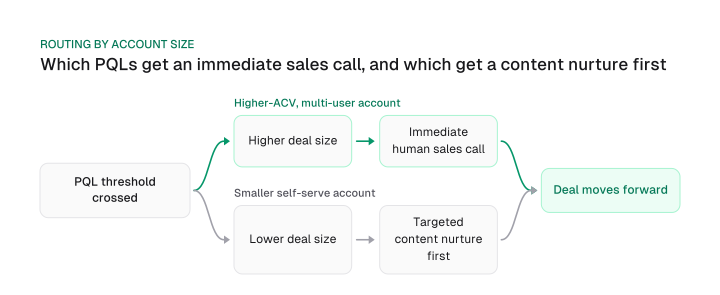
ProductLed's own tiered conversion data makes the case for treating those two accounts differently. A PQL sitting inside the $5,000-$10,000 ACV tier converts at 39%, well above the 25% average for a free trial, so that deal is worth a person's time the moment it crosses the line.
A self-serve account that just crossed the same score threshold sits statistically closer to the lower end of the range. Putting a rep on the phone with it burns time better spent on a targeted content sequence that keeps the account warm until it either upgrades or plateaus.
Once that routing rule is written down, AI marketing agents watching the same product and CRM data are the natural place to automate the handoff decision instead of running it by hand every time a score changes.
Measuring PQL conversion
Three numbers make up PQL conversion measurement: PQL count, PQL rate, and PQL-to-paid rate.
A weak result in any one of them points to a different root cause. Track each one separately:
- PQL count: how many accounts crossed your scoring threshold in a given period.
- PQL rate: PQL count divided by total qualified accounts (or active trial and free accounts) in the same period.
- PQL-to-paid rate: how many of those PQLs actually converted to a paying account.
A low PQL rate usually means an activation problem: too few accounts are reaching real usage in the first place. Read that number as a cue to check activation before touching anything downstream.
A healthy PQL rate paired with a low PQL-to-paid rate points somewhere else entirely. Check who followed up on those PQLs and how fast, before touching the lead definition or the price.
A weak conversion number usually triggers a debate about whether the scoring model or the price is wrong. Often the accounts were qualified correctly and simply never got a fast enough follow-up.
Naming which of the three numbers moved is the same discipline that makes a content ROI figure legible instead of a single blended rate nobody can act on.
A product qualified lead is only as good as three pieces: a scoring model that excludes vanity signals, a routing rule sized to account value, and a measurement method that separates causes.
That routing rule treats a five-figure account differently from a self-serve one, and that measurement method tells you whether a bad number is an activation problem or a follow-up problem.
The conversion-rate claims used to justify caring about PQLs at all only hold up once checked against their own sources, and most of the widely repeated ones don't.
Start with the accounts already in your pipeline this week. Score five of them against Custify's four weight tiers, set an SMB threshold, and see how many cross it.
Then check whether the ones that crossed actually got a human follow-up fast enough to matter, before you touch the scoring model or the price.
Frequently asked questions
Which PQLs should go straight to a sales call versus into an automated content nurture?
Route by ACV tier: a higher-ACV, multi-user account that just crossed the PQL threshold gets an immediate human sales call, while a smaller self-serve account gets a targeted content nurture first and waits for a stronger signal.
Is a low PQL-to-paid rate a lead-quality problem or a follow-up problem?
Check the PQL rate itself first. If that number is healthy and only the PQL-to-paid rate is low, the more likely cause is who followed up and how fast; check routing and follow-up speed before touching the lead definition or the price.
What is a Product-Qualified Account (PQA)?
A PQA is the account-level version of a PQL for multi-user B2B products. Under Custify's own framework, an account needs a score of at least 12 points with 3 or more active users in the last 7 days to count as one.
How is a PQL different from an activation event?
An activation event is the moment a user first experiences a product's core value; a PQL is a usage pattern that signals buying intent, and it usually shows up after activation rather than instead of it.
How do I stop counting logins and pricing-page views as PQL signals?
Apply the exclusion checklist from the definition above: a signal only counts if it repeats, and a sign-up, a login or a one-time page visit never counts on its own, no matter how recent it is.
Figures and images in this post are free to reuse under CC BY 4.0 with credit to Mission Growth.
Get Mission Growth highlighted in your Google results.