Best AI First SEO Agency 2026: 7 Compared on Price, Term
Which AI first SEO agency fits? Seven compared on the price, term and robots.txt each states itself, read November 2026, from $1,500 a month.


On this page
Four of the seven AI-first SEO agencies below print a starting price and a flexible term on their own pages, and three print neither. Their robots.txt files barely separate them: six of seven leave GPTBot unblocked.
That is what reading each agency's own domain on 2026-11-05 turned up, and it changes how to shop for an ai first seo agency. Choose on the price, term and monitoring report an agency states. Treat robots.txt as a consistency check instead of a ranking, since these AI SEO agencies look alike there.
The rest of this post gives the shortlist by situation, the rule that picked these seven, a card for each, a reading of what their robots.txt files say, a spec for the monitoring report you should ask for, and a check you can run in about 10 minutes.
Best AI first SEO agency by situation
The best AI-first SEO agency depends on your term, budget and size: Optimist for B2B SaaS, Loopex Digital for a $1,500 start, Stridec or Tenten GEO for a priced, cancellable start, iPullRank or Onely for enterprise. Thrive suits a buyer who wants to talk scope first, since it prints no figure. No page can name the one best AI SEO agency for everyone, so the table sorts by situation.
The choice follows three stated facts: the price or program, the term, and who the agency says it does not serve. It does not follow a rank. Four agencies print both a price and a flexible term (Optimist, Loopex Digital, Stridec, Tenten GEO). iPullRank sells fixed 3-month and 12-month programs. Onely and Thrive print neither a price figure nor a term.
Download CSV (CC BY 4.0)
Read the table by exclusion. A small business should skip Onely, which says small businesses, local search and paid media are outside its focus.
A buyer who needs a number before a call can only compare four of the seven, and the only monthly dollar figures to set side by side are Tenten GEO's $4,999 a month, Optimist's $3,000 and Loopex Digital's $1,500, with Tenten GEO the highest of the three. Stridec's S$2,500 is left in its own currency.
What AI-first has to mean, and how the seven were picked
An AI-first SEO agency is one you can verify from outside on three checks: what it states about price and term, how its own site treats AI crawlers, and what its monitoring report contains.
- Price and term. Checked from outside on its own pages.
- Crawler policy. Read from its own robots.txt.
- Monitoring report. Prompts, engines, cadence and runs.
A list position is weak evidence for any of this. Onely, an agency with a card below, asked five AI engines the same agency question twice on one day, and four of five changed most of their shortlist between runs. It also reports that, in the answers that changed, the publisher of each cited list ranks itself first.
Citation and recommendation are also separate outputs. Search Engine Land's June 2026 report on an analysis of B2B software queries found Google AI Overviews cited self-promotional listicles while excluding the brands behind them from recommendations in 69% of cases. Those are cases, meaning citations of listicles, and the analysis tested software queries, not agency queries.
The pattern still gives a plain rule. Self-promotional listicles can be cited but not recommended, so reviews and best-of lists, including AI first SEO agency reviews, deserve less weight than facts an agency states on its own domain.
Every card meets both parts of one selection rule, each checked on the agency's own domain and not on a ranked list. First, the site presents AI search (GEO, AEO or AI visibility) as an offer it sells. Second, a page states a price figure, a term or program length, a contract stance, or the buyers the agency does not serve.
The starting pool came from agencies that page-one lists and the AI Overview name, so it is not independent of those lists. The rule, not list position, decided who got a card.
Sash Digital shows the rule at work. The Overview names it, but its homepage lists projects across web design, brand identity, SEO, GEO and performance marketing as one set, with no price, term or program length. It fails the second part, so it has no card. Still deciding between hiring and software? Read AI SEO agency vs software first.
Seven AI-first SEO agencies compared
Seven agencies fit AI-first SEO work: Optimist, Loopex Digital, Stridec, Tenten GEO, iPullRank, Onely and Thrive, each with a different term and price disclosure. Four print a starting price and a flexible term, one sells fixed 3- and 12-month programs, and two print neither. For what the work itself usually includes, see AI search optimization services; the cards below cover only price, term and fit.
Each card opens with a Best for line, and the AI SEO packages are described as each agency states them. An LLM SEO agency, a GEO agency and an AI search shop sell overlapping work, so the label matters less than the page behind it.
Every Con comes from the agency's own words. None is a third-party review theme, and no card carries a rating.
1. Optimist
Best for: B2B SaaS marketing leaders who want monthly commitments and weekly AI visibility tracking.
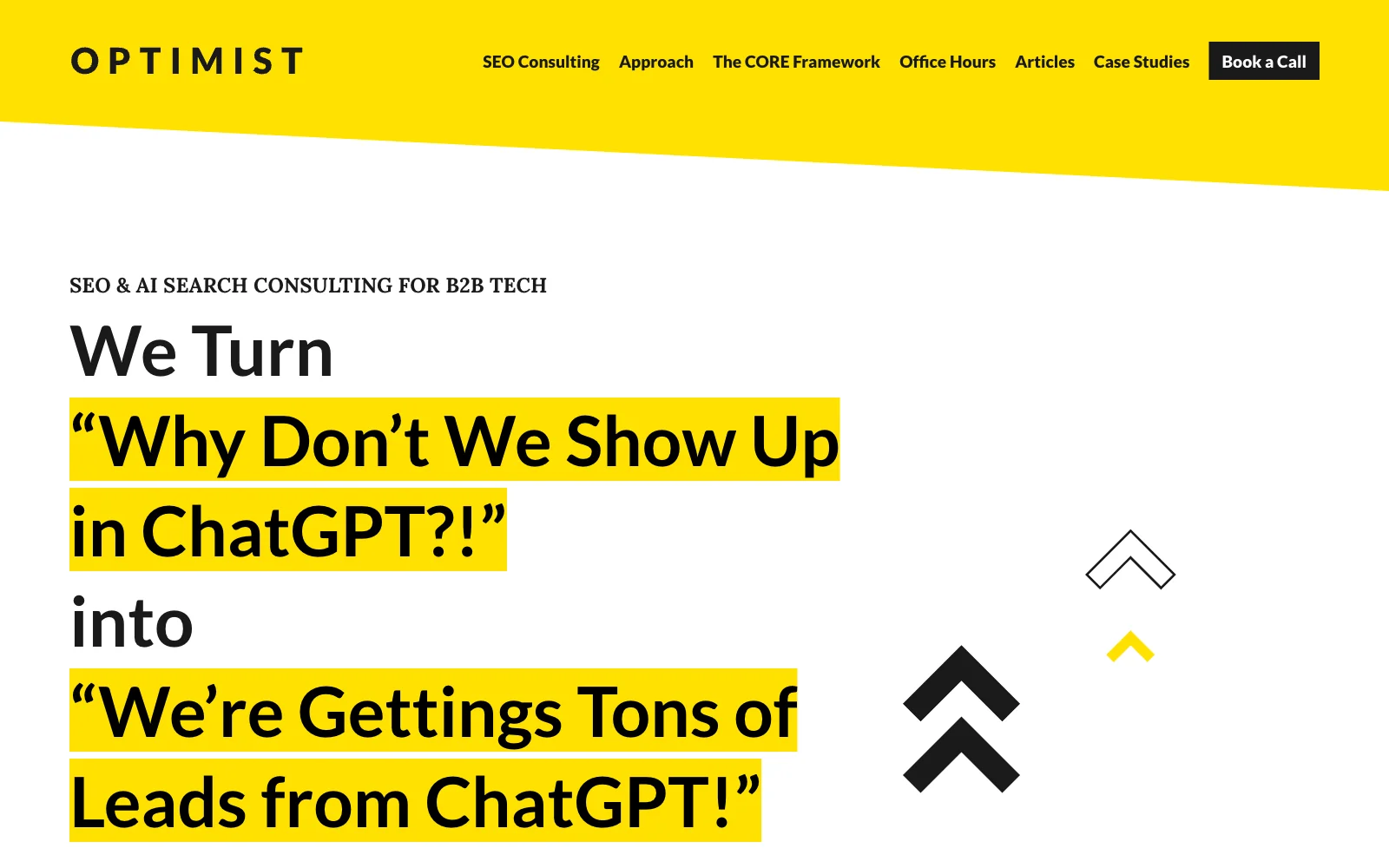
Optimist describes its job as helping B2B SaaS marketing leaders win at SEO and AEO. Its retainers are month-to-month and include hands-on execution support, project planning and regular strategy calls. The reporting line pairs custom monthly organic performance reporting with weekly AI visibility tracking.
The price is printed on the homepage, which puts Optimist among the four agencies that state both a figure and a flexible term.
Optimist says nearly 200 B2B marketing teams have worked with it over 10 years, from early-stage startups to publicly-traded businesses. Its 6-12 month plans cover technical and on-page work, content creation, website and content optimization, messaging alignment and third-party presence.
The audit looks at AI visibility across key models, a breakdown by topic and model, fan-out queries, citation patterns and a CORE audit across 21 key visibility factors.
CORE is what Optimist calls its proven system for driving organic revenue through AI search and SEO, a complete and systematic process to rank in search, get recommended by LLMs and generate inbound demand.
The B2B tech case was framed as AEO: Optimist says it helped the client reset its content strategy to grow AI visibility and referral revenue and traffic from LLMs.
For proof it shows a B2B tech case with an unnamed large client: 49x LLM revenue and 26x LLM referral traffic. Treat that as Optimist's own account, since the client is unnamed and the figure is unverified.
Pros:
- States a starting price and a month-to-month term
- Weekly AI visibility tracking alongside monthly organic reporting
Cons:
- Its own pitch addresses B2B SaaS marketing leaders, so other buyers should ask whether the fit holds
Price: Starts at $3,000 a month.
2. Loopex Digital
Best for: Teams that want a $1,500 a month start and a rolling 30-day term.
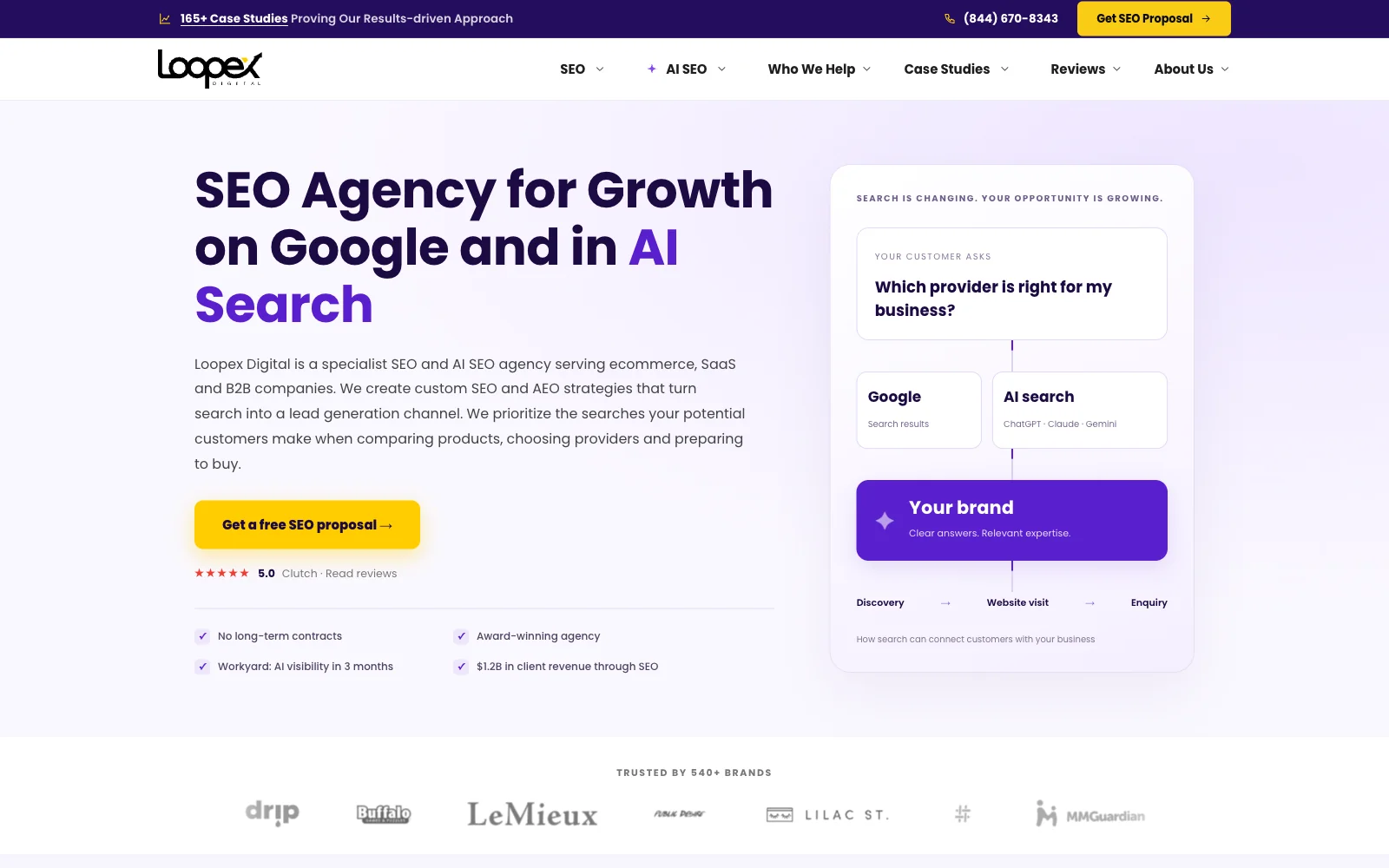
Loopex Digital calls itself a specialist SEO agency, with rankings in Google plus visibility in ChatGPT, Perplexity and AI Overviews. Its homepage says work runs on a rolling 30-day basis, and the proposal sets scope, priorities and monthly budget before you commit. A dashboard for monitoring brand appearances across ChatGPT, Perplexity, Gemini and Google AI Overviews comes included in the plan.
The detail to read is how AI work is priced. Selected AI SEO activities can be included within the agreed budget, so the $1,500 a month figure is an SEO engagement price and AI work is allocated inside it.
Loopex says it serves ecommerce, SaaS and B2B companies, and that its custom SEO and AEO strategies turn search into a lead generation channel. The AI SEO work has two named workstreams. AIO and GEO citation outreach researches the sources cited for relevant buyer queries and pitches them to include clients. Content strategy for AI identifies the most common buyer queries and answers them through your content.
Tracking runs on internally built software, and Loopex reports weekly on every step completed on your account. A strategist leads the account with content specialists and link builders, and the founders review the strategy and key steps for every client. Technical audits use internally built scrapers that check more than 200 technical parameters.
Loopex also says it has generated a lifetime total of $1.2B in client revenue through SEO and AI answer engine optimization. That is a self-reported figure.
Pros:
- The lowest of the three dollar monthly starts, $1,500 a month
- Rolling 30-day term and an included dashboard
Cons:
- AI work sits inside the agreed budget, with allocation and deliverables set in the proposal
Price: SEO engagements from $1,500 a month.
3. Stridec
Best for: Buyers who want a priced AI search start on a single channel with no lock-in.
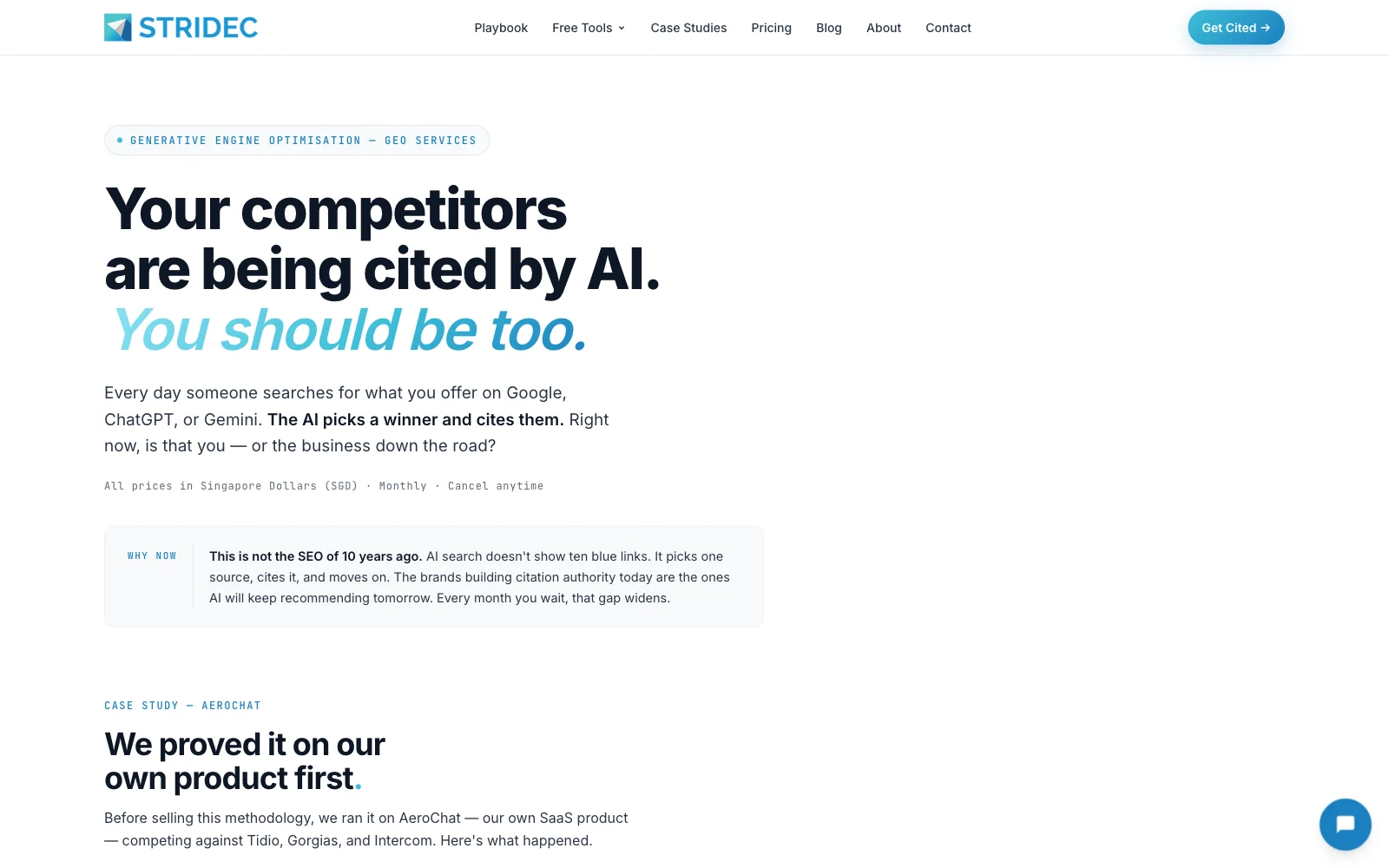
Stridec publishes a GEO pricing page with three tiers from S$2,500 a month, the deliverables in each, and a promise of no hidden scope and cancel anytime. Reporting is monthly: it connects Google Search Console and GA4, runs automated snapshots of AI results across platforms, and reports where your brand appears.
The entry tier is narrow. You choose one channel, Google (AI Overview plus Gemini) or ChatGPT, so coverage of both starts at a higher tier.
The three tiers differ by channels, topics and monthly output:
- Starter, S$2,500: one channel, 3 core topics expanded into 30-50 search terms, a Brand Authority Directive that documents and deploys your differentiation, and at least 8 content pieces a month.
- Growth, S$4,500: a second channel, so Google (AI Overview plus Gemini) and ChatGPT are both covered, with 7 core topics and at least 15 content pieces a month. Pricing is a Let's talk button rather than a checkout.
- Domination, S$8,000: Claude as a third channel next to Google (AI Overview plus Gemini) and ChatGPT, up to 20 core topics and at least 25 content pieces a month. It also sends you to a conversation first.
Subscribe annually and Stridec gives you 2 months free. Its pricing page also reports a result on its own product: before selling the methodology, it ran it on AeroChat, its own SaaS product competing against Tidio, Gorgias and Intercom, and says impressions grew 343% and clicks 127% in 90 days. All prices are in Singapore dollars, billed monthly.
Pros:
- Price, tiers and cancel-anytime term on one page
- Monthly report built on automated snapshots of AI results
Cons:
- The entry tier covers one channel, Google or ChatGPT
Price: Three tiers from S$2,500 a month, shown in Singapore dollars and not converted.
4. Tenten GEO
Best for: Buyers who want an audit first, a forecast before signing and a way out.
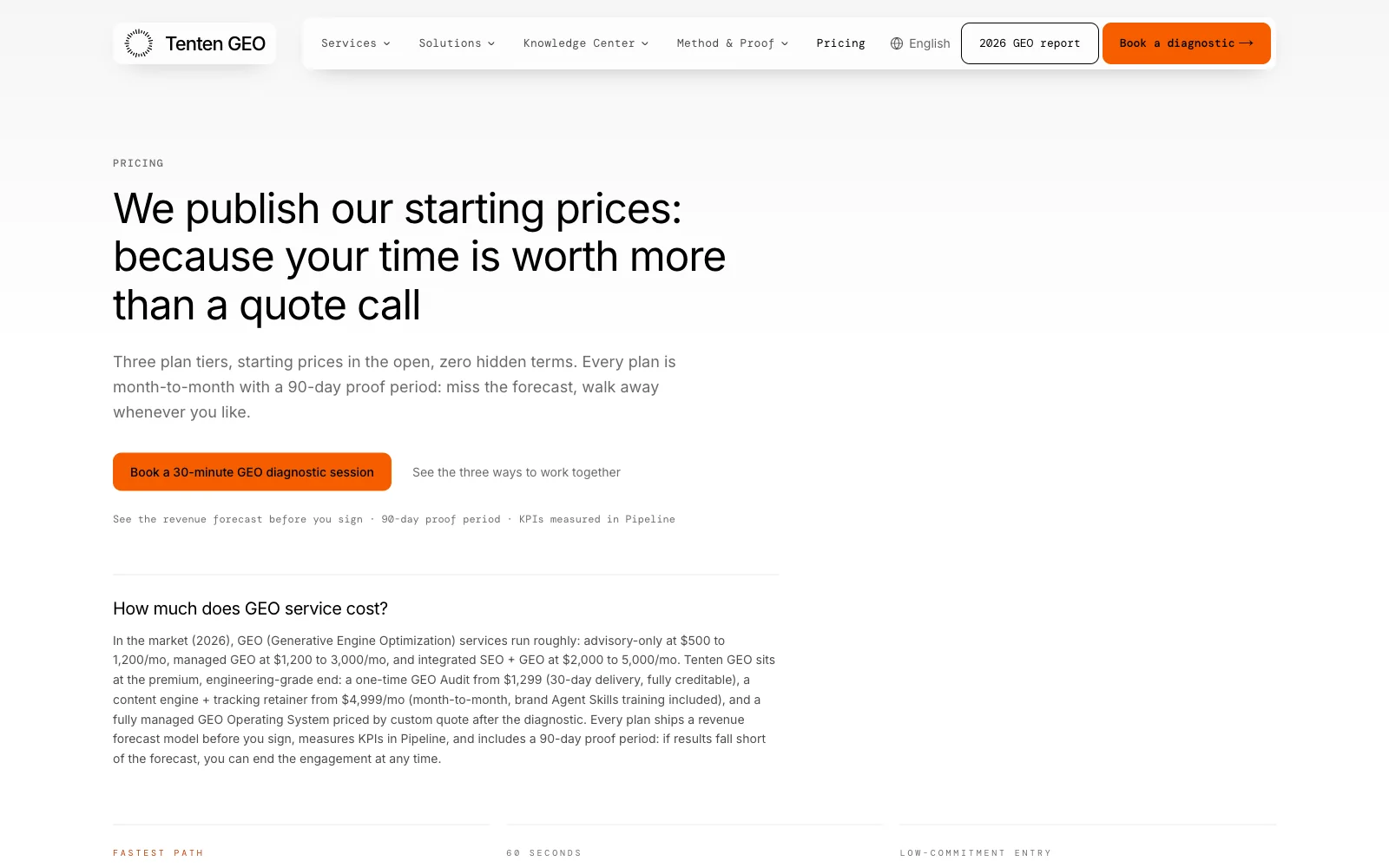
Tenten GEO prints its pricing "in the open": a GEO audit from $1,299 with 30-day delivery, content engine plus tracking from $4,999 a month, and fully managed enterprise plans by custom quote. The audit fee credits in full toward any plan that follows.
Terms are month-to-month with a 90-day proof period. Every plan ships a revenue forecast model before you sign, and if results fall short of the forecast you can end the engagement at any time.
That ties the exit to a forecast the buyer sees before signing, and it comes at the highest dollar price among the three agencies that print one.
Tenten GEO also prints its own read of the 2026 market. Advisory-only work runs $500 to 1,200 a month, a managed service $1,200 to 3,000 and an integrated SEO plus GEO program $2,000 to 5,000. That is the seller's market anchor, so read it as context.
The audit includes a competitor share-of-voice gap analysis: your AI citation share against theirs, and which sources (domains, Reddit, YouTube) drive their citations while you're absent. The retainer adds monthly GEO content production covering entity building, structured data and original, citable points of view, plus a weekly citation report with a six-engine citation rate and share of answer.
Request a proposal and Tenten GEO says you receive a firm quote and revenue forecast model within 24 hours after the call. It also argues that bringing GEO in-house takes a 3 to 5 person cross-functional team and at least six months on the learning curve, which is a vendor claim.
Pros:
- Audit fee credits in full toward a plan
- 90-day proof period with an exit if results miss the forecast
Cons:
- $4,999 a month is the highest of the three dollar figures, against $3,000 and $1,500
- Enterprise plans are by custom quote
Price: Audit from $1,299; content engine and tracking from $4,999 a month.
5. iPullRank
Best for: Complex organizations that need strategy, technical work and content to run as one program.
iPullRank sells its AI search strategy as two programs: a focused 3-month program for teams that need clarity before scale, and a 12-month program for teams ready to connect strategy, technical work, content, authority, execution and measurement in one continuous cycle. It frames the fit around organizations where the more complex the structure, the more important it is to break down silos.
Of the seven, it is the only one whose term is a fixed length instead of a monthly or cancel-anytime clause.
The program has three flexible starting points, Emerging, Growth and Elite, and iPullRank recommends the scope after it understands your goals, business risk, people, technology and capacity to execute. You do not need to choose a program before you book a call. The 3-month sprint turns the highest-impact search, content and technical opportunities into a practical 90-day action plan.
Founder Michael King walks through six key deliverables. They include an Omnimedia content plan, a production, optimization, governance and measurement roadmap, and a measurement plan that defines the visibility, citation, execution and business metrics your team tracks. iPullRank calls the approach Relevance Engineering, which aligns content strategy, technical foundation, user experience, PR, distribution and off-site authority.
It publishes two cases with unnamed clients. A telecom client went from 712 to 3,235 AI Overview inclusions year over year, and a vehicle platform's ChatGPT visibility rose from 32% to 67% in less than a year.
Pros:
- Clear program lengths, so you know what you are buying in time
- Built for cross-team work in complex organizations
Cons:
- Its AI search strategy page prints no price figure
- Fixed 3-month and 12-month programs, no monthly option stated
Price: No figure on its program page; programs run 3 months or 12 months.
6. Onely
Best for: International enterprises that need AI search work across markets.
Onely names itself the right GEO agency for enterprises that want AI search across borders. It is also the clearest of the seven about who it will not serve: small businesses, local search and paid media sit outside its focus. It scopes every engagement to the brand's problem and does not sell a fixed package.
That makes it easy to rule in or out and hard to budget for. Onely is also the source of the shortlist and list-ranking research cited earlier, which you should weigh knowing it is an agency writing about agencies.
An engagement includes audience research, entity mapping, content restructuring, team training and monthly measurement against a baseline, and each part ends in something your team keeps. Onely sources its questions from real conversations, such as Reddit threads, forums and the follow-up questions AI engines suggest. Each country gets its own question research, because the same need is asked differently in different languages and cultures.
Onely judges its reports by leads rather than mentions, because in its view being named by an AI engine turns into sales only if the brand knows its audience and meets it in context. Restructuring rewrites existing content and product pages so each passage answers one question completely. Training leaves your team the question map, the content rules and playbooks it keeps using after the engagement.
The entry offer is an AI visibility audit that shows where your brand stands in AI answers to your customers' questions and which sources the engines rely on.
Pros:
- States plainly who it does not serve
- Scoped to the brand's problem, not a fixed package
Cons:
- No fixed package means no figure to compare before a call
- Excludes small businesses, local search and paid media from its focus
Price: No fixed package; each engagement is scoped to the brand.
7. Thrive
Best for: Buyers who want to discuss scope first and scale by outcome.
Thrive says its AI SEO company earns partnership through performance, not contracts, and that GEO work can scale with outcomes and priorities. It pitches AEO and GEO at companies of every size, type and budget.
Read that as a contract stance, not a term. The page names no length and no cancellation clause, and it prints no price figure.
Thrive publishes its own result: in 2025 it grew total traffic from all AI platforms by +5,556%, including +1,078% from ChatGPT and +404% from Gemini. It says it identifies what works through structured prompt engineering, rich snippet optimization and real-time experimentation before implementing tactics for clients, and that it offers fully managed GEO.
It describes two unnamed clients. A medical group combining AI SEO and PPC reached over 1,000 total AI citations, after Thrive worked to earn more mentions and citations in the biggest LLMs, and a shoe company saw a 610% increase in ChatGPT traffic after Thrive worked on content relevance and trust signals.
Tactics are listed per engine:
- ChatGPT search: optimizing for Bing, content built for AI answers, link building aimed at chosen targets, technical SEO, brand management on social media and reputation management.
- Google's AI Mode: content optimized at passage level, targeting conversational queries, semantic SEO, topical authority and schema markup.
Staffing combines human expertise with AI efficiency, which Thrive describes as personalization plus speed. It says the fully managed service fits any industry.
Pros:
- Says it works through performance rather than contracts
- Positions services for any size, type or budget
Cons:
- No price figure and no stated term, so nothing to compare before a call
Price: Flexible pricing, no figure published.
What the seven agencies' own robots.txt files say
Of the seven card domains read on 2026-11-05, six leave GPTBot unblocked and Onely blocks GPTBot, so robots.txt separates one agency from six. The count is by effect: a named Allow under an open User-agent: * group behaves like silence, so Tenten GEO counts with the five that name no OpenAI bot.

What each file says, in short:
- Optimist:
User-agent: *with an emptyDisallow:. No AI bot is named. - Loopex Digital:
User-agent: *blocking only /api/. No AI bot is named. - Stridec: disallows 12 named crawlers, including Amazonbot and Bytespider. It names no OpenAI or Anthropic bot.
- Tenten GEO: a
Content-Signal: search=yes, ai-input=yes, ai-train=noline underUser-agent: *, plus named Allow rules for GPTBot and ClaudeBot. - iPullRank:
User-agent: *blocking only /wp-admin/. No AI bot is named. - Onely: disallows GPTBot, ClaudeBot, anthropic-ai and CCBot, and allows ChatGPT-User. It has no OAI-SearchBot rule, and its wildcard group allows everything except /wp-admin/ and /brand-discovery/.
- Thrive: path rules under
User-agent: *, and the only bots it names are Ahrefs bots.
Blocking GPTBot is a training opt-out. OpenAI documents each bot setting as independent of the others: a site can allow OAI-SearchBot to appear in search results while disallowing GPTBot to signal that its content should not train OpenAI's foundation models.
Sites opted out of OAI-SearchBot are not shown in ChatGPT search answers, though they can still appear as navigational links. So Onely's GPTBot block does not by itself remove it from ChatGPT search, and its missing OAI-SearchBot rule leaves the wildcard group in charge.
ChatGPT-User is not used to decide whether content may appear in Search, so Onely's Allow for it says little about search visibility. The GPTBot guide covers what each crawler does and how to decide for your own site.
Tenten GEO's Content-Signal line is a stated preference in the file. This post does not claim to know what any crawler does with it. Treat it as a question to ask: what does the agency apply to itself, and why?
None of this ranks the seven. It shows the files do not separate them much, so a robots.txt result should confirm what the agency says on price and term, not decide the shortlist.
AI search monitoring: what the agency should report
An agency's AI search monitoring report should name a fixed prompt list, the engines, the run cadence and the share of repeated runs that mention your brand. Without those four, a number in a report cannot be compared month to month.
The reason is noise. When most AI engines change most of a shortlist between two runs on one day, as Onely found, one screenshot is a single draw. Whether you hire an AI search monitoring agency or a full-service one, ask for these items:
- A fixed prompt list. The same questions every period, agreed up front, so a change in the result is not a change in the question.
- The engines. Which of ChatGPT, Perplexity, Gemini and Google AI Overviews are measured, and which are not.
- The cadence. How often the prompts run.
- The share of runs. Of the repeated runs per prompt, the share of runs that name your brand.
Our judgment is three runs per prompt per period. With answers changing between two runs, a third is the smallest number that gives a majority. That is a rule of thumb, not a measured threshold.
The cadences the agencies print differ. Optimist tracks AI visibility weekly, and Tenten GEO prints a weekly citation report. Stridec runs automated snapshots and reports monthly. Loopex Digital includes a dashboard in the plan and says nothing on this page about run cadence.
A weekly cadence with one run per prompt can still be weaker than a monthly report built on repeated runs, which is why the share of runs matters more than the calendar. For how to read signals when tools disagree, see AI search monitoring.
Run the 10-minute check before you book a call
A 10-minute check has four steps: read the agency's robots.txt, ask for the price or program scope, ask for a monitoring sample, and ask what term ends the contract. The time is an editorial estimate for reading two files and asking two questions, not a measurement.

-
Read the agency's robots.txt. Run curl on the agency domain and filter for the AI bots that matter:
curl -s https://example-agency.com/robots.txt | grep -i -A1 -E "gptbot|oai-searchbot|chatgpt-user|claudebot|anthropic-ai"
curl -s https://example-agency.com/robots.txt | grep -i -E "user-agent: \*" -A3
The first command lists rules for named AI bots with the line after each. The second shows what the wildcard group allows or disallows.
-
Ask for the price or program scope. A figure, a tier list or a program length. "Scoped per brand" is an answer, but only after you hear the scope.
-
Ask for a monitoring sample. It should show the prompt list, the engines, the cadence and the share of runs, as in the section above.
-
Ask what term ends the contract. Month-to-month, rolling, cancel anytime, a proof period or a fixed program, and who can end it.
Here is a worked reading of Onely's file with curl -s output in hand. It has User-agent: GPTBot with Disallow: /, the same for ClaudeBot, anthropic-ai and CCBot, and User-agent: ChatGPT-User with Allow: /. Its wildcard group reads User-agent: *, Allow: /, then Disallow: /wp-admin/ and /brand-discovery/.
Reading by effect: GPTBot is blocked, which opts out of training. No rule names OAI-SearchBot, so the wildcard group applies and allows it. The Allow for ChatGPT-User does not decide Search appearance.
That is a deliberate-looking file, and the right question is why. A training opt-out with search left open is a coherent policy, and an agency can explain it in one sentence.
The first three findings are reasons to pause. Silence on AI crawlers is a question, not a verdict, because five of the seven agencies here name no OpenAI bot in a file you can read. For a fuller walk through checking your own site the same way, see the AI SEO audit guide.
Seven agencies print different amounts about price and term, and their robots.txt files barely separate them, so the facts an agency states about price, term and monitoring are what make a shortlist defensible. Pick the two or three cards that fit your situation, run the four steps on each this week, and take the answers into your first call.
Frequently asked questions
Does a place on a best-of list show an agency is good at AI search?
No. A place on a list shows that someone published it. Onely's research found that, in the answers that changed, the publisher of each cited list ranks itself first, and engines changed most of a shortlist across two runs. In one analysis of B2B software queries, an AI answer cited a list while recommending someone else. Judge the facts an agency states instead.
Do AI-first agencies replace human strategists?
The pages read for this list sell people alongside tooling. Optimist's month-to-month retainers include regular strategy calls and hands-on execution support, and Stridec reports monthly on where your brand appears. Ask any agency who reads the report with you and who decides the next move.
How do I spot an agency that only rebranded old services?
Ask for the monitoring sample and the scope. An agency doing AI search work can show a prompt list, engines, cadence and the share of runs. One that rebadged SEO shows rankings and traffic only. A scope that never names the AI engines it measures is the signal to pause.
Should one agency run SEO and AEO?
Several of the seven sell both together. Optimist covers SEO and AEO for B2B SaaS marketing leaders, and Loopex Digital folds selected AI SEO activities into its SEO budget. One agency avoids two reports that disagree. Ask how the AI work is allocated inside the proposal.
What should a small business look for?
A printed price and a term you can leave. Loopex Digital starts at $1,500 a month on a rolling 30-day basis, and Stridec lists tiers from S$2,500 a month with cancel anytime. Onely says it is not focused on small businesses. A broader SEO agency list will cover more options than this AI-first set.
Cite this page
Aktaş, F. (2026, November 5). Best AI First SEO Agency 2026: 7 Compared on Price, Term. Mission Growth. https://missiongrowth.io/blog/seo-agency-ai
Download the data: 1 table as CSV (CC BY 4.0)
Figures we made for this post are free to reuse under CC BY 4.0 with credit to Mission Growth.