Content Decay: What It Is and How to Actually Fix It
Content decay explained: how to tell real decay from seasonality, the actual freshness mechanism behind it, and when to refresh, rewrite, or retire a page.
On this page
A page that used to rank well starts losing traffic for no clear reason. No algorithm update, no technical break, nothing anyone can point to. That is content decay.
Most explanations stop at one worn line: search engines like fresh content, so update your old posts. Neither half of that line survives a close look.
This guide gives three things: a content decay detection test that separates a real decline from ordinary seasonality, the actual mechanism behind why standing still is a disadvantage, and a decision rule for a content refresh, a rewrite, a consolidation, or a retirement.
What is content decay (and what it isn't)
Content decay is a page's organic traffic and rankings sliding downward gradually, often with no single visible trigger.
It is not a sudden algorithmic penalty or a technical break, and it is not the newer, unrelated idea called platform decay. Search for the term today and Google's own results page puts Wikipedia's entry on enshittification at the top, ahead of any SEO guide.
Enshittification, Cory Doctorow's term, describes a platform deliberately squeezing value from its own users and business customers over time. That is a business-model choice rather than a ranking mechanism.
Content decay: one page losing search relevance or freshness signal, nothing else about the site changing. Platform decay (enshittification): a whole platform's business model squeezing value from its users over time. Different terms, unrelated mechanisms.
The two ideas share loose vocabulary about things getting worse gradually, and nothing else. Getting that distinction right matters, given the scale involved: Ahrefs' 2023 study of roughly 14 billion pages found that 96.55% earn zero organic traffic from Google at all.
Most pages never had traffic to lose in the first place. A page that used to rank and is now sliding is a different, smaller, and more fixable problem: one that used to perform and is measurably losing ground now.
What causes content decay
Content decay has four recurring causes, and only one of them has a specific, sourced mechanism behind it, rather than a general observation.
The first cause is a structural freshness bias in how search engines score aging pages. Google's patent US8832088B1, "Freshness-based ranking," filed 2012-07-30 and granted 2014-09-09, describes adjusting a page's ranking score S into a new score S′ using the formula S′ = S × Q^D, where Q is a query freshness value and D is a resource age value.
The two values are Q, a query freshness value, and D, a resource age value. Q comes from QtoA, a signal for how strongly searchers currently prefer newer results for that query:
"computing a ratio QtoA of the recent impression probability to the overall impression probability"
The patent's legal status is expired for fee-related reasons, and Google has never confirmed this exact formula runs in production today. It describes a method Google's engineers filed, not a live confirmation of current ranking behavior.
What it does establish is that freshness scoring, where it applies, is query-specific and mechanical, rather than a blanket preference for anything new. An unmaintained page can lose ground on a query where freshness matters most, even if no competitor ever touches theirs.
The other three causes are more familiar:
- Competitor displacement: another page earns more links, better content, or stronger relevance signals, and simply out-executes yours over time.
- Search intent shift: the meaning behind a query moves and the results page shows it, a listicle result swapped for a tool or a comparison page, so a page built for the old intent slips even with zero technical changes on its end.
- Keyword cannibalization: a second page on your own site starts competing for the same query, splitting the signals a single page used to hold alone.
Any of the four causes can explain a specific page's decline. Before deciding which fix to apply, it's worth seeing how long does SEO take to show results again on a fixed page, since the recovery timeline differs by cause.
Is your traffic drop actually content decay, or something else
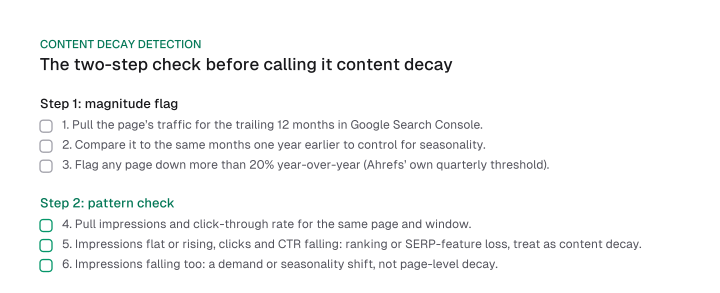
A real content decay signal is a page down more than 20% year-over-year that also shows a matching impressions-and-CTR pattern.
The two checks run together as one sequential test rather than as either signal alone.
Ahrefs recommends, as its own practitioner threshold, flagging any page whose traffic has dropped more than 20% in Site Explorer's Declining filter, checked quarterly against the same period the year before:
"flag any pages that have dropped more than 20% in traffic year-over-year"
That magnitude flag alone isn't proof of a real decline. A page can dip 20% from a one-off algorithm update, a seasonal keyword, or a SERP feature stealing the click, then recover on its own.
The second check confirms or clears the flag: pull impressions and click-through rate for the same page over the same window. Impressions flat or rising while clicks and CTR fall points at ranking-position slippage, a weaker snippet, or a stronger competing result.
Impressions falling too points at a demand or seasonality shift instead, which a refresh won't fix. Ahrefs states both checks in its own published guidance, but as two separate observations.
Sequencing them, magnitude first, pattern second, is what turns either check alone into an actual detection test.
Does all content decay at the same rate
Content decay moves at different speeds depending on content type.
The reason is the same query-side freshness ranking mechanism from the section above, not that some pages are simply better maintained than others.
| Content type | Typical audit cadence | Why |
|---|---|---|
| Price, availability, or news-anchored pages | Weeks | The query itself is freshness-seeking; a fixed price or a "current" news claim goes stale within days |
| How-to guides and process explainers | About a year | The underlying process changes slowly, but the tools, screenshots, and named products inside it still age |
| Reference or pure-definition pages | Multiple years | The query's own freshness demand is close to zero; the definition itself rarely changes |
Download CSV (CC BY 4.0)
Demandspring's own coverage of this topic gestures at the same split, naming "time-sensitive content like statistics or news" against "evergreen explainer content," and recommending scheduled maintenance to avoid wasting refresh capacity.
It stops at the two-bucket label, though, with no specific cadence for either bucket and no stated reason the split exists. Tying each bucket to how strongly its query demands freshness turns that into a number to schedule against, rather than a vague instruction to maintain regularly.
How content decay differs in AI search
A page can hold its Google ranking and still disappear from AI answers, because AI assistants cite noticeably fresher pages than organic search rewards.
Ahrefs' July 2025 study of 16.975 million citations across ChatGPT, Perplexity, Gemini, Copilot, and Google AI Overviews found that AI-assistant citations average 1,064 days old, versus 1,432 days for pages that rank organically only, about 25.7% fresher.
Subtracting the two averages gives a 368-day gap. An AI assistant is, on average, citing a page more than a year newer than what organic search alone tends to reward for the same kind of query.

That gap is the core content decay AI search difference. Ranking recovery and citation recovery are two separate things to check after a refresh.
A page can climb back to its old organic position while still sitting outside the freshness window AI assistants favor, and the reverse can happen too.
Mission Growth's platform tracks AI citations and visibility for customers. It's one practical reason to set up AI search analytics to track that separately from ordinary rank recovery, rather than assuming one metric moving means the other did too.
The most common content decay mistake
The most common content decay mistake is changing only the publish date.
Google's own patented content-update scoring explicitly gives little to no weight to a date or time-tag change on its own. Patent US8549014B2, "Document scoring based on document content update," filed 2011-09-14 and granted 2013-10-01, also expired for fee-related reasons, describes scoring a content update as a function of update frequency and update amount.
The patent's own language on update amount is explicit:
"given relatively little weight or even ignored altogether"
A date or time-tag change alone gets exactly that treatment when the patent computes how much a page's content actually changed. The title and body text are weighted far more heavily.
Like the freshness-ranking patent above, this describes a method Google's engineers filed, not a confirmed statement of what runs in production today. It does name the exact reason a re-date without a real content change tends not to move anything: the scoring system is built to look past the timestamp and measure the substance underneath it.
That is also the single most common mistake by a wide margin: bumping "Updated 2026" onto a byline while leaving the paragraphs, statistics, and examples untouched.
What a decaying page actually needs is a change to what update amount measures: the title, the body text, the examples inside it. The date sitting above them was never the fix.
Refresh, rewrite, consolidate, or retire: the decision
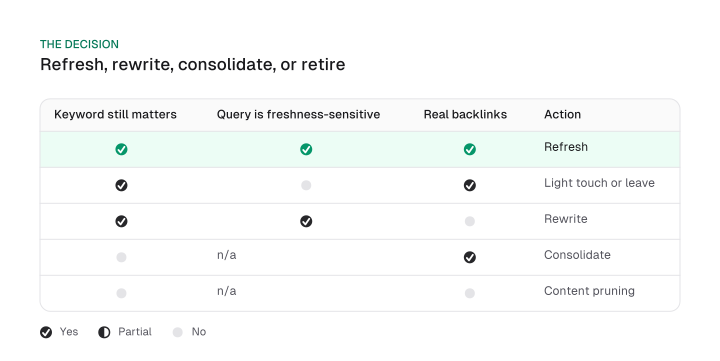
The right fix for a decaying page depends on more than its traffic level.
It depends on whether the keyword still matters to the business, whether the query itself depends on freshness, and how much link authority the page has already earned.
A sort by traffic, backlinks, or keyword difficulty alone misses real cases. None of those three add whether the query itself depends on freshness, the one criterion that actually changes the right action at the same traffic level.
Two pages with identical traffic can need opposite fixes.
A page targeting a query where freshness matters needs a substantive refresh to stay competitive. A page on a stable, reference-style query at the same traffic level might need only a light touch, or nothing beyond a periodic check.
Executing each action follows a consistent shape:
- Refresh: update the statistics, restructure outdated sections, and tighten internal links.
- Consolidate: fold the page's best sections into the surviving page and permanently redirect the old URL.
- Content pruning: remove the page outright, with no redirect, only when traffic and backlink value are both minimal.
A refresh also means re-promoting the page through its original channels; redistribution tactics themselves are a separate topic this guide doesn't cover. A page with meaningful traffic or backlinks still holds authority worth carrying forward through consolidation instead of pruning.
Is decaying content worth keeping at all? Usually yes, if the term is still worth ranking for and the page holds real backlinks. Deleting a page that still earns links and reroutable value throws away authority a retire decision can't get back.
Keep a decaying page if its term still matters and it holds real backlinks. Retire or consolidate it if neither is true.
The table above gives the actual keep-or-drop criteria instead of leaving it as an unanswered heading.
A page whose keyword still matters but whose best fix is a new format entirely (video, an infographic, an interactive tool) belongs to reformatting rather than another rewrite of the same article.
With several confirmed-decaying pages competing for the same limited time, prioritize which pages to fix first by SEO ROI, instead of fixing them in the order they happened to be noticed.
What to re-measure after a refresh
Content decay cannot be prevented entirely, but a fixed audit cadence plus a specific re-measurement window after every refresh catches it while it's still cheap to reverse.
No page holds its position forever. A fresher competitor eventually shows up, or the query itself shifts meaning, even without anything being done wrong on your end.
What separates a well-run content program from one that reacts too late is a checkpoint schedule, not eyeballing traffic a month later with no fixed dates in mind.
Re-measure on a fixed schedule after every refresh:
- Within twenty-four to seventy-two hours: check the Last crawl date on the page in Search Console's URL Inspection tool to confirm Google actually recrawled it after the update.
- Over the following 1 to 3 weeks: watch ranking position for queries where freshness matters, instead of waiting for a full quarter to pass.
- After a full month: judge whether the refresh actually recovered traffic. Ranking movement and traffic recovery don't always land on the same timeline, and judging too early risks reversing a change that just needed more time to register.
Put that re-measurement window on the same recurring calendar as the quarterly decay check from earlier, and it folds into a recurring how to do SEO audit cadence instead of becoming a separate task nobody owns.
Content decay SEO comes down to three tools: a sequential test to confirm a decline is real, a named mechanism explaining why standing still is a disadvantage, and a decision rule that turns on whether the query itself is freshness-hungry.
Start this week. Pick one page suspected of decaying, run the two-step test from the detection section above, and place it into the refresh, rewrite, consolidate, or retire table before touching a single word of it.
Frequently asked questions
Usually yes, when the page still targets a term worth ranking for and holds real backlinks. The decision table above gives the exact criteria for confirming that, instead of guessing from traffic level alone.
No. Every page eventually faces a fresher competitor or a shift in what its query means. A fixed audit cadence catches it early instead of eliminating it outright.
No. Pruning only helps when a page has minimal traffic and minimal backlink value. A page with real backlinks and reroutable value should get a permanent redirect into a related page instead of a deletion, so the authority it earned doesn't just disappear.
No. Platform decay is another name for enshittification, a deliberate platform-level business-model decline. Content decay is an unintentional, page-level SEO decline, two different mechanisms that happen to share loose vocabulary.
Figures and images in this post are free to reuse under CC BY 4.0 with credit to Mission Growth.
Get Mission Growth highlighted in your Google results.