
Zero Click Searches: Why Studies Disagree and What to Do
Zero click searches are 68.01% of US Google searches in 2026 by one panel and 49% by another. See what each study counts and what to do when clicks fall.

On this page
Zero click searches are Google searches that end without a click on any result, and the percentage quoted for them depends on the study.
SparkToro's 2026 study says 68.01% of US queries end that way (January to April 2026, weighted two-thirds mobile). iPullRank's panel of 10.2 billion sessions (its headline says searches) gives 46.96% across several countries and 49% for the US (October 2024 to December 2025, a 94.5%-desktop panel).
Both are careful work, and they measure different things. This guide shows what each study counts, why the climb from about 45% ten years earlier to 68.01% splices three panels, and how to line the numbers up before you change a plan. It closes with a decision table by query class, because a headline rate can't tell you what to do with your own queries.
What zero click searches are and what counts as a click
A zero click search is a Google search that ends without a click on any result, and whether a visit to Google's own Maps, YouTube or ads counts changes the percentage.
So what is a zero click search in practice? SparkToro's 2024 study defines zero click searches as searches that end without clicking on any of the results presented. The searcher got what they needed, gave up, or rewrote the query. Semrush, Similarweb and Wikipedia describe the same idea, and the studies below turn it into a number.
A search ends in one of three ways: the searcher clicks, the session ends, or the searcher types another search. Only the first is a click. SparkToro's 2024 study found searchers ended their session entirely about 37% of the time and changed their query about 22% of the time.
Which features end a search on the results page
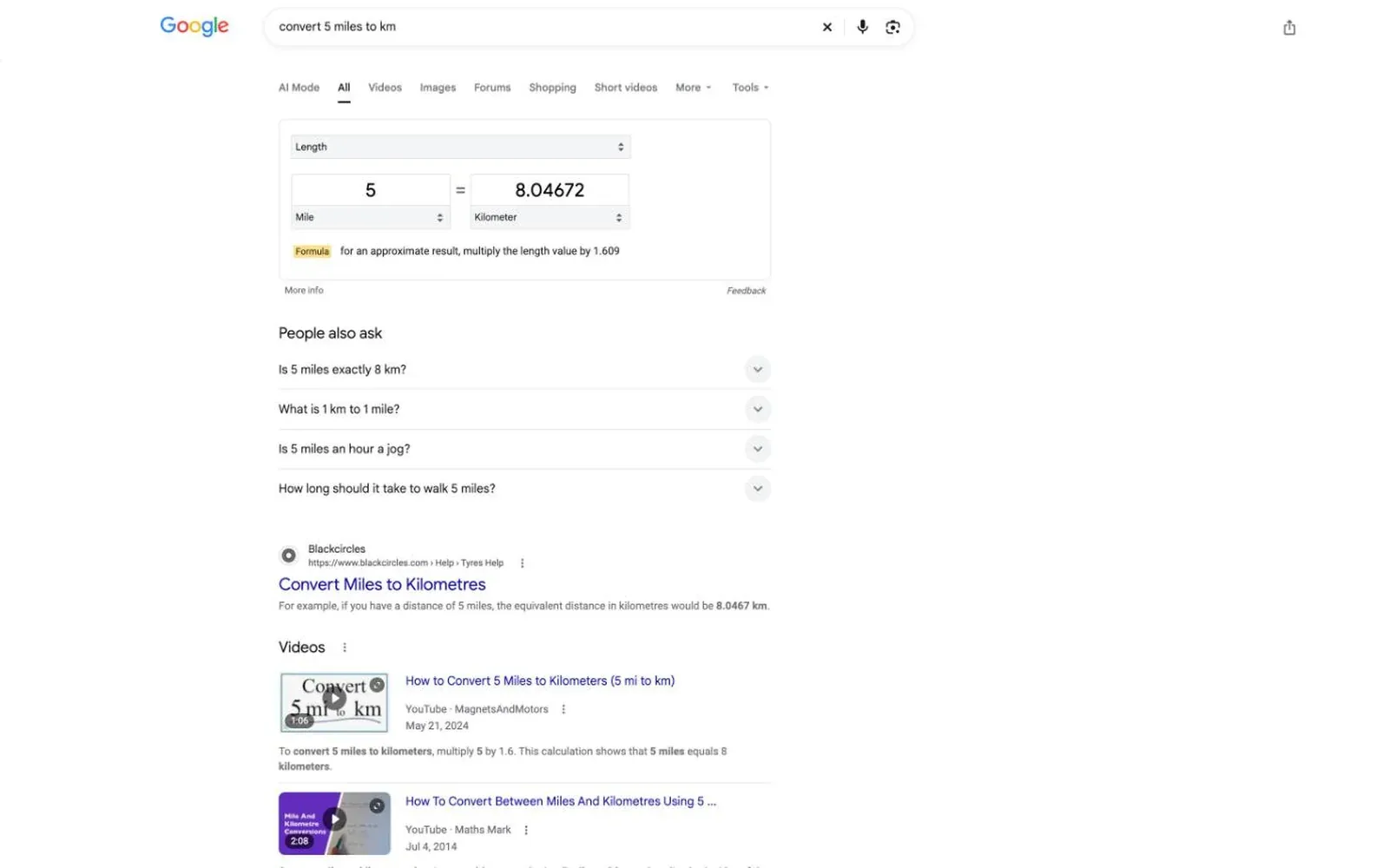
Similarweb's support page names the features behind zero-click results: Quick Answers, Knowledge Boxes, Featured Snippets and Top Stories. Knowledge panels, local packs and People Also Ask boxes belong in the same group. The table pairs each feature with an example and the endings it can produce.
A feature alone therefore can't be labeled zero-click. A local pack can end a search where it appears, and it can also send the searcher into Google Maps, which the 2026 study records as a click.
The counting rule behind the 68.01%
SparkToro's 2026 study counts every click except another search typed into the default search box. That includes visits to Google-owned properties such as Maps or YouTube, organic links to the open web, and paid ads.
Someone who taps an ad therefore hasn't produced a zero click search in that study.
A correction to the "open web" wording
The 68.01% treats Google-owned properties and ads as clicks, so "ends without a click to the open web" describes a different quantity. The 2024 study lets us size the gap.
SparkToro's 2024 study says nearly two-thirds of searches stay inside the Google ecosystem after the query. It also says 360 of every 1,000 US searches send a click to a property that is neither Google-owned nor a Google ad.
Subtract: (1,000 minus 360) over 1,000 is 64.0% of 2024 searches that did not reach the open web, which is 5.5 points above the 58.5% zero-click headline.
The derivation treats each of the 360 open-web clicks as a separate search, and the study says about 20% of searches with at least one click have more than one, so no more than 360 searches reached the open web and 64.0% is a floor for that reading.
Use "zero click" for searches that ended with no click of any kind, and "did not reach the open web" for the wider figure.
How many Google searches are zero click
SparkToro's Similarweb-based study puts 68.01% of Google searches in the US as ending without a click in January to April 2026, against 58.5% of American Google searches in its 2024 study.
SparkToro's 2026 text gives 60.45% for 2024, while the 2024 study itself says 58.5%. The 2024 study page is the primary source for that year, so 58.5% leads here and 60.45% sits beside it. Anyone reusing these zero click search statistics should check the seams first.
The series, panel by panel
SparkToro's zero-click study measures the share of Google searches that end without a click, using clickstream panels. Its finding is a climb from about 45% ten years earlier to 68.01% in January to April 2026. What a page can do about AI replies is covered in answer engine optimization, which sorts proven steps from folklore.
Each point comes from a different panel. SparkToro's 2026 post says the 2016 and 2019 numbers come from Jumpshot, a clickstream panel that no longer exists, the 2024 numbers from Datos (now a Semrush company) and the 2026 numbers from Similarweb. The percentage of zero click searches therefore rises across three data sources.
SparkToro says as much itself: its graph compares "a bit of apples and oranges", since the panels aren't the same users or devices. Read the line below as a direction with panel changes in it. For who holds the share of search these panels sample, see our search engine market share guide.

Two 2024 baselines in SparkToro's own pages
SparkToro's two pages give two 2024 baselines that differ by 1.95 points: 58.5% in the 2024 study and 60.45% in the 2026 text. The 2026 post then holds two pairs of figures that can't both be right on one baseline.
The first pair says zero-click searches grew 12.5%, or 7.5 percentage points. That fits 68.01% minus 60.45%, which is 7.56 points.
The second pair says searches with a click (the "Clicks 1X+" metric) fell 9.51 points, a 22.9% decline. That pair reproduces only from 58.5%: 68.01 minus 58.5 is 9.51, and in the 2024 study 41.5% of searches had a click, so 9.51 divided by 41.5 is 22.9%.
On a 60.45% baseline the same change would be 7.56 points and 19.1%.
SparkToro doesn't explain the 1.95-point gap on either page, so this rests on text arithmetic from the two pages and no chart. Searches with any click went from 41.5% to 31.99%, which is why SparkToro's headline says fewer than a third of searches now send one. We use 58.5% from here on, since it is the only baseline where both pairs reproduce.
Why the zero click share keeps rising
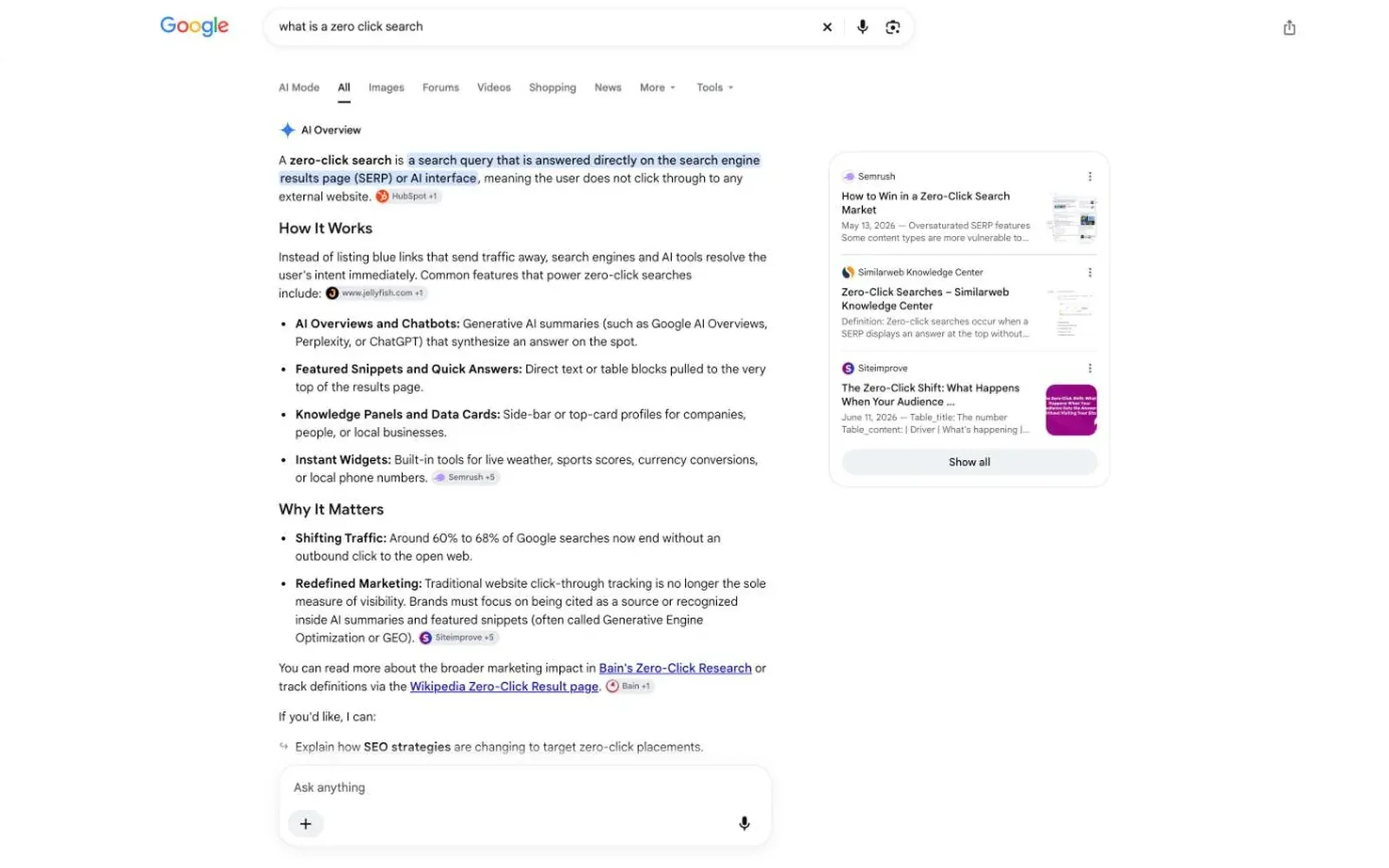
The searcher who searches again explains 76% to 95% of the rise in zero click searches between SparkToro's 2024 and 2026 figures, depending on the baseline, and AI Mode took only 0.34% of searches.
SparkToro's own text reports that searchers who go on to another search rose 7.2 points between 2024 and 2026. It reads that as Google getting people to run more queries. We divide that 7.2 points by the size of the rise to see how much of the climb it covers.
What moved between 2024 and 2026
Start from the 2024 study's baseline, where the climb is 9.51 points: 7.2 divided by 9.51 gives about 76%. On the 2026 text's baseline the climb is 7.56 points, and 7.2 divided by 7.56 gives about 95%. Either way, most of the rise is a searcher who stays in Google.
Download CSV (CC BY 4.0)
Two caveats belong next to those percentages. The 2024 figure is a Datos panel and the 2026 figure a Similarweb panel, so the split is a reading of SparkToro's own two figures and not a measured causal share. And "another search" is the one thing the Clicks 1X+ metric excludes from its definition of a click, so a person who searches again stays on the zero-click side.
For a site, the practical meaning is that the searcher is still inside Google and the open question is who ranks for the second query.
An AI Overview can start that second query. Our google ai overviews statistics post covers how often Overviews appear and what they do to visits.
Where AI Mode and mobile fit
AI Mode is too small a share of the 2026 panel to explain the rise. It handled 0.34% of searches in January to April 2026, so the climb from 2024 comes from other behavior. That describes this window. Nothing in the figures says AI Mode will stay that small, and our google ai mode statistics post tracks its usage.
Mobile pushes the rate up wherever a panel has more of it. SparkToro's 2024 study found that almost half of mobile searches in both the US and EU end the browsing session entirely, more than 2X the share on desktop.
For 2026 SparkToro weighted devices at two-thirds mobile and one-third desktop, counted browser searches only and left out the Google mobile app. A change in device mix between panels can move the rate with no change in behavior.
Why studies disagree: unit, click definition and panel
Zero-click studies disagree because they count different units, clicks, devices, countries and periods: iPullRank's 46.96% is multi-country on a 94.5%-desktop panel, and SparkToro's 68.01% is US and two-thirds mobile.
The iPullRank study ran on Datos panel data from October 2024 to December 2025 and covers 10.2 billion sessions and 13.1 billion search events. The 21.05-point gap between its multi-country figure and SparkToro's 68.01% is a measurement artifact until five checks say otherwise: unit, click rule, device mix, geography and period.
The table takes each row's unit, click rule, geography, device mix and period from that study's own page as of November 2026, and the derived figures below it show their arithmetic.
The reconciliation table
Download CSV (CC BY 4.0)
The rule line for the table: two numbers compare only if they share unit, click rule, device mix, geography and period. Start with what counts as a click, then check the device mix.
Reading the table
The Pew row is a click rate per visit and not a zero-click rate, so don't set its 8% and 15% beside the 68.01%. Our organic ctr by position post makes that point for results-page, visit and search denominators.
The Bain-Dynata survey measures self-reported reliance, which says something about habits and nothing about counted searches. Bain's text says zero-click results while its chart labels reliance on AI summaries, so we report it in Bain's survey wording and don't convert it to a share of searches.
The device mix matters most. In iPullRank's panel, people in the UK zero-click 65% of the time on mobile and 46% on desktop, a 19-point gap, and the US mobile penalty is +17 points. A 94.5%-desktop panel produces a lower headline than a two-thirds-mobile one before any behavior differs.
Worked example: putting iPullRank's US rates on SparkToro's device mix
iPullRank's US rate of 49% (the page does not label it by device) behaves like a desktop proxy, since the panel is 94.5% desktop: the US mobile rate of 66% minus the +17-point penalty, which we read as mobile minus desktop, is 49%. With iPullRank's US rates reweighted to two-thirds mobile, the US rate is 66 times 2/3 plus 49 times 1/3, which is about 60.3%.
Now compare US to US. SparkToro's 68.01% minus iPullRank's 49% is a 19.01-point headline gap. Against the reweighted 60.3%, the gap shrinks to about 7.7 points. Those remaining points belong to unit, period and panel: Datos against Similarweb, October 2024 to December 2025 against January to April 2026, and SparkToro's exclusion of the Google mobile app. The 19-point US-to-US gap is mostly device mix.

Does Google's stable-clicks claim contradict the panels?
Google's August 2025 statement that organic click volume to websites is relatively stable doesn't contradict a falling zero-click share if searches grew, and SparkToro's change would need about 29.7% more searches to leave clicks flat.
Google's blog post says total organic click volume from Google Search to websites has been relatively stable year over year. It gives no data behind the sentence. So the useful question is what the panels would need for both statements to hold.
The breakeven runs like this. SparkToro's Clicks 1X+ fell 22.9%. Holding total clicks flat while searches with a click fall by that much requires total searches to grow by one divided by the share that remains, minus one, which is about 29.7%. Google has published no search-volume growth of that size, so this is a breakeven and no finding that searches grew.
Three limits sit next to the 29.7%:
- SparkToro's 22.9% is a fall in searches with a click of any kind, Google properties and ads included, while Google's claim concerns organic clicks to websites.
- Searches with a click aren't click volume, since some searches produce several clicks.
- The spans differ. Google compares year over year, and SparkToro compares 2024 to 2026 across a Datos panel and a Similarweb panel.
One independent data point leans the same way as the panels. SparkToro cites an Ahrefs tracker of opted-in sites: from June 2025 to May 2026, the traffic share Google sends to 75,000+ domains dropped 8 percentage points, about 22%.
The sites are self-selected, so the figure shows direction on that tracker and says little about the wider web. Google's stable clicks claim and the panels can both hold only if searches grew by roughly that much, which this comparison can't confirm.
What to do when clicks fall
When clicks fall, split Search Console impressions from clicks by query class first, then chase the click on branded, local and transactional queries and the citation or exposure on informational ones.
The headline rate doesn't decide your plan. The query class does, and Search Console can tell you impressions against clicks but never which searches ended where.
Search Console defines impressions as how often someone saw a link to your site on Google, and it reports impressions, clicks, CTR and position. It has no session-end or zero-click metric. A falling click line over steady impressions looks the same whether searchers found the answer on the page or searched again.
The organic traffic effect shows up first as a gap between those two lines. Bain's survey estimates a 15% to 25% reduction in organic web traffic from zero-click reliance, an estimate built on self-reported habits and no measured loss.
Which query classes still send clicks
SparkToro names the groups that still benefit from SEO: branded searches, local businesses, and tactical or high-intent transactional queries. Similarweb's support page notes that zero-click searches tend to be informational rather than purchase-driven. Put together, they give a decision table.
The table is a decision rule built from three sources and no study here publishes a measured share per class. For tracking, our seo kpis to track post covers the metrics.
For the work itself, what ai overviews means for seo covers what changes when an Overview sits above your result.
When to pursue zero click keywords and when to avoid them
Pursue a keyword when its class still sends visits. SparkToro says local businesses, branded searches and high-intent transactional queries still benefit from SEO, so a ranking there is worth a click-first plan: the page, the listing or the product result has to win the visit.
Avoid building a traffic target on a keyword that is informational. Similarweb's support page notes that zero-click searches tend to be informational, so a page can rank, collect impressions and still see few visits. That keyword isn't worthless. Its value shifts to exposure, being the source that gets cited or remembered, and you judge it on impressions and branded demand rather than on visits.
Mixed keywords need a measurement first. Take the query, split its impressions from its clicks in Search Console, and watch both lines for a few weeks. If impressions hold and clicks fall, treat it as an exposure keyword. If both fall, the problem is ranking and not the results page.
Search Console can't label a keyword zero-click, so this is a judgment per class, and it stays one until your own data says otherwise. Revisit it when an Overview appears on a query you rank for.
A three-step diagnosis
Zero click marketing starts from the idea that exposure on the results page can be worth having when nobody visits, and a zero click strategy is the per-class decision above. Zero click SEO is the same work applied to your own query list. Three steps put it to work:
- Split Search Console impressions and clicks by query class, with the branded, local and transactional rows first and the informational rows second.
- Check demand for your brand and your locations. A fall in branded impressions is a different problem from a fall in informational clicks on stable impressions.
- Replace traffic as the KPI with a correlation dashboard, as SparkToro advises: pair impressions and clicks with branded search volume and the visibility measures that fit each class.
Where your audience asks outside Google, search everywhere optimization covers the other places. The tactics for becoming the answer sit in the answer engine optimization guide in this series, and this post stops at the decision whether to pursue it.
So there is no single zero-click rate to plan around. The 49% and the 68.01% both count something real, most of the rise since 2024 is people searching again, and a stable-clicks claim and a falling share can coexist.
Your next step is small: export your Search Console queries for the last quarter, label them branded, local, transactional or informational, and compare impressions with clicks inside each class before you accept any headline number.
Frequently asked questions
What percent of searches are zero click?
SparkToro's 2026 study found 68.01% of US Google searches ended without a click in January to April 2026, counting visits to Google's own properties and ads as clicks. Other studies report lower figures because they count other units and panels; the reconciliation table above shows how.
Is zero click the same as no traffic?
No. In SparkToro's 2026 study a tap into Google Maps or YouTube counts as a click, so a search can end inside Google and still not be zero click. Your site's traffic depends on the open-web clicks inside that total.
Does AI Mode make searches zero click?
Not yet in these figures: only 0.34% of searches in the 2026 panel went to AI Mode. Most of the rise in zero click searches since 2024 comes from searchers who search again.
What is a zero click strategy?
It's a decision per query class. Chase the click where branded, local and high-intent transactional queries still send it, and chase the citation or brand exposure on informational queries.
Are zero-click searches bad for SEO?
They change what you measure more than whether you do SEO. Impressions and clicks can diverge when more searches end on the results page, so split them by query class in Search Console before you act.
Cite this page
Aktaş, F. (2026, November 21). Zero Click Searches: Why Studies Disagree and What to Do. Mission Growth. https://missiongrowth.io/blog/zero-click-searches
Download the data: 3 tables as CSV (CC BY 4.0)
Figures we made for this post are free to reuse under CC BY 4.0 with credit to Mission Growth.