Search Engine Market Share: Google, Bing, ChatGPT (2026)
Search engine market share, September 2026: Google 89.94%, Bing 5.29% of referrals. ChatGPT reads 0.22-0.41% of referrals but 0.5-19% of prompts.
By Ömer Furkan AktaşPublished
On this page
In September 2026, Google's share of worldwide search referrals was 89.94%, a month still inside StatCounter's correction window, against 91.32% in settled July 2026. ChatGPT has no single share: counting referral clicks it reads 0.22-0.41%, and counting prompts sent it reads anywhere from 0.5% to 18.8% of Google's volume.
Search engine market share depends on the unit. Every number below carries its measure (referrals, queries or visits), its month and the ruler that produced it, so you can tell which figure answers your decision.
Last verified: October 1, 2026
Key numbers
- Google had 89.94% of worldwide search engine referrals in September 2026, a month still inside StatCounter's correction window, and 91.32% in settled July 2026 (StatCounter).
- Bing's 5.29% in September 2026 (provisional) is the highest month in StatCounter's worldwide series since January 2009; its highest settled month is 5.14% in April 2026.
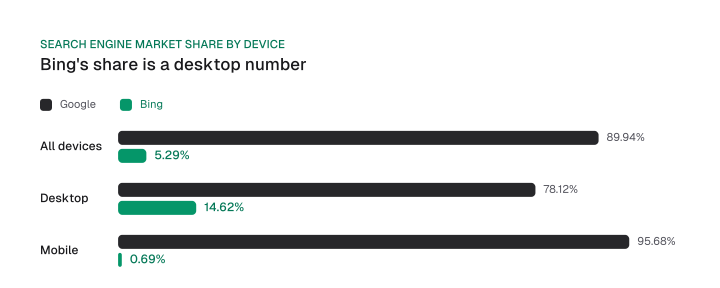
- Bing has 14.62% of desktop referrals and 0.69% of mobile ones, worldwide, September 2026 (StatCounter).
- Google's monthly worldwide share averaged 90.04% over the 22 settled months from October 2024 to July 2026, and moved 0.32 points in a typical month (StatCounter).
- ChatGPT had between 0.22% and 0.41% of Google plus ChatGPT referrals worldwide in the 18 months to September 2026 (StatCounter).
- ChatGPT's query volume was 10-15% of Google Search's in the UK in June 2025 (UK Competition and Markets Authority).
- OpenAI's July 2025 message counts equal between 4.5% (Seeking Information only) and 18.8% (every message) of Google's daily search volume, taking Google's March 2025 figure as the denominator.
- ChatGPT's share of generative AI web visits fell from about 76% to about 53% between June 2025 and May 2026 (Similarweb).
- Google referred nearly 90% of search traffic to Cloudflare-protected sites in 2025 and Bing 3.1%, Cloudflare reported in December 2025.
- A US court found Google handled 89.2% of US general search queries in 2020.
- Bing averaged 31.80% of Japan's search referrals from February to July 2026 against 13.66% from August 2025 to January 2026 (StatCounter).
Search engine market share worldwide in September 2026
Google had 89.94% of worldwide search engine referrals in September 2026, Bing 5.29%, Yahoo! 1.36%, Yandex 1.30%, DuckDuckGo 0.74% and Baidu 0.44%, by StatCounter's count of clicks from results pages. The table splits the same month by device. Google is the most used search engine on every cut, and because September is provisional, StatCounter may still correct the decimals.
| Engine | All devices | Desktop | Mobile |
|---|---|---|---|
| 89.94% | 78.12% | 95.68% | |
| Bing | 5.29% | 14.62% | 0.69% |
| Yahoo! | 1.36% | 3.35% | 0.45% |
| Yandex | 1.30% | 1.51% | 1.21% |
| DuckDuckGo | 0.74% | 0.94% | 0.64% |
| Baidu | 0.44% | 0.37% | 0.48% |
What is the second largest search engine?
The second largest search engine is Bing, with 5.29% of worldwide referrals in September 2026, ahead of Yahoo! at 1.36% and Yandex at 1.30%.
Which are the most used search engines, and what are the top 10?
The most used search engine is Google at 89.94%. The five major search engines after it are Bing, Yahoo!, Yandex, DuckDuckGo and Baidu, so the top 10 list thins out fast: DuckDuckGo's market share is 0.74% and Baidu's 0.44%.
A fair question is whether StatCounter's referral counts are a quirk of one panel. Four sources that count different things line up like this, with the population, geography and date of each reading.
| Source | What it counts | Population and geography | Date | Google's value |
|---|---|---|---|---|
| StatCounter | Referrals from results pages | Sites with StatCounter's code, worldwide | September 2026 (provisional) and July 2026 (settled) | 89.94% and 91.32% |
| Cloudflare | Referrals to sites on its network | Cloudflare-protected sites, worldwide | 2025 | Nearly 90% |
| US District Court finding | General search queries | United States | 2020 | 89.2% (94.9% on mobile) |
| UK Competition and Markets Authority | General search queries | United Kingdom | 2025 decision | More than 90% |
Worldwide referral counts put Google near 90% across all of them, and the two national query findings are consistent with it. This is a consistency check, not four independent rulers: the court and the regulator count queries in one country each, and StatCounter's own readings for those countries are 85.19% for the US and 91.39% for the UK in September 2026.
Cloudflare's 2025 review also has a different device mix, about 80% desktop and almost 93% mobile for Google, against StatCounter's 78.12% and 95.68%.
On classic engines the choice of source moves the worldwide answer by about a point, while for the AI assistants below the choice of unit moves it far more. For the engines themselves, the roster of ai search engines covers who they are; this page only sizes them.
How much does Google's search market share move in a month?
Google's worldwide share moves about 0.32 points in a typical month (StatCounter, October 2024 to July 2026), so a 1.08-point drop between August and September 2026 is more than three typical moves, yet it leaves the share inside its 22-month band.
Google search market share changes slowly, and the next table shows how slowly. We took the 22 settled monthly values and computed their mean, spread and month-to-month change.
| Measure | Value |
|---|---|
| Mean, 22 settled months | 90.04% |
| Level deviation | 0.51 points |
| Noise band (mean plus or minus two deviations) | 89.02% to 91.06% |
| Typical monthly change | 0.32 points |
| Provisional September 2026 reading | 89.94%, inside the band |
The 1.08-point fall from 91.02% in August 2026 is 3.4 typical moves, which makes it larger than usual but not outside the band. Our judgment, not a derived result: treat a move as real when the settled monthly share leaves the 89.02% to 91.06% band for 3 consecutive months, or when two rulers move together.
"Google falls below 90%" is a headline about noise. In 13 of the 22 settled months Google was below 90%, and the series low is 88.73% in October 2013. The two open months do not change the band; they are tested against it.
The longer view is a year-end table, every December from December 2015 to December 2025, which also settles the question of what Google held in 2021 and 2022.
| December | Bing | |
|---|---|---|
| 2015 | 91.1% | 3.05% |
| 2016 | 92.57% | 2.75% |
| 2017 | 91.79% | 2.75% |
| 2018 | 92.25% | 2.41% |
| 2019 | 92.71% | 2.32% |
| 2020 | 91.38% | 2.69% |
| 2021 | 91.94% | 2.86% |
| 2022 | 92.58% | 3.03% |
| 2023 | 91.62% | 3.37% |
| 2024 | 89.73% | 3.98% |
| 2025 | 90.82% | 4.03% |
Across the eleven year-ends in the table, Google sat between 89.73% and 92.71% at every year-end, and Bing climbed from 2.32% to 4.03%. Read together, the year-ends show Google lower at the 2024 and 2025 year-ends than at any earlier year-end in the table, while Bing was higher.
Bing market share is a Windows desktop number
Bing's 5.29% worldwide share is a weighted average of 14.62% on desktop and 0.69% on mobile, which puts about one third of referrals on desktop.
Solve 14.62w + 0.69(1 - w) = 5.29 and the desktop weight is w = 0.330. The same solve on Google's figures gives 0.327, so the two engines agree on the weight. All three inputs are the September 2026 provisional readings.
That makes Bing market share a device mix. Cloudflare's data shows the same shape from another angle: on Windows, Google had 76% and Bing about 14% of referrals in 2025. Bing's 5.29% is also the highest month in StatCounter's series since January 2009, though its highest settled month is 5.14% in April 2026, so the direction is up while the exact peak is still open.
You can adjust the number for your own audience. A site whose visitors are 70% desktop should expect 10.44% of search referrals from Bing: weight the 14.62% desktop reading by the 70% desktop share, and the 0.69% mobile reading by the rest. The 70% split is an assumption for illustration; swap in the desktop share from your own analytics.
Yahoo market share and Bing against Google
Bing's market share against Google's is 5.29% to 89.94% worldwide, but 14.62% to 78.12% on desktop. Yahoo! holds 1.36% worldwide and 3.35% on desktop in September 2026.
Two cautions follow. The weight describes StatCounter's panel, so a B2B audience that works at desks will sit above it and a consumer audience on phones below it. And the one-third weight is a September 2026 reading, so recompute it when you reuse the formula in another month.
Search engine market share by country
Google led 10 of the 12 markets in StatCounter's settled July 2026 readings, Baidu led China and Yandex led Russia, and the one market with a contested lead is South Korea, where Naver was ahead of Google in 2 of 14 months.
This search engine market share by country table gives each market's leader and challenger in three months, so you can see which readings are stable. The August 2025 and July 2026 columns are settled; September 2026 is provisional.
| Country | August 2025 | July 2026 (settled) | September 2026 (provisional) |
|---|---|---|---|
| China | Baidu 60.39% / Bing 18.86% | Baidu 51.15% / Bing 22.73% | Baidu 46.65% / Bing 21.76% |
| Russia | Yandex 69.03% / Google 29.12% | Yandex 72.86% / Google 25.47% | Yandex 70.33% / Google 28.12% |
| South Korea | Naver 46.18% / Google 45.21% | Google 49.52% / Naver 40.87% | Google 47.97% / Naver 43.06% |
| Japan | Google 80.12% / Yahoo! 10.37% (Bing 7.63%) | Google 59.68% / Bing 32.11% | Google 59.27% / Bing 31.41% |
| Turkey | Yandex 50.05% / Google 44% | Google 80.79% / Yandex 17.21% | Google 73.42% / Yandex 25.19% |
| United States | Google 85.72% / Bing 7.95% | Google 86.61% / Bing 8.63% | Google 85.19% / Bing 9.89% |
| United Kingdom | Google 93.25% / Bing 4% | Google 91.56% / Bing 5.86% | Google 91.39% / Bing 6.08% |
| India | Google 97.32% / Bing 1.29% | Google 97.85% / Bing 1.18% | Google 96.63% / Bing 1.92% |
| Germany | Google 86% / Bing 6.23% | Google 85.68% / Bing 7.08% | Google 87.84% / Bing 6.49% |
| Canada | Google 88.66% / Bing 6.9% | Google 85.97% / Bing 9.38% | Google 85.3% / Bing 10.06% |
| Brazil | Google 91.05% / Bing 6.46% | Google 87.38% / Bing 10.13% | Google 88.41% / Bing 9.63% |
| Czechia | Google 81.56% / Seznam 13.14% | Google 81.02% / Seznam 14.10% | Google 78.71% / Seznam 15.05% |
Source for all rows: StatCounter's monthly CSV for each country, referrals, downloaded October 1, 2026.
What search engine is used most in Russia?
Yandex is the search engine used most in Russia, with 70.33% of referrals in September 2026 (provisional) and 72.86% in settled July 2026.
Which European country has the strongest local search engine?
Among the markets we checked, Russia's Yandex is strongest at 72.86% in July 2026, and Czechia's Seznam holds 14.10% against Google's 81.02%.
How accurate are country-level market share figures?
Country figures are accurate as readings of one month on one panel, but they swing, so quote the month. Google held 85.97% in Canada and 97.85% in India in July 2026.
Which national shifts are real. We ran a persistence test on settled months: a shift counts when the average of February to July 2026 lies outside the whole range of August 2025 to January 2026.
Three moves pass. Japan's Bing referrals rose 18.1 percentage points (13.66% to 31.80%), Turkey's Yandex share fell 26.6 points (41.01% to 14.42%) and China's Baidu fell 12.0 points (61.10% to 49.08%).
Both Korean engines move under 1 point and fail the test. StatCounter does not state a cause for any of the three. Single months stay noisy even where the shift is real: Turkey's Yandex series runs from 10.88% to 50.51%, so quote a national share together with its month.
South Korea has two rulers. StatCounter's referral count had Google at 49.52% and Naver at 40.87% in July 2026, and Naver ahead of Google in 2 of 14 months. A market tracker, InternetTrend, put Naver at 63.8% and Google at 28.7% for March 2026; the article that prints it (The Korea Times) gives no method.
Quoted figures are often older readings. The 60.4% for Baidu is the August 2025 reading of the same series; Baidu read 46.65% in September 2026 (provisional), and its monthly range from August 2025 to July 2026 is 44.64% to 63.97%.
Likewise the 94.6% for Google on mobile is the September 2025 reading (94.64%), while July 2026 settled at 95.82%.
In Russia the lead holds and the decimal does not: Yandex moved between 68.35% and 73.72% over the same months. A September 2025 reading and a July 2026 reading of one engine can differ by more than a percentage point, so name the month every time.
AI search engine market share: two units for ChatGPT against Google
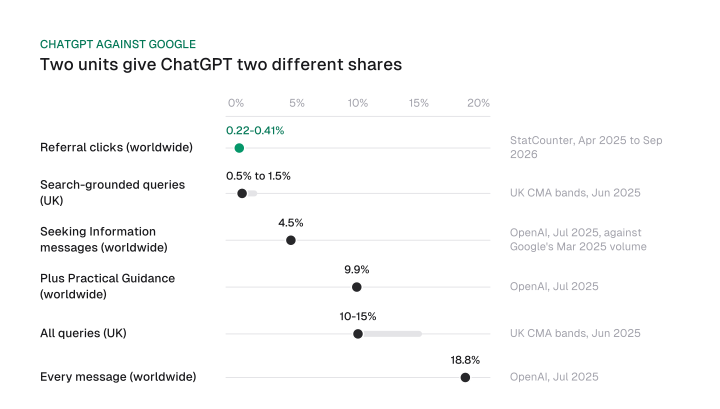
ChatGPT's share against Google reads 0.22% to 0.41% when counting referral clicks (worldwide, to September 2026) and 0.5% to 18.8% when counting prompts sent (July 2025 worldwide, June 2025 UK), because a click, a message and a search-grounded query are different things.
AI search engine market share is a ladder of readings, so the table keeps each with its own population, geography, date and denominator, and none of the rows form one series.
| Reading | Unit counted | Population | Geography | Date | Denominator | Value |
|---|---|---|---|---|---|---|
| Referral clicks, band | Clicks sent out | ChatGPT only | Worldwide | April 2025 to September 2026 | Google plus ChatGPT referrals | 0.22% to 0.41% |
| Referral clicks, settled | Clicks sent out | ChatGPT only | Worldwide | July 2026 | Google plus ChatGPT referrals | 0.22% |
| Referral clicks, provisional | Clicks sent out | ChatGPT only | Worldwide | September 2026 | Google plus ChatGPT referrals | 0.39% |
| Every message | Messages | ChatGPT only | Worldwide | July 2025 | Google's 5 trillion searches a year (March 2025) | 18.8% |
| Seeking Information plus Practical Guidance | Messages | ChatGPT only | Worldwide | July 2025 | Google's 5 trillion searches a year (March 2025) | 9.9% |
| Seeking Information only | Messages | ChatGPT only | Worldwide | July 2025 | Google's 5 trillion searches a year (March 2025) | 4.5% |
| All queries | Queries | ChatGPT only | UK | June 2025 | Google Search UK queries | 10-15% |
| Search-grounded queries | Queries | ChatGPT only | UK | June 2025 | Google Search UK queries | 0.5% to 1.5% |
| Search-grounded queries, all assistants (ChatGPT Search, Perplexity, Meta AI) | Queries | All assistants | UK | September 2024 to June 2025 | Google Search UK queries | 0-5% |
The StatCounter band comes from its Google versus ChatGPT series; the two open months, including 0.39% in September 2026, are table cells that stay out of the headline.
The prompts rung combines two company statements. In its usage paper, OpenAI reported 18 billion messages a week by 700 million users in July 2025 and classified 24% of them as Seeking Information and roughly 29% as Practical Guidance. Google said in March 2025 that it handles more than 5 trillion searches a year.
The UK numbers are from the Competition and Markets Authority's October 2025 decision, which gives bands: ChatGPT's query volume was 10-15% of Google's Search volume in June 2025, up from 0-5% in December 2024, and 5-10% of ChatGPT queries were search-grounded.
Rebuilding the message rung shows how much the choice of filter moves the answer:
- 18 billion messages a week is 2.57 billion a day; Google's 5 trillion searches a year is 13.7 billion a day.
- Every message counted: 2.57 billion is 18.8% of Google's daily volume.
- Seeking Information plus Practical Guidance (24% plus roughly 29%, so 53%): 1.36 billion a day, 9.9%.
- Seeking Information alone (24%): 617 million a day, 4.5%.
The 4.5% is a mid-range point, neither a floor nor a ceiling. Dropping Practical Guidance, which covers how-to advice, a classic search task, understates search-like use, and counting follow-up messages as queries overstates it.
The search-grounded UK reading of 0.5% to 1.5% (10% x 5% to 15% x 10%, from the CMA's bands) sits at the bottom, with every message at the top.
The CMA's 10-15% for all UK queries and OpenAI's 18.8% for all worldwide messages are the same unit, prompts sent, and fall in the same range; geography, date and denominator explain the remainder, and no source we used reconciles them further. The Google denominator is March 2025 and the ChatGPT numerator is July 2025.
Each reading is blind to something:
- Referral clicks miss every answer that never sends a click out. Seeking Information messages are about 17 times the referral ratio in July 2025, which is how far a click count sits below message volume.
- OpenAI's message counts treat a message as a search. Messages are not searches, and the 24% classification is OpenAI's.
- The UK regulator's query volume is the only compelled, non-panel measure here, but it covers one country and publishes only bands. The CMA excluded Claude.ai from its comparison because Anthropic said it does not compete with general search, and treated the Gemini assistant as outside the designated activity.
- The 0-5% all-assistant row mixes ChatGPT Search, Perplexity and Meta AI, so it is never a ChatGPT figure.
None of these is the ChatGPT vs Google market share. Other circulating ChatGPT share estimates, such as those in our AI SEO statistics roundup, are single readings of one method; this page's ladder is the way to place each of them.
Which AI assistant has the most share? StatCounter and Similarweb disagree
ChatGPT leads every AI assistant ruler, but StatCounter's referral share keeps it near 80% of chatbot referrals while Similarweb's visit share has it falling from about 76% to about 53% of generative AI visits, with Gemini taking most of the difference.
In September 2026 StatCounter gave ChatGPT 80.48%, Gemini 10.91%, Perplexity 5.85%, Microsoft Copilot 1.79%, Claude 0.95% and DeepSeek 0.02% of chatbot referrals. Each assistant's own user and revenue numbers are on our ChatGPT statistics, Gemini statistics, Perplexity statistics and Claude statistics pages.
The two sources list different assistants, so the table compares the three both list (ChatGPT, Gemini, Claude) for May 2026. To get the index, we renormalized each source's shares to those three assistants: StatCounter's three add to 89.08 points and Similarweb's to about 89.5.
| Assistant | StatCounter share of chatbot referrals | Similarweb visit share | Referral-to-visit index |
|---|---|---|---|
| ChatGPT | 79.05% | About 53% | About 1.5 |
| Gemini | 7.04% | 27-28% | 0.26 |
| Claude | 2.99% | Close to 9% | 0.33 |
Download CSV (CC BY 4.0)
Perplexity is not in the table because Similarweb's published figures give no Perplexity share; StatCounter had it at 7.67% of chatbot referrals in May 2026. We also had to take Gemini's Similarweb 27-28% as a midpoint, and the other Similarweb inputs are rounded.
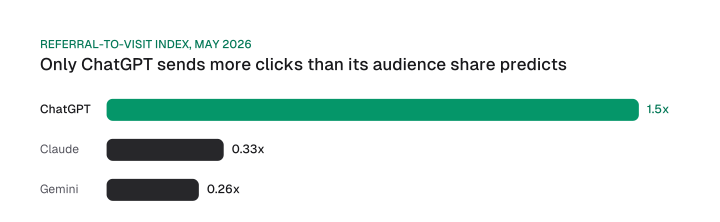
The referral-to-visit index divides an assistant's referral share by its visit share. ChatGPT's is about 1.5, Gemini's 0.26 and Claude's 0.33, so ChatGPT sends out more clicks than its audience size predicts and the other two send out fewer. Read it as an order, above 1 or below 1, because the Similarweb inputs are rounded and a precise ratio would claim too much.
On trend, StatCounter's ChatGPT share went from 81.12% in September 2025 to 79.05% in May 2026, a fall of 2.07 points, and stayed between 76.85% and 81.84% through September 2026.
Similarweb's went from about 76% in June 2025 to about 53% in May 2026. The start months differ and the bases differ, so we read direction only, flat against steep, and quote no gap in points between the two.
The two rulers disagree because one counts clicks out and the other visits in, and their bases differ (six chatbots against all generative AI sites). The Similarweb visit share is the better guide to audience size and StatCounter to traffic sent to sites.
The outbound side has its own ratio: between June 2025 and May 2026, Similarweb counted 770.7 million referral visits a month sent out by AI platforms against 9.5 billion visits to them, about 8.1 referral visits out per 100 in.
Why the same engine shows different market share
Market share numbers differ because each source counts a different thing: StatCounter counts referrals, Cloudflare counts referrals to its network, courts and regulators count queries, and Similarweb counts visits to the assistant's own site.
| Ruler | Unit | Who is counted | What it misses |
|---|---|---|---|
| StatCounter | Referrals from results pages | Sites that run StatCounter's code | Answers that send no click; AI browser traffic recorded under Chrome |
| Cloudflare | Referrals | Sites on Cloudflare's network | Sites off the network; a single year |
| Courts and regulators | Queries | One country's general search | Other countries; any date but the one measured |
| Similarweb | Visits | Visits to generative AI websites on its worldwide panel | Clicks out to other sites; usage inside other products |
A referral is a click, not a search. StatCounter's own FAQ defines its share as search engine referrals; searches performed are a different count. A person who reads a Google or ChatGPT answer and never clicks leaves no trace in that series. That is why a referral counter cannot see the 4.5% to 18.8% of Google's volume that ChatGPT's messages equal, and why we keep the two units apart.
AI browsers are recorded under Chrome. The same FAQ says Comet, Dia and ChatGPT Atlas identify as Chrome, so their usage is recorded under Chrome. Traffic from those browsers cannot be separated from ordinary Chrome traffic in StatCounter's data.
The newest two months are provisional. StatCounter may correct a published month, with no changes after 45 days from first publication. August and September 2026 are both inside that window, which is why this page labels them provisional in every table and builds no band, trend or swing on them.
StatCounter's AI chatbot series has no line for Google's AI surfaces, such as Google AI Mode: its six named chatbots are ChatGPT, Gemini, Perplexity, Copilot, Claude and DeepSeek. Google's own AI surfaces are measured on our Google AI Overviews statistics and Google AI Mode statistics pages.
For a method you can run on your own site, see how to measure AI search traffic in your referral data.
Methodology and last verified
We read the StatCounter pages and downloaded each series as its CSV export on October 1, 2026, and recomputed every derived figure from those files. Similarweb, Cloudflare, OpenAI, Google, the US court and the UK Competition and Markets Authority figures are quoted from their own publications at the dates given.
The Korea Times figure for South Korea is a report of a tracker whose method the article does not state. StatCounter's August and September 2026 months are provisional and will read differently after its correction window closes.
Search engine market share numbers that circulate and do not hold up
Four search engine share figures in circulation do not match their primary data, and each is a reading from the wrong month, the wrong measure or a model. The first column quotes the claim; the second gives what the primary data says.
| Circulating figure | What the primary data says | Why it differs |
|---|---|---|
| "May 2025 marked the first time in over a decade that Google's share has fallen below the 90% threshold" (a widely read encyclopedia entry) | StatCounter read 89.34% in October 2024, was below 90% in 13 of the 22 settled months to July 2026, and its series low is 88.73% in October 2013 | Below-90% months are routine noise, not a first |
| "Google's share dropped to 77.52% in April 2024" (a market-size report) | StatCounter worldwide read 90.91% in April 2024 | The report's figure does not match StatCounter's series for that month |
| "ChatGPT has about 17.9% of digital queries" in Q2 2026 (one 2026 agency model that does not publish its inputs) | OpenAI's own message data gives 4.5% to 18.8% of Google's volume depending on the filter; the compelled UK figure is 10-15% | A model built on client analytics and third-party datasets, not a measurement |
| "Baidu has 60.4% of China" and "Google has 94.6% of mobile" | 60.4% is the August 2025 reading and 94.6% the September 2025 reading | Older months of series that have since moved |
On the 17.9% model, the agency also puts Google at 57.0%. A model built on client analytics and third-party datasets is not StatCounter-style referral counting, and it is not OpenAI's message data, so it cannot be set beside either without a conversion nobody has published.
Every circulating figure fits some real reading. The table gives that reading's month and measure, which is the part that gets lost when a number is copied from page to page.
Which market share number to use for which decision
Use referral share to plan traffic, query share to judge competition, and visit share to size an AI audience, because each answers a different question. Start from the decision, then pick which ruler answers it.
| Decision | Ruler | Current reading | Caution |
|---|---|---|---|
| How much search traffic Google and Bing can send my site | Referral share (StatCounter) | Google 89.94%, Bing 5.29% (September 2026, provisional) | Weight Bing by your own desktop share; Aug and Sep 2026 may be corrected |
| How strong Google's position is in a market | Query share (court, regulator) | 89.2% of US queries in 2020; more than 90% of UK queries in 2025 | One country each, one date each |
| How big an AI assistant's audience is | Visit share (Similarweb) | ChatGPT about 53% of generative AI visits, May 2026 | Visits are not clicks out to your site |
| How much traffic an AI assistant sends | Referral share (StatCounter) | ChatGPT 0.22% to 0.41% of Google plus ChatGPT referrals | Misses answers that send no click |
| How much ChatGPT is used like search | Query volume (CMA, OpenAI) | 10-15% of Google's UK volume in June 2025; 4.5% to 18.8% worldwide in July 2025 | Bands and a mixed-date denominator |
Three if-then rules follow from the table.
- If you are budgeting search effort, start with Google, then give Bing a weight equal to your own desktop share times 14.62% plus your mobile share times 0.69%.
- If your question is whether Google is losing ground, wait for the settled monthly share to leave the 89.02% to 91.06% band for 3 consecutive months before you act on it.
- If your question is how much AI assistants matter to you, treat them as a separate channel and measure them in your own referral data with AI referral traffic tracking, then decide whether AI Overviews optimization or ChatGPT search optimization deserves the next sprint.
A market share number never sets a budget alone. Worldwide referral counts put Google near 90%, and ChatGPT's share is two units, 0.22-0.41% of referral clicks and 0.5% to 18.8% of prompts. Check your own analytics first: export last quarter's organic referrals by source and device, and compare the Google, Bing and AI assistant lines with the readings above.
Frequently asked questions
Which search engine has a market share of 92%?
Google's worldwide all-device share was last at or above 92% in StatCounter's data with 92.07% in July 2023. On September 2026 readings, worldwide mobile (95.68%) and India (96.63%) are above 92%. We checked 12 markets for this page, so we do not claim those are the only ones.
Which search engine ranks second behind Google?
Bing, with 5.29% of worldwide referrals in September 2026 (provisional) by StatCounter's count. Yahoo! sits third at 1.36% and Yandex fourth at 1.30%. Bing's share is a device mix: 14.62% on desktop and 0.69% on mobile, so its rank on any one site depends on that site's desktop audience.
What is ChatGPT's market share compared with Google?
It depends on the unit. ChatGPT had 0.22% to 0.41% of Google plus ChatGPT referral clicks (StatCounter, April 2025 to September 2026). Counting prompts, it was 10-15% of Google's UK query volume in June 2025 and 4.5% to 18.8% of Google's worldwide daily volume in July 2025, depending on which messages count.
What is Baidu's market share in China?
Baidu read 51.15% of China's search referrals in July 2026 (settled) and 46.65% in September 2026 (provisional). Its monthly range from August 2025 to July 2026 was 44.64% to 63.97%, so there is no stable decimal. Quote the month with the figure, and treat the 60.4% still in circulation as an August 2025 reading.
Does Yandex or Google lead in Russia?
Yandex, at 70.33% of Russian search referrals in September 2026 (provisional), with Google at 28.12%. The lead is stable and the decimal is not: Yandex moved between 68.35% and 73.72% from August 2025 to July 2026. Check the month before quoting a Russian share.
Figures and images in this post are free to reuse under CC BY 4.0 with credit to Mission Growth.
Get Mission Growth highlighted in your Google results.