ChatGPT Statistics 2026: Users, Revenue, Which Figure to Use
ChatGPT statistics for 2026: weekly users from 100 million to 1 billion, messages per user, subscribers, revenue, and which figure to cite for each claim.
By Ömer Furkan AktaşPublished

On this page
ChatGPT statistics start from one dated number: 1 billion weekly users on August 6, 2026, by OpenAI's own account. Every ChatGPT headline number counts a different thing (weekly accounts, web visits, adults surveyed, messages, app users), so a figure is citable only with its unit and date.
These ChatGPT usage statistics put each figure beside its unit, publisher and date, say when two numbers that look like rivals measure different things, and list the circulating ChatGPT stats that fail on one of the three.
Last verified: October 1, 2026.
Key figures:
- ChatGPT had more than 900 million weekly active users on February 27, 2026, OpenAI said in its funding announcement.
- OpenAI said on August 6, 2026 that 1 billion people use ChatGPT every week.
- OpenAI counted more than 50 million consumer subscribers on February 27, 2026.
- By July 2025, users sent 18 billion messages a week, according to the NBER working paper by OpenAI and university economists.
- Dividing those messages by the paper's 700 million weekly users gives 3.7 messages per user per day.
- The same paper found 73% of ChatGPT messages were not work related in June 2025.
- Pew Research Center found 44% of US adults used ChatGPT in February 2026.
- Similarweb put ChatGPT at about 53% of generative AI web visits in May 2026.
- Similarweb found homepage landings at 62-63% of ChatGPT referral traffic by late May 2026.
- OpenAI's CFO put annualized recurring revenue at $20B+ at the end of 2025.
ChatGPT weekly active users: milestones, net additions and the 1 billion question
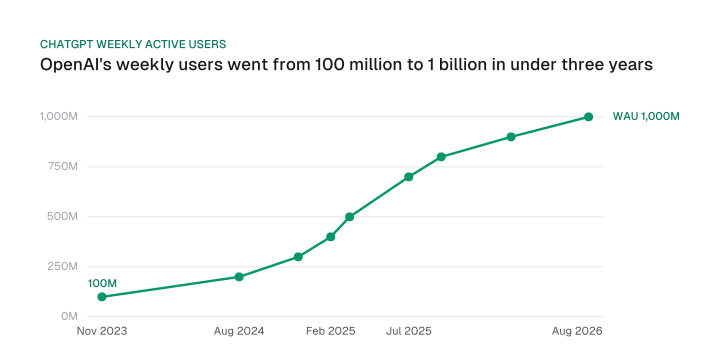
ChatGPT reached 1 billion weekly users on August 6, 2026, by OpenAI's own account, up from 100 million in November 2023; the last earlier floor was more than 900 million on February 27, 2026. The 900 million is superseded. It was right for its date.
The table lists every dated ChatGPT weekly active users figure OpenAI or its executives gave, with the publisher. Every endpoint after 700 million is a "more than" floor or, for August 6, 2026, a rounded 1 billion, each dated by its announcement, so treat the intervals between them as approximate.
| Date | Weekly users | Publisher |
|---|---|---|
| November 2023 | 100 million | OpenAI, announced at its first developer conference |
| August 2024 | 200 million | OpenAI |
| December 2024 | 300 million | OpenAI |
| February 2025 | 400 million | OpenAI, told to CNBC (TechCrunch) |
| End of March 2025 | 500 million | Nick Turley, OpenAI head of ChatGPT |
| End of July 2025 | More than 700 million | NBER working paper by OpenAI and Duke and Harvard economists |
| October 6, 2025 | More than 800 million | Sam Altman at DevDay (TechCrunch) |
| February 27, 2026 | More than 900 million | OpenAI, in its funding announcement |
| March 31, 2026 | More than 900 million | OpenAI, in its funding close announcement |
| August 6, 2026 | 1 billion people every week | OpenAI, in a model-update post |
| August 31, 2026 | More than 1 billion weekly active users | OpenAI, in its ads announcement |
Download CSV (CC BY 4.0)
OpenAI's own wording moved in steps. Its March 31, 2026 post called ChatGPT "soon the fastest to 1 billion weekly active users". The Information reported on July 29, 2026 that the mark was about to be reached, seven months later than OpenAI had projected.
On August 6 OpenAI wrote "Every week, 1 billion people turn to ChatGPT", and its August 31 ads post says "more than 1 billion weekly active users". A third post, on country data, says "more than 1 billion people are putting ChatGPT to work" with no weekly label, so that sentence alone does not confirm the weekly figure.
That sequence matters because a widely read roundup updated on September 3, 2026 still calls 1 billion weekly users "a projection, not a reported milestone". OpenAI's pages had already said otherwise: 1 billion people every week on August 6, more than 1 billion weekly active users on August 31. When a source says "not yet", check its update date against those two sentences.
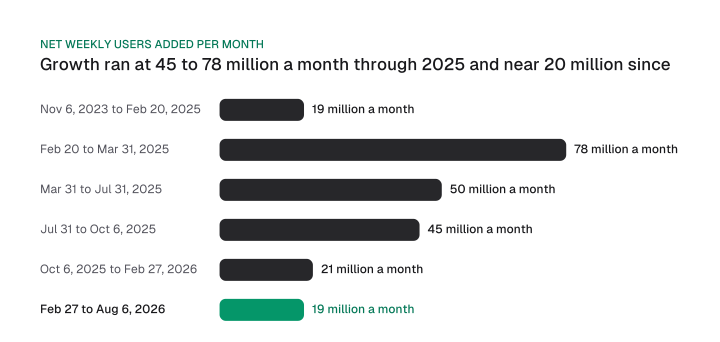
The curve hides a slowdown. We divided each change in weekly users by the real number of days between consecutive announcements and converted it to a monthly rate:
- November 6, 2023 to February 20, 2025: about 19 million a month.
- February 20 to March 31, 2025: 78 million.
- March 31 to July 31, 2025: 50 million.
- July 31 to October 6, 2025: 45 million.
- October 6, 2025 to February 27, 2026: 21 million.
- February 27 to August 6, 2026: 19 million.
Every 2025 interval from February onward ran above 45 million a month, and both intervals since run near 20 million, under half the slowest 2025 interval.
The 700 million in that calculation is the NBER paper's total weekly count, a different counting basis from the announced milestones, so the 2025 rates carry that mismatch. OpenAI has told the public its weekly count. It has not published a daily or monthly one (more on that below).
For how those users turn into prompt counts, see our guide to ai prompt volume; ranking-impact studies on the search side live in AI SEO statistics.
Which ChatGPT audience number should you cite?
Cite weekly users for reach, web visits for traffic and Pew's share for US adults, because in the NBER paper a ChatGPT weekly active user is a distinct login or browser cookie, a count the paper expects to somewhat exceed distinct people.
The paper's footnote spells it out for its July 2025 count. For logged-in users the count rests on distinct login credentials (email addresses), and one person may have several accounts. For logged-out users it rests on distinct browser cookies, so one person on two devices counts twice.
The data covers Free, Plus and Pro plans only; Business, Enterprise and Education are excluded. The paper calls its 700 million nearly 10% of the world's adult population, and the account and cookie rules explain why that reads as an upper bound on people. OpenAI's February and August 2026 posts give no definition, so none of this carries over to the 900 million or the 1 billion.
Five figures that all get called ChatGPT users sit side by side below. No two are comparable.
| Figure | What it counts | Who measures | Date |
|---|---|---|---|
| 1 billion people every week | People who use ChatGPT in a week; the post gives no counting definition | OpenAI | August 6, 2026 |
| More than 700 million weekly active users | Distinct login credentials and browser cookies, Free, Plus and Pro only | NBER paper, with OpenAI | End of July 2025 |
| One billion app monthly active users | Monthly users of the ChatGPT mobile app | Sensor Tower | May 2026 |
| 44% of US adults | Share of surveyed adults who report using ChatGPT | Pew Research Center | February 2026 |
| About 53% of generative AI web visits | ChatGPT's share of visits across generative AI sites | Similarweb | May 2026 |
Download CSV (CC BY 4.0)
OpenAI's CFO said in January 2026 that both the Weekly Active User (WAU) and Daily Active User (DAU) figures were at all-time highs. OpenAI tracks daily users, but no DAU count appears in what it has published, so any daily number is an outside estimate.
The monthly figure also sits outside OpenAI's own counts: the one billion monthly users belong to the app, which Sensor Tower's State of AI 2026 calls the fastest mobile app ever to reach that mark, in May 2026. As a monthly app figure it does not conflict with the weekly one.
The decision table maps each claim you might want to make to the one figure that supports it.
| Claim you want to make | Number to cite | Do not use for |
|---|---|---|
| ChatGPT's reach | 1 billion people every week (OpenAI, August 6, 2026) | Web traffic or US adult adoption |
| ChatGPT's web traffic | Similarweb's visit counts, which it describes as roughly flat | Reach, or a fall in share read as a fall in visits |
| US adult adoption | 44% of US adults (Pew, February 2026) | A global user count |
| Mobile app audience | One billion app monthly active users (Sensor Tower, May 2026) | Comparison with weekly active users |
| Share of generative AI traffic | About 53% (Similarweb, May 2026) | A count of visits or of people |
Download CSV (CC BY 4.0)
Rival chatbots follow the same rule. A weekly account count and a monthly user count do not rank two products against each other, which is why the Gemini statistics and Claude statistics live on their own pages.
Has ChatGPT traffic declined?
ChatGPT's traffic has not declined in absolute terms: Similarweb's share of generative AI web visits fell from about 76% in June 2025 to about 53% in May 2026 while its visit count stayed roughly flat.
Similarweb says so directly: "None of this means ChatGPT is shrinking." A flat leader looks like a declining one when its category grows.
Taking Similarweb's "roughly flat" at face value, we worked out what the share fall implies. If ChatGPT's visits stayed flat, total visits equal those visits divided by the share, so the whole generative AI category grew about 1.4 times between June 2025 and May 2026 and everything outside ChatGPT about 2.8 times. The share itself dropped 23 points, a 30% relative drop.
The second panel reads very differently, because it measures something else.
| Panel | Unit | ChatGPT figure | Month |
|---|---|---|---|
| Similarweb panel | Share of generative AI web visits | About 53% | May 2026 |
| Statcounter panel | Share of its AI chatbot panel | 80.48% | September 2026 |
The two ChatGPT market share readings, 53% and 80.48%, differ in panel, unit and month, so neither refutes the other; Statcounter's panel also puts Gemini at 10.91% in September 2026. Converting between panels needs more than this page; our guide to search engine market share puts ChatGPT, Gemini and Claude on one base.
An older Similarweb piece reported that web traffic to chat.openai.com dropped 9.7% from May to June 2023, a dip from a different era and a different domain. For the question people ask now, the weekly figures above are the better guide: ChatGPT users kept growing, only more slowly (see the net additions figure).
What people use ChatGPT for
By late June 2025, 51.6% of ChatGPT messages were Asking, 34.6% Doing and 13.8% Expressing, and 73% of messages were not work related, up from 53% a year earlier, according to the NBER paper.
The headline split of 49% Asking, 40% Doing and 11% Expressing is the paper's average across a sample of about 1.1 million conversations from May 2024 to June 2025. It counts messages rather than interactions and covers the whole May 2024 to June 2025 window, so it is no longer the current mix. Asking and Doing still carry most use, and Expressing messages are the smallest share.
Non-work messages grew fastest. The paper's table of daily messages, in millions, shows it:
| Messages a day | June 2024 | June 2025 | Growth multiple |
|---|---|---|---|
| Non-work | 238 | 1,911 | 8.0 times |
| Work | 213 | 716 | 3.4 times |
| Total | 451 | 2,627 | 5.8 times |
Download CSV (CC BY 4.0)
We divided each June 2025 count by June 2024's. Daily non-work messages grew 8.0 times against 3.4 times for work in a year, which is why the share of non-work messages climbed from 53% to 73%. Total counts are exact, while the work and non-work split is estimated from a random sample of conversations each day.
At work, about 56% of messages were Doing as of July 2025, and nearly three-quarters of those were writing tasks. OpenAI's August 2026 Signals post puts the odds of using ChatGPT for doing at more than twice as high at work as outside it.
The same post says multimedia was 7.8% of messages in the second quarter of 2026, after ChatGPT Images 2.0 launched in April 2026, across Free, Go, Plus and Pro accounts.
So "seven in ten messages are personal" is a June 2025 share and "49% asking" is an average over May 2024 to June 2025. For what the shift means for optimization, our chatgpt seo guide picks up where this section stops.
Who uses ChatGPT: age, gender and country
Pew Research Center found 44% of US adults used ChatGPT in February 2026, up from 18% in 2023, and use among adults 65 and older rose 4.8 times against 1.8 times for ages 18-29.
Pew surveyed 5,119 US adults from February 17 to 23, 2026. Its wording changed: from 2023 to 2025 it asked "Have you ever used ChatGPT?" of people who had heard of the chatbot, and in 2026 it also asked about other chatbots. Read the 34% to 44% step with that in mind. The full series ran 18%, 23%, 34% and 44%.
| Age band | 2023 | 2026 |
|---|---|---|
| Ages 18-29 | 33% | 61% |
| Ages 30-49 | 21% | 55% |
| Ages 50-64 | 13% | 37% |
| Ages 65 and older | 4% | 19% |
| Ratio, 18-29 to 65 and older | 8.3 times | 3.2 times |
Download CSV (CC BY 4.0)
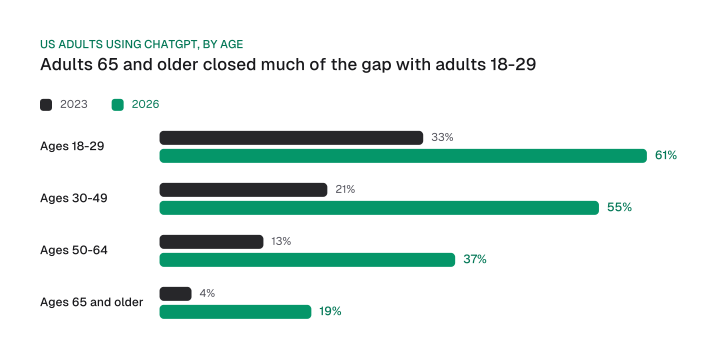
The age gap is closing. Dividing the youngest band by the oldest gives 8.3 times in 2023 and 3.2 times in 2026. The OpenAI paper says the same from a different unit: users under 26 sent nearly half of adult messages, and the paper notes the gaps have narrowed. One is a survey of people, the other a share of messages, and they agree on direction.
Gender follows the same drift. By June 2025, 48% of active users carried typically masculine first names, down from about 80% in the first months after launch, which leaves about 52% typically feminine among classified names. The method infers gender from first names, so read it as a signal about names.
India weekly active users stand at 100 million, Sam Altman said in February 2026. Against 900 million weekly users that is about 11%, or roughly 1 in 9.
A weekly 198 million India count would be 22% of the global total, which is implausible, so a 198 million figure with no unit is more likely a monthly or all-time count. OpenAI's second-quarter 2026 country ranking is a chart on its Signals hub; the text names Peru, Uruguay and Costa Rica as the biggest rank gainers.
How ChatGPT search behaviour shows up in referrals and ads
Similarweb found citations in about 1.6% of US ChatGPT prompts in June 2025 and about 6.8% by May 2026, and homepage landings rose to 62-63% of ChatGPT referral traffic after a May 2026 link change.
| Measure | Earlier reading | Later reading |
|---|---|---|
| Citation presence in US ChatGPT prompts | About 1.6% (June 2025) | About 6.8% (May 2026) |
| Homepage landing share of ChatGPT referral traffic | 26-29% before the May 2026 update | 62-63% by late May 2026 |
| What ChatGPT changed in May 2026 | Footnote-style citations | Clickable brand names inside answers |
| ChatGPT Ads | Planned tests on Free and Go (January 2026) | $1 billion annualized revenue run rate (August 2026) |
Download CSV (CC BY 4.0)
The homepage landing share rose about 2.3 times (from midpoints of 27.5% to 62.5%), so ChatGPT referrals now behave like a brand-name click rather than a deep-page search click. Similarweb ties the change to ChatGPT replacing footnote-style citations with clickable brand names in May 2026.
Citation presence climbed in the same window, from 1.6% to 6.8% of US prompts: sources appeared more often just as the links began pointing at brand homepages. If you want the working side, our guide on how to get cited by chatgpt covers it, and the guide to gptbot covers the crawler side.
Ads are past the test stage. OpenAI's January 2026 plan was to test ads in the US on the Free and Go tiers, with Plus, Pro, Business and Enterprise subscriptions staying ad-free. Its August 2026 ads post says ChatGPT Ads reached $1 billion in annualized revenue run rate in under 200 days after launch. The August post places them in an advertising-supported free tier.
Subscribers, revenue and valuation
OpenAI reported more than 50 million consumer subscribers and more than 9 million paying business users on February 27, 2026, and its CFO put annualized revenue at $20B+ at the end of 2025.
The 50 million counts consumer subscribers. Business users are a separate count, so adding the two is wrong, and so is reading the 50 million as business seats.
Set against the same announcement's weekly count, ChatGPT subscribers come to about 5.6 consumer subscribers per 100 weekly users (50 million divided by 900 million). OpenAI's March 31, 2026 post repeated both counts.
OpenAI revenue and profit
OpenAI's 2025 revenue was $13.07 billion with a $20.92 billion operating loss in leaked financial statements that OpenAI has not confirmed, while its CFO put annualized revenue at $20B+ at the end of 2025.
ChatGPT revenue figures conflict partly because they measure different quantities: an annualized run rate, recognized revenue and the ChatGPT-only slice are three separate things. The CFO's own series is annualized recurring revenue of $2B in 2023, $6B in 2024 and $20B+ in 2025.
| Figure | Metric | Who said it | Date |
|---|---|---|---|
| $8 billion | ChatGPT's 2025 revenue, about 66% of OpenAI's | One widely read 2026 roundup, unconfirmed | 2026 |
| $10 billion | OpenAI's 2025 revenue | The Information | July 29, 2026 |
| $13.07 billion | 2025 revenue in leaked financial statements | Fortune, unconfirmed by OpenAI | June 16, 2026 |
| $20.92 billion | 2025 operating loss in the same leaked statements | Fortune, unconfirmed by OpenAI | June 16, 2026 |
| $20B+ | Annualized recurring revenue at the end of 2025 | OpenAI's CFO | January 2026 |
| $21.4 billion | Annualized revenue at the end of 2025 | The Information, citing a person familiar | End of 2025 |
| $25 billion | Annualized revenue, end of February 2026 | The Information, citing a person familiar | End of February 2026 |
| Above $40 billion | Annualized revenue OpenAI is headed toward | Bloomberg, citing people with knowledge | August 2026 |
Download CSV (CC BY 4.0)
The 2025 anchor is itself contested. The $20B+ year-end annualized run rate is 1.5 times the leaked statements' revenue, 2.0 times the $10 billion report and 2.5 times the $8 billion ChatGPT figure, dividing $20B by each.
A run rate extrapolates the latest period, while recognized revenue is what was booked across the year, so a run rate above a revenue total is expected. The $25 billion run rate in the table is likewise not comparable with any annual total.
OpenAI valuation and funding
OpenAI announced $110B in new investment at a $730B pre-money valuation on February 27, 2026. It closed the round on March 31, 2026 with $122 billion in committed capital, valuing the company at $852 billion post-money.
ChatGPT statistics that do not hold up
Six circulating ChatGPT figures misstate a date, a unit or a scope, and five of the six sit on one widely read 2026 roundup: the 1 billion "not yet", the date of 800 million, the scope of 50 million, 2.78 prompts per user and an India count with no unit; the sixth, ChatGPT Plus at 50 million, is on another.
Each row below pairs the circulating figure with what the primary source says. Where a roundup's own wording is not reproduced, the row describes it.
| Circulating figure | What it gets wrong | What the primary says | Source |
|---|---|---|---|
| 1 billion weekly users is still a projection | Stale; written as if OpenAI had not said it | On August 6, 2026 OpenAI wrote that 1 billion people turn to ChatGPT every week | OpenAI |
| 800 million weekly users, dated December 2025 | Wrong date | More than 800 million on October 6, 2025 | Sam Altman, via TechCrunch |
| 50 million subscribers, counted across every paid tier | Wrong scope | More than 50 million consumer subscribers on February 27, 2026; business users counted separately at more than 9 million | OpenAI |
| 2.78 prompts per user per day | Divides mid-2025 prompts by February 2026 users (2.5 billion by 900 million) | 3.7 messages per user per day from same-date inputs: 18 billion messages a week by 700 million users | NBER paper |
| India has 198 million ChatGPT users | No unit stated | 100 million weekly active users in India in February 2026; a weekly 198 million would be 22% of 900 million | Sam Altman, via TechCrunch |
| Plus alone accounts for around 50 million paying subscribers | Narrows the scope to one plan | More than 50 million consumer subscribers on February 27, 2026 | OpenAI |
Download CSV (CC BY 4.0)
The 2.78 reproduces cleanly, which is what makes it persuasive. It is 2.5 billion divided by 900 million, but the 2.5 billion is a July 2025 prompt count and the 900 million is a February 2026 user count. Using inputs from the same date gives 3.7 messages per user per day, about 1.3 times higher.
How these numbers were checked
Each figure traces to a named publisher: OpenAI's own posts, the NBER working paper, a named panel (Similarweb, Statcounter, Sensor Tower) or a named survey (Pew Research Center). Where only a press report exists, the report is named and its hedge ("citing a person familiar") is kept.
Every number carries its unit and date, and derived numbers show their arithmetic. The "Last verified" line near the top shows the date of the last check.
Check the unit and the date before quoting any ChatGPT number. The corrections table above lists the figures that failed on those two checks. To see where ChatGPT mentions your own brand, our guide to track chatgpt mentions is the next step.
Frequently asked questions
How many weekly active users does ChatGPT have?
OpenAI said on August 6, 2026 that 1 billion people use ChatGPT every week, and its August 31 ads post says more than 1 billion weekly active users. The last earlier figure was more than 900 million on February 27, 2026.
How many messages does ChatGPT get per user per day?
The NBER paper counts 18 billion messages a week from 700 million users in July 2025, which is 3.7 messages per user per day. Both inputs come from the same date, which is why this figure differs from the circulating 2.78.
Is ChatGPT traffic falling?
ChatGPT's absolute visits have stayed roughly flat, according to Similarweb, but its share of generative AI web visits fell from about 76% in June 2025 to about 53% in May 2026. Share fell because the rest of the category grew faster.
Does OpenAI publish daily or monthly active users?
OpenAI publishes a weekly count. Its CFO said in January 2026 that both WAU and DAU were at all-time highs, but no DAU count has been stated, and the monthly figure of one billion belongs to the ChatGPT app (Sensor Tower, May 2026).
Does ChatGPT have more users than Gemini or Claude?
The figures are in different units, so a user-count ranking is unsafe. In Pew's February 2026 survey 44% of US adults used ChatGPT against 24% for Gemini, and Statcounter's AI chatbot panel put ChatGPT at 80.48% in September 2026. Our Gemini and Claude pages cover their own counts.
Figures and images in this post are free to reuse under CC BY 4.0 with credit to Mission Growth.
Get Mission Growth highlighted in your Google results.