Best AI Search Engines: How They Retrieve, Rank and Cite
Every AI search engine compared: how AI search engines retrieve, rank and cite answers, real 2026 usage data, and which one fits your situation.

On this page
You've started noticing AI answers where a search used to be. ChatGPT gives you a direct response. Perplexity shows numbered sources next to its answer. Google's own results page often opens with a written AI summary before the usual ten blue links.
The result is a blur most people just call "AI search," and it isn't one thing. Eleven tools compete for that job right now.
This list of AI search engines compares what each one actually retrieves from, how it cites what it finds, and which one is worth your time and money for the job you actually have.
One set of questions to answer before picking any of them:
- How the pipeline works, and what actually differs between engines
- A test for spotting a real answer engine
- Eleven engines compared on retrieval, citation style and price
- The real trend behind "AI is taking over search"
- A four-point trust check for any AI answer
- A decision table by need and budget
Think of it as the top AI search engines 2026 shortlist, built around retrieval source instead of marketing copy.
What is an AI search engine?
An AI search engine answers your question directly, with a synthesized, cited response, rather than a ranked list of pages you open and read on your own.
That's the whole category difference. A traditional search engine ranks pages and lets you do the reading.
An AI search engine reads the pages for you and hands back an answer with its sources attached.
Every one of these tools runs the same four-step pipeline underneath its branding:
- Retrieve. The engine pulls candidate pages or passages from an index: its own crawl, a licensed one, or several combined.
- Score. A retriever ranks those candidates, most often by vector similarity between your question and each passage instead of exact keyword overlap.
- Generate. A language model composes an answer from the top-scored passages instead of listing them.
- Cite. The engine attaches the sources it actually used, though how visibly it does that varies a lot by engine, covered below.
That retrieve, score and generate sequence traces to a named source: a 2020 paper by Lewis and coauthors, presented at NeurIPS, that coined the term retrieval-augmented generation. It defines a retriever that scores candidate passages by vector similarity and a generator that composes the answer from the top-scored ones.
The citation layer, the part that shows you which page an engine actually used, is something the consumer products added afterward. It isn't in the original paper.
The one step in that pipeline that actually varies by engine is the first one: which index retrieval draws from. Some engines run a fully independent crawl. Some license someone else's index. Some aggregate several. That split is what separates the eleven tools compared later in this piece, not how fast an engine can technically fetch a page.
Fetching pages fast enough to get indexed at all is a publisher's problem, and how to optimize for AI search engines already covers it.
Against a traditional search engine, the advantage is speed to an answer: one synthesized response instead of ten pages to open and cross-check yourself. The tradeoff is that you're trusting the engine's selection and synthesis instead of doing that work yourself. That's exactly why its citations matter.
Which platforms count as AI answer engines in 2026?
A platform counts as an AI answer engine when it composes an inline-cited synthesized answer as its default first response, not when it merely has a chat window that can search the web.
That's a binary test, and it's meant to replace a vaguer standard. AI search engines like ChatGPT get compared constantly, and one widely read comparison admits its own line between "answer engine" and "chatbot" is pretty arbitrary, based on feel rather than a rule anyone else can apply.
This one isn't. Does the tool answer with citations by default, without you opting into a special mode or clicking through links first? If yes, it's an answer engine. If no, it's a chatbot or a conventional search engine with an AI layer added on top.
Run that test across the roster and it sorts cleanly:
- Answer engines by default: Perplexity, ChatGPT Search, Google AI Mode, Microsoft Copilot, Brave Search with Leo, and You.com. Cited synthesis is what they do without you asking for it.
- Chatbots that can search: the base ChatGPT product (not its dedicated search mode), Claude, and Gemini. They only search and cite when you ask them to.
- Conventional or specialized search with an AI layer: Kagi, DuckDuckGo AI Chat, Consensus, and Wolfram Alpha. This is where the answer engines vs ai search engines line actually gets blurry, and why the comparison below treats all eleven on the same terms rather than picking a side.
Each of these tools still has to retrieve a page before it can decide whether to cite it. What decides whether your own content is retrievable enough to enter that pool is a separate, publisher-facing question. This page stays on the searcher's side of that line.
The AI search engines compared: how each one retrieves, ranks and cites
Eleven AI search engines are compared below on what each one actually retrieves from, the detail behind the usual "best for" line every listing repeats.
Here's how each entry is scored, from public vendor pages, pricing listings and documentation rather than hands-on testing: where its answers actually come from (its own crawl, a licensed index, or a mix), how it shows its work (numbered inline citations, a looser source list, or none), who it's built for, and its starting price. Prices are current as of September 2026.
By the answer-engine test above, the platforms most people mean by "top AI platforms" are the six that pass it by default: Perplexity, ChatGPT Search, Google AI Mode, Microsoft Copilot, Brave Search and You.com. The comparison below covers all eleven, including the more specialized ones.
Each of these engines still has to retrieve a page before it can cite it. Whether your own content is retrievable enough to make it into that pool is what generative engine optimization actually deals with, not something scored in the table below.
Mission Growth's platform tracks AI citations and visibility for customers.
| Engine | Best for | Retrieval source | Citation style | Starting paid price | Top paid tier |
|---|---|---|---|---|---|
| Perplexity | Research and fact-checking where every claim needs a source | Live web retrieval plus its own search and crawl layer | Numbered inline citations by default | $20/mo (Pro) | $200/mo (Max) |
| ChatGPT Search | Combining research with writing, coding and analysis in one session | Real-time web retrieval through search-provider partnerships | Cites sources, looser granularity than Perplexity | $8/mo (Go) | $200/mo (Pro) |
| Google AI Mode | Broad, everyday, local and shopping queries inside Google's ecosystem | Google's own web index, with a conversational layer on top | Cites sources, in a separate tab from standard Search | $19.99/mo (AI Pro) | $249.99/mo (AI Ultra) |
| Microsoft Copilot | Teams already standardized on M365, Edge and Bing | Bing's index, plus internal M365 documents in enterprise use | Cites sources, less granularity than Perplexity or ChatGPT Search | $9.99/mo (M365 Personal) | +$30/user/mo (M365 Enterprise add-on) |
| Claude | Long-document analysis and extended, multi-step reasoning | Web search added to a chat-first product, not its main focus | Cites sources on web-search answers | $20/mo (Pro) | $100/mo (Max) |
| Brave Search + Leo | Privacy-first users who want a free, independent AI search | A fully independent web index, not rented from Google or Bing | AI summaries with page-level source links | $3/mo (Search Premium) | $3/mo |
| Kagi | People who pay directly for ad-free results without tracking | Aggregates several indexes plus its own, then re-ranks them | Source-quality stats per result, domain-level personalization | $5/mo (Starter) | $25/mo (Ultimate) |
| You.com | Workflows where search starts a task instead of ending one | An agentic setup: many specialized agents handle retrieval and tasks | Not citation-first; positioned as a connected workspace | Free tier available | Varies by usage, no flat number published |
| DuckDuckGo AI Chat | Anonymous, zero-account answers with no query storage | External sources, including Bing for some queries, via an anonymizing relay | Lighter citations, built for quick factual answers | $9.99/mo (Privacy Pro) | $9.99/mo |
Download CSV (CC BY 4.0)
Prices as of September 2026.
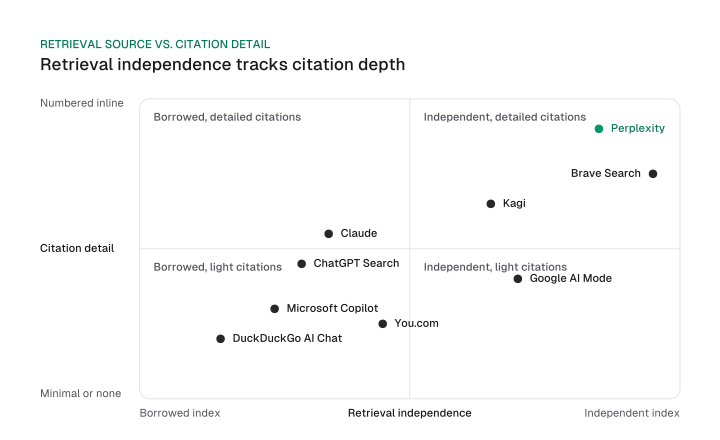
Retrieval source is the fact that predicts both answer independence and citation depth: engines running their own index tend to cite more granularly than the ones leaning on a licensed one. That pattern only shows up once retrieval source and citation style sit in the same table, next to each other, which no single vendor page or roundup here does.
Here's what each of the nine general-purpose engines looks like up close, plus two specialists.
Perplexity
Perplexity retrieves live from the web through its own search and crawl layer rather than renting a general index, and its Focus modes let you scope that retrieval to a specific source set: academic papers, Reddit, or news. Every answer carries numbered inline citations by default, the most transparent citation system of the eleven tools here.
That combination makes Perplexity the strongest pick for research and fact-checking, where every claim needs to trace back to a source you can open yourself. Publishers trying to be the source it retrieves and cites have their own playbook: see perplexity seo.
Where it falls short: citations don't fix a weak or biased source. Perplexity can still ground an answer in shaky material and cite it cleanly, and its deepest search sits behind the paid Pro tier.
ChatGPT Search
ChatGPT Search adds real-time web retrieval to a broader assistant, routed through search-provider partnerships rather than one owned index. It cites the sources it pulls in, but with looser inline granularity than Perplexity, and web search isn't its default behavior: ChatGPT leans on its own trained knowledge unless a query actually triggers browsing.
That makes it the strongest pick for combining research with generation, writing, coding, or analysis, in one conversation rather than switching tools. Earning a citation inside it specifically, rather than just training-data recall, is its own discipline: see chatgpt seo.
Set against Google AI Mode and AI Overviews, the difference comes down to that same point: ChatGPT reasons and creates in the same thread, while Google AI Mode stays closer to a search result read out loud.
Where it falls short: citations are less systematic than Perplexity's, and because web search isn't the default, an answer can quietly rely on stale trained knowledge instead of a live source.
Google AI Mode
Google AI Mode layers a conversational interface on top of Google's own web index, the largest of any engine here, rather than running a separate one. It cites sources, though AI Mode sits in a separate tab from Google's standard search results instead of appearing inline with them.
Broad coverage is the payoff: for local, shopping and everyday queries, Google AI Mode has more to draw from than any competitor here, especially if you're already inside Google's ecosystem.
Sources disagree on which specific model currently powers it, and none cites Google directly, so treat it as a Gemini model rather than naming a fixed version. Ranking well enough in Google's own index to get pulled into that layer is a separate question, covered in google ai mode.
Where it falls short: citation density and layout read less research-oriented than Perplexity's, and using it keeps you inside Google's ad and tracking ecosystem.
Microsoft Copilot
Microsoft Copilot runs on Bing's search index passed through an AI layer, and in enterprise deployments it also taps internal M365 documents. It cites its sources, with less granularity than Perplexity or ChatGPT Search.
Teams already standardized on M365, Edge and Bing get the most out of it. Copilot's real value shows up in that combination rather than as a standalone search tool. Publisher tactics for its citation behavior specifically live in microsoft copilot seo.
Where it falls short: full value stays locked to the Microsoft ecosystem, and Copilot's most capable features sit behind enterprise licensing rather than the free tier.
Claude
Claude added web search to a chat-first product, but it isn't the main focus the way it is for Perplexity or ChatGPT Search.
When Claude does search the web, it cites its sources, and it's strongest at synthesizing long documents rather than producing dense, citation-heavy research output. That combination makes it the best pick here for long-document analysis and extended, multi-step reasoning: tasks where you're feeding it a large amount of material and need a coherent answer back.
Where it falls short: for research that leans on many sources at once, Perplexity remains the more specialized tool. Web search stays secondary to Claude's main focus on long-document reasoning.
Brave Search + Leo
Brave Search runs on a fully independent web index, the only one of the eleven engines here that doesn't rent results from Google or Bing, with its Leo AI layered on top for summarized, cited answers. "Goggles" let you apply custom ranking filters on top of that independent index.
It's the strongest free, privacy-first pick: no tracking, no ads by default, and page-level source links on every AI summary.
Where it falls short: an independent index this size is smaller than Google's on long-tail and local queries, and Leo's summaries are shallower than a dedicated research tool's.
Kagi
Kagi aggregates multiple indexes, including Brave, Mojeek and anonymized Google requests, plus its own Teclis and TinyGem indexes, then applies its own ranking on top. It shows source-quality stats per result and lets you personalize rankings by boosting or suppressing specific domains.
That control is the whole pitch: Kagi is for people willing to pay directly for results without ads or tracking, instead of accepting an ad-funded engine's incentives.
Where it falls short: it costs money outright, a hard sell for casual users when Google is free, and a subscription model limits how broadly it spreads across a team.
You.com
You.com works differently from the rest of this list. Many specialized agents handle retrieval and task execution instead of one retrieval step feeding one generated answer, and citations take a back seat to getting the task done.
It works as a connected workspace for research, writing, coding and image generation, a broader tool than a pure answer engine.
That makes it the pick for workflows where search starts a task rather than ending one. If you need a developer-focused answer engine specifically, Phind fills that niche, so it's worth naming rather than comparing head to head.
Where it falls short: spreading across so many agents makes it feel less precise than a dedicated tool, and it isn't as citation-dense as Perplexity for pure research.
DuckDuckGo AI Chat
DuckDuckGo AI Chat routes queries through an anonymizing relay and leans on external sources, including Bing, for some of its answers. Citations are lighter than the research-focused tools on this list, built for quick factual answers rather than multi-step research.
It's the anonymous option: no account, no setup, no query storage, unlimited free use.
The widely repeated "100 million searches a day" figure traces to a January 2021 measurement of the search engine overall, years before the AI Chat product launched. That figure is history now, already stale for the product it gets quoted about.
Where it falls short: fewer research features than the dedicated tools here, and it still leans on outside sources, including Bing.
Specialized answer engines: Consensus and Wolfram Alpha
Two engines here don't compete for general search at all. Each is built for one job.
Consensus searches academic-paper databases rather than the open web, with Quick, Pro and Deep tiers pulling from progressively more papers as you dig deeper, and it displays how much consensus exists across those papers on a given question.
It's the pick for scientific and academic research specifically. Where it falls short: it's too niche for anything outside academic and scientific questions.
Wolfram Alpha works from a curated, structured knowledge graph rather than an open web crawl, using symbolic computation to produce step-by-step computed answers instead of links. It's built for math, science and statistics questions that need an exact, worked answer.
Wolfram Alpha's own pricing page lists Pro at $9.99/mo (or $5/mo billed annually) and Pro Premium at $12/mo (or $8.25/mo billed annually), on top of its free tier, as of September 2026. Where it falls short: it isn't a general web search replacement, stays narrow outside math and science, and needs precisely phrased queries to work well.
Is AI search actually taking share from Google?
Google's worldwide search share has not declined in a straight line: StatCounter's own monthly data shows it bottomed out, partly recovered, then dropped again.
Google held 92.9% of worldwide search in January 2023. That fell to a low of 89.54% by June 2025, recovered to 91.32% by July 2026, then slid back to 89.48% by September 2026, StatCounter's own monthly data shows. That's a volatile pattern, moving both directions, not the flat "steepest decline in its history" line you'll see repeated elsewhere.
Bing moved the other way over the same stretch: from 3.03% in January 2023 to 5.50% by September 2026, nearly doubling its starting share.
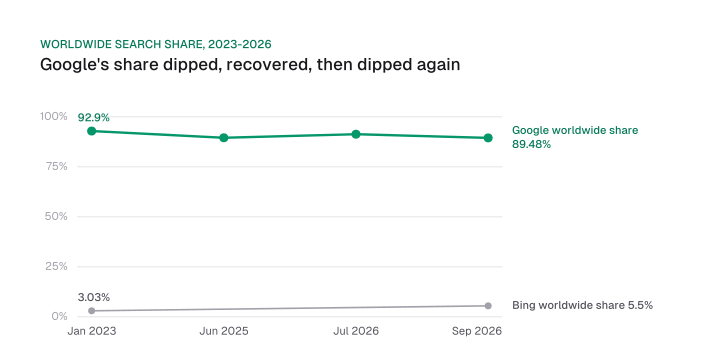
Two numbers worth pulling out of that chart. Google's full range across the period runs 3.42 percentage points, from 92.9% down to 89.48% (92.9 minus 89.48).
It also clawed back 1.78 points off the 2025 low before slipping again, from 89.54% up to 91.32% (91.32 minus 89.54). That's a share getting fought over month to month.
The number that actually moved fast during this window sits on the other side of the ledger, and it corrects two things people repeat without a source: a vague "2 billion queries a day" line and an unattributed "$110 billion funding round."
OpenAI announced in February 2026 that ChatGPT had passed 900 million weekly active users, alongside that $110 billion round at a $730B pre-money valuation, with Amazon, SoftBank and Nvidia each putting in tens of billions.
Those are real, dated figures behind "AI is bigger than people realize," and they hold up better than the vague, unsourced "2 billion queries a day" claim that circulates instead.
The fuller trend beyond Google and Bing, across every AI platform, lives in the running ai seo statistics page.
Where AI search engines still fall short
AI search engines can misattribute sources, surface outdated pages, and build a query profile even when they cite correctly, so no answer should be trusted without a quick check.
Three failure modes show up across every engine on this list:
- Sourcing. An answer can cite a real page that doesn't actually say what the engine claims it says.
- Freshness. A cited page can be out of date even when it's real and on topic.
- Privacy. Every query you type builds a profile somewhere, citations or not.
Run these four checks on any single AI search answer before you act on it:
- Where did this actually come from? Open the cited source and confirm it's a real, live page rather than a dead link or a placeholder.
- Keyword match or semantic match? A deterministic, keyword-based match is easier to verify than a probabilistic, semantic one; know which kind you're looking at.
- Does the citation say what the engine claims? Read past the sentence the engine pulled. A citation that's technically present isn't automatically faithful to the source's actual point.
- How fresh is the cited page? A page can rank and get cited while its content is a year or more out of date.
That last check matters more than it sounds like it should. An engine can ground an answer in a real, on-topic, correctly quoted page and still hand you stale information if that page hasn't been touched since a fact changed.
Publishing content these engines might retrieve? The flip side of this checklist, keeping your pages accurate enough to survive it, is covered in our ai search optimization best practices.
Which AI search engine should you use?
Your primary need and your budget decide which AI search engine fits, not a single "best overall" pick.
Searching for the single best AI search engines pick is the wrong frame. The table below breaks it out by what you actually need and what you're willing to pay, with a free option in every row.
| Primary need | Free pick | Worth paying for |
|---|---|---|
| Research with citations | Perplexity, free tier | Perplexity Pro, $20/mo, for deeper search |
| Everyday, local and shopping search | Google AI Mode, free in Search Labs | Rarely worth $19.99/mo AI Pro unless you already pay for Google's other AI features |
| Privacy | Brave Search + Leo, free and unlimited | Kagi Starter, $5/mo, for ad-free, untracked ranking |
| M365 teams | Microsoft Copilot, free tier | M365 Personal, $9.99/mo, which includes Copilot |
| Coding and dev workflows | You.com free tier, or Phind for a developer-specific tool | Claude Pro, $20/mo, for long-context reasoning alongside code |
| Long-document analysis | Claude, free tier | Claude Pro or Max, $20 to $100/mo |
| Academic and scientific research | Consensus, free (15 Pro searches/mo) | Consensus Pro, $10/mo, for unlimited Pro searches |
For every need category here, a free option gets you most of the way there. The paid pick only earns its price for a specific gap: deeper search, ad-free ranking, or M365 integration.
Most people land on one free tool plus one paid one for a specific job, a pair rather than a single overall winner. That's really the point of naming eleven engines instead of crowning one, and it's worth checking the ai seo checklist once you've picked yours.
None of this makes AI search a replacement for a traditional search engine, not entirely, and not yet. The real story is which index each tool draws from and how honestly it shows its work, not a single winner or a flat decline in Google's share.
Pick the one or two engines that match what you actually need, then run the four-point check from earlier on the first answer each one gives you.
Frequently asked questions
Run the four-point check above: confirm the citation is a real, live page, note whether the match was keyword-based or semantic, check that the citation actually says what the engine claims, and check how fresh the cited page is. An answer failing even one of those deserves a second look before you act on it.
Not in a straight line. Google's worldwide search share ran from 92.9% in January 2023 down to 89.54% in mid-2025, back up to 91.32% by mid-2026, then down again to 89.48% by September 2026, StatCounter's own data shows. That's a share moving both directions over time.
An AI search engine composes a cited, synthesized answer as its default first response. The base ChatGPT product can search the web when needed, but doesn't cite sources by default the way answer engines do; you have to trigger that behavior rather than get it automatically.
Brave Search runs a fully independent web index that doesn't rent results from Google or Bing. Kagi doesn't run a single independent crawl of that size; it aggregates several indexes instead, including its own Teclis and TinyGem, alongside Brave, Mojeek and anonymized Google requests, then re-ranks the result itself.
Brave Search's AI-assisted search is free with no cap, and DuckDuckGo AI Chat is also free and unlimited. Both trade some depth for that: Brave's independent index is smaller than Google's on long-tail queries, and DuckDuckGo's citations are lighter than a dedicated research tool's.
Phind is the dedicated developer specialist of the group, built around coding questions rather than general search. Three of the eleven engines compared here fit a developer's workflow best: ChatGPT Search, because writing, coding and analysis share one session with its retrieval; You.com, whose specialized agents split coding and research instead of one query box; and Claude Pro, at $20 a month, for the long-document, multi-step reasoning a large codebase needs.
Figures and images in this post are free to reuse under CC BY 4.0 with credit to Mission Growth.
Get Mission Growth highlighted in your Google results.