AI Chatbot Website Optimization: Conversion Rate Goals and Benefits
AI chatbot website optimization for conversion goals: see which benefits and numbers are real, which are vendor claims, and how to pick your site's goal.
On this page
Most vendor blog posts describe AI chatbot website optimization conversion goals benefits the same way. A chatbot answers around the clock, qualifies leads through conversation instead of a form, and can trigger a support or cart-recovery flow the moment a visitor shows a specific signal. Most AI chatbot benefits lists repeat that same handful of claims without naming where any of them came from.
One specific number differs from post to post: a percentage lift in conversion, usually with no study named and no link attached. This guide separates the mechanism from the marketing. It names the one figure in this topic that traces to a dated, sample-backed source, and states exactly what that figure measures.
It also lays out a framework for picking an AI chatbot's conversion goal that works across business models, unlike the one convenient vertical (a roofer, a dental clinic, an agency) every vendor page reaches for.
In this guide:
- What conversion job an AI chatbot is actually built to do
- The four conversion goal types a chatbot can be built around, and the metric that proves each one
- Which chatbot benefit numbers trace to a real study, and which are unsourced vendor claims
- A worked example showing how the wrong metric can make a chatbot look successful when it isn't
- The mistakes, including one compliance rule, that cost a chatbot conversion without ever tripping an alarm
AI chatbot website optimization conversion goals benefits: what a chatbot is built to do
An AI chatbot on a website is an NLP-based conversation layer that answers, qualifies and routes visitors inside a single bounded conversation. Because it never acts outside that conversation, its conversion goal has to be chosen deliberately, not left at whatever a vendor's template sets by default.
Mechanically, an AI-powered chatbot works in four steps on every message: it reads what the visitor typed, matches that text to an intent, answers directly or routes to the right flow, and logs the outcome for reporting.
Its concrete benefits map onto the four conversion goals below: capturing a lead's contact details, qualifying that lead with the right questions, booking a meeting on the spot, or deflecting a support ticket before it reaches a person. The main challenge isn't the mechanism; it's the default goal, since without configuration none of those four outcomes gets prioritized over whatever the vendor's own template counts as success.
Three shifts explain why more sites are adding one now: visitors expect a reply within minutes rather than hours, staffing that reply with a person costs more every year, and no-code AI tooling has turned a conversational flow into a weekend project instead of a development sprint.
Two kinds of tools get called an "AI chatbot," and the difference matters for everything that follows. A rule-based, scripted bot matches keywords against a fixed decision tree: type something the script didn't anticipate, and it stalls or loops back to a menu.
A modern AI/NLP chatbot parses open-ended phrasing and holds context across several turns. Only this second kind can run an actual qualification conversation instead of a decision tree wearing a chat bubble.
Two more items belong on this table-stakes list, each worth a single mention rather than a headline claim: most AI/NLP chatbots handle multiple languages without extra setup, and the better ones carry context from earlier in the same conversation instead of re-asking a question the visitor already answered.
An AI chatbot is also a different discipline from AI conversion rate optimization (AI CRO), which covers AI-driven A/B testing and personalization engines that change a page's layout or copy for different visitors. A chatbot is one application inside that broader category. Which CRO platform to buy for testing and personalization is a separate question from what a chatbot on your site should be built to do.
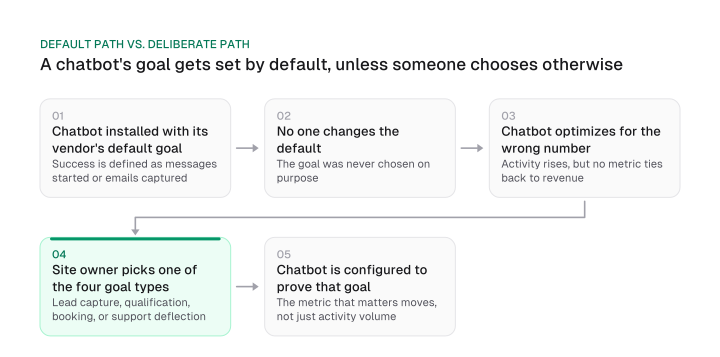
Left on its installer defaults, a chatbot silently optimizes for whatever its vendor's template counts as success, usually raw messages started or emails captured, instead of the goal the business actually needs: a booked demo, a qualified quote request, or a deflected support ticket.
Nobody has to approve that default for it to take hold; the dashboard just keeps reporting a rising number that was never the point, and the gap only surfaces once someone asks why messages-started never turned into revenue. That's why the next section treats goal-setting as the first deliberate step.
For how a chatbot's bounded, single-conversation scope differs from an AI agent that can act autonomously across systems, see AI agents in marketing.
The four conversion goals an AI chatbot can be built around
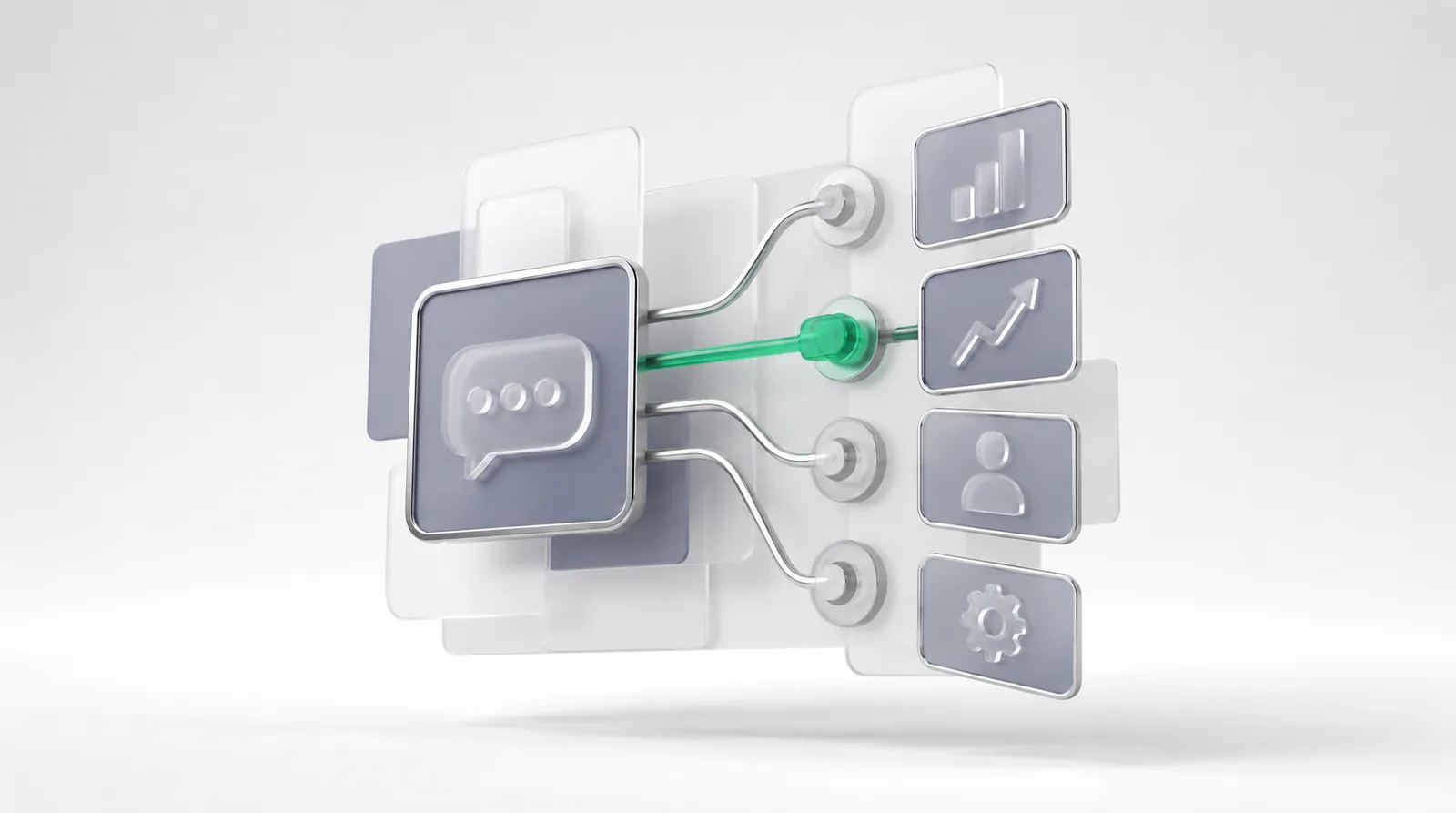
An AI chatbot's conversion goal falls into one of four types (lead capture, lead qualification, booking, or support deflection), and the goal chosen determines which questions the bot should ask and which metric proves it worked.
| Goal type | What the chatbot should do | Primary metric |
|---|---|---|
| Lead capture | Ask for contact details early, keep friction low, hand off to email or CRM | Captured-lead rate |
| Lead qualification | Run a structured question flow, such as a budget/authority/need/timeline (BANT) sequence, before any handoff | Qualified-lead rate |
| Booking / meeting scheduling | Offer calendar slots inside the conversation once qualification passes | Booked-meeting rate and no-show rate |
| Support deflection | Answer common questions from existing docs, escalate when unresolved | Autonomous-resolution rate |
An AI-powered chatbot built for customer service maps onto the fourth row above, support deflection: it answers common questions from existing documentation and escalates the ones it can't resolve, and the metric that proves it's working is autonomous-resolution rate, not raw tickets touched.
An AI chatbot for lead generation, by contrast, is one configured around the first row: it collects a visitor's contact details in exchange for information, a demo, or an offer, before any qualification conversation happens.
Every vendor page in this topic illustrates its benefit list with one convenient vertical: a roofer's booking flow, a dental clinic's intake form, an agency's lead form. That makes the list hard to carry into a different business model. Setting chatbot conversion goals before writing a single script question is what turns four disconnected examples into one applicable framework.
An eCommerce store, a B2B SaaS company and a services agency can each drop their own chatbot into one of the four rows above and read off the metric that proves it's doing its job. Using an AI chatbot for lead generation is the simplest of the four, but it's also the easiest to get wrong by optimizing for volume instead of quality.
Chatbot lead qualification works best as a structured flow, most commonly a BANT-style sequence, run conversationally instead of through a static form.
A chatbot improves customer experience mainly by removing the wait: a visitor with a question at the exact moment of doubt gets an answer immediately instead of abandoning the page to look elsewhere. That's the same fast-response mechanism behind the lead-response finding covered next, used here only as a directional proxy for why speed matters, not as a live-chat measurement in its own right.
Deciding which specific chatbot platform, or broader CRO tool, to buy for any of these four goals sits outside this guide.
Which chatbot benefit numbers are measured, and which are vendor claims
AI chatbot conversion rate claims are where this topic gets shakiest. The lift is real in mechanism but mostly unverifiable in the specific percentage vendors quote, and the one number this topic's ranking pages most often mis-cite traces to a real, dated, sample-backed study once you look for its actual source.
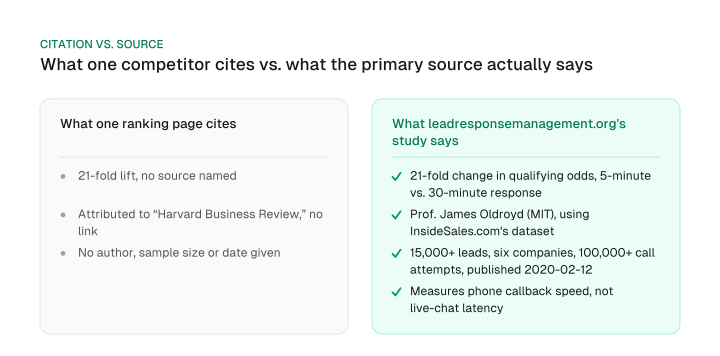
Two of the highest-ranking pages on this topic repeat a striking claim: responding to a lead fast changes its odds of qualifying by 21-fold. One states the figure with no source at all. Another attributes it to "Harvard Business Review," with no link, no author and no sample size given. Neither is right.
The actual source is leadresponsemanagement.org's research with Prof. James Oldroyd (MIT), built on a dataset from InsideSales.com: six companies' data over three years: more than 15,000 leads and over 100,000 call attempts, published 2020-02-12. Its finding is specific: a lead contacted within five minutes is 21 times more likely to enter a qualified sales conversation than one contacted after thirty minutes.
That number deserves one caveat every time it gets used. The study measured phone callback speed on a lead who had already filled out a form, a different signal than same-session chat-reply latency inside a browsing session. It's the closest verified proxy this topic has for how much response speed matters, though it never tested a chatbot directly, and no ranking page states that distinction.
A second widely repeated figure, an average website conversion rate cited with total confidence, leads at least one ranking page with no named study, sample or date attached anywhere on it. This guide discounts that figure instead of swapping in an equally unsourced replacement.
One more figure belongs here purely as context. Baymard Institute's cart-abandonment average, last refreshed 2025-09-22, puts the documented rate at 70.22%, a mixed-vintage rollup of 50 studies dating back to 2006. It matters for a chatbot's cart-abandonment-recovery trigger because it shows the scale of the problem that trigger targets, even though the number predates most of the chatbots being sold today.
A full breakdown of cart abandonment as a funnel-wide problem is a separate discussion. Here, a chatbot's role is limited to one recovery trigger inside checkout, distinct from a full funnel diagnosis.
How to set the right metric for your chatbot's conversion goal
An AI chatbot optimized for the wrong metric can look successful while working against the business it's meant to help. The metric must match the goal type chosen above instead of simply counting activity.
To optimize conversion rates with AI, start from the goal rather than the tool. Pick one of the four goals, choose the metric that measures its end outcome (a booked meeting that actually happens, a paid order, a resolved ticket), then tune the chatbot's prompts and routing against that metric and compare it with the same pages' baseline from before launch.
Picture a B2B SaaS company that configures its chatbot to maximize captured leads: every visitor who submits an email counts as a win. Within a month, the sales team's calendar fills with demo calls, but the demo-to-paid conversion rate drops, because the chatbot never filtered for budget, authority, need or timeline before booking the call.
Captured-lead count looked great on a dashboard, and booked-demo rate looked fine too, at first. What actually mattered, the share of no-shows on those calls and the eventual demo-to-close outcome, told the real story: a chatbot that books meetings nobody qualified for fills a calendar with wasted seats.
Tying the tracked metric to the goal type above fixes this: a booking-goal chatbot gets judged on booked-demo rate together with no-shows, a pair a raw conversation count can't substitute for.
The same logic applies to every goal type:
- Lead capture: number of leads captured
- Lead qualification: share of leads that pass the qualification flow
- Booking: booked-meeting rate, weighed against no-shows
- Support deflection: autonomous-resolution rate
Once a chatbot is producing a known rate of captured leads or booked demos, translating that rate into a dollar figure is a separate step. See how to calculate your SEO ROI on a captured lead using customer lifetime value against close rate, the same math that applies to a chatbot-sourced lead as an organic one.
Mission Growth also ships a free SEO ROI calculator for exactly that conversion.
Common mistakes that quietly kill chatbot conversion
An AI chatbot most often loses conversion through over-asking, a robotic tone, stale content, and treating AI disclosure as a legal checkbox instead of a trust factor the flow depends on.
- Over-asking. Why it costs conversion: a visitor abandons before qualification finishes once the bot stacks five or six questions before showing any value. Fix: ask the minimum needed to route the conversation, and defer deeper qualification to a human or a later step.
- Robotic tone. Why it costs conversion: generic, scripted phrasing signals "template" and reduces trust before the ask ever lands. Fix: write the flow in the brand's actual voice, then test it against how real visitors phrase their questions.
- Stale content. Why it costs conversion: a bot answering from documentation that's months out of date gives wrong answers with total confidence. Fix: put the underlying content on a fixed review schedule instead of waiting for a complaint to trigger an update.
- Disclosure treated as a compliance checkbox instead of a trust factor. Why it costs conversion: most guidance frames AI disclosure as a CCPA/TCPA-style box to check, but a visitor who suspects, even briefly, that they're talking to an undisclosed script disengages before the qualification questions ever land, no matter how well the rest of the flow is built. Fix: state it plainly in the bot's opening line, so the disclosure itself becomes the first trust signal in the conversation rather than fine print.
Fixing stale content matters especially here, since a chatbot amplifies whatever's wrong with its source material at conversation speed. See how to measure content roi to decide which pages are worth that maintenance first.
The disclosure fix carries the most weight of the four. It functions less like a compliance line item and more like the condition the rest of the flow depends on: a visitor who feels tricked into talking to a bot disengages before any qualification question lands.
An AI chatbot's real, checkable job on a website is narrower than the benefit lists suggest. Response speed is the one mechanism in this topic with a real, dated study behind it, and even that study measured a phone callback rather than a chat window.
Everything else worth taking from this topic is the goal-to-metric framework above, built to travel past any one vendor's example vertical. Using an AI chatbot for website conversion pays off only when its goal is chosen deliberately, instead of left at a vendor's default.
Pick one of the four goal types for your own site, write down the metric that proves it, and check your current chatbot configuration against that metric before adding another qualification question to the flow.
Frequently asked questions
Does an AI chatbot ever hurt conversion rate?
Yes. When it over-asks, sounds robotic, or hides that it's a bot, a visitor disengages before the qualification questions land. See the mistakes section above for the fix for each one.
What's the difference between an AI chatbot and an AI marketing agent, and why does it matter for setting a goal?
A chatbot never acts outside one conversation, so it can't reprioritize toward a better goal the way an AI agent reprioritizes a live campaign across systems. That's why a chatbot's goal has to be chosen deliberately, upfront; see the AI agents in marketing section above for that boundary.
What is AI conversion rate optimization, and how does it work?
AI conversion rate optimization (AI CRO) uses models to decide which page variant, offer or message each visitor sees, then learns from which version actually converts. It works in a loop: define the conversion metric, generate or pick variants, split traffic between them, and shift traffic toward whatever wins.
Is a chatbot the same as AI conversion rate optimization (AI CRO)?
No. AI CRO is the broader discipline: models pick which page variant, offer or message to show a visitor, personalize content on the fly, or run automated tests, and the system learns which version actually converts.
A chatbot is one narrower application inside that discipline, a conversational tool a visitor talks to directly rather than a background testing or personalization engine. CRO best-practice tactics are a wider set again, each with its own strength of evidence.
Which conversion goal should a chatbot be built around?
It depends on the business model: lead capture, qualification, booking or support deflection. See the goal-type table above for what each one should do and which metric proves it.
How do you measure whether a chatbot actually improved conversion?
Tie the metric to the goal type chosen, since raw activity volume like conversations started or leads captured doesn't confirm the goal was actually hit.
Figures and images in this post are free to reuse under CC BY 4.0 with credit to Mission Growth.
Get Mission Growth highlighted in your Google results.