
Growth Loops vs Funnels: Loop Gain, Cycle Time and Types
Growth loops compound where a funnel resets. See the loop types, a step-by-step build process, why loops stall, and whether B2B can use one.

On this page
A growth loop compounds because the output of one pass through your product funds the next one, and it only keeps compounding while its loop gain stays above 1. A funnel does something different: it measures one pass and resets before the next one starts.
That's the real growth loops vs funnels question, and it isn't a fight over which model is correct. What decides whether your specific loop actually compounds, instead of just looking like it should, comes down to two numbers: loop gain and cycle time.
In this guide:
- The four-part shape of a growth loop and the mechanism that makes it compound, or stop
- Growth loops vs. funnels and vs. network effects, each with a decision rule
- The four practical loop types and which one fits what your product already has
- How to build one and measure it, with a worked cycle time table
- Whether growth loops work for B2B, and what has to change if they do
What is a growth loop?
A growth loop is a cycle that reinforces itself: each action's output becomes the next action's input, and it only keeps compounding while its loop gain stays above 1.
That's a different thing from GrowthLoop.com, a customer data platform with a similar name.
Systems dynamics, the field Jay Forrester founded at MIT, publishing its foundational text Industrial Dynamics in 1961, models exactly this: a reinforcing loop compounds until a balancing loop, Peter Senge's 1990 terms for the two basic feedback types, pulls the growth rate back down and bends the curve into an S.
A four-post Reforge series popularized this idea in growth circles, co-written by Brian Balfour and Casey Winters, together with Kevin Kwok and Andrew Chen, framing it as the mechanism funnel-only thinking misses.
Every growth loop breaks down into the same four parts:
- Trigger: what starts a cycle for one user, an email, a referral link, a search result landing on your content.
- Action: what that user does once triggered.
- Value delivered: what the user gets back for taking the action.
- Reinvestment: the exact mechanism that turns that value into a new trigger for the next user.
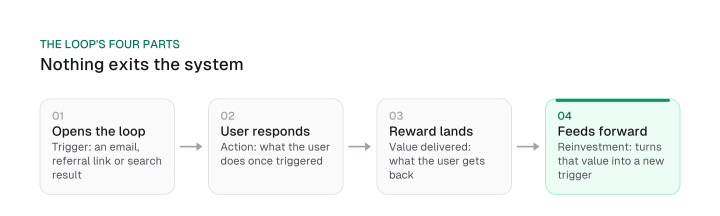
A growth loop is a reinforcing feedback loop in the formal system-dynamics sense, more than a circular story. Whether it compounds is a gain question about loop gain, separate from its shape.
Growth loops vs. funnels
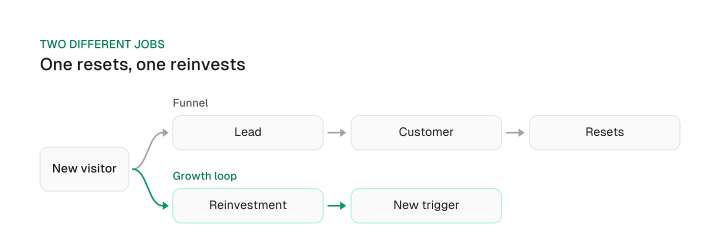
A growth loop and a funnel measure two different things: a funnel measures one pass, a loop measures what a finished pass causes the next cycle to do.
A funnel measures one pass through your product. A visitor becomes a lead, a lead becomes a customer, and the funnel resets for the next visitor rather than feeding what that customer does back into acquiring the next one.
The funnel model behind most of these comparisons is some version of the AARRR framework, and growth loops don't retire it. They answer a question AARRR was never built to answer: what happens after the pass ends.
A funnel and a loop aren't either/or: run a funnel to diagnose where a single pass leaks users, run a loop to engineer what a finished pass causes next.
| Funnel | Growth loop | |
|---|---|---|
| Measures | One pass through the product | What a finished pass causes next |
| Resets after each user? | Yes | No, it reinvests |
| Feeds the next cycle? | No | Yes, by design |
You'll see a specific number attached to this comparison:
Growth loops can produce a 15 to 30 percentage point contribution-margin differential over funnel-only growth.
That figure has no named study, sample or methodology behind it. What's actually defensible is simpler.
A loop's marginal acquisition cost tends to fall as reinvestment compounds, because each new cycle draws on cheaper, already-earned inputs: existing users, indexed content, accumulated reviews, instead of buying acquisition fresh every time. That's the mechanism, and it doesn't need a manufactured percentage to be true.
Run both. A funnel and a loop aren't competing models, they're different jobs: one tells you where a pass leaks, the other tells you what to do with everyone who finishes it.
Growth loops vs. network effects
A network effect and a growth loop are different mechanisms: a network effect makes a product more valuable as people join; a loop brings the next person in.
A network effect only requires that per-user value rise with more users; the product itself doesn't have to do anything to recruit the next user. A growth loop is the opposite kind of requirement: it must actively bring in or activate the next cycle, whether or not value per user changes at all.
Run the four-way test before assuming you have both, because most teams assume that by default and usually have one.
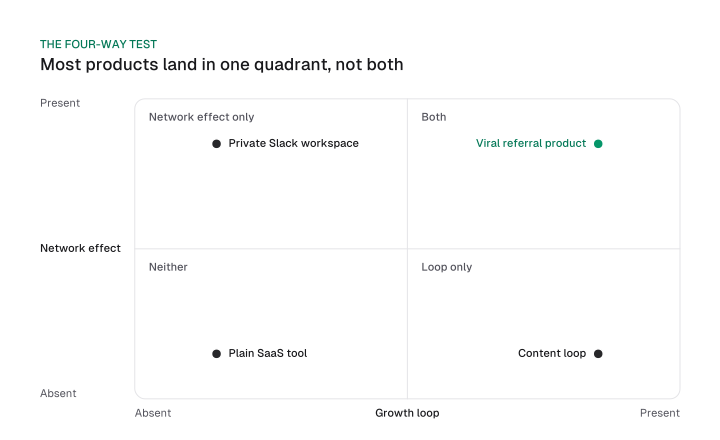
Each quadrant maps to a real product type:
- A private Slack workspace has a real network effect. It gets more useful as teammates join, with no growth loop: nothing about it actively recruits outside users.
- A content loop actively recruits new readers with no network effect: one reader's presence adds nothing for another.
- A viral referral product has both. Value rises with the network, and sharing actively recruits the next user.
- A plain SaaS tool bought through outbound sales has neither, and has to buy every cycle of growth from scratch.
Know which quadrant you're actually in before you invest in either mechanism.
The types of growth loops
Growth loops come in four practical types for most products, content, viral or referral, paid acquisition and sales, and the wrong pick is why attempts stall.
The types of growth loops below double as growth loop examples to match against what your own product already has.
| Loop type | Requires | Skip it if |
|---|---|---|
| Content loop | Something worth publishing and existing search demand | Nobody is searching for the topic yet |
| Viral or referral loop | A sharing moment that genuinely helps the sharer | There's no natural reason for a user to invite someone |
| Paid acquisition loop | Positive margin after CAC to reinvest | Margin after CAC is break-even or negative |
| Sales loop | Closed-deal revenue that funds the next hire | There's no revenue yet to fund headcount |
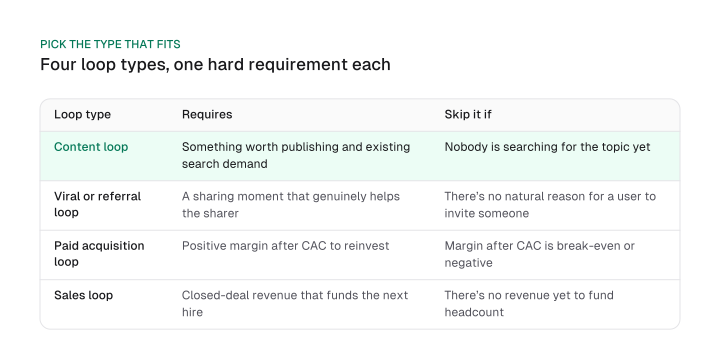
A content loop needs something worth publishing and existing search demand for the topic. Without demand, the loop has nowhere to draw its next reader from.
A viral loop is the version where using the product creates the next invitation: one user's action exposes or invites the next user, so acquisition rides on usage instead of on spend.
Viral loops and referral loops need a sharing moment that genuinely helps the person sharing, beyond helping you. That definition is as far as this covers it: the K-factor formula and how to measure it belong to viral coefficient, and the incentive design and launch sequence belong to how to create a referral program.
A paid acquisition loop needs positive margin after CAC to reinvest. Without it, every cycle drains budget instead of funding the next one. We built the LTV:CAC calculator to check that condition before you commit budget to this loop type.
A sales loop needs closed-deal revenue that funds the next hire. Without that revenue, there's no next cycle to fund.
Match the type to what your product already has, a shareable output, a margin to reinvest, a sales motion, before you design anything else.
How to build a growth loop
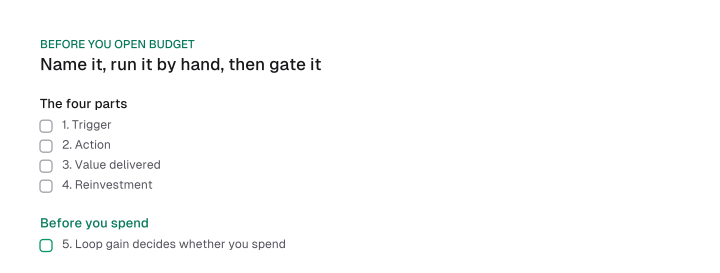
Knowing how to build a growth loop starts with naming its four parts, trigger, action, value delivered and reinvestment, on paper for one real cohort before a single feature ships.
- Name the trigger for one real cohort: what starts a cycle for this specific group of users.
- Name the action: what they do once triggered.
- Name the value delivered: what they get back for acting.
- Name the reinvestment mechanism: the exact step that turns that value into a new trigger for someone else.
- Gate: run the sequence by hand on that one cohort, compute loop gain, and only open budget once gain clears 1.
Whatever you name as the action step, measure it against your north star metric, the one number your team is actually optimizing for, not a step you can move without moving that number.
A loop you build once and never retest drifts. See growth experiment cadence for how often to run it again.
Treat loop gain as a gate, not a scoreboard: it decides whether you're allowed to spend, not how good the loop looks on a slide.
How to measure a growth loop
A growth loop is measured by two numbers, loop gain and cycle time, and cycle time decides how many chances it gets to compound in a year.
The relationship is simple math for time to double: days to double a cohort equals cycle time in days times ln(2), divided by ln(gain). At a steady loop gain of 1.2:
- a 3-day cycle doubles a cohort in about 11 days
- a 14-day cycle takes about 53 days
- a 30-day cycle takes about 114 days
- a 90-day cycle takes about 342 days
| Cycle time | Days to double |
|---|---|
| 3 days | ~11 days |
| 14 days | ~53 days |
| 30 days | ~114 days |
| 90 days | ~342 days |
Download CSV (CC BY 4.0)
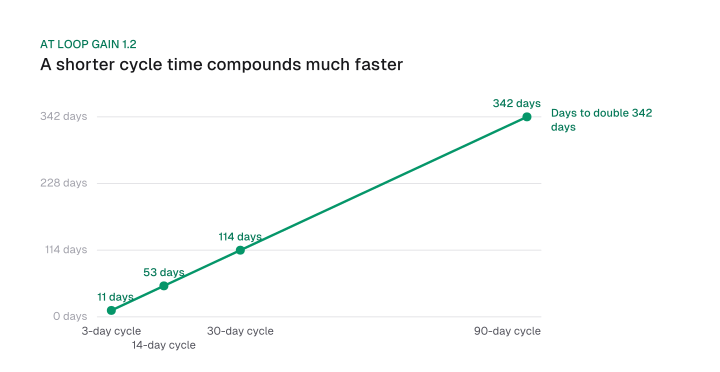
That's a worked example at a steady loop gain of 1.2. Your own gain and cycle time will differ, so redo the formula with your real numbers instead of reusing the day counts above.
This table never computes or names K-factor. For the actual viral cycle time math and how it interacts with K, see K-factor and viral cycle time.
Compare that to how long SEO ROI takes: a single content channel ramps on its own curve, while a loop's payoff compounds on top of whatever channel feeds its trigger.
The answer to "how long until I see results" is cycle time: shorten it and the same gain compounds faster.
Do growth loops work for B2B?
B2B growth loops work, but a sales loop's cycle time is capped by the deal cycle, so B2B teams need a second, faster loop running alongside it.
If your deal cycle runs about 90 days, a sales loop built on it completes roughly 4 cycles a year. A 14-day content loop running in parallel completes roughly 26 cycles over that same year, using the same cycle time table from the section above.
Pair that faster loop with the slow sales motion instead of expecting the deal cycle alone to compound quickly. The sales side still matters; it just doesn't move fast enough on its own to show results inside a single year.
For the acquisition channel that usually feeds the faster loop, see B2B SEO strategy. For how to sequence loop-building against everything else an early-stage team has to do, see SEO for startups.
Why growth loops plateau (and what to do about it)
A growth loop plateaus because every reinforcing loop eventually meets a balancing loop, a real constraint like market saturation or incentive fatigue that pulls its gain back toward 1.
That's the same mechanism from the definition above: a reinforcing loop compounds until a balancing loop bends the curve into an S. The constraint isn't a bug in your execution, it's what every reinforcing loop eventually runs into.
Brian Balfour, in a later solo piece, described this same shape directly: a loop that once compounded starts working against itself once its binding constraint takes hold.
Organizational theorist Chris Argyris named the fix for this in a 1976 paper: single-loop learning corrects the action inside a fixed assumption, tightening the same incentive or copy again; double-loop learning questions the assumption itself.
Applied to a stalled growth loop, once tactical tuning (the incentive, the copy, the friction) stops moving the gain, the next move isn't another tweak. The move is asking whether the loop is still reinforcing the behavior that actually matters.
When gain stalls despite real tactical effort, audit the governing assumption before you touch the incentive again. If a tuning pass is still moving the number, the assumption isn't the problem yet.
Once you know which behavior the loop should reinforce, translating that into how big the lever actually is belongs to a growth model. Deciding whether this loop is worth the team's time over everything else on the roadmap is what the RICE framework is for.
A growth loop is a reinforcing feedback loop, not a rebrand of "circular beats linear": it compounds only while gain stays above 1, and it will eventually meet a balancing constraint that pulls that gain back down. Start with arithmetic, not vibes: name your loop's four parts, compute its gain on one real cohort, and check its cycle time against the table above before a dollar goes into it.
Frequently asked questions
Can I have multiple growth loops running at once?
Yes, but most companies are actually run by one or two loops at a given stage; a handful more becomes coordination overhead before it becomes insurance. Audit a loop before building a new one: name its gain and cycle time first, and only add another once the first one is measured and running.
Is a growth loop the same as GrowthLoop, the CDP company?
No. GrowthLoop.com describes itself as "the agentic, composable CDP," a customer data platform product. The general growth-marketing mechanism, the self-reinforcing cycle of trigger, action, value delivered and reinvestment, is a different thing with a similar name.
Is there a growth loop template I can use?
The loop type table above and the four-step build sequence work as a reusable template: pick your loop type, then name the trigger, action, value delivered and reinvestment for one real cohort. Run it by hand before you build or spend anything.
What's a good loop gain to aim for?
Above 1 is the bar for compounding at all; below that, the loop shrinks every cycle. Sustained gain much higher than 1 is rare without a strong viral mechanic, so most teams should expect slow, real compounding rather than a sudden takeoff.
Figures and images in this post are free to reuse under CC BY 4.0 with credit to Mission Growth.
Get Mission Growth highlighted in your Google results.