How to Create a Referral Program: Reward Sizing and Setup
How to create a referral program that actually pays for itself: reward sizing, timing, fraud checks and real worked examples for every business type.
On this page
How to create a referral program starts with one decision most frameworks skip: how big the reward should be. Google's AI Overview already compresses the generic five steps, define goals, choose incentives, pick technology, promote, into a handful of bullets before a searcher clicks through to any page.
So the part worth your time is what that framework leaves out: a reward size tied to CAC, a hold period tied to your return window, a fraud check that catches real abuse, and whether the IRS cares about what you're paying out.
This guide answers those questions with real, verified numbers from Dropbox's and Google Workspace's own referral programs, numbers you can check yourself instead of a vendor blog's rounded percentage.
In this guide:
- How reward size, hold period and fraud checks actually get decided
- A checkable two-sided vs. one-sided reward count, not the usual "90%+" claim
- The $2,000 IRS threshold that changes how you pay cash rewards
- Two worked examples: Dropbox's storage reward and Google Workspace's per-seat dollar reward
- Whether it's worth it for a new, B2B or subscription business
How to create a referral program: what it is and why it works
A customer referral program is a formal system that rewards an existing customer for bringing in a new one.
It works because word-of-mouth carries more trust than any paid channel, and you can check that part of the case yourself. Nielsen's 2021 Trust in Advertising Study surveyed more than 40,000 consumers across five regions in September 2021.
88% said they trust recommendations from people they know more than any other channel, and those recommendations earn 50% more trust than lower-ranked channels like banner ads, mobile ads, SMS and search ads.
Three other numbers get repeated to justify launching a program in the first place.
A 30% lift in conversion, 84% of B2B decision-makers trusting referrals, and a 16% lift in lifetime value.
Two of the three don't trace to a real study. SaaSquatch, the source behind the conversion figure, names only "Finances Online" as its own source, no study, no sample size, no year.
The trust mechanism behind referrals is real, and the lifetime-value figure has real backing too: a peer-reviewed 2011 Journal of Marketing study of a German bank's customers found referred customers worth at least 16% more. The other two percentages aren't independently verifiable, so treat them as marketing copy.
A referral program is one of three ways businesses turn existing customers or promoters into new demand, and the three aren't interchangeable:
- Referral program: rewards an existing customer for bringing in someone they already know, built on trust between two people.
- Affiliate program: pays a commission to any promoter, customer or not, per sale, with no prior relationship required.
- Loyalty program: rewards a customer's own repeat purchases. It doesn't bring in anyone new.
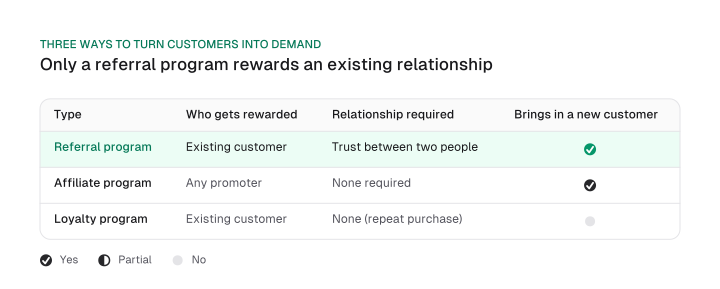
A referral program is one specific version of a growth loop, where the reward reinforces a customer to repeat the same reward-and-referral action.
Choosing and sizing your reward structure
Two-sided rewards dominate real referral programs, more than the commonly cited figure suggests. Size the reward against your own CAC and what your business already sells.
Real programs also vary by structure as well as by side: standard (one flat reward for everyone), tiered (bigger rewards as a customer refers more people), multi-step (a reward released at each stage of the referred customer's journey, from signup onward) and gamified (a leaderboard or badge layered on top of a cash or credit reward).
SaaSquatch, the same source behind the earlier uncorrected stats, claims more than 90% of referral programs are double-sided, meaning both the referrer and the friend they refer get rewarded rather than only the referrer under a one-sided reward. Counting the 15 named brand programs profiled in one competitor's own list corrects that round figure to a tighter, checkable 93%, 14 of 15, independently verifiable instead of taken on faith.
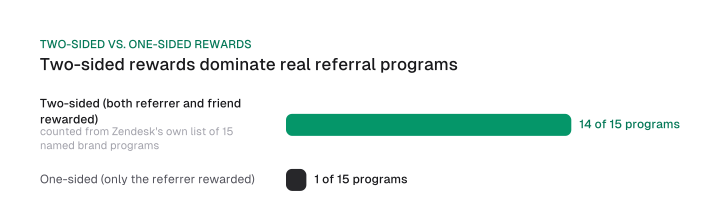
These referral program ideas map the reward type to how your business already gets paid, instead of a generic referral program template:
- SaaS or subscription: account credit or an extra free month, the same unit the customer already pays in.
- E-commerce: a percentage-off or fixed-dollar discount on the next order.
- Storage or seat-based tools: more of the product itself (storage, seats, usage), the way Dropbox and Google Workspace both do it.
Timing matters as much as size. Yotpo recommends holding the reward until the store's own return or refund window closes, rather than defaulting to a flat number, commonly a 30 to 90 day hold.
Cash or gift-card referral rewards count as miscellaneous income to the recipient. The IRS requires a Form 1099-MISC once one person crosses $2,000 in prizes, awards or other miscellaneous income in a calendar year, a threshold raised from $600 for tax years beginning after 2025. Discount-based rewards that lower a future purchase price work differently; check with a tax advisor before scaling a cash or gift-card program.
Testing different reward amounts and promotion copy against each other belongs on a steady growth experiment cadence.
Setting goals, picking your tech stack and making sharing frictionless
A referral program needs a stated goal and a way to track it before it needs software. Decide what you're optimizing for first:
- Pick one metric: new customers, referral revenue or activation rate.
- Set a baseline from your current word-of-mouth signups before you launch anything.
- Decide how you'll track a referral: unique codes, personal links or both.
- Set the volume where manual tracking breaks and software starts paying for itself.
You don't need dedicated software to start. A spreadsheet and unique discount codes work at low volume. Once volume outgrows manual tracking, software earns its cost back mainly in fraud prevention and saved time.
Yotpo's own "Common Pitfalls" section names half of the fix for friction: "Aim for one-click sharing for advocates and an automatic discount application for friends." What that line doesn't name is the specific failure mode it's solving. A referred friend who has to create an account before the discount shows up will often abandon right there.
The fix is sequencing: apply the discount at checkout before the login prompt appears. One-click sharing gets the friend to the site; the reward showing up before the account wall is what keeps them there.
On mobile, the same rule means the referral link opens the app or the mobile checkout with the code already applied, and sharing uses the phone's native share sheet rather than a copy-paste code.
Promoting the program, measuring it and avoiding the mistakes that kill it
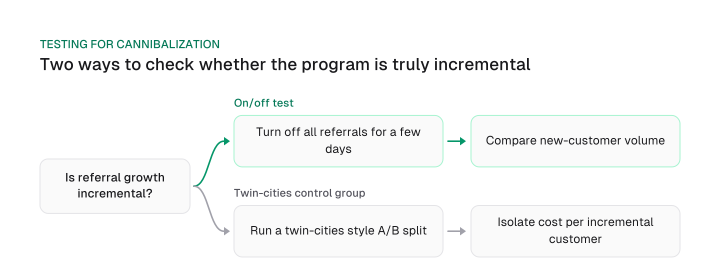
A referral program fails most often from under-promotion. A weak reward is rarely the real cause. And measuring whether it actually works means checking cannibalization: the difference between customers the program created and word-of-mouth that would have happened anyway.
Promote continuously across the channels a customer already uses: the post-purchase receipt or confirmation page, the account dashboard, and a periodic reminder email to customers who haven't referred anyone yet. A single launch email gets forgotten within a week.
Yotpo recommends a straightforward ROI formula: subtract total reward cost from total revenue from referred customers, divide by total reward cost, then compare the resulting cost per referral to your paid-channel CAC. If your team already tracks SEO ROI, this cost-per-referral number slots into the same dashboard instead of living in its own spreadsheet.
That formula alone can mislead you, because it assumes every referred customer wouldn't have shown up anyway. The fix, from andrewchen.com, is a cannibalization check: turn off all referrals for a few days and see whether new-customer volume actually drops, or run a twin-cities style control-group test to isolate the "Cost Per Incremental Customer."
A real fraud check looks for two specific signals, not a vague instruction to "monitor for suspicious activity":
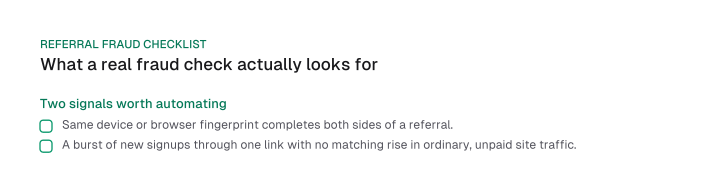
- The same device or browser fingerprint completing both sides of a referral.
- A burst of new signups through one link with no matching rise in ordinary, unpaid site traffic.
Does a referral program work for your business? Worked examples
A referral program works for almost any business model once it has paying customers to draw from, and Google Workspace's own B2B tiers show how to size it: the payout cap and the per-seat reward work out to the same 100 referred users on every plan.
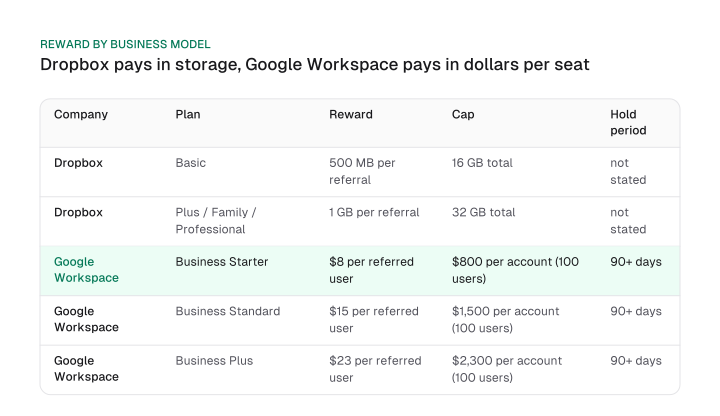
Dropbox's referral program examples pay in storage. Basic accounts earn 500 MB per successful referral, up to 16 GB total; Plus, Family and Professional accounts earn 1 GB each, up to 32 GB total. Both sides of the exchange get the same storage bonus.
Google Workspace pays in per-seat dollars instead, held until the referred account has stayed a paying customer for more than 90 days: $8 per referred user on Business Starter (capped at $800 per account), $15 on Business Standard (capped at $1,500), and $23 on Business Plus (capped at $2,300).
Divide each cap by its own per-seat rate and the same number appears at every tier: $800 ÷ $8, $1,500 ÷ $15 and $2,300 ÷ $23 all equal 100. Google Workspace's "cap" functions as a 100-referred-user limit, priced differently at each plan tier but structurally identical across all three.
Fit by business stage:
- New business: wait until you have enough paying customers to draw from. A referral program compounds existing demand; it doesn't create the first wave of it. Pair it with early startup SEO work to build that first wave organically.
- B2B: Google Workspace's own referral program targets exactly this case. The purchasing decision behind each referred account is typically made by a buying committee, not one user, so a referral program still needs to fit a b2b seo strategy built around every stakeholder in that committee, and not only the person who clicks the link.
- Subscription business: the same reward-and-refer loop that grows a subscription business organically can also make it hard to tell how much of your growth is the program versus word-of-mouth that would have happened anyway. Check your viral coefficient to see whether the program is actually growing itself or just taking credit for growth that was already happening.
A referral program is a reward sized against your CAC, timed to your return window, checked for fraud and matched to how your business already gets paid, the parts the AI Overview's bullet list leaves out. Start by picking one metric to optimize and setting your baseline before you write a single line of reward copy.
Frequently asked questions
Are referral rewards taxable, and do I need to file anything with the IRS?
Cash or gift-card rewards are miscellaneous income to the recipient and trigger a Form 1099-MISC once one person crosses $2,000 in a calendar year, for tax years beginning after 2025. Discount-based rewards that reduce a future purchase price work differently. Check with a tax advisor for your specific structure.
What's the single biggest mistake brands make with referral programs?
Under-promotion: a genuinely good program that nobody hears about after week one. Promoting it once at launch and never again is the most common way a referral program quietly dies without ever being tested properly.
What are the three types of referrals?
The three types of referral programs are friend-to-friend, affiliate and influencer, each suited to a different kind of trust relationship: a personal connection, a paid promotional relationship, or an audience relationship built on public credibility.
How long should the referral window be before a reward pays out?
Match it to your own return or refund window rather than defaulting to a flat 30 days. A 30 to 90 day hold is the common range, and paying out before a return window closes risks rewarding referrals that get reversed.
How much should I offer as a referral reward to start?
Size it against your CAC, noticeably less but still substantial, and against the unit your business already sells: storage, seats, account credit or a discount. See the worked examples above for how Dropbox and Google Workspace each made that call.
Can I run a referral program without dedicated software?
Yes, at low volume, with a spreadsheet and unique discount codes. Once volume outgrows manual tracking, software earns its cost back in fraud prevention and the time you'd otherwise spend reconciling codes by hand.
Figures and images in this post are free to reuse under CC BY 4.0 with credit to Mission Growth.
Get Mission Growth highlighted in your Google results.