
Technical GEO: What It Is and How It's Actually Different
Technical GEO isn't crawl access or schema markup rebranded. See the retrieval chunk mechanism and the policy risk most checklists skip entirely.

On this page
You've read the technical SEO checklist. Crawlers can reach your pages, JavaScript renders on the server, canonical tags line up. Then someone calls it "technical GEO" and asks what's actually different, or a vendor pitches it as a separate discipline you now need to buy.
It isn't a separate discipline. This geo implementation guide covers the two things a technical SEO checklist doesn't already handle: chunk sizing and structured data accuracy. That's the technical SEO vs GEO question that actually matters, and it's narrower than most AI crawler alignment advice makes it sound.
What technical GEO means: the retrieval chunk problem
Technical GEO is the layer deciding whether a single retrieval chunk of your page, not the whole page, still carries a complete, correctly labeled answer.
In this guide:
- How Google's disclosed chunking mechanism splits your page, and where headings get lost
- Why mismatched structured data runs into a named Google policy, with its own enforcement path
If you're still asking what generative engine optimization is or want it laid out activity by activity against classic SEO, start with geo vs seo, activity by activity instead. This post assumes you already know the difference and picks up where those posts stop.
It also assumes the fundamentals are already settled: crawler access, JavaScript rendering and llms.txt. If you haven't confirmed those yet, run through the AI SEO optimization checklist or follow the steps in how to optimize for AI search engines first, then come back.
Canonical tags, sitemaps and Open Graph alignment matter too, but that's the technical SEO checklist's job. Rendering, the reason a React single-page app can disappear from AI answers entirely, is covered in our LLM optimization guide's rendering section. Neither repeats here.
Once those are handled, two things are left that a technical SEO checklist doesn't already cover: whether a single retrieval chunk still carries a complete answer, and whether your structured data survives a policy review. The second gets its own section below. Here's the first.
The chunk size Google discloses
Google's Agent Search product (formerly Vertex AI Search) is the clearest disclosed example of how a real retrieval pipeline chunks a page for AI search.
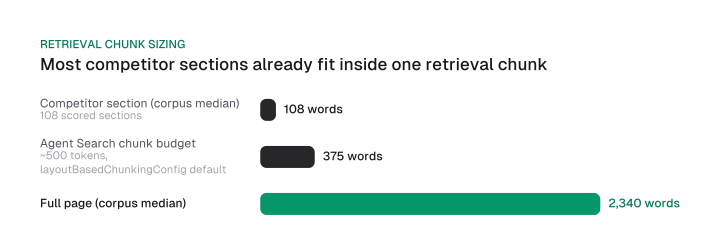
Its default is public: chunks of around 500 tokens, roughly 375 words, with a supported range of 100 to 500 tokens.
Treat this as a disclosed example rather than a confirmed description of how every AI engine chunks this specific page. It's Google's own retrieval product, the clearest one publicly documented.
The setting that matters more than length is includeAncestorHeadings. It defaults to off, so a chunk doesn't automatically carry its own heading or the page title with it.
Google's own documentation names the risk directly: appending title and headings to a chunk "can help prevent context loss in chunk retrieval and ranking." That inheritance only happens once you turn the setting on yourself.
At this corpus's median page length of 2,340 words, a page needs roughly six of those chunks end to end. The math: 2,340 words divided by a 375-word chunk budget comes out to about 6.24. So most of a page's words never share a chunk with its own opening claim.
Why length usually isn't the problem
Across 108 scored sections from the competitor pages behind this guide, the median section ran 108 words.
Only 3.7% topped 375 words: most sections already fit inside one chunk on their own.
The risk chunking creates is different from a length problem. A short, clearly headed section can still arrive at its chunk with no heading attached at all, because that heading inheritance is something you have to turn on yourself.
| Unit | Median length | Fits Agent Search's default chunk? |
|---|---|---|
| Competitor section | 108 words | Yes, with room to spare |
| Agent Search chunk budget | ~375 words | The line itself |
| Full page | 2,340 words | No, needs ~6 chunks |
For example, take a section that states its claim early, spends roughly two-thirds of its length on supporting detail, and only adds the caveat that qualifies the claim in the closing lines, well past the 375-word chunk boundary.
The claim and its limit land in separate chunks. A retrieval system that grabs only one can return the claim without the caveat that was supposed to travel with it.
The fix is reordering the section, not padding it down: move the caveat up to sit right after the claim, inside the same 375-word budget, in one chunk, together.
Structured data has to say what the page says
Structured data that describes something the visible page doesn't back up runs into Google's structured data spam policy: it's a named violation with its own enforcement path.
Google's guidelines say it plainly: don't mark up content that isn't visible to readers of the page. When markup and page content disagree, the enforcement is a manual action.
Google is specific about what that action does:
- Loses eligibility for appearance as a rich result
- Leaves normal search ranking untouched
The penalty is losing the rich snippet while your position in search holds steady, which makes the problem easy to miss until someone checks for it.
This is the one narrow slice of "does your structured data hold up" that belongs in a technical GEO post: does the markup match what a visitor actually sees on the page, not which schema types to add or how to implement them. That's covered separately in our schema-for-ai-search guide.
Signal alignment more broadly, canonical tags, sitemaps and Open Graph tags agreeing with each other, is a different question with a different fix. It's already covered in the canonical and sitemap alignment section of our technical SEO checklist.
Frequently asked questions
JavaScript-only content that never reaches the rendered HTML. Most AI crawlers don't execute JavaScript, so content injected client-side never reaches them at all rather than merely ranking lower. It's a rendering problem before it's a technical GEO problem: chunk sizing and structured data accuracy don't matter for content the crawler never sees.
Eligibility checks are fast. Whether a page renders without JavaScript or its markup validates, you can confirm today. Whether an AI answer actually changes is different: it follows the engine's own retrieval and refresh cycle, not a request you can make, so there's no fixed timeline worth quoting.
Yes, in two specific ways once crawl access and canonical hygiene are solved: whether a single retrieval chunk of your page still carries a complete, correctly labeled answer, and whether your structured data is accurate enough that Google won't treat it as a policy violation.
No. Schema is one narrow piece of it, and even that piece isn't about which type to add, it's about whether the markup matches what's actually on the page. Mismatched or hidden structured data risks a manual action that costs you rich results.
Once crawl access and schema markup are handled, technical GEO comes down to two things: whether one retrieval chunk of your page carries a complete answer on its own, and whether your structured data is accurate enough to survive a manual review. Check your longest sections against a 375-word budget first, caveat placement included, then run your structured data against what the page actually shows.
Figures and images in this post are free to reuse under CC BY 4.0 with credit to Mission Growth.
Get Mission Growth highlighted in your Google results.