
LLM Seeding Strategy: Where to Seed for Each AI Engine
LLM seeding is placing your brand on pages AI engines cite. See where to seed for ChatGPT, AI Overviews and AI Mode, and how to test it with data.


On this page
LLM seeding is placing your brand on third-party pages that AI engines retrieve and cite, so the answer to "which tool should I buy?" names you. The catch is that each engine reads a different slice of the web.
Advice such as "post on Reddit, Quora and listicles" treats ChatGPT, Google AI Overviews and Google AI Mode as one audience. They aren't, and the measured gaps between them are large.
A single AI answer proves nothing about whether a placement worked, because the cited pages change even when you ask the same question twice. So an LLM seeding strategy has two halves: decide where to seed content for LLM answers per engine, then judge the placements over repeated runs. How to measure LLM visibility with labels and a worked prompt panel is covered separately.
In this guide:
- What seeding is, and what two training-data figures get wrong
- Which index ChatGPT reads in each mode
- Where to seed per engine, with measured shares
- A thread rule for Reddit
- A seed-target sheet you can fill in from your own prompts
- Where seeding becomes unlawful or risky
- A noise floor for judging whether it worked
What LLM seeding is (and what it is not)
LLM seeding is placing your brand, with accurate and consistent information, on pages that a model trains on, a search index retrieves or a live fetch reads. Those are three separate routes, and seeding can change each one differently.
- Training: a placement can only matter at the next training run, and you can't observe or schedule it.
- Search index: a placement matters when the engine retrieves the page for a question, which you can test today.
- Live fetch: the engine opens a page during the answer, so the page's title, address and opening lines decide what it takes.
For most brands the second and third routes are the ones you can act on and check. That is why the rest of this guide is about retrieval and citation. If you want the umbrella view of optimizing for AI answers, the generative engine optimization guide covers it, and the measurement side of seeing where you appear sits in our LLM visibility guide.
Two terms get confused with it. Content seeding is an older marketing term for sending a product or a story to influencers and publishers so that it spreads. The "seed parameter" is an unrelated model setting for reproducible outputs (more in the FAQ).
What the training-mix figures actually say
Two figures circulate in seeding advice: that Reddit made up 22% of what GPT-3 trained on, and that Wikipedia alone was about 22% of major AI training data. The primary table says otherwise.
In the GPT-3 paper's training mix, Wikipedia carried a 3% weight (3 billion tokens). The 22% belongs to the WebText2 dataset (19 billion tokens), a different row.
WebText2 is not a copy of Reddit. OpenAI's GPT-2 model card describes WebText as data derived from outbound links from Reddit, and says it does not consist of data taken directly from the forum. The corpus is the set of pages linked from Reddit.
This is 2020-era evidence, so treat it for what it is. It shows that a page earning links on a heavily linked platform once counted for a lot, and that Wikipedia was a small slice. It does not tell you what any current model weights. Don't build a plan on it.
How LLM seeding reaches an answer in each ChatGPT mode
Which index ChatGPT reads depends on the mode, so seeding for ChatGPT means being present in more than one index. A single Google check will mislead you.
Resoneo's 2026 retrieval study measured this in two steps. In July 2026, on a free account in instant mode, it read the source of results from snippet length across 424 answers. In August 2026, it compared free Think with paid thinking. The Think attributions are inferred from response shape, because the study's labelled field was no longer available.
The shares by mode:
Download CSV (CC BY 4.0)
Instant mode on a free account answered stable information, business and product questions almost entirely from OpenAI's own index, with news split between that index and Google. Free Think drew about three quarters of its results from the same index. Paid thinking still took 75% of its URLs from scraped Google results.

Rules like this age. Seer Interactive's February 2025 check of about 100 questions found 87% of ChatGPT search citations matched Bing's top 20 results, against 56% for Google. That was the picture then. Resoneo's numbers come from a setup that moved between July and August, so state the month beside any of these figures and re-check before you rely on one.
What this means for you:
- Don't read one SERP. A page ranking on Google can help in paid thinking, where 75% of URLs came from scraped Google results, but instant mode mostly draws on a different index.
- Check the mode your buyers use. Resoneo found that the path taken, instant, free Think or paid thinking, decides which engine supplies results far more than the subscription does.
- Put the brand and category in the title and first lines. ChatGPT takes a title, an address and roughly 200 characters of a result, and works from that. An off-site page that mentions you in paragraph nine may never show you in those 200 characters.
For the on-page side of that, the guide to get cited by ChatGPT covers titles, addresses and quotable passages. One crawler note: OpenAI documents that you can allow OAI-SearchBot to appear in search while disallowing GPTBot for training, so the two settings are independent.
Where to seed: sources by engine and industry
Company websites took 67% of citations in one 78 business sample, so seeding competes for the other third, and that third differs by engine and vertical.
The data is one agency sample: 193,507 answers from ChatGPT, Google AI Mode and Google AI Overviews, collected weekly from 27 August to 21 October 2026 by TJ Digital for its clients. Treat the shares as that sample's, and expect them to move with the industry.
Company websites, including competitors' sites, ranged from 52% of citations for consumer products and e-commerce to 87% for B2B industrial and distribution companies. If you sell industrial goods, third parties get a thin slice. If you sell consumer products, they get nearly half.
The engine split is where the plan changes:

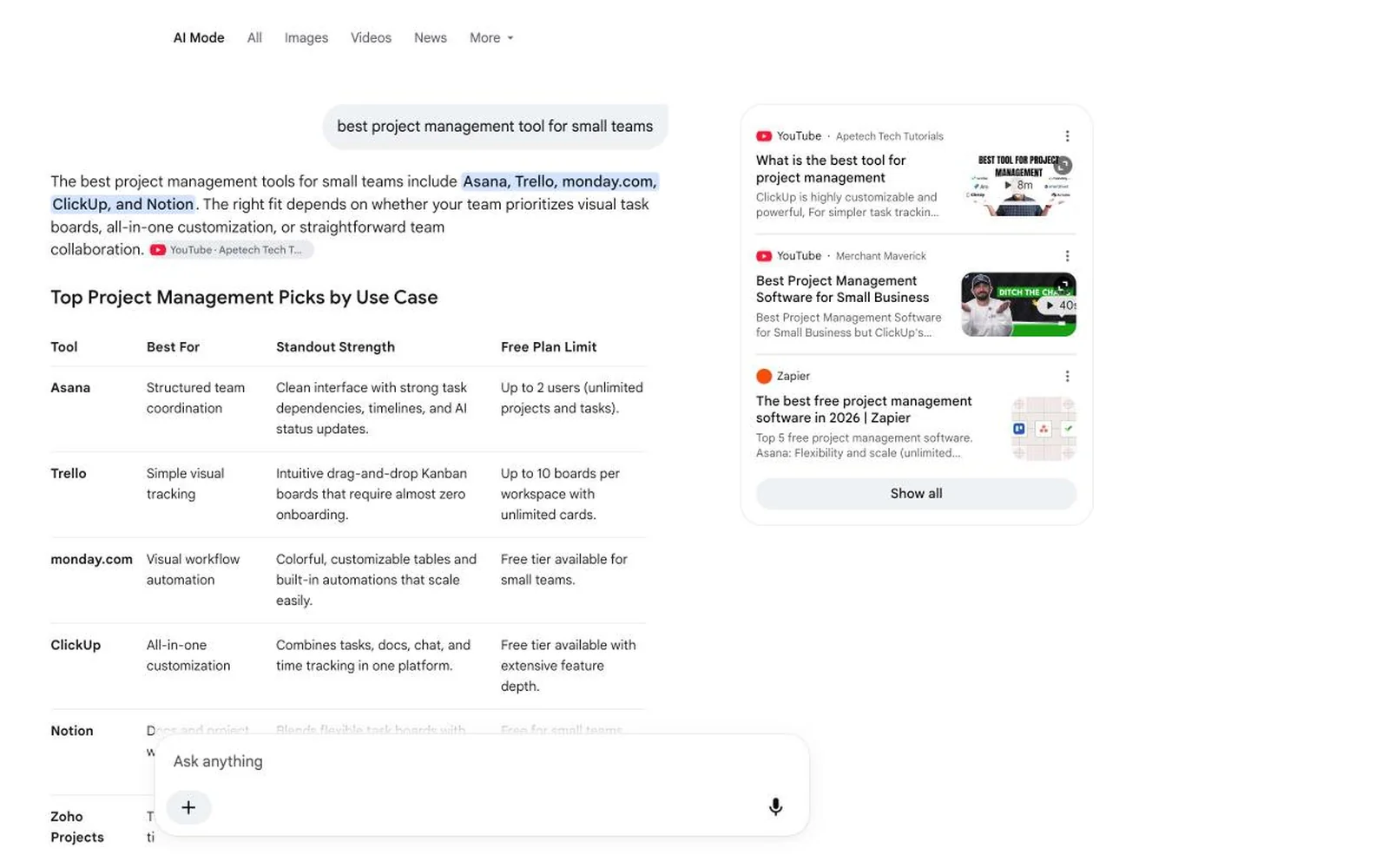
Reddit appeared in 16% of AI Overview answers, 7% of AI Mode answers and 1% of ChatGPT answers. YouTube appeared in 23% of AI Overview answers, 9% of AI Mode answers and almost none of ChatGPT's. So video and forum seeding mostly serve Google's engines in this sample.
ChatGPT leans the other way: government, university and nonprofit sites took 17% of its citations, against 7% in AI Overviews. And for review profiles, Quora, LinkedIn and GitHub, the study gives no per-engine share, so we make no claim about their weight; it says only that ChatGPT cites profile pages more than Google's AI does, without defining them as review sites. Check them against your own prompts.
What a distributed footprint can and can't do
Mentions of a brand across the web do track AI visibility. Ahrefs' 2025 study of 75,000 brands found brand web mentions correlate at 0.664 with brand visibility in AI Overviews, against 0.218 for backlinks. Ahrefs labels this correlation, not causation: brands that get mentioned a lot are probably also the ones that are known.
A distributed footprint only pays where the engine cites third parties at all. Citations are concentrated: the top 10% of domains took 81% of citations in the TJ Digital sample, yet 55% of cited URLs were cited only once. A few large domains repeat, and a long tail of one-off pages does not. Which is why the next two sections choose targets by how often a page recurs.
LLM seeding on Reddit: join threads that are already cited
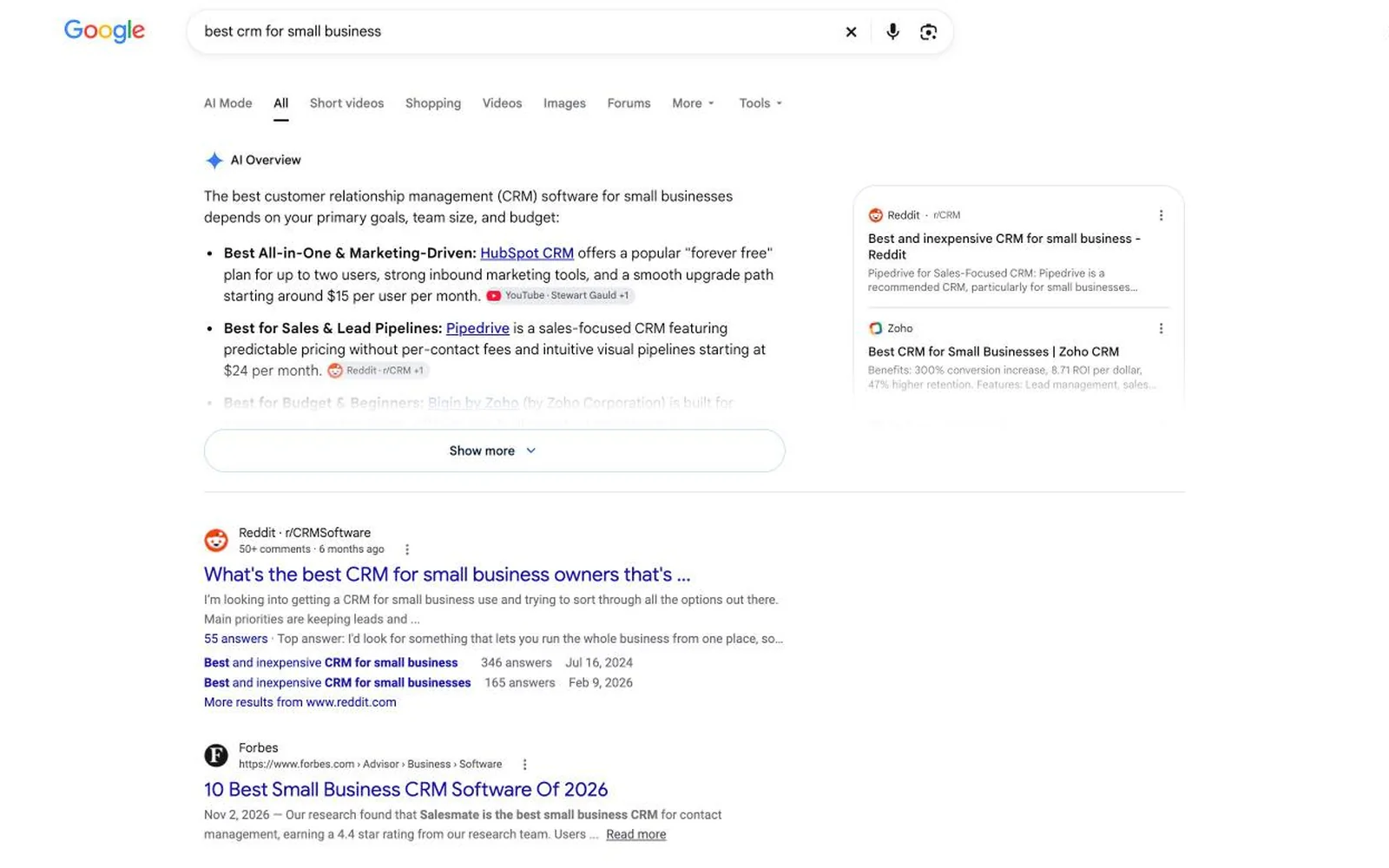
For LLM seeding Reddit threads are worth a look only once an AI engine has cited them. A thread that an AI engine has already cited for a question was cited for the same question again the next week 47-50% of the time in one sample, about twice the rate for pages in general. So threads your own prompts already cite are where to look first.
Here is what the TJ Digital sample measured about threads:
- Repeat rate: 47-50% for a cited thread, the next week, same question.
- Persistence: about 4 in 10 cited threads were cited in more than one week, and those took about three quarters of all Reddit citations.
- Typical thread: 6 upvotes, 18 comments, and about half were more than two years old.
- Engine: Reddit shows in 1% of ChatGPT answers against 16% of AI Overview answers, so this is mainly a Google engine finding.
Two things are not measured. We found no published comparison of cited threads with uncited ones, so there's no basis to say size or popularity matters either way. And whether a comment you add to a cited thread is itself retrieved or quoted is unknown.
Our advice: if you contribute to a thread, answer the thread's actual question with a disclosed affiliation, only where you can add a specific true answer. Then re-check the thread against your prompts after several weeks. No effect size backs this. It rests on one thread level figure and on common sense about being useful.
Use this to pick threads:
- Run your buying prompts on AI Overviews and AI Mode and list every Reddit thread they cite.
- Keep the threads cited for more than one prompt or more than one week.
- Read each thread's question. Skip any where you can't give a specific, true answer.
- Contribute with your affiliation stated, then re-run the prompts for several weeks.
This is a rule for Google's engines first. If your buyers ask ChatGPT, 1% of answers is a thin reason to spend a week in forums.
LLM seeding strategy: build a seed-target sheet from your own prompts
A seed-target sheet lists every URL your buying prompts cite, tags it, and ranks it by how many prompts and engines it recurs in. It turns "post everywhere" into an ordered list of pages that already get cited.

Citation reading is a common first step, and several vendors sell it. The sheet adds a ranking rule. Here is how to get started with LLM seeding in five steps:
- Write the prompts a buyer would ask, in their words, and run each on the engines and ChatGPT modes you care about.
- Log every cited URL against its prompt and engine.
- Tag each URL by source type: own site, listicle, forum, review profile, reference or video.
- Mark whether the page names you, yes or no.
- Count how often each URL recurs across prompts and engines.
The rule: seed first the URLs with the highest recurrence that do not name you. Own site rows are fixes you make on your pages. An example with illustrative rows and no real brands:
Priority order from this sheet: roundup A first, because it recurs across prompts and engines and doesn't name you. Review profile C second. Forum thread B third. The pricing page isn't a seed, it's a page you already control.
Which listicles are worth seeding
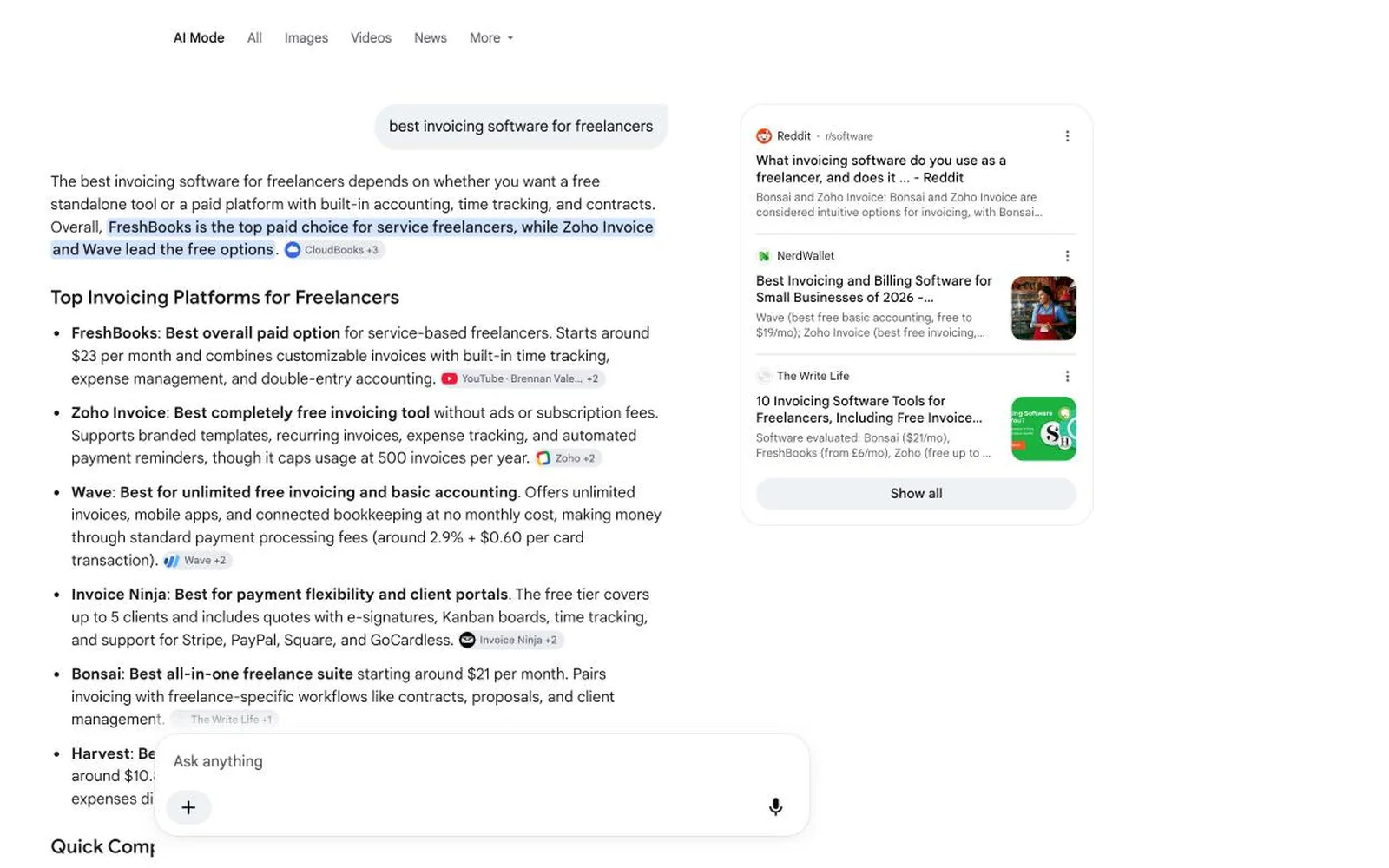
Seed a best-of article only if your own prompts already cite it. In the TJ Digital sample, comparison pages and "alternatives to" pages were rare, at 2.5% and 0.2% of citations. So a listicle placement is not a default move. Seed the listicles your prompts cite, because that is the evidence the page is retrieved for your questions.
Once the sheet names a roundup, the outreach craft is a digital PR job. Scoring which gaps matter and proving a fix worked is covered in the AI citation gap analysis guide.
What to supply to a placement
A placement can only quote what you give it, and this part is our judgment and no effect was measured. Keep a fact sheet and copy it word for word everywhere:
- Name and category sentence: one sentence that says what you are, in the form buyers search.
- Pricing form: how you charge, in the same words each time.
- Founding and size facts: only the ones you can verify.
- Differentiators: two or three, stated plainly.
- One original figure: a number from your own data that a roundup or thread can quote.
Then run the 200 characters test: read the first 200 characters of each placement and check that the brand and category appear in them. Inconsistent descriptions across a directory, a profile and a review site give a model three versions to pick between.
Where seeding crosses the line
Fake reviews and placements that hide your affiliation carry two risks: the FTC's consumer reviews rule, and retrieval poisoning, which one preprint demonstrates on research agents.
The legal line is clear for reviews. The FTC's final rule on consumer reviews and testimonials prohibits selling or buying fake consumer reviews, buying positive or negative reviews, and certain insiders writing reviews without clearly disclosing their relationship. It covers consumer reviews and testimonials, so don't stretch it to every forum comment, but fake consumer reviews are off the table in any engine.
The second risk is technical. A Cornell Tech preprint on retrieval poisoning tested deep research agents (STORM, Co-STORM and OmniThink), and it never tested ChatGPT.
Its finding: as few as 13 words added to one URL could get the added content retrieved in 57-76% of agent runs on a topic and cited in 38-51% of the generated reports. Each figure comes from a single poisoned page.
The defences have costs. Dropping user generated content from retrieval blocks the attack but degrades the quality of the reports. Lightweight anomaly detection on inputs and outputs did not reliably identify poisoned content.
Two consequences follow. First, forums are costly for an engine to filter out, since dropping user generated content cost report quality in that study. Second, a manufactured consensus is a poor bet: a placement that only works while its origin stays hidden fails the moment anyone looks.
So the safe line is the one we used in the Reddit section: add a specific, true answer with your affiliation stated. If a placement only works while its origin stays hidden, treat it as a poisoned page waiting to be found.
How to tell LLM seeding worked
Judge a placement by citation share across repeated runs over several weeks, against prompts you did not seed, never by one answer. The citations themselves are unstable.
In the TJ Digital sample, asking the same question twice on the same day repeated only 23-25% of the cited pages. A week later, 24-28% of the cited pages were cited again. After seven weeks, it was 11-16%. Each range runs from the lowest to the highest of three engines.

The same-day and one-week ranges overlap, meeting at 24-25%. We got that by intersecting the two ranges, so it is a comparison of ranges and not a ratio for any one engine. The seven-week range, 11-16%, sits below both with no overlap.
What it means: a page appearing in an answer a week after you seeded it tells you little, because asking the same question twice on the same day already gives you a different set. Only a pattern over repeated runs can show a change.
The rule list:
- Run each prompt several times per engine and mode, on the same day, to see the noise.
- Keep control prompts you did not seed, so a general shift in citations doesn't pass as your win.
- Compare weeks, not answers. Track the share of runs that cite or name you.
- Wait past the first week. The seven-week drop says old citations decay, so a result you measure early may not last.
The programme and metrics side belongs to our LLM visibility guide, and tracking tools are covered in how to track ChatGPT mentions. Mission Growth's platform tracks AI citations and visibility for customers.
If you do one thing this week, build the sheet from your buying prompts, pick the one URL that recurs most without naming you, and set a calendar check for seven weeks out. Seeding is placing your brand where each engine already looks, and checking it enough times to trust what you see.
Frequently asked questions
Is an LLM seed parameter the same as LLM seeding?
No. The seed parameter is a model setting. OpenAI added it so developers can request (mostly) consistent outputs across repeated calls, which makes results reproducible outputs for testing. It has nothing to do with placing a brand on third-party pages.
What does content seeding mean?
Content seeding is a marketing term for getting a piece of content or a product in front of influencers, publishers or communities so it spreads. LLM seeding borrows the word but targets the pages AI engines retrieve and cite, so the audience is a retrieval system as well as people.
How long does LLM seeding take to show up?
Retrieval can pick up a page quickly, but you can't judge a result quickly. Citations repeat only 23-25% of the time when you ask the same question twice on one day, and 11-16% after seven weeks. Training effects arrive only at a model's next training run, which you can't schedule.
Is Reddit worth it for ChatGPT?
Mostly not. Reddit appeared in 1% of ChatGPT answers against 16% of AI Overview answers in one agency sample. If your buyers use Google's engines, threads already cited for your prompts are worth a look. For ChatGPT, check which mode they use first.
Is LLM seeding legal?
Real, disclosed contributions sit on the safe side of the FTC's rule on consumer reviews and testimonials, which prohibits buying or selling fake consumer reviews and writing reviews as an insider without disclosing it. The rule covers reviews and testimonials, so check the rules of each platform too.
Does LLM seeding replace SEO?
No. Company websites took 67% of citations in the TJ Digital sample, so your own pages still do most of the work. Seeding adds third party placements to a base that search already builds. For the wider question, see whether will AI replace SEO holds up.
Cite this page
Aktaş, F. (2026, November 23). LLM Seeding Strategy: Where to Seed for Each AI Engine. Mission Growth. https://missiongrowth.io/blog/llm-seeding
Download the data: 2 tables as CSV (CC BY 4.0)
Figures we made for this post are free to reuse under CC BY 4.0 with credit to Mission Growth.