Tools for GEO, Sorted by Category and Budget (2026)
Tools for GEO, sorted by category: a buyer's checklist, real cost bands, free checkers worth trying, and 7 mistakes that waste the budget.

On this page
Tools for GEO are easy to find and hard to choose between, because the rubric that sorts them usually belongs to whoever is selling. This page hands you the checklist to run on any vendor instead, names the buying risk that decides whether you can walk away from a tool later, prices the category in real bands, and settles whether a free GEO tool is worth trying.
Trackers built around one engine, and roundups that already rank named vendors, live elsewhere on this site.
This guide sorts the category itself: what to check, what it costs, which free options to run first, and the budget mistakes to avoid before any demo.
In this guide:
- What a GEO tool actually tracks, and the mechanism behind why it has to watch a set of prompts
- A buyer's checklist to run before any vendor demo
- Real cost bands, not a single vendor's price
- Free GEO tools and geo audit tools worth trying first
- The mistakes that waste a GEO tool budget
What is a GEO tool, and what does it actually track?
A GEO tool tracks whether AI engines mention or cite your brand across a set of prompts, then, in the better ones, helps your team close the gaps it finds.
Vendors market these as tools for geo engines, AEO software, or AI visibility trackers almost interchangeably. The terminology fight matters less here than picking the right category; for the full distinction, read generative engine optimization vs SEO before you shop.
Two measurements get bundled under "AI visibility," and they aren't the same thing:
- Mention: your brand's name appearing anywhere in an AI answer.
- Citation: a link or explicit reference back to your page.
Some vendors brand themselves as a geo optimization tool, others as a geo analysis tool. The label rarely tells you which of the two a dashboard actually reports.
A tool that only tracks mentions can make a brand look far more visible than it is to a reader who never gets a link to click.
A related category, prompt and keyword research tools, does something different. Instead of tracking your current visibility, it maps which prompts your buyers actually type into ChatGPT or Gemini before you've built content for them. Treat it as input to your content plan; the tracking above is a separate job.
Google's own documentation explains why a GEO tool must watch a whole set of prompts. Its Search Central page "AI features and your website," updated in December 2025, describes query fan-out: multiple related searches run across subtopics and data sources before one answer gets synthesized.
A single prompt about your product can trigger a dozen underlying searches, each pulling from a different page. A tool checking one exact phrase misses most of what actually shaped the answer.
The GEO tool buyer's checklist: what to check before anyone gets a demo
A GEO tool buyer's checklist checks whether a platform turns a citation gap into a fix, shares one contract with SEO, and lets your data leave if it's acquired or shut down.
Run through these before you sit through a single demo:
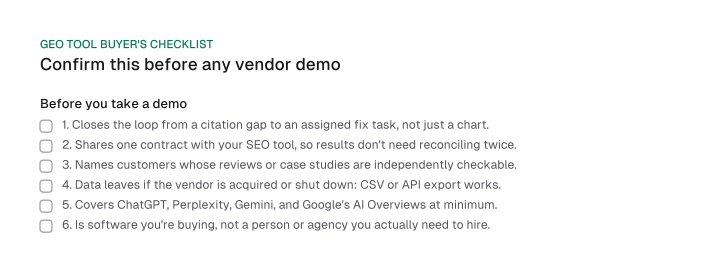
- Closes the loop, or just reports the gap? Some dashboards stop at "you're not mentioned for this prompt." The better ones turn that gap into an assigned fix task instead of a red number on a chart.
- Shares one contract with SEO, or needs a second? A tool that treats AI visibility and organic rankings as separate systems adds a second contract to reconcile every time a page changes. One that shares definitions with your SEO tool skips that reconciliation.
- Are its named customers independently checkable? A logo wall proves nothing. Look for a customer quote or case study you can verify outside the vendor's own site; paraphrased praise you can't trace doesn't count.
- Can your data leave if the vendor is acquired or shut down? Vendor pages list CSV or API export as a feature convenience. Nobody frames it as protection against the vendor disappearing, which is the one buying risk missing from every page in this category. Confirm export works before you sign; checking after a shutdown notice is too late.
- Which engines does it actually cover? At minimum, a GEO tool should cover ChatGPT, Perplexity, Gemini, and Google's AI Overviews. Higher tiers extend coverage further, and a tool tracking only one engine can't tell you what's happening on the rest.
- Is it software, or does it need a person running it? A checklist can only evaluate features. If you're also deciding between hiring an agency and buying software, that decision belongs in ai seo agency vs. software.
The same checklist produces two different starting points depending on who's running it:
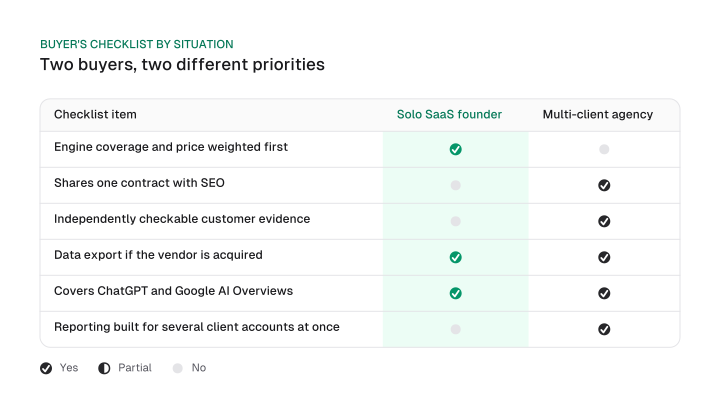
A solo SaaS founder with no dedicated SEO hire should weight engine coverage and price first. A tool covering ChatGPT and Google AI Overviews for around $59 a month beats an enterprise tier used at a fraction of its capacity.
A multi-client agency should weight the shared-contract question and independently checkable customer evidence first. Reconciling several clients' AI visibility against separate SEO tools multiplies the exact work this checklist exists to avoid.
Once you know what to look for, hand the actual vendor comparison over to best AI SEO tools or the llm seo tools roundup instead of scoring vendors yourself.
How much do GEO tools cost? Category bands, not vendor prices
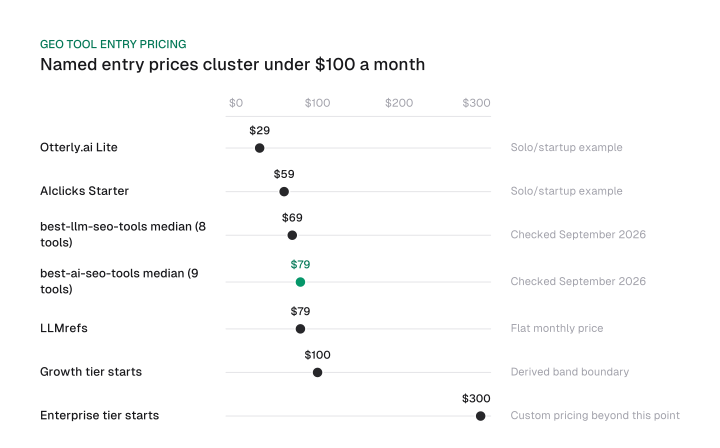
GEO tool entry pricing clusters into three bands: under $100 a month for solo and startup tiers, roughly $100 to $300 a month for growth tiers, and $300-plus or custom for enterprise tiers.
| Band | Price range | Fits | Named example |
|---|---|---|---|
| Solo/startup | Under $100/month | Founders and small teams testing GEO for the first time | Otterly.ai Lite, $29/month |
| Growth | Roughly $100-300/month | Teams tracking several products or engines at once | No example named here; this is the gap between where solo pricing tops out and enterprise quoting starts |
| Enterprise | $300-plus/month or custom | Agencies and large brands needing multi-brand or white-label coverage | Profound's Enterprise tier |
Prices checked in September 2026.
These bands come from cross-referencing two of Mission Growth's own tool roundups. Its best AI SEO tools post puts its median entry price at $79 a month across nine tools with published pricing, and its llm seo software post puts its own median at $69 a month across eight.
Neither post bands the two together. Averaging and rounding their named examples against each other is how the three ranges above were set.
Treat any single vendor's number as a snapshot. One vendor in this category, Searchable, had its own $50-a-month Starter tier, visible in December 2025, gone by May 2026. Five months is not a long shelf life for a price you'd budget around, so check a vendor's current page before you commit to a number from any post, including this one.
Free tools for GEO worth trying before you pay for anything
Free tools for GEO exist for a spot check or a light standing monitor. Continuous multi-engine tracking still needs a paid tier, and the category's own contradiction on this question is the proof.
Writesonic's own roundup calls free GEO tools "not for serious use" and sets $50 a month as the real entry point.
Three tools, verified on their own pricing pages in September 2026, contradict that framing outright:
- Mangools AI Search Watcher is free to start, no credit card required, and its free tier tracks eight engines: ChatGPT, Gemini, Claude, Grok, Mistral, Llama, and both of Google's AI Overviews and AI Mode.
- HubSpot's AEO Grader works as a free geo audit tool for a single diagnostic, not continuous monitoring; it covers ChatGPT, Perplexity, and Gemini and is the thing to run first, before you pay for anything.
- Botric's free plan is an always-on entry tier, not a time-limited trial, per its own pricing page FAQ: five prompts, one site audit, no credit card, and it runs indefinitely.
Run the one-time grader first to see where you stand today. Leave a standing monitor running once you actually need the trend line, rather than a single snapshot.
One GEO roundup in this category calls free tools "not for serious use." Mangools, HubSpot, and Botric are free right now and verified as described above, checked September 2026. That blanket framing doesn't hold.
These three are proof against a blanket claim, not a full roundup of every free AEO checker on the market.
We built and ship free tools too: an llms.txt checker, a tracker audit, an SEO ROI calculator, and an LTV:CAC calculator, worth adding to this shortlist. If you're not sure the llms.txt file matters yet, is llms.txt worth it walks through what the checker actually catches.
7 mistakes that waste a GEO tool budget
Most wasted GEO tool budget traces back to one of a handful of repeatable mistakes, starting with mistaking an SEO suite's bolted-on AI add-on for a real GEO tool.
- Mistaking an SEO suite's AI add-on for a GEO tool. A classic rank tracker's new "AI visibility" tab often samples a handful of prompts once a month. That's not the same product as a dedicated tool built to watch a full prompt set continuously.
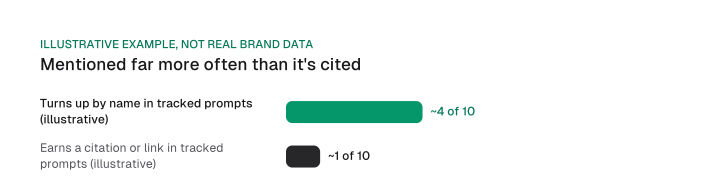
- Treating "mentioned" and "cited" as the same number. Say a brand turns up by name in roughly four out of every ten tracked prompts, illustrative figures, but earns an actual citation or link in barely one of them, the gap the chart below makes concrete. A dashboard that only reports the mention rate makes visibility look far better than the number that would actually send a reader to the site.
- Running one-off prompts instead of a fixed panel. Checking a handful of different prompts each month produces no trend line, only noise, since AI answers vary run to run even for the same prompt.
- Buying a bigger tier than the question in front of you needs. An enterprise tier bought to answer a question a free grader could have answered is budget spent on capacity nobody uses.
- Signing up before checking which engines it actually covers. A tool that only tracks ChatGPT tells you nothing about Google AI Overviews, and the gap doesn't show up until after the invoice.
- Expecting the tool to replace the trust reviews carry. A GEO tool surfaces review content as one signal among several. It doesn't create the independent trust a real customer review carries on its own, so a review-generation program still has to run alongside it.
- Canceling before a fix has had time to get recrawled. A fix to a citation gap doesn't move the numbers until the underlying page gets recrawled, which can take weeks. Judging the tool a failure inside the first month usually means judging it too early.
For the method of tracking those mentions day to day, see track brand mentions in AI search.
How long before a GEO tool shows results?
A GEO tool's dashboard populates within days of connecting it, but a fix to a citation gap only shows up in those numbers once Google or another engine has recrawled and reprocessed the page, which Google states can take anywhere from several days to several months.
Google's own "AI features and your website" documentation states that crawling "can take anywhere from several days to several months, depending on how often our systems determine a page needs to be refreshed." Fixing a citation gap on a page doesn't change anything in an AI answer until that recrawl happens.
Two separate clocks run here. The tool's dashboard clock starts the day you connect it, so expect real numbers within a week.
The recrawl clock starts the day you publish a fix. It can run for months, depending on how often the underlying engine decides that page needs another look.
If nothing has moved three weeks after a fix, the tool probably isn't broken. The second clock probably hasn't finished.
Once the tool is live and both clocks are running, measure AI search traffic covers the rest of the tracking stack you'll want alongside it.
The fastest way to waste a GEO tool budget is buying before you know what you're checking for. Run the checklist above before any demo, pick the cost band your team actually needs, try the free tools first, and the first few months go toward building visibility instead of arguing with a vendor about it.
Frequently asked questions
Only as portable as the CSV or API export you confirmed before signing. This market moves fast enough for it to matter: Searchable's own $50-a-month Starter tier, visible in December 2025, was gone by May 2026. Confirm export access works before you sign; checking after a shutdown notice is too late.
No. A GEO tool surfaces review content as one signal among several; it doesn't create the independent trust a real customer review carries on its own. Keep running a review-generation program regardless of what the dashboard shows.
That's a different question. Search Console reports clicks and impressions from Google Search, so it structurally can't show an AI citation that never produced a click. See your SEO dashboard won't show an AI citation for why that gap exists.
Perplexity, Gemini, ChatGPT, and Google's AI Overviews make up the core four for 2026. Higher tiers extend coverage further. Confirm coverage before you sign, since a tool tracking one engine can't tell you what's happening on the rest.
Yes. Free options and tools priced under $100 a month exist specifically for this: Mangools, HubSpot, and Botric all offer a free option, and Otterly.ai Lite starts at $29 a month. Enterprise pricing only applies once you need multi-brand or agency-scale coverage.
Figures and images in this post are free to reuse under CC BY 4.0 with credit to Mission Growth.
Get Mission Growth highlighted in your Google results.