
GEO Roadmap: Your 90-Day Generative Engine Optimization Plan
A 90-day GEO roadmap sequenced by what actually gates AI citations, not by habit: a week-by-week calendar with a checkpoint before each phase.

On this page
Most GEO roadmaps read like a checklist with dates stapled on: fix crawler access, add schema, write better content, track results, repeat. Ordering by habit costs real weeks, because clearing every task on that list still doesn't guarantee a citation.
Of the URLs ChatGPT retrieves, Ahrefs found only 49.98% get cited and 50.02% do not, across 1.4 million prompts. Retrieval is only the midpoint of a longer pipeline.
Where a task sits in that pipeline, not how urgent it looks, decides which week it belongs in. GEO vs SEO covers whether GEO is worth doing at all; this roadmap assumes the answer is yes and gives the full sequence.
The roadmap goes by several names, depending on which part of the work a team is searching for first:
- GEO roadmap
- Generative engine optimization roadmap
- Geo implementation roadmap
- Geo strategy roadmap
- Geo audit roadmap
Same sequence of gates, regardless of the label.
What a 90-day GEO roadmap actually needs to sequence
A 90-day GEO roadmap works when its tasks are ordered by which stage of the AI-answer pipeline they affect, a different cut than the generic foundation-content-authority label most roadmaps default to.
Martinez 2026's pipeline survey describes generative engine optimization as a multi-stage, partially observable process: search activation, crawling and indexing, retrieval, reranking and context allocation, and citation. A brand only surfaces once it clears every stage in order.
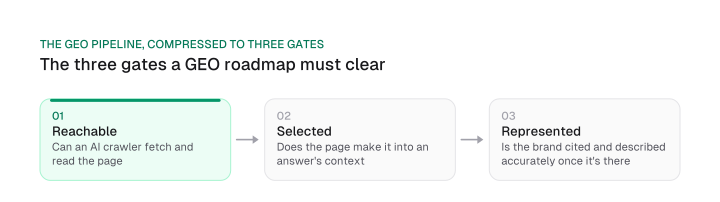
The roadmap compresses that longer chain into three checkpoints built for a calendar: reachable (can an AI crawler fetch and read the page), selected (does the page make it into an answer's context), and represented (is the brand cited and described accurately once it's there).
Reachable, selected and represented are the roadmap's own working names for Martinez's stages, not the paper's terminology or an established industry term. They exist because a calendar needs a workable three gates to build around, a compressed slice of Martinez's longer list.
In this guide:
- Why schema markup and llms.txt land later than habit suggests, not in week one
- The gate-priority matrix that turns an audit finding into a specific week
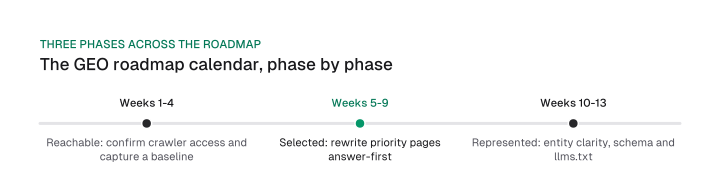
- What weeks 1-4, 5-9 and 10-13 each actually contain
- The checkpoint that tells you when to move on, instead of a fixed date
A fix aimed at a downstream gate does nothing while an upstream gate stays shut: content tuned for citation can't help a page AI crawlers never fetch in the first place.
That dependency order isn't new to this site. AI SEO checklist already states it as the reasoning behind its own pass/fail checklist, phase by phase, with no dates attached.
What this roadmap adds is a calendar: which week each gate gets worked, how many weeks it gets, and a checkpoint for knowing you're actually clear to move on rather than out of days. Generative engine optimization covers the full concept if any of this needs unpacking first.
Why schema and llms.txt don't belong in week one
Schema markup and llms.txt are not access blockers. The matched study on schema shows no meaningful citation lift, and the log measurement on llms.txt shows it going almost entirely unread.
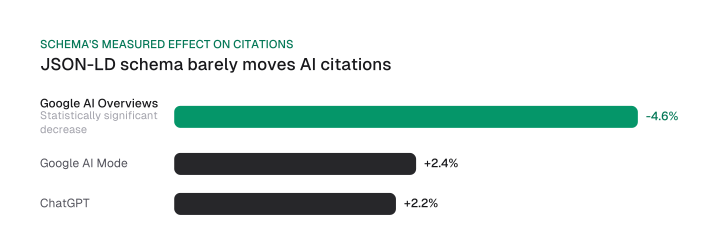
Ahrefs' matched study (May 2026) added JSON-LD schema to 1,885 pages against 4,000 control pages between August 2025 and March 2026. It found no statistically meaningful citation change on Google AI Mode (+2.4%) or ChatGPT (+2.2%), and a small but statistically significant decrease on Google AI Overviews (-4.6%).
The full breakdown, treatment design and platform-by-platform detail live on ai search optimization services. The conclusion this roadmap needs is just the direction: schema doesn't behave like a reachable-gate fix.
llms.txt fares no better as a foundation task. Ahrefs' separate May 2026 study found that of roughly 38,000 domains with a valid llms.txt file, out of 137,210 domains analyzed, 97% received zero requests to that file in the measured month.
Of the requests that do happen, SEO audit tools alone read the file more often than every named AI bot combined. The full request-composition breakdown, including the per-bot-type split, is already covered on ai seo audit tools.
The one line that matters here: a file almost nothing reads can't be gating access to anything.
Neither task moves earlier just because it feels technical. Schema earns its place later for rich-result eligibility and entity disambiguation.
llms.txt, if a reader builds one at all, belongs wherever the rest of their represented-gate work lands. Both sit in weeks 10-13 of the calendar below, timed to when that gate is actually being worked.
The gate-priority matrix, and what it puts in weeks 1-4
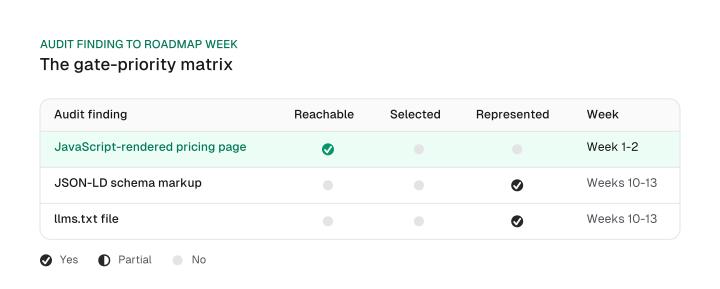
The gate-priority matrix crosses what an audit finding blocks against which pipeline gate it affects. It names the week the finding belongs in.
What a finding blocks breaks into three tiers: access entirely, citation likelihood, or long-term position. Severity, how bad a finding looks in an audit report, is not the scheduling signal; gate is. A JS-rendering problem and a missing meta description can both read as "technical," but only one of them stops a crawler from getting anything at all.
Vercel's network-wide analysis of AI crawler traffic (December 2024) found GPTBot and ClaudeBot making roughly 569 million and 370 million monthly requests respectively. None of the major AI crawlers, GPTBot, ClaudeBot or PerplexityBot, execute JavaScript.
They show up in volume; they just can't process anything that only renders after a script runs. That's a reachable-gate problem, and it goes first regardless of how the audit tool labeled it.
Applied to a fresh audit, only genuine reachable-gate items belong in weeks 1-4:
- Confirm AI crawlers can fetch every priority page (robots.txt rules, and the CDN or WAF rules that sit above them)
- Check whether priority content only appears after JavaScript executes, since none of the major crawlers run it
- Capture a baseline reading of the target query set before touching anything else, so later weeks have something to compare against
Everything the matrix scores as a selected- or represented-gate item, including schema and llms.txt, moves later regardless of how technical it looks. Running this kind of audit end to end is covered in the ai seo audit guide.
What actually goes in weeks 1-4
The reachable gate asks one binary question before anything else: can AI crawlers fetch and read your priority pages.
A page they can't reach never gets a chance at any later gate. In practice that means confirming crawler access at both the robots.txt level and the CDN or WAF level, since the two don't always agree. Then check whether the pages that matter most, pricing, comparison, and high-intent product or service pages, render their core content without JavaScript.
Ai seo audit tools lists the specific pass/fail checks for this phase. This roadmap's job is just naming which week they run in.
Google Search Console and a site's own server logs show whether AI crawlers are actually requesting these pages, at no added cost; dedicated AI-visibility platforms track this at scale for teams that want it automated.
This phase is mostly marketer-led, with a developer pulled in for the rendering fix itself. Weeks 5-9 leans on a writer, and weeks 10-13 splits between a marketer handling entity clarity and outreach support for third-party signals.
Weeks 5-9 and 10-13: build what gets selected, then what gets represented
Content built around a specific sub-question, evidence and clear structure gets selected into an AI answer's context. Entity and third-party signals then decide how accurately you're represented once you're there.
Weeks 5-9 target the selected gate: rewriting priority pages so each section leads with a direct answer, backed by a named source or a number, rather than background context first. Site architecture work belongs here too: internal links that connect a priority page to its topical cluster give retrieval systems more paths to find it, and a clear hierarchy signals which page is authoritative on a sub-topic.
A brief for this phase names the sub-question the page must answer, the evidence to cite, and the structural shape, answer-first, then support, the page should take, so a writer isn't guessing at what "better content" means.
Aggarwal et al. (2023) found that the best-performing content methods, Cite Sources, Quotation Addition and Statistics Addition, improved visibility by 30-40% on the Position-Adjusted Word Count metric and 15-30% on the Subjective Impression metric, relative to baseline, when the source was already present in the model's context.
That condition matters: the gain is measured after a page has already cleared retrieval, which is exactly why this work waits until the selected gate is actually being worked rather than running in week one.
In the same paper's separate deployed-engine run on Perplexity.ai, keyword stuffing performed about 10% worse than baseline, the one content method that reliably makes things worse rather than doing nothing.
Weeks 10-13 target the represented gate: entity clarity, using a brand's proper name instead of "the platform" or "the tool," and third-party signals that corroborate a claim independently of the page itself. This is also where schema and llms.txt land, on their own merits rather than as access work.
Weeks 10-13 work draws on the full tactics catalog covered in how to optimize for ai search engines, applied specifically to entity clarity and third-party signals rather than the earlier phases.
Once a page is already selected, get cited by chatgpt covers the citation mechanics behind why that entity clarity matters, and how a platform decides what to do with a page once it has it in context.
Worked example: triaging a JS-rendered pricing page through the matrix
A pricing page that depends on client-side JavaScript to render its content is a reachable-gate problem, so it goes in week 1-2 regardless of how "content-related" it looks.
An audit might flag it under a content or conversion heading, because the page reads fine to a human visitor. Run through the matrix above, the same finding lands differently: it blocks access entirely, not citation likelihood, so it's a reachable-gate item.
The fix, in this case, is a rendering change, not a rewrite: serve the pricing content in the initial HTML response rather than waiting on client-side JavaScript. That way, a crawler that doesn't execute scripts gets the same page a browser does.
Once that fix is confirmed, spending part of weeks 5-9 polishing the page's answer structure makes sense. Before that, the best-written pricing copy on the site is invisible to the systems this roadmap is built for.
The checkpoint: how you know you're ready for the next phase
The checkpoint between phases is a second baseline reading, not a date: move on only once it shows the prior gate is actually clear.
A day count on a calendar tells you time has passed; it doesn't tell you whether the problem you spent that time fixing is actually fixed.
The same baseline query set captured at the start of weeks 1-4 gets run again at the end of that phase. If priority pages are now getting fetched and appearing in retrieval where they weren't before, the reachable gate is clear and weeks 5-9 can start.
If they aren't, the fix didn't work yet. Starting content work on pages AI systems still can't reach just wastes the next phase too.
The same rule repeats at the boundary between the selected and represented gates: a second reading confirms pages are actually being selected into answers before entity and third-party work begins.
AI search visibility KPIs covers the full catalog of what to track and how each metric is defined. What this roadmap adds is only the cadence: checking the same query set at each boundary.
Frequently asked questions
The checkpoint isn't a date, it's a second reading of the same baseline query set used at the start of the phase. Run it whenever the phase's work is actually done, whether that lands a little early or a little late, and only move to the next phase once that reading shows the current gate is clear.
Different signals show up at different points because the gates are sequential. Early signals, pages getting fetched and appearing in retrieval, can show up as soon as the reachable-gate checkpoint passes, inside the first phase.
Broader citation gains depend on the represented gate, which by definition can't be evaluated until the selected gate has already cleared. Those results take the fuller run of the roadmap rather than arriving all at once.
Yes. Nothing about the gate order depends on content volume; a small brand runs the same three gates, just against fewer priority pages. Scope the calendar down to the pages that actually drive revenue or qualified traffic rather than skipping a gate to compress the timeline, since a skipped reachable-gate check doesn't get cheaper later, it just gets found later.
Most of the reachable-gate audit doesn't need a developer: checking robots.txt rules, capturing the baseline query set, and confirming which pages the audit tool flags as JavaScript-dependent are all things a marketer can do directly. Fixing a JavaScript-rendering problem, once it's found, usually does need a developer, since it's a rendering change to how the page is served.
Treat the end of the roadmap as a baseline to revisit, on whatever recurring cadence the team already uses for content refreshes.
A represented-gate signal that holds today can still drift as competitors' entity and third-party signals change. The checkpoint habit built during the roadmap is the thing worth keeping, more than the one-time result.
The most common failure is a gate mismatch: doing represented-gate work, schema markup, entity cleanup, in week one because it's on a template that lists it under "foundation." The matrix above exists specifically to catch that mistake before it costs real time.
The second most common failure is treating the checkpoint as optional and moving to the next phase on the calendar date regardless of what the baseline reading shows.
A GEO roadmap works when it's sequenced by which pipeline gate each task actually affects, reachable before selected before represented, rather than by which tasks feel most urgent to a team that's just been told to "do GEO." The gate-priority matrix above turns that principle into a decision for any specific audit finding.
The checkpoint turns "the calendar says move on" into "the reachable gate is actually clear." Start there: take the last technical or content audit already sitting in a drive somewhere, run each finding through the matrix, and use the output to fill in weeks 1-4 before touching anything scheduled for later.
Figures and images in this post are free to reuse under CC BY 4.0 with credit to Mission Growth.
Get Mission Growth highlighted in your Google results.